

Cambricon’s report for the first half of 2026 leads with a number any chipmaker would want. Operating revenue was RMB 6.0 billion, up 108% on a year earlier. Net profit attributable to shareholders rose 123% to RMB 2.3 billion. Further down the same report are two numbers that say more about the business. Net cash from operating activities, the money that actually came in from customers less what went out to run the company, fell 66% to RMB 311 million. Inventory, meaning chips, components and materials bought but not yet sold, reached RMB 8.2 billion, or 45% of everything Cambricon owns.
Cambricon is one of four. Moore Threads, Hygon and MetaX, which make AI and server chips and are also listed on Shanghai’s STAR Market, filed half-year reports with the same shape. Moore Threads and MetaX listed in December 2025. Across the four, revenue grew by between 45% and 147%. Operating cash flow was negative at three of the four and down by two-thirds at Cambricon. Inventory rose at three. The annual reports for 2025 show how concentrated the buying was. The five largest customers took 89% of Cambricon’s sales, 91% of Moore Threads’ and 61% of MetaX’s. At Cambricon, four of those five were new that year. Alongside China’s policy push for domestic AI chips, these suppliers are booking orders that are very large, come from very few buyers and so far bring in little cash. They do not yet add up to a broad market, in the sense of many customers paying on ordinary terms. The filings give their own reasons for the growth, such as demand, products and wider market coverage, and several describe a supportive policy environment; what they cannot show is how much of the orders that environment explains.
This matters to anyone weighing China’s chip supply chain, whether through a server plan, a component forecast or a view on how quickly domestic substitution is happening. A policy-backed supplier’s revenue growth is the least informative number it reports. Three others tell you more: who the customers are, how much cash comes in against revenue, and how much stock the supplier holds while waiting for those customers to order again.
How a profit turns into a pile of stock
Start with the plumbing. A chip designer books revenue when control of the chips passes to the customer, often on delivery, and the cash arrives when the customer pays, which may come later. Meanwhile it buys wafers, packaging and components for the next order, and those purchases sit in inventory until the chips are sold, so they reach the profit line only then, while the cash to pay for them goes out when the bills fall due, which can come before customers pay. A company that delivers a lot and buys heavily for the next round can report a large profit with very little cash behind it.
Cambricon’s half-year fits that description closely. A year earlier, operating cash flow was RMB 911 million on revenue of RMB 2.9 billion, about 32 yuan of cash for every 100 yuan of sales. This half it was RMB 311 million on RMB 6.0 billion, about five yuan per hundred. Revenue doubled and the cash that came with it fell by two-thirds. That does not, by itself, show that customers paid more slowly. The report attributes the fall mainly to higher external purchases and higher tax payments than a year earlier.
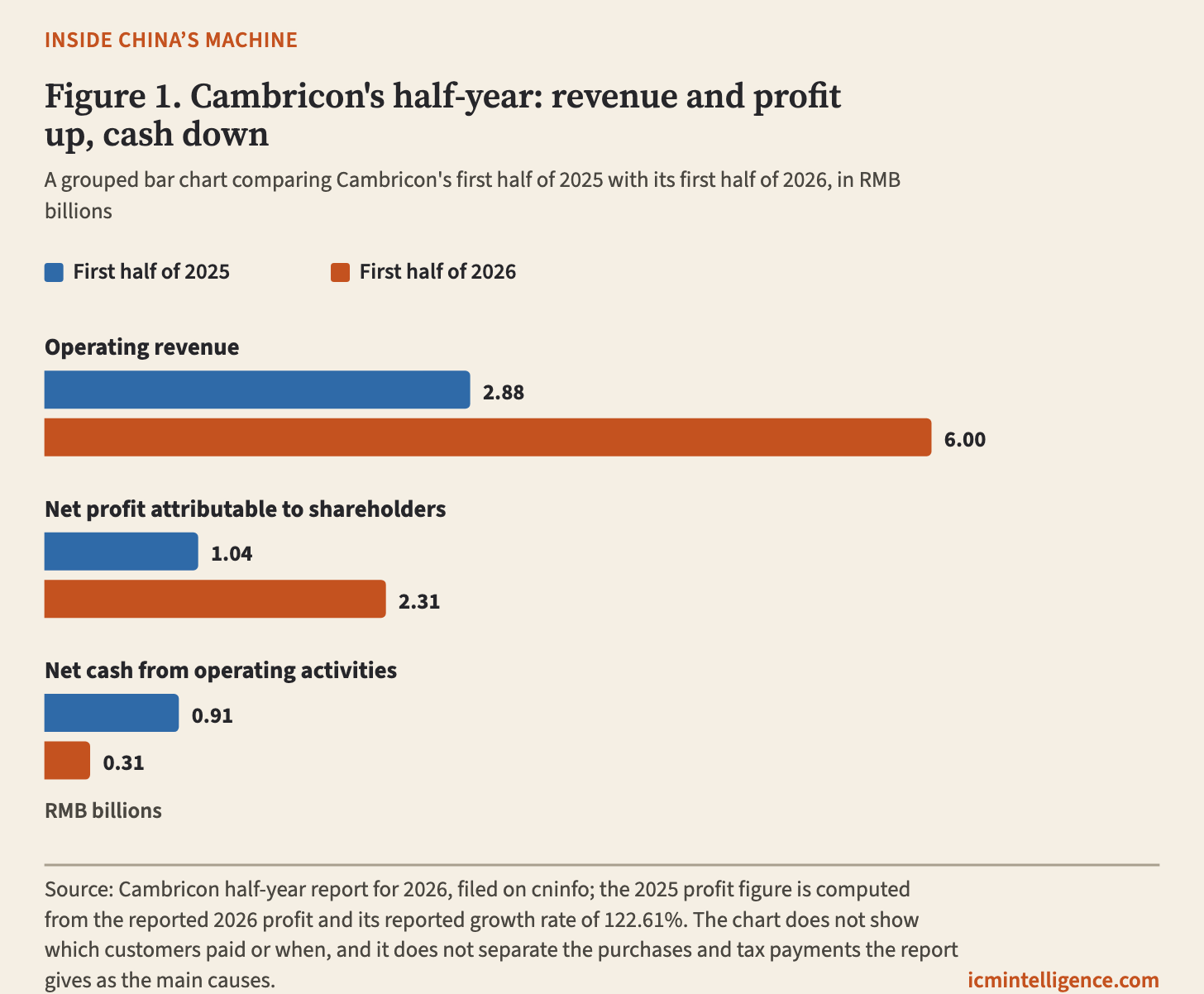
The balance sheet shows what the purchases bought. Inventory rose 67% in six months, from about RMB 4.9 billion at the end of 2025 to RMB 8.2 billion, and from 37% of total assets to 45%. The report says the increase is mainly raw materials and goods held at contract processors, the outside firms that package and test chips for designers that have no factories of their own. Prepayments to suppliers, money paid before the supplies arrive, nearly quadrupled to RMB 2.9 billion, 16% of assets. Taken together, inventory and prepayments come to 61% of total assets. The report itself flags the risk of inventory write-downs, the charge against profit if that stock can no longer be sold for what it cost.
None of this, on its own, shows a business in trouble. It does mean that most of what Cambricon owns was bought or paid for ahead of sales to a small number of customers.
Four filings, one shape
Set beside Cambricon’s, the other three filings show the same shape.
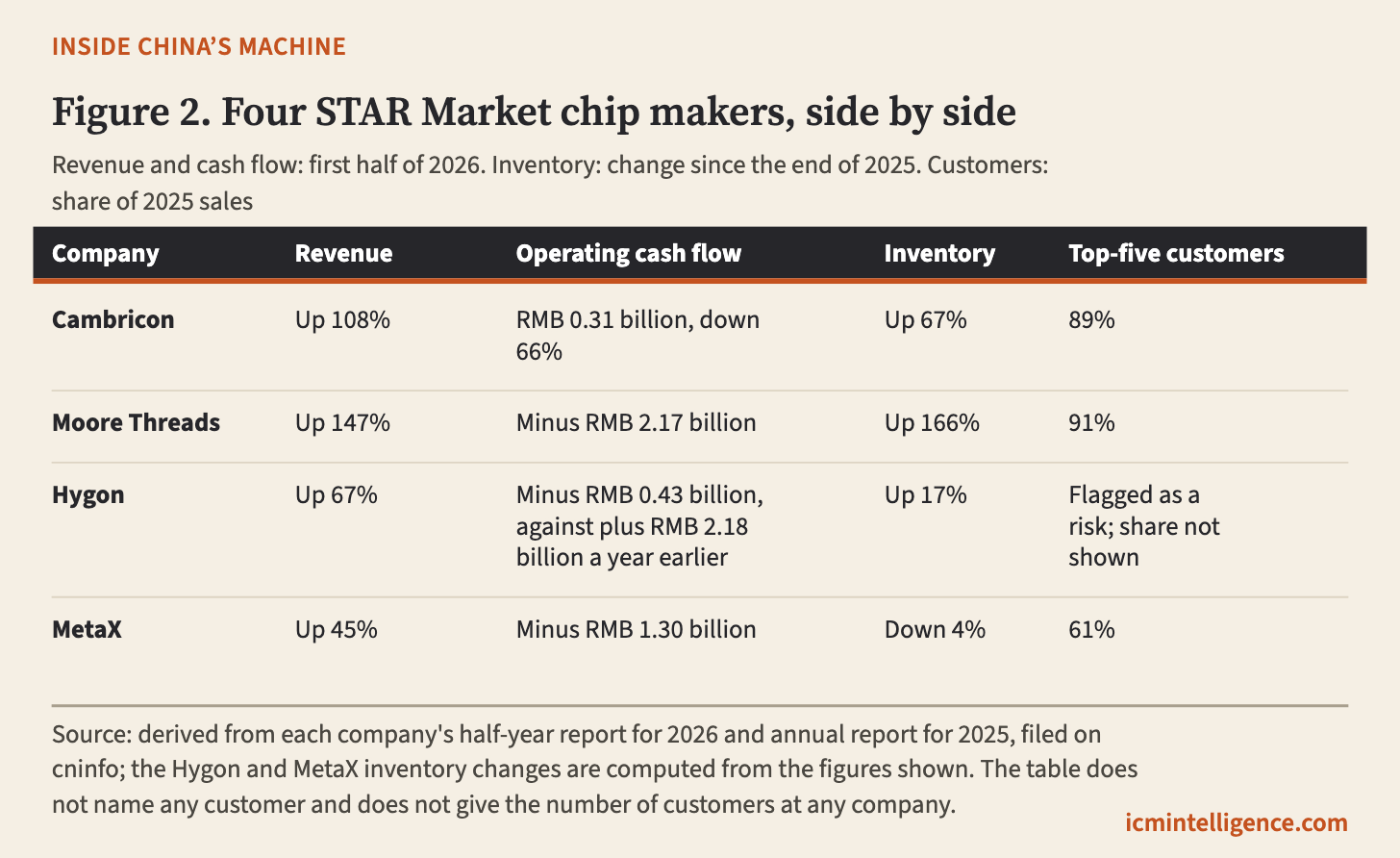
Combined, the four reported RMB 18.2 billion of revenue in the half and RMB 4.7 billion of net profit, yet their operations consumed RMB 3.6 billion of cash. Moore Threads came close to breaking even, with a net loss of RMB 12 million against a loss of RMB 271 million a year earlier, while spending RMB 2.2 billion more in operations than it took in. MetaX swung to a profit of RMB 612 million while spending RMB 1.3 billion more in operations than it took in. Hygon, the largest by revenue, went from bringing in RMB 2.2 billion of operating cash to using RMB 428 million, and its report attributes the change to spending to meet its sales plan and secure supply.
MetaX does not fit one part of the pattern. Its inventory fell slightly over the half. Of the three companies that disclose a top-five share, it also has the lowest, at 61%, although that still means a majority of its sales depends on five buyers.
Elsewhere in the chain, SMIC, the foundry, also listed on the STAR Market, reported first-half revenue of RMB 38.6 billion and operating cash flow of RMB 20.8 billion, up 252%, so its net operating cash came to more than half its revenue. That is not a ranking of the companies, whose business models differ, but it shows that in the same six months and the same country, a part of the chip business was bringing in plenty of cash.
Who is buying
The 2025 annual reports give the clearest answer, and it is narrower than the revenue growth suggests.
In 2025 Cambricon’s revenue rose 453% to RMB 6.5 billion. Its five largest customers took RMB 5.8 billion of that. The two largest took RMB 1.70 billion and RMB 1.40 billion, so between them they accounted for 48% of the company’s sales. The report states that apart from the third-largest, all five were new customers that year. Within a single year, Cambricon went from a company with RMB 1.2 billion of revenue to one mostly selling to buyers it did not have the year before. Operating cash flow for the year was minus RMB 498 million.
Moore Threads is even more concentrated. Its five largest customers took 91% of 2025 revenue of RMB 1.5 billion, and its half-year report lists customer concentration as a risk. At MetaX the figure was 61% of RMB 1.6 billion. Hygon’s half-year report says plainly that customers are concentrated among a few domestic server makers.
What the policy actually says
It would be easy to call these orders “policy demand” and stop there. The official texts are more general than that label suggests.
The State Council’s “AI+” opinion of August 2025 says to support breakthrough innovation in AI chips, build the software ecosystem around them and speed up the deployment of very large computing clusters. The published text sets no chip volume and says nothing specific about domestic chips. A Shanghai Economic and Informatization Commission document asks for “domestically controllable, secure and reliable” compute infrastructure and for wider use of domestic chips, but gives no percentage; the figure of more than half domestic chips in Shanghai’s computing centres, which circulates in press reports, is not in that text. A national survey of computing capacity asked operators to report their chip count and domestic share as of 31 March 2025, a measurement rather than a target. The MIIT and NDRC five-year plan for electronics manufacturing, issued in September 2026, sets a revenue target of RMB 30 trillion for the sector by 2030. Xinhua’s report of it gives no chip volume or domestic share.
Reuters reported on 5 November 2025, citing anonymous sources, that state-funded data-centre projects had been told not to use foreign AI chips. In the versions that circulated, projects less than 30% complete were to remove those chips and the rest would be handled case by case. Reuters said the Cyberspace Administration and the NDRC did not respond.
These texts and reports give a policy context, not a traceable explanation for the sales. The filings cannot confirm a link between these orders and any policy.
The case for a normal ramp
There is a strong argument against this reading, and it deserves a fair hearing. A young chip supplier ramping up for a few very large buyers could look exactly like this in its first years. Big cloud and server customers place big orders. Stocking components under export controls, when access to supply can tighten without warning, can be prudence rather than overreach. Hygon’s report points to that rationale when it attributes its cash outflow to spending to secure supply. In its description of the industry, Hygon’s report also says the sector is at a critical stage in which domestic-chip development is shifting from being policy-driven to being market-driven, which is the company’s own account of where things stand. On this view, concentration and inventory are simply what the first years of the business look like, and the market will widen as the products mature.
That reading may turn out to be right. Later filings will show which reading holds. If the next annual reports show top-five shares falling, operating cash flow turning positive and inventory levelling off, the ramp reading gains ground and these half-years will look like the awkward middle of a normal growth curve. If the shares stay near nine-tenths, cash keeps lagging profit and inventory keeps climbing, then the orders are still arriving in lumps from a few hands. The annual reports for 2026 are the first real test.
The top of Cambricon’s report, with revenue and profit both more than doubled, measures the orders. The lines below it, with RMB 311 million of cash and RMB 8.2 billion of stock, measure what those orders have not yet become. For any supplier with a government behind it, ask three questions: who buys, how much cash comes in against revenue, and how much stock is held while waiting for the next order. Five buyers can fill an order book; a market begins when the buyers are too many to fit in five lines of an annual report.
Sources
Cambricon, Half-Year Report 2026 (filed 8 August 2026), http://static.cninfo.com.cn/finalpage/2026-08-08/1225464969.PDF, captured 2026-11-12. Revenue, profit, operating cash flow, inventory, prepayments and the stated reasons.
Cambricon, Annual Report 2025 (filed 13 March 2026), http://static.cninfo.com.cn/finalpage/2026-03-13/1225007336.PDF, captured 2026-11-12. 2025 revenue, operating cash flow and the five largest customers.
Moore Threads, Half-Year Report 2026 (filed 10 August 2026), http://static.cninfo.com.cn/finalpage/2026-08-10/1225465335.PDF, captured 2026-11-12. First-half results and inventory.
Moore Threads, Annual Report 2025 (filed 27 April 2026), http://static.cninfo.com.cn/finalpage/2026-04-27/1225197717.PDF, captured 2026-11-12. 2025 revenue and the five largest customers.
MetaX, Half-Year Report 2026 (filed 31 August 2026), http://static.cninfo.com.cn/finalpage/2026-08-31/1225535168.PDF, captured 2026-11-12. First-half results and inventory.
MetaX, Annual Report 2025 (filed 27 March 2026), http://static.cninfo.com.cn/finalpage/2026-03-27/1225036092.PDF, captured 2026-11-12. 2025 revenue, the five largest customers and the December 2025 listing.
Hygon, Half-Year Report 2026 (filed 14 August 2026), http://static.cninfo.com.cn/finalpage/2026-08-14/1225472510.PDF, captured 2026-11-12. First-half results, cash flow and the stated reason, inventory.
SMIC, Half-Year Report 2026 (filed 28 August 2026), http://static.cninfo.com.cn/finalpage/2026-08-28/1225520297.PDF, captured 2026-11-12. First-half revenue and operating cash flow.
State Council, opinion on the “AI+” action (August 2025), as reprinted by the Cyberspace Administration of China, https://www.cac.gov.cn/2025-08/27/c_1758018277755538.htm, captured 2026-11-12. The chip passages.
Shanghai Municipal Commission of Economy and Informatization, two documents on computing infrastructure and the national computing-capacity survey notice, https://sheitc.sh.gov.cn/cmsres/c0/c0fd9acf0e0e4ea180117c2dd53a5f0c/6e6a7f6f9af82f92ca110edcac495613.pdf and https://www.sheitc.sh.gov.cn/cmsres/25/25ab4139bede447683264f16523891b8/fdb6f0a44993d5dfb15bb019044d3e4e.docx, captured 2026-11-12. The wording on domestic compute infrastructure and the survey’s reporting date.
Xinhua, reports of the MIIT and NDRC five-year plan for electronics manufacturing (15 and 16 September 2026), https://www.news.cn/fortune/20260915/4f91eae235a045cb8c4f39c42e244f19/c.html and https://www.news.cn/20260916/b42d2b75a6964bc5809cc1b225f6525b/c.html, captured 2026-11-12. The 2030 revenue target.
Reuters, “China bans foreign AI chips from state-funded data centres, sources say” (5 November 2025), as reprinted at https://www.tbsnews.net/node/1277811, captured 2026-11-13. A news report citing anonymous sources, not an official document.
Inside China’s Machine · Frontier, Episode 7
Disclaimer: This article is for informational and educational purposes only. It is not investment, financial, legal or tax advice, and it is not a recommendation or solicitation to buy or sell any security. Do your own research, and consult a licensed professional before making investment decisions.