

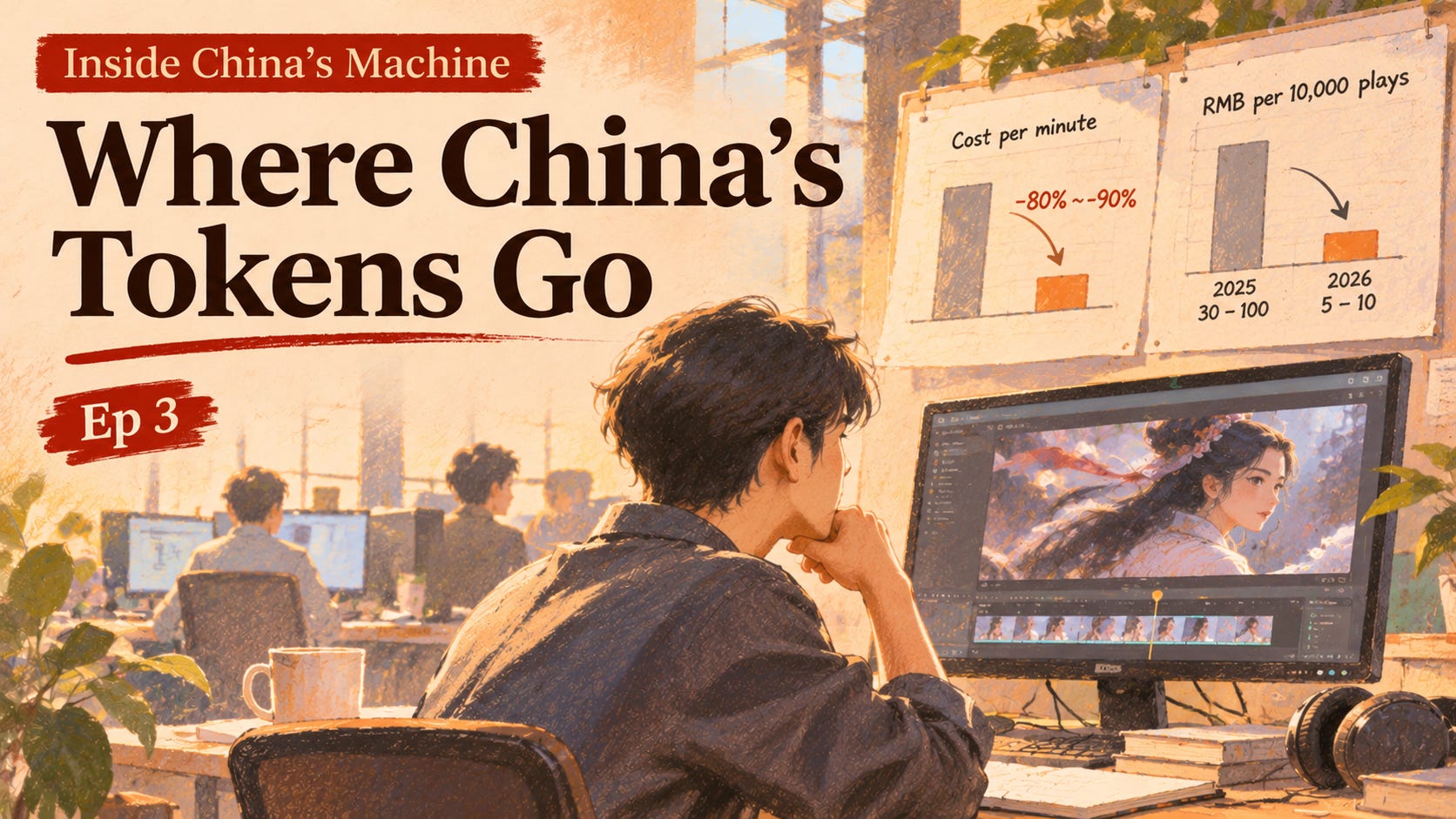
Inside China’s Machine · Where China’s Tokens Go, Episode 3
In May a Weibo hot topic summed up a business in one line: “one play 10,000 times, five yuan.” Around it went a screenshot from the back end of a company making AI manju (漫剧, animated micro-drama, here made with AI tools), along with a studio owner’s post that had a sum in it. A drama had drawn 180 million plays and settled at RMB 180,000. By our arithmetic that is RMB 10 for every 10,000 plays, on a title nearly twice the 100-million mark that the data firm DataEye uses to count hits.
AI has made this kind of drama much cheaper to make. It has not made it easier to earn from. The cost fall is real, at least in the cheap tier. At the other end, over the same months, supply multiplied, producers reported the payment per 10,000 plays falling most of the way, some AI scripts moved from a guarantee plus a share to a share alone, and only about one title in 210 on Douyin passed 100 million plays in the first half of 2026. Studios buy this production as AI video generation, which model vendors bill by the token (Volcano Engine lists Seedance 2.0 at RMB 46 per million tokens, IT Home reported on 4 March 2026), so the money that goes out for tokens is the first half of the sum, and what a play pays back is the second.
We read “cheaper to make” and “harder to earn” as one event seen from two ends. That is a reading of dated reports, and you are free to read them differently; it is not a measured effect. The sources show these things moving together and platforms behaving as if supply were plentiful. None of them shows the mechanism, and none shows that supply alone decided what a play pays.
The payment number needs its provenance stated before it does any work. The claim is that payment per 10,000 valid plays went from RMB 30-100 in 2025 to RMB 5-10 in 2026. It rests on that netizen’s screenshot, that studio owner’s post, and Yicai’s line of 26 August that “several production companies reported” the same two ranges, in an article that names no platform or format and does not say how a play is counted. Whether the payment is a fixed rate or a share, and who receives it, the reports do not say. Pedaily (27 May, relaying Entertainment Unicorn), Huxiu/36Kr (26 May, a report by Gudou) and a Jiemian column carried the material, and because they are relaying one topic and one set of screenshots, they are not three confirmations.
This is not platform data. No platform has published its rate. Where the reports get specific, they are about AI manju at Hongguo, the free short-drama app of Douyin Group, and not about every kind of AI drama on every platform. The supply counts here are about Douyin, a different platform in the same group.
Take the ranges at face value and the fall runs from two-thirds to nearly all of the earlier payment, depending on which ends of the two ranges are compared. From RMB 30 to RMB 10 is 67%, and from RMB 100 to RMB 5 is 95% (our arithmetic). The “over 90%” that travelled with the story needs a high figure from last year’s range set against a low one from this year’s.
The cases quoted beside the screenshot are also a little kinder than the band they illustrate. The 180-million-play title works out at RMB 10 per 10,000, 25 million plays for RMB 33,000 at RMB 13.2, and 17 million plays for “a bit over RMB 30,000” at no less than RMB 17.6. Gudou, on writers’ and producers’ accounts, describes a staircase from about RMB 100 at the 2025 peak to 50, then 30, then 20, and now 5-10 for most projects. The direction is consistent across all of it. The size is soft.
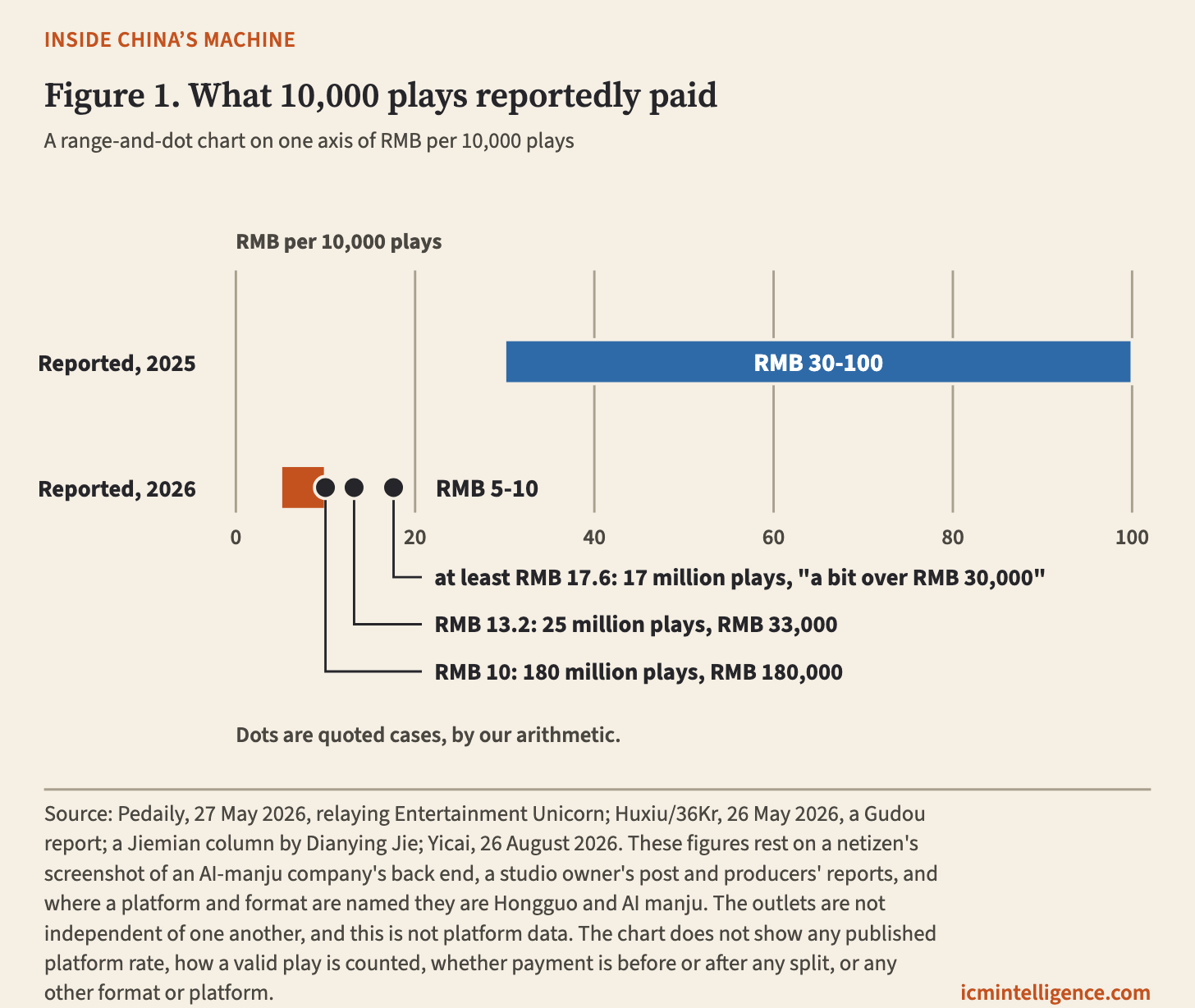
The bars are the reported ranges; the dots are what individual quoted titles settled at. The opening title sits at the top of this year’s range, and its 180 million plays made it a hit by DataEye’s mark, but RMB 180,000 alone cannot say whether it made money. For that you need the bill.