

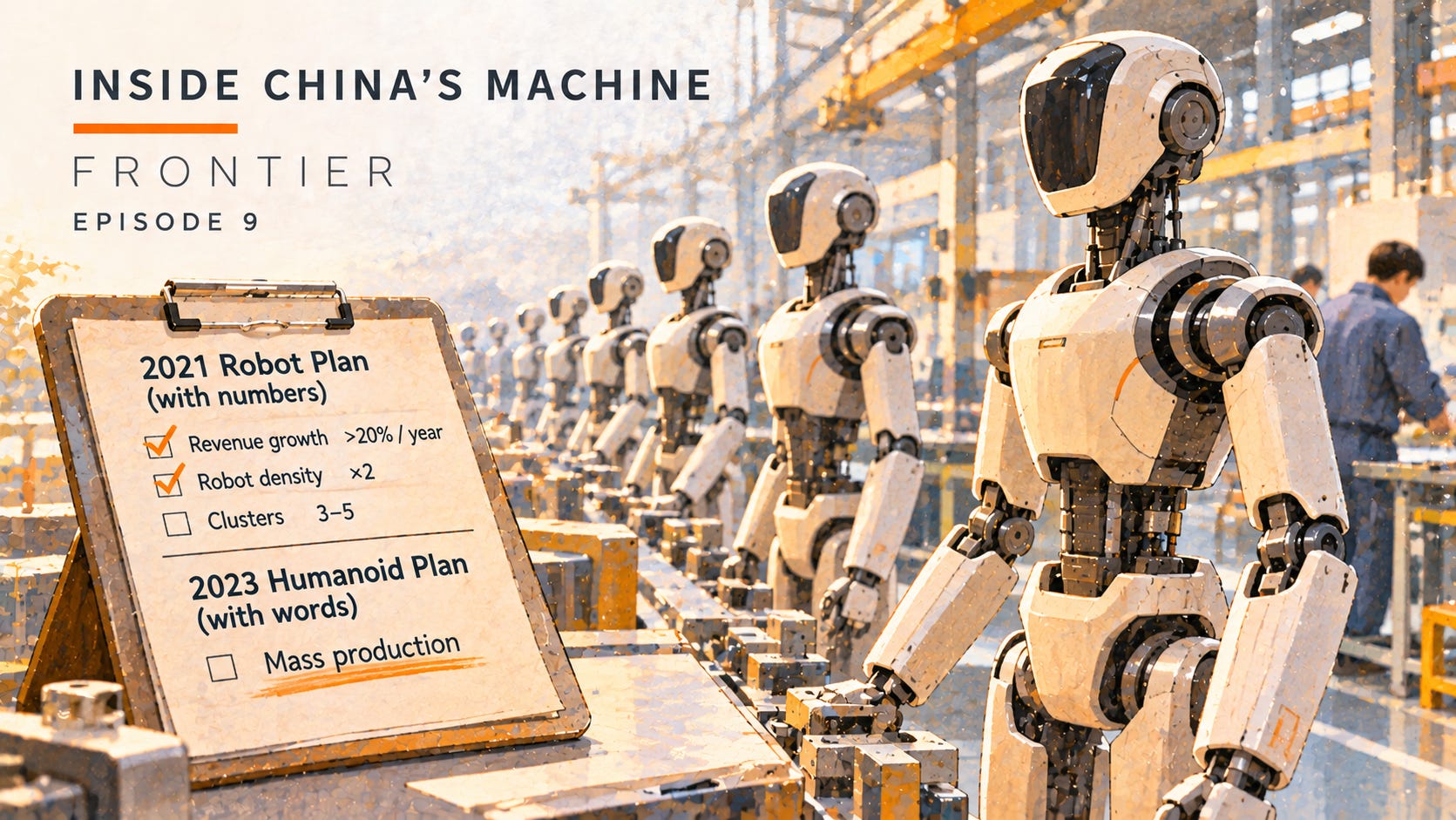
In November 2023, China’s Ministry of Industry and Information Technology (MIIT) issued guidance on humanoid robots. Its goal for 2025, as Science and Technology Daily relayed it, was that complete machines should reach the international advanced level “and go into mass production”. They should also be in demonstration use in factories, special settings and household services. The guidance gave no number of units. Mass production could mean a thousand machines or a million, and the document did not say which.
Two years earlier, the same ministry had led a 15-ministry effort that took the opposite approach. Their five-year robot plan, dated December 2021, set targets that could be counted. Industry revenue would grow by more than 20% a year. Manufacturing robot density, the number of robots relative to the workforce, would double. Three to five internationally influential clusters would be built. The revenue and density targets came with 2020 baselines, so their outcomes could be scored. The cluster target gave a number but no baseline.
Set side by side, the two documents tell a simple story. Where China’s robot policy gave the industry a number it could be scored against, the available figures show the industry keeping pace with it or beating it. Where it gave a word, a crowd showed up. By January 2026, MIIT counted more than 140 humanoid makers and more than 330 products. By November 2025, the National Development and Reform Commission (NDRC), the state planner, was already warning in public about crowded launches of overlapping products.
For anyone with money or a product in a “supported sector”, the lesson is narrow. In this record, a numeric target behaves like a floor the sector clears or comes close to. A target without a number behaves like an invitation to enter. Neither one says who will earn.
Three targets, three yardsticks
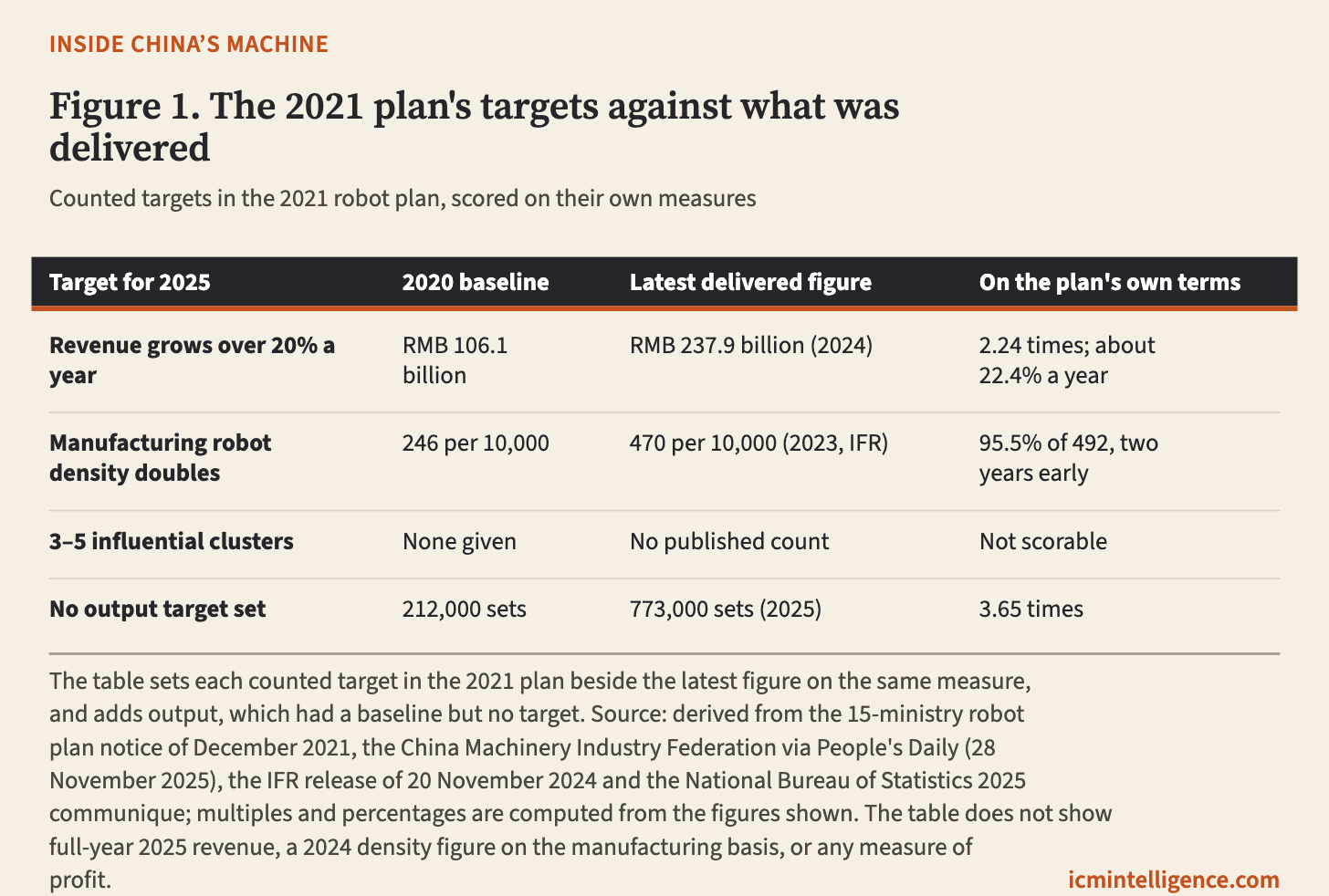
Revenue is the cleanest of the three. The plan put 2020 industry revenue at just over RMB 100 billion. The China Machinery Industry Federation, an industry body, put it at RMB 106.1 billion for 2020 and RMB 237.9 billion for 2024, in figures reported by People’s Daily. That is 2.24 times in four years, or about 22.4% a year, above the plan’s 20% threshold. Starting from RMB 106.1 billion, five years of growth at 20% a year would bring 2025 revenue to about RMB 264 billion. The 2024 figure was already 90% of that, and the federation reported 29.5% growth for the first three quarters of 2025. The full-year 2025 figure is not in the sources cited here. MIIT’s own summary, given in July 2026, is that average growth over the five years was “over 20%”. That claim covers only firms above a size threshold, and it gives no exact figure.
Density comes close to the target. The plan said China had 246 manufacturing robots per 10,000 people in 2020, so doubling meant 492. The International Federation of Robotics (IFR), which compiles the global series, put China at 470 per 10,000 manufacturing employees in 2023. That is 95.5% of the target, reached two years before the plan’s end year. The comparison comes with a caveat: neither document says whether the plan’s “per 10,000 people” and the IFR’s “per 10,000 employees” count the same workers.
The clusters target cannot be scored. No published count of “internationally influential” clusters appears in the sources cited here, and the plan does not define what would qualify.
The plan set no target for output, only a baseline: 212,000 industrial robots in 2020. The National Bureau of Statistics reported 773,000 sets for 2025, which is 3.65 times as many. This comparison assumes the plan’s baseline comes from the same statistics-bureau series, which is likely but not confirmed. It is the largest multiple in the record, and it belongs to a measure the plan never asked for.
The density figure that looks like a collapse
The next density figure is easy to misread. In April 2026, the IFR put China at 166 robots per 10,000 people employed for 2024, ranked 22nd in the world and up 17% on the year before. Set beside 470 for 2023, it looks like a two-thirds fall in a year in which China installed 295,000 robots, 54% of all those installed worldwide.
The two numbers are not one series. The release says the figure rests on “updated labor market data” from the National Bureau of Statistics and counts robots per 10,000 “people employed”. It does not say which workers that count covers, so the figure cannot be read as the next point in the old series. The 17% rise compares 2024 with the year before on the new basis, not with the old figure of 470. The IFR releases cited here give no 2024 figure on the old manufacturing basis, so the density target’s last two years cannot yet be scored.
The word, and who answered it
The humanoid guidance did set some counts: two to three globally influential ecosystem companies and two to three industrial clusters. For the production goal itself, it said only “mass production” by 2025 and that the industry should “scale up” by 2027. An industry told to produce at scale, with no number attached, can hit the target in many ways.
The industry responded with numbers of firms, products and units. In January 2026, MIIT vice minister Zhang Yunming said China had more than 140 humanoid makers in 2025 and that they had released more than 330 products. In July, vice minister Ke Jixin put 2025 output at about 20,000 units, the first half of 2026 at over 40,000, and the full-year 2026 forecast at over 100,000. In October, Wei Wei, head of MIIT’s science and technology department, gave the same first-half and full-year figures and said the number of complete robot models had passed 400. These are official statements relayed by the press, not company filings or independent counts. The 100,000 is a forecast.
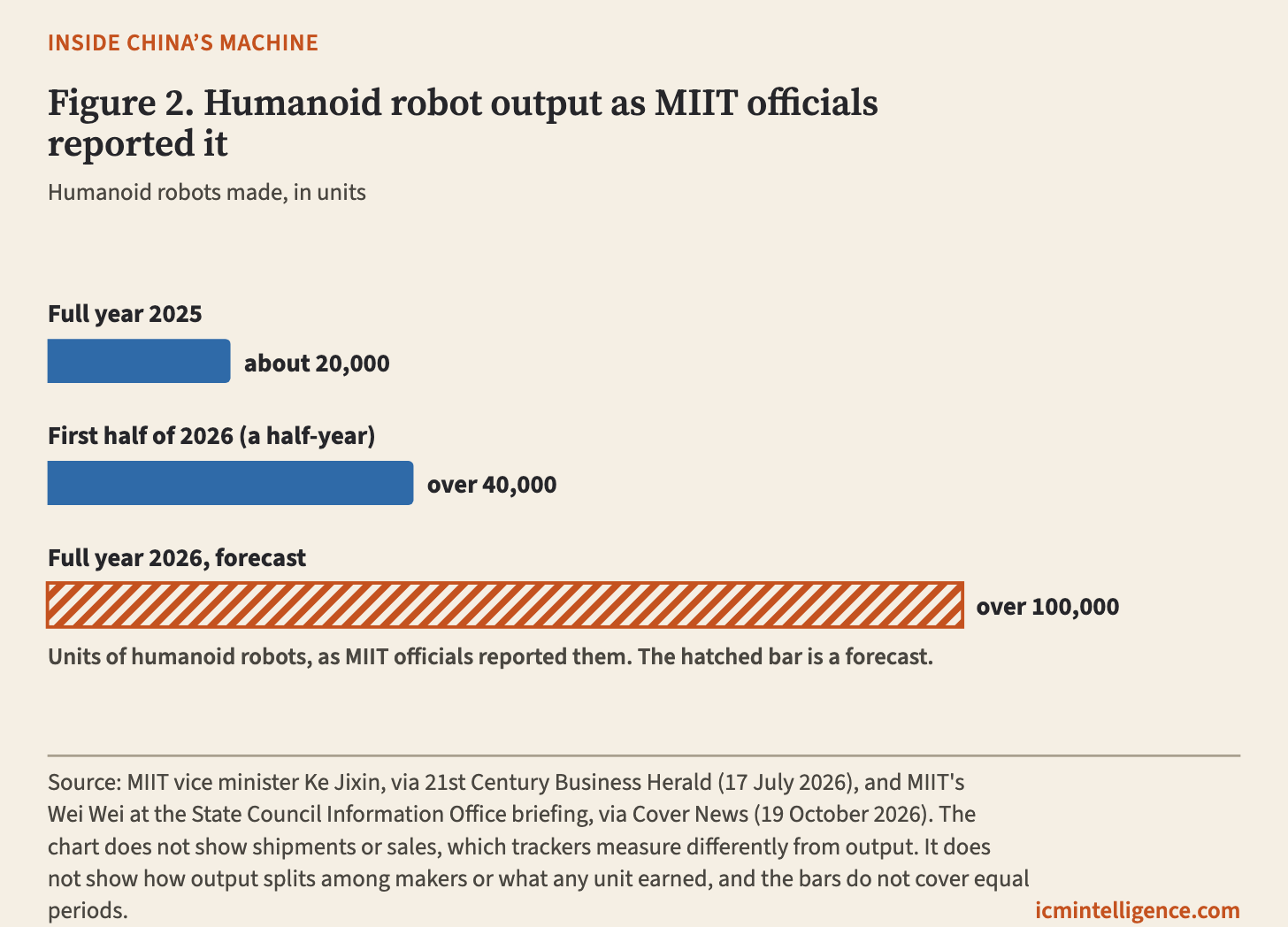
If the 2025 output were spread evenly across 140 makers, each would have made about 143 machines. It was certainly not spread evenly; the arithmetic says nothing about a typical maker, only how thin the output was against the number of firms.
The two arms of the state described this field in different terms. In November 2025, the NDRC’s Li Chao counted more than 150 humanoid companies, “and the number keeps rising”. He said more than half were startups or entrants from other sectors. He called this good for innovation, but added that the state “must guard against crowded launches of highly overlapping products” and should set up “entry and exit mechanisms” for embodied AI, the wider field of AI systems that act through physical machines. Two months later, MIIT reported its own count of more than 140 firms. It also announced that a RMB 60 billion National AI Industry Investment Fund was operating and “will strengthen its support for the humanoid robot field”. The planner warned about the crowd, and the ministry announced more support for the field. The two counts differ, and nothing in the sources cited here reconciles them.
The rival reading
The strongest objection is about causation, and that is the weakest premise of this reading. On the objection’s view, robots got cheaper and factories wanted more of them, so the sector would have grown with or without a plan, and the plan took the credit. The humanoid crowd is what any new category looks like before it consolidates, and it will thin out without help from the state.
Nothing in the record cited here rules that out. The 2021 plan set targets, not a mechanism that can be shown to have produced the growth. What the record does show is the shape of the result. Revenue grew faster than its target rate, density neared its target two years early, and output grew most on a measure that had no target. The production goal that was only a word was followed by a field of entrants large enough that the planner asked for mechanisms governing entry and exit. That sequence is visible; the plan’s role in causing it is not. A case that would challenge this reading would be a supported sector with counted targets that failed to grow. Another would be evidence of the humanoid field consolidating on its own. The sources cited here contain neither.
What the count counted
The revenue, density and output figures in Figure 1 measure how big the sector got: revenue, robots per worker, sets produced. These are measures of sector-wide scale, but the total does not show how it was shared. It says nothing about which firms kept the margin or how much of it there was.
The humanoid figures are less informative still. They give output, not sales. The 100,000 for 2026 is a forecast five times the reported 2025 figure. The more than 330 products are spread among some 140 or 150 firms, which shows a crowded field, not how much demand there was for each product. When an official says a target was beaten, the useful question is what the number counted. Nothing in the record cited here measures who earns.
The NDRC called for “entry and exit mechanisms” for embodied AI, and the sources read here show none published yet. A rule on who may leave, and on what terms, is what an operator should watch, because it would say more about who earns than another output figure.
Where Beijing wrote figures into a plan, the industry met them or came close; where it wrote a word, a crowd arrived. Revenue, sets and density were all counted and published. What none of these plans set, and none of these counts report, is how much of that growth turned into profit for any of the firms.
Sources
Fifteen ministries led by the Ministry of Industry and Information Technology, notice on the 14th Five-Year robot industry development plan (Gongxinbu Lian Gui [2021] No. 206, dated 21 December 2021, posted 28 December 2021), https://www.gov.cn/zhengce/zhengceku/2021-12/28/content_5664988.htm, with the plan PDF, captured 2026-11-12. The 2025 targets and the 2020 baselines for revenue, industrial robot output and manufacturing robot density.
People’s Daily, 28 November 2025, https://paper.people.com.cn/rmrb/pc/content/202511/28/content_30117299.html, captured 2026-11-12. Revenue of RMB 106.1 billion in 2020 and RMB 237.89 billion in 2024, and growth of 29.5% in the first three quarters of 2025, as released by the China Machinery Industry Federation.
China Securities Journal via China Finance Information Network, 7 July 2026, https://www.cnfin.com/hg-lb/detail/20260707/4436457_1.html, captured 2026-11-12. The MIIT official’s summary of five-year growth of over 20%.
National Bureau of Statistics, 2025 statistical communique, 28 February 2026, https://www.stats.gov.cn/sj/zxfb/202602/t20260228_1962662.html, captured 2026-11-12. Industrial robot output of 773,000 sets.
International Federation of Robotics, press release of 20 November 2024 (Chinese), https://ifr.org/downloads/press2018/CN-2024-NOV-20-IFR-press_release_Robot_Density_2024.pdf, captured 2026-11-12. China’s density of 470 robots per 10,000 employees in 2023.
International Federation of Robotics, robot density release of April 2026, https://ifr.org/news/robot-density-surges-in-europe-asia-and-americas/1st, and its German version, captured 2026-11-12. China’s 166 robots per 10,000 people employed in 2024, and the 295,000 robots installed.
Science and Technology Daily via Xinhua, 3 November 2023, https://www.news.cn/tech/20231103/f76096318e964b13a8c31011de8cda2a/c.html, captured 2026-11-12. The 2025 and 2027 goals of MIIT’s humanoid robot guidance.
21st Century Business Herald, 17 July 2026, https://www.sfccn.com/2026/7-17/xOMDE0MDdfMjE4NDExOQ.html, captured 2026-11-12. The vice minister’s figures for 2025 output, the first half of 2026 and the full-year forecast.
Cover News, 19 October 2026, https://cbgc.scol.com.cn/news/8071936, captured 2026-11-12. The MIIT science and technology department head’s figures at the State Council Information Office briefing.
China Securities Journal, 22 January 2026, https://www.cs.com.cn/xwzx/hg/202601/t20260122_6534435.html, captured 2026-11-12. The vice minister’s count of humanoid firms and products, and the RMB 60 billion fund.
National Development and Reform Commission, transcript of the press conference of 27 November 2025, https://www.ndrc.gov.cn/xwdt/wszb/11yxwfbh1/wzsl/202511/t20251127_1401983.html, captured 2026-11-12. The count of humanoid companies, the warning on overlapping products and the call for entry and exit mechanisms.
Inside China’s Machine · Frontier, Episode 9
Disclaimer: This article is for informational and educational purposes only. It is not investment, financial, legal or tax advice, and it is not a recommendation or solicitation to buy or sell any security. Do your own research, and consult a licensed professional before making investment decisions.