


Inside China’s Machine · China’s AI Chip Bet, Episode 1
In the quarterly report it filed on 20 May 2026, Nvidia wrote one sentence about China that no market-share chart can hold: “No shipments of Data Center Hopper products to China occurred during the quarter.” That quarter ended on 26 April 2026. A year earlier the same line of business had shipped $4.6 billion worth of products to China in a single quarter. Three months later, in its next filing, Nvidia put Hopper shipments to China at “less than 1% of Data Center revenue,” in a quarter when Data Center revenue was US$89.0 billion. It described itself as “effectively foreclosed from competing in China’s data center computing/compute market.”
When the largest seller of AI accelerators says, in its own SEC filing, that it cannot sell its main data-center products into a market, a rising domestic share shows Chinese chips taking more of that market. It does not show why buyers bought them. A buyer who picks a domestic card because it is better or cheaper and a buyer who picks it because the alternative is not for sale both add one card to the domestic count. The count cannot distinguish preference for Chinese chips from demand created by restrictions on the alternative. Those restrictions are documented in Nvidia’s filings and in US export rules. None of the Chinese government texts in this article requires buyers to use domestic AI chips. Two disclosures would help show what the count cannot: domestic share by revenue, and the identity of the end buyer.
What the domestic share counts
Start with what is being counted. IDC is a research firm that counts accelerator cards by the brand of the chip on them. A card is the board that goes into a server, so this is not a count of chips or of servers. “Domestic” in IDC’s count means every Chinese vendor, including chips made by a buyer’s own affiliate. IDC’s own release for 2024 counted over 2.7 million accelerator cards in China, over 820,000 of them domestic brands. That is about 30% (our division of IDC’s figures). Its release for the first half of 2025 counted over 1.9 million cards, with domestic chip brands at about 35% of the market. The release implies a unit basis but does not state one. After that, the IDC figures used here reach the public through Reuters. For full-year 2025, citing IDC data, Reuters reported about 4 million cards: Nvidia about 2.2 million (55%), Chinese vendors 1.65 million (41%), Huawei about 812,000 within that domestic total, and AMD about 160,000. For the first half of 2026, citing an IDC report it had seen, Reuters reported 2.008 million cards, with Nvidia at 678,000 and Huawei at 572,000. It gave no domestic total for that half. IDC lists its report on the 2025 China accelerator-card market for sale (document CHC54360326, June 2026), and the figures here are those Reuters reported from IDC data.
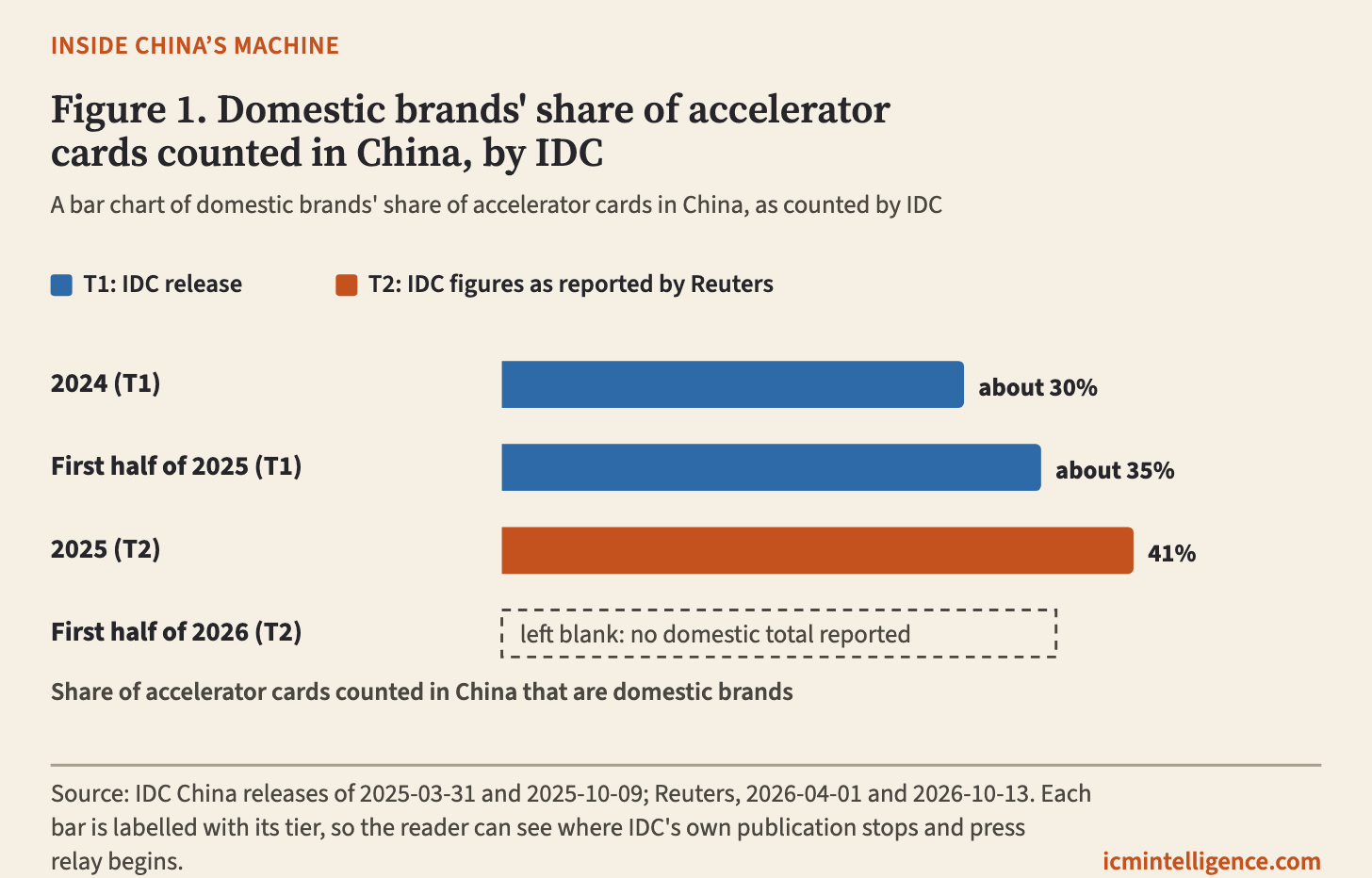
Nothing in that chart is denominated in money. The 2024 and 2025 bars come from different IDC documents, and the available material does not establish that they are strictly comparable.
The counts and Nvidia’s filings also disagree, and the disagreement belongs in plain view. IDC, in the report Reuters saw, counts 678,000 Nvidia accelerators in China in the first half of 2026. For roughly the same months, Nvidia’s filings report no Hopper data-center shipments to China in one quarter and shipments worth under 1% of Data Center revenue in the next. These are not matching measures: IDC counts cards, while Nvidia reports shipment revenue for a particular product family. IDC did not say which Nvidia products it counted, so the documents do not provide enough detail to reconcile the two. One more Nvidia number does not close the gap either. The same filing puts China revenue, including Hong Kong, at US$7,880 million for the quarter. That figure is assigned by where the customer is headquartered, covers all products, and comes with Nvidia’s own warning that “end customer and shipping location may be different.”
The case for commercial demand and why it is not yet proven
There is a serious case for reading the domestic gains as evidence of commercial demand. Private internet companies, not ministries, are the largest buyer industry of accelerated servers in China. IDC’s own releases put internet companies at over 65% of China’s accelerated-server market by buyer industry in 2024 and about 69% in the first half of 2025. Those are shares of servers, not cards, but they show that commercial platforms account for most of that server market. Some of those platforms describe demand in commercial terms. Enflame’s prospectus says Tencent’s demand for AI cards “far exceeds” Enflame’s supply. In its March-quarter results, published 13 May 2026, Alibaba said “over 100,000 Zhenwu PPUs” had been deployed on its public cloud, and in its June-quarter results, published 20 August 2026, it said its in-house Zhenwu chips had “more than 650 external customers across over 20 industries.” If those customers are paying market prices and could have chosen an available alternative, that is commercial demand independent of the restrictions, and the reading would have to narrow.
The same documents show why that conclusion cannot yet be drawn from them. A buyer that cannot get Nvidia’s data-center parts still has to buy something, so strong demand for domestic cards fits both readings. Some of the buying also sits close to home. An affiliate of Tencent holds 19.9493% of Enflame. Alibaba’s Zhenwu is an in-house chip of a platform company, deployed on that company’s own public cloud, and IDC’s “domestic” total includes chips like it. Commercial buyers are real, but their purchases cannot yet be separated from the restriction they were made under.
What the Chinese texts say
That leaves the other half of the “chose or was steered” question: what Chinese rules actually say. The verbs are the evidence here, so they are given exactly. The Ministry of Industry and Information Technology’s 15th Five-Year plan for the ICT industry (工信部规〔2026〕188号, published 7 September 2026) calls for deploying 10,000-card and larger computing clusters “in an orderly way” and for “加大力度适配国产算力芯片,” stepping up efforts to adapt to domestic compute chips. That is adaptation wording, with no share and no duty to buy. The State Council’s AI document (国发〔2025〕11号) says “支持,” support, for AI chip breakthroughs. Fujian (闽数据规〔2025〕1号) says “推动,” promote, a higher domestic rate in computing centres, with no figure. Shanghai (沪府办发〔2026〕5号) says “部署,” deploy, high-performance domestic clusters, with no share. Tianjin (津政办发〔2024〕18号) sets a goal that domestic chips exceed 60% of use in the city’s compute centres by 2026, but names no party obliged to meet it. Beijing (京经信发〔2024〕25号) pays a subsidy, in proportion to investment, to firms that buy self-controllable GPUs to provide computing services. Its “100%” target for 2027 is a capability to build self-controllable computing centres, not a share of chips installed, and its word for secure and reliable hardware is “encourage.”
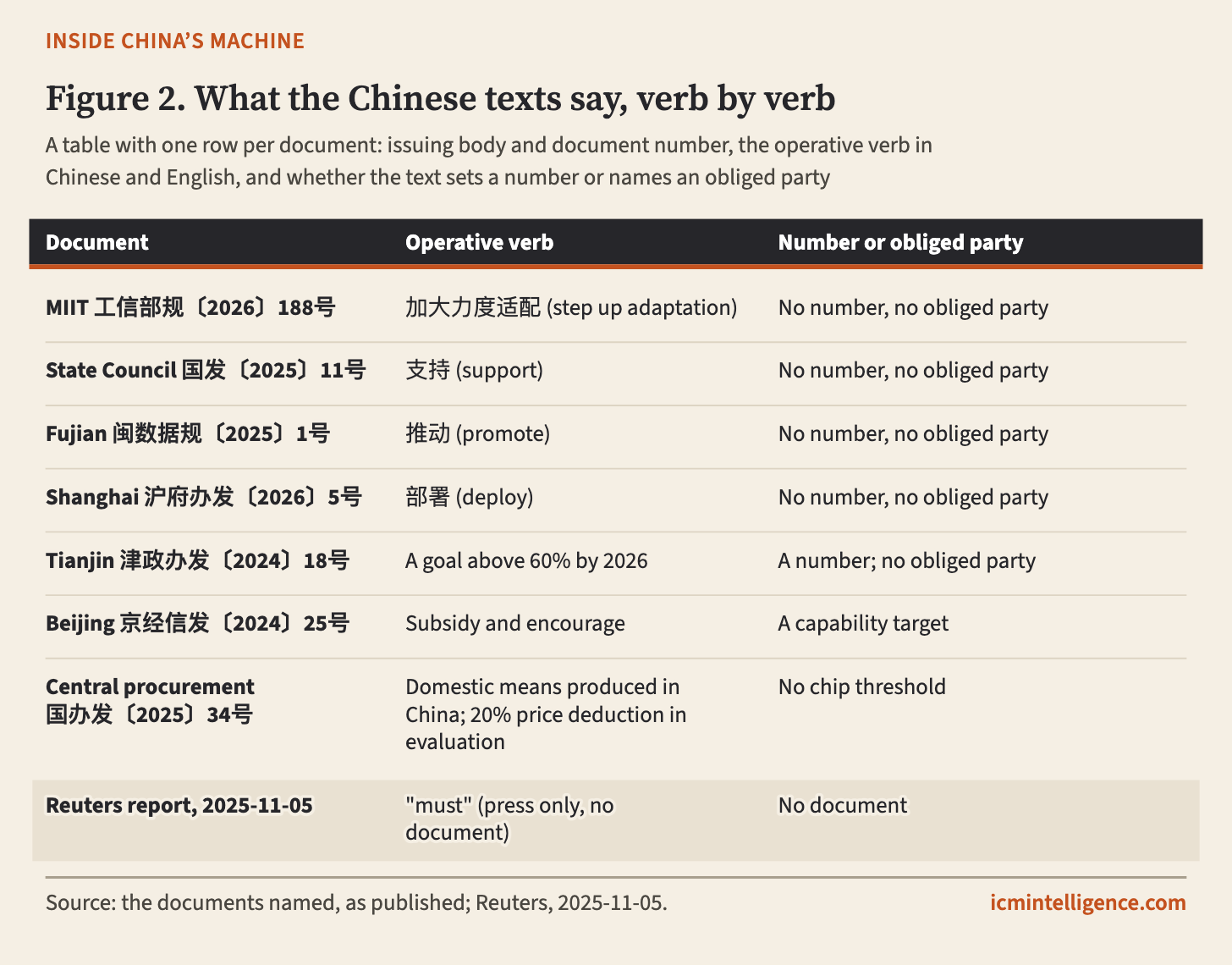
The central government’s procurement rule (国办发〔2025〕34号, in force from 1 January 2026) cuts against a simple steering story. It treats a product as domestic if it is produced in China, gives domestic products a 20% price deduction in evaluation, and says suppliers must not be treated differently by brand owner, ownership form or investor nationality. Component thresholds are to be set product by product within five years. The rule sets no chip threshold so far; the first batch of product standards under it, opened for consultation on 30 October 2026, covers five products, none of them an AI chip, server or other computing product, and Beijing and Shanghai server tender templates leave the required ratio blank.
The one “must” on record has no document behind it. On 5 November 2025, Reuters reported, citing sources it did not name, that new state-funded data-centre projects must use only domestic AI chips, and that projects less than 30% complete had been told to remove all installed foreign chips, or cancel plans to purchase them. Reuters reported that, according to its sources, it was unclear whether the guidance applied nationwide or only in certain provinces, and that the sources did not say which regulatory bodies issued it. On 9 November 2026 China’s foreign ministry neither confirmed nor denied import restrictions on Nvidia chips.
Nvidia’s own filings describe Chinese restrictions more explicitly than any Chinese text in this article. Its 10-K says “the Chinese government has encouraged customers to purchase from our China-based competitors and discouraged customers from purchasing, importing, or using our data center products.” Its August 10-Q says H200 sales to China, licensed by the US from February 2026, were “restricted by the PRC government.” The Chinese official actions on Nvidia that are on record are a Cyberspace Administration summons over H20 security risks in July 2025 and antitrust steps by the market regulator in December 2024 and September 2025. Neither mentions domestic substitution. On the US side, the restrictions are documented in Commerce Department (BIS) rules of October 2023, December 2024, January 2025 and January 2026. The last moved H200-class exports to case-by-case review with conditions. A licence requirement for H20 from April 2025 is known from Nvidia’s filings.
Who the filings and the tenders say is paying
If the rules cannot settle who chose, the sellers’ filings might help: a chip designer’s exchange disclosures can identify who pays it. What they name, mostly, is the next company along the chain.
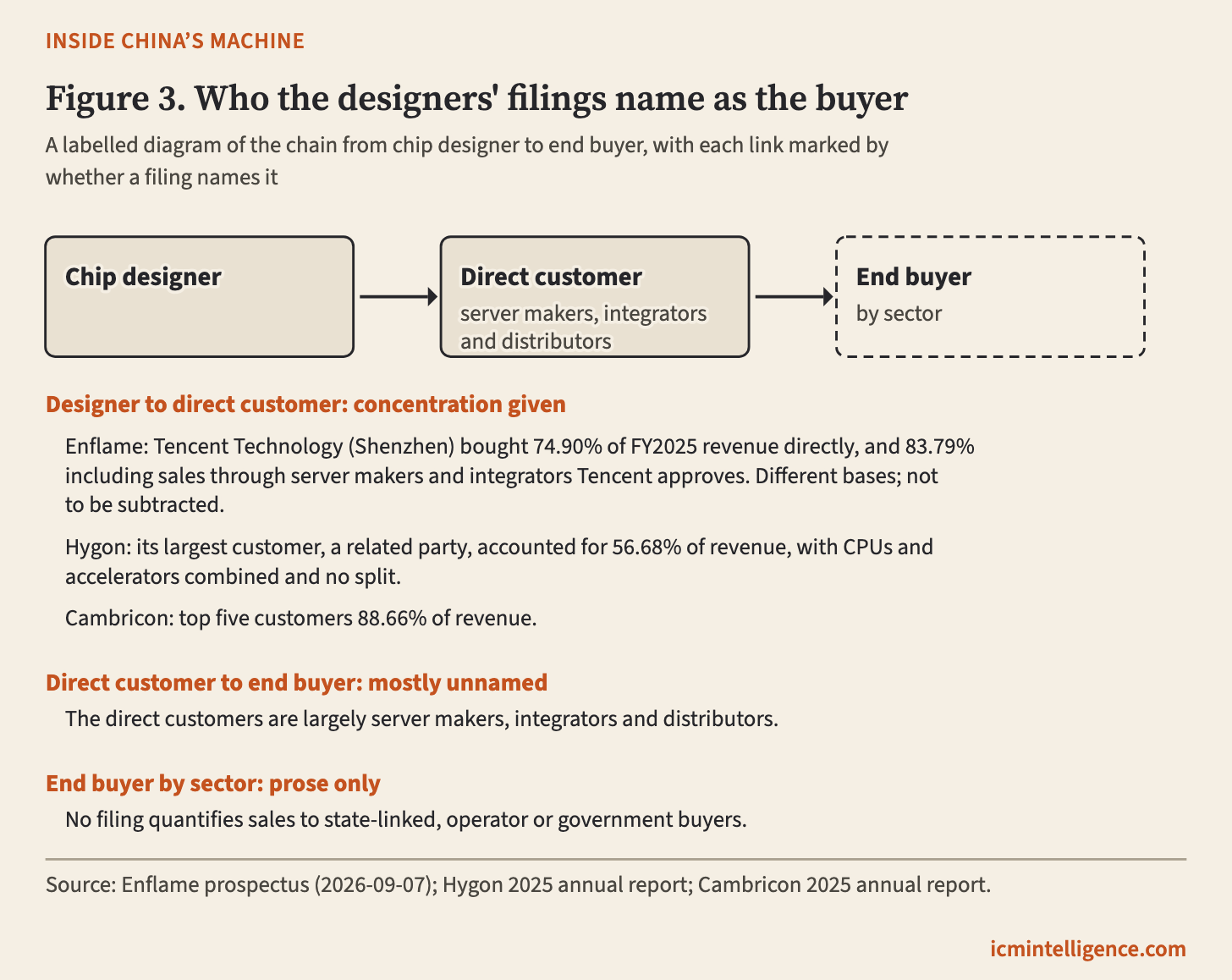
Customer concentration is one thing these filings measure precisely, and it varies. Cambricon’s largest customer accounted for 79.15% of FY2024 revenue and about 26% of FY2025 revenue (our arithmetic); total FY2025 revenue was RMB6.50 billion. Biren’s largest customer’s share fell from 54.5% to 19.1%, and Iluvatar’s top five from 73.4% to 43.0%. Moore Threads’ top five accounted for 91.36% of RMB1.51 billion in revenue. These shifts say that some designers are becoming less dependent on a small number of direct customers. Hygon, for its part, describes the sector as at a “key stage” of moving from policy-driven to market-driven.
The telecom operators, which often stand for the state in this story, do not resolve it either. China Mobile, China Telecom and China Unicom report capex and compute capacity and name no accelerator vendor. China Mobile spent RMB150.9 billion in 2025 and planned about RMB136.6 billion for 2026. Its 2026-2027 “AI super-node equipment” tender, published on 29 September 2026, covers 20,480 cards. On 28 October a candidate list proposed five bidders for 6,144, 5,120, 4,096, 3,072 and 2,048 cards, splits of 30, 25, 20, 15 and 10% (our arithmetic). A candidate list is not an award, and an award is not a delivery. All five bids were about RMB11.6 to 11.7 billion, although the shares run from 10% to 30% of the 20,480 cards, so each bid appears to price the whole procurement, not the bidder’s own cards. The shares follow the order of the candidate list: the first-ranked candidate gets 6,144 cards and the fifth gets 2,048. Digital China reported its bid for the whole project as RMB11,665,750,379.84 excluding tax, with a share of 2,048 cards. Dahua reported about RMB2.63 billion including tax for its subsidiary’s 4,096 cards, its share of about 20% of the project. That is above the RMB2.05 billion it had announced on 24 October as the most it expected from the project. The tenderer is a subsidiary of China Mobile Communications Group, which holds over 5% of Dahua, and Dahua reports the deal as a related-party transaction. No contract had been signed as of 3 November. In an earlier China Mobile tender, in July 2026, Digital China’s filing said the final amount was subject to actual orders. Sohu’s report of 30 September 2026 on the notice quotes the bidder rules: only manufacturers of the super-node equipment may bid, with no agents and no consortia, each bidder must bid on every configuration, and each must commit at least 30% of supply for each configuration. The rules it quotes name no domestic chip, and the technical specifications sit in a chapter of the notice that the report does not reproduce, so whether the tender requires domestic chips is open. Alibaba’s RMB67.7 billion and Tencent’s RMB52.8 billion quarterly capex name no domestic accelerator purchases either. Alibaba partly attributed its figure to higher chip component prices and CPU compute.
What the evidence establishes and what would change it
So the reading stands, and the evidence behind it can be stated plainly. The domestic share of cards IDC counted in China rose from about 30% in 2024 to 41% in 2025. That count cannot separate buyers who preferred Chinese chips from buyers whose alternative, Nvidia’s main data-center products, was restricted: Nvidia says in its own filing that US rules stop it selling them into China, and that the Chinese government discouraged buying them, which no Chinese text in this article confirms. No published Chinese government text in this article orders buyers to switch; the one “must” on record is a press report with no document behind it. The designers’ filings give the concentration of their direct customers precisely, and almost never name the end buyer.
Four disclosures would move the reading. Each would strengthen or weaken it, and none settles it alone.
A domestic share by revenue would show how much of the market’s sales value those cards capture, rather than just how many are counted.
A named end buyer, rather than a server maker or a related party, would help distinguish commercial, affiliated and state-linked demand.
Nvidia’s China data-center shipments, in units or dollars that line up with IDC’s count, would show how much of the alternative remained available.
Any binding Chinese purchase text, a tender clause or a rule with “must” in it and a document behind it, would turn steering from a question into a finding for the buyers it covers.
For a buyer or supplier today, the 41% shows that Chinese cards now fill a larger part of a market where Nvidia says it cannot sell its main data-center products. We read the count as showing that these cards are being bought; it does not show that buyers preferred them, and it says nothing about whether the sellers earn money from them. Our view is that a unit share cannot show buyer preference or independent commercial demand, and we would change that view only when a domestic share by revenue and a named end buyer say otherwise.
Sources
IDC China, press release on China’s accelerated server market, 2024 (Beijing, 31 Mar 2025)
IDC China, press release on China’s AI server market, first half of 2025 (Beijing, 9 Oct 2025)
IDC, report listing CHC54360326 on China’s AI accelerator-card market, 2025 (listed June 2026)
Nvidia, annual report on Form 10-K for fiscal 2026 (filed 25 Feb 2026)
Nvidia, quarterly report on Form 10-Q for the quarter ended 27 April 2025 (filed 28 May 2025)
Nvidia, quarterly report on Form 10-Q for the quarter ended 26 April 2026 (filed 20 May 2026)
Nvidia, quarterly report on Form 10-Q for the quarter ended 26 July 2026 (filed 26 Aug 2026)
Alibaba Group, Form 6-K with results for the quarter ended 31 March 2026 (13 May 2026)
Alibaba Group, Form 6-K with results for the quarter ended 30 June 2026 (20 Aug 2026)
Tencent, 2026 second-quarter results announcement (12 Aug 2026)
State Council, 国发〔2025〕11号 on the “AI Plus” action (26 Aug 2025)
Shanghai Municipal Government, 沪府办发〔2026〕5号 on the digital economy plan (13 Apr 2026)
Tianjin Municipal Government, 津政办发〔2024〕18号 on the computing-power industry plan (18 Jul 2024)
Xinhua, first batch of domestic-product standards opened for comment (30 Oct 2026)
21st Century Business Herald, first batch of domestic-product standards (5 Nov 2026)
Ministry of Foreign Affairs of China, regular press conference (9 Nov 2026)
Cyberspace Administration of China, notice on the summons of Nvidia over H20 (31 Jul 2025)
State Administration for Market Regulation, Nvidia case opened (9 Dec 2024)
State Administration for Market Regulation, Nvidia further investigation (15 Sep 2025)
US Bureau of Industry and Security, Federal Register rule 2023-23055 (25 Oct 2023)
US Bureau of Industry and Security, Federal Register rule 2024-28270 (5 Dec 2024)
US Bureau of Industry and Security, Federal Register rule 2025-00636 (15 Jan 2025)
US Bureau of Industry and Security, Federal Register rule 2026-00789 (15 Jan 2026)
Digital China, announcement on an earlier China Mobile tender (3 Jul 2026)
Dahua, announcement on bid participation and related-party transaction (24 Oct 2026)
Dahua, announcement on bid progress and related-party transaction (3 Nov 2026)
Sohu, report on China Mobile’s 2026-2027 AI super-node tender notice (30 Sep 2026)
Shanghai Securities News, candidates for China Mobile’s AI super-node tender, via Sohu (29 Oct 2026)
iFeng, relay of Zhidongxi on the 20,480-card candidate list (2 Nov 2026)
Inside China’s Machine · China’s AI Chip Bet, Episode 1
Disclaimer: This article is for informational and educational purposes only. It is not investment, financial, legal or tax advice, and it is not a recommendation or solicitation to buy or sell any security. Do your own research, and consult a licensed professional before making investment decisions.