


This is the first installment of a quarterly series mapping China’s AI model makers.
Xiaomi, which sells phones and cars, puts nearly 30 percent of a ¥18.2 billion half-year research budget into AI, by its own account. That is up to about ¥5.5 billion ($0.8 billion) by our estimate, covering all its AI work, language model included, so the comparison that follows is not like for like. It is more than twice the ¥2.13 billion ($316 million) that Zhipu, a lab listed in Hong Kong, spent on all of its research in the same six months.
Their language models sit one point apart on the Artificial Analysis Intelligence Index, an independent benchmark. Xiaomi’s MiMo-V2.6-Pro scores 46 and Zhipu’s GLM-5.3 scores 45. Running the full index costs a buyer $207 on MiMo and $2,503 on GLM. That is the buyer’s bill. What the models cost their makers is a different number, and this piece asks who pays it. For Xiaomi the answer is its phone and car business, and the piece sets that profit against the AI spend.
A model pays for itself when its revenue exceeds what it costs to build and run, research included. Zhipu and MiniMax, the two listed labs that sell models as their business, both report a positive gross margin, which is revenue less the direct cost of serving customers, so the gap lies outside the cost of revenue they report.
Zhipu’s accounts show the loss. It lost ¥2.07 billion ($308 million) on ¥954 million ($142 million) of revenue in the half, and raised or agreed to raise about ¥61 billion ($9 billion) between July and mid-September, by our sum of company filings and reports, some of it not yet shown as closed.
Our answer is that no account we read shows a model paying for itself. At Zhipu and MiniMax, customers’ gross profit covers about one-eighth and one-fourteenth of research. Where a parent can be measured, its profit covers its AI spend about 2 to 7 times. The labs fill the rest from investors, at share prices that move. The parents that file report model costs inside larger segments, so no model profit and loss exists to read. The private labs and ByteDance do not file.
That matters to an investor sizing exposure to Chinese AI and to an operator choosing a Chinese model to build on. Neither can read a maker’s staying power from its score or its price.
Most of the Field Discloses Little About What Its Models Cost
Five of the 19 makers on the map in Figure 1 file accounts that say anything about models: Zhipu, MiniMax and SenseTime, plus Alibaba's and Baidu's AI lines. Tencent, Xiaomi and Kuaishou give model figures in results releases and calls, and the rest is read through company statements and press reports.
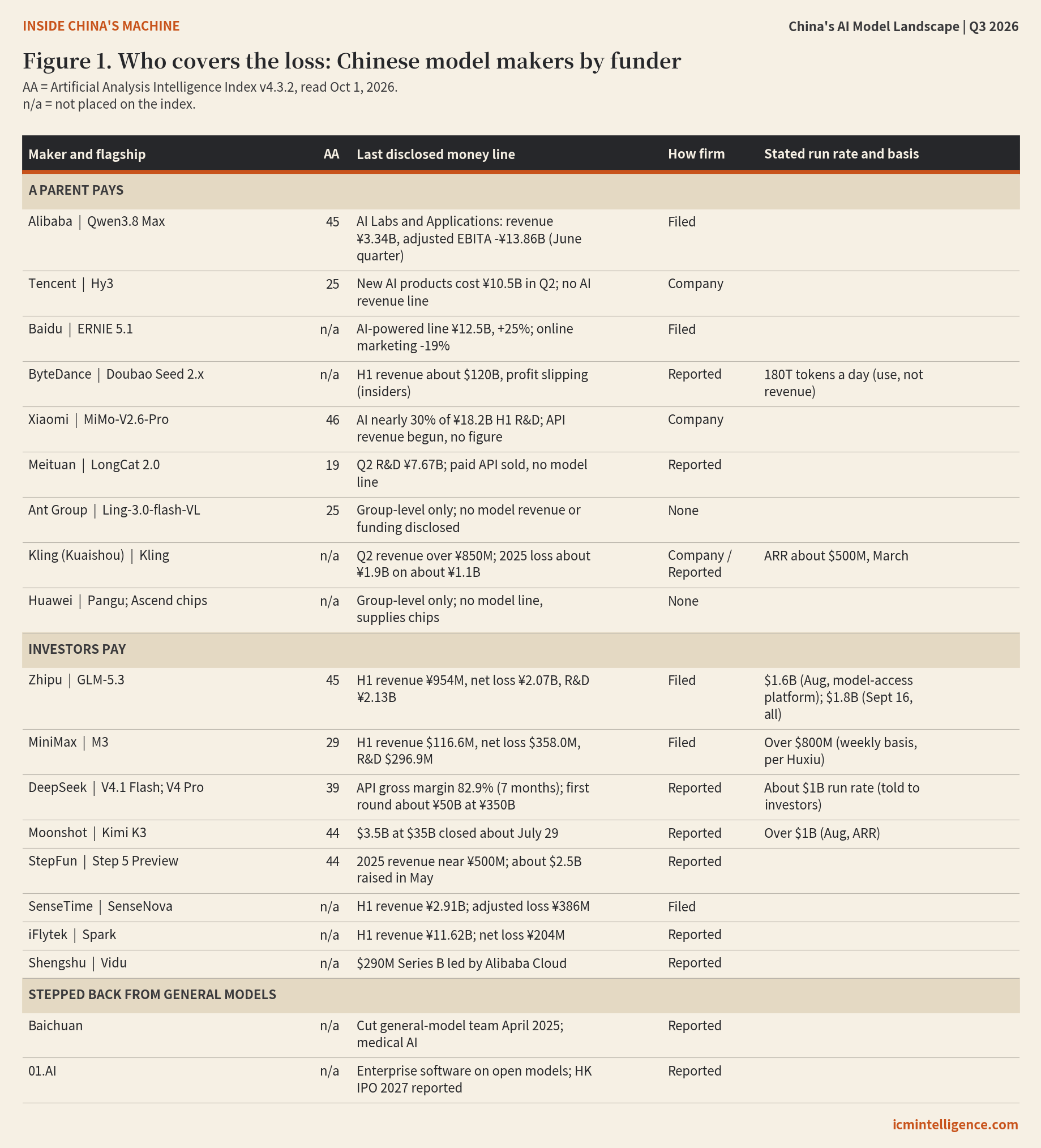
Tap the figure to enlarge. How firm: Filed means in the maker’s own filed accounts. Company means stated by the company on a results call or release. Reported means a named press outlet, insiders or an unconfirmed filing, and should be read as unverified. None means nothing disclosed. H1 is the first half of 2026; ARR is annual recurring revenue. Run rates are not comparable across makers. Zhipu’s stated $1.6 billion compares with about $283 million from doubled H1 revenue. Ant Group and Huawei disclose at group level only. Not tabulated: the telcos, which host and distribute models and publish no model revenue; ModelBest; Shanghai AI Laboratory, a non-profit.
With so little filed, a buyer starts from what every model publishes, its score and its price. What do they say about the maker?
One Score Band, Bills Up to 24 Times Apart
Five Chinese models score between 44 and 46 on the index, as the Artificial Analysis leaderboard rounds its scores to whole numbers: Xiaomi’s MiMo-V2.6-Pro, Alibaba’s Qwen3.8 Max, Zhipu’s GLM-5.3, Moonshot’s Kimi K3 and StepFun’s Step 5 Preview. These are the five highest Chinese scores on Artificial Analysis’s board, read on October 1. The best US model on the same index scores 58, 12 points above the top Chinese score. Several other Chinese makers sit lower or are not placed.
A score says what a model can do. Artificial Analysis also reports what it cost to run the whole index on each model, which is what a buyer would pay to run the same tests. Among the five, that bill runs from $207 for MiMo to $4,935 for Qwen, nearly 24 times as much for the same band of score. GLM’s $2,503 is twelve times MiMo’s. Figure 2 shows the five bills.
Token counts can outweigh list price. A token is a fragment of a word, and models charge separately for the text they read and the text they write. Qwen’s list price for what it writes is lower than Kimi’s, yet Qwen cost $4,935 against Kimi’s $3,658 because it read 9.9 billion input tokens on the tests to Kimi’s 2.6 billion. An operator should price a model against its own workload.
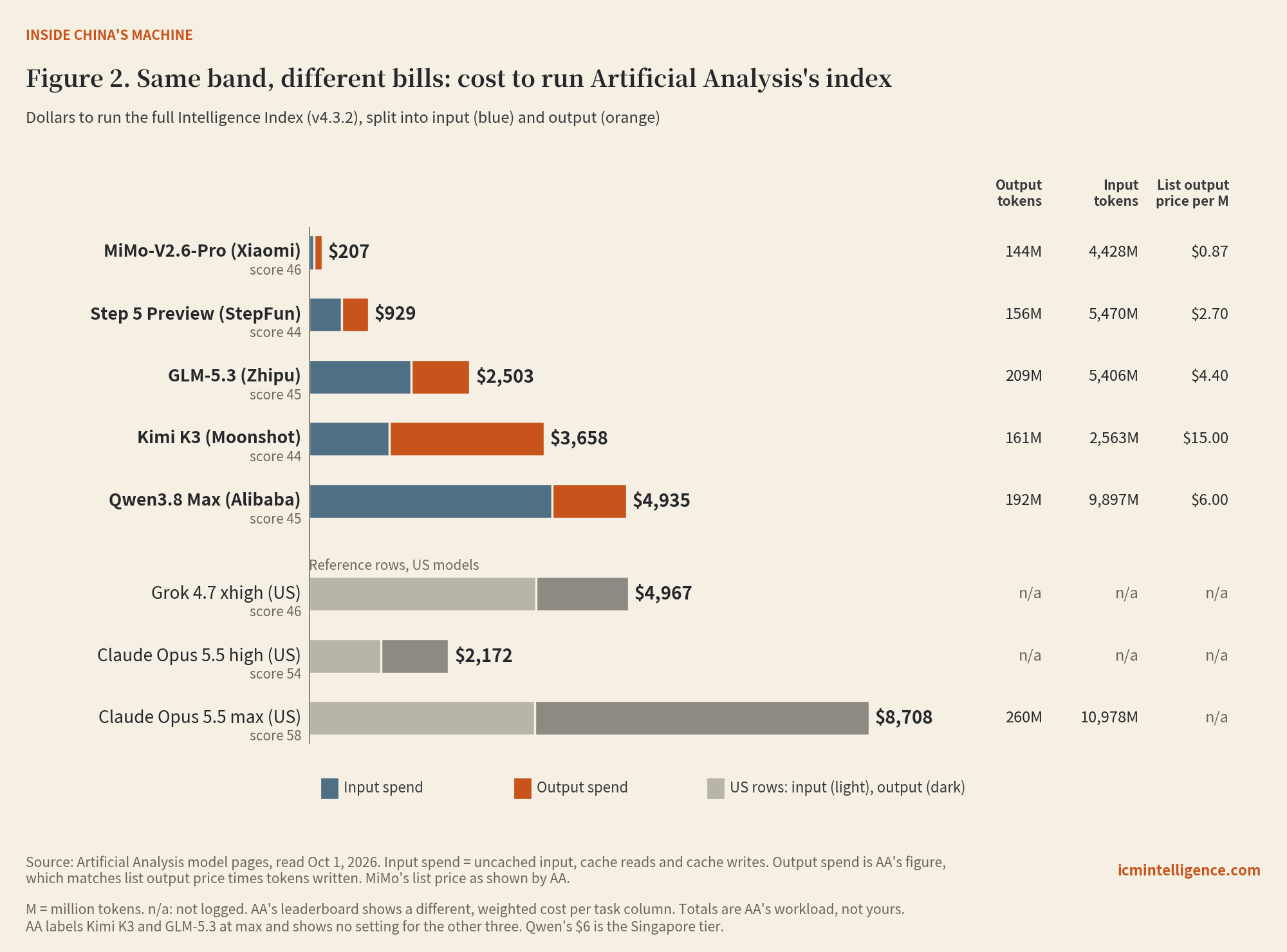
Grey rows are US reference runs. Claude Opus 5.5 at its high setting scored 54 and cost $2,172, less than GLM’s $2,503 at 45.
MiMo’s list output price is $0.87 per million tokens. A price that low can reflect low cost or a decision to win customers, and nothing on the buyer’s side tells which. For what a model costs its maker, and who pays it, the evidence is in the makers’ accounts.
At the Two Listed Labs, Customers Do Not Close the Gap
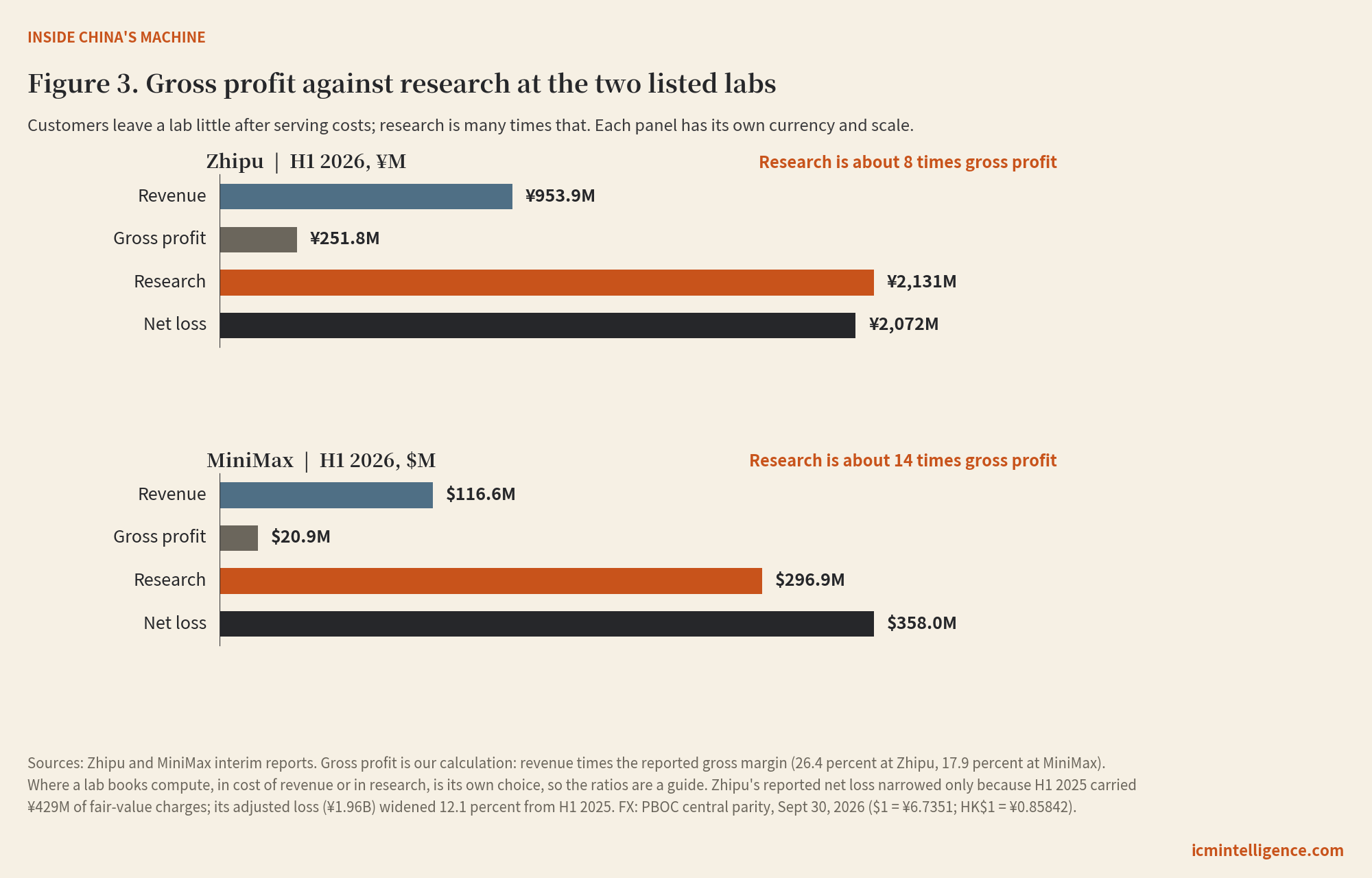
Zhipu and MiniMax file accounts that are mostly the model, and have no parent business to pay for them. Zhipu’s revenue grew 399.7 percent in the half and its net loss was ¥2.07 billion. Its gross margin was 26.4 percent, down from 50.0 percent a year earlier, so revenue is growing fast at a thinner margin. MiniMax’s revenue grew 283 percent to $116.6 million. Its net loss was $358.0 million and its research spend $296.9 million, at a gross margin of 17.9 percent.
Both labs earn a positive margin on what they sell. Where a lab books compute, in cost of revenue or in research, is its own choice, so the ratios that follow are a guide. By our calculation, Zhipu’s gross profit was about ¥252 million against ¥2.13 billion of research, and MiniMax’s about $21 million against $296.9 million: research ran at about 8 and 14 times what customers left after serving costs. At both labs research spend is close to the size of the net loss, so research accounts for most of the gap.
Figure 3 sets gross profit beside research at the two labs. SenseTime, also listed in Hong Kong and maker of the SenseNova models, reports generative AI as 79.9 percent of revenue and vision AI as 17.1 percent, but we found no model-level cost in its results, so its accounts cannot show a model paying for itself. Alibaba’s AI segment is covered in the next section.
No account we read shows customers covering what a model costs to build and run, research included. Someone else is paying the difference.
A Parent Pays Only as Long as Its Core Business Holds
Three parents disclose enough to size the cover, which is the profit left after the AI spend set against that spend. The rest of the field cannot be measured. Figure 4 sets the lab ratios beside the parent ones.
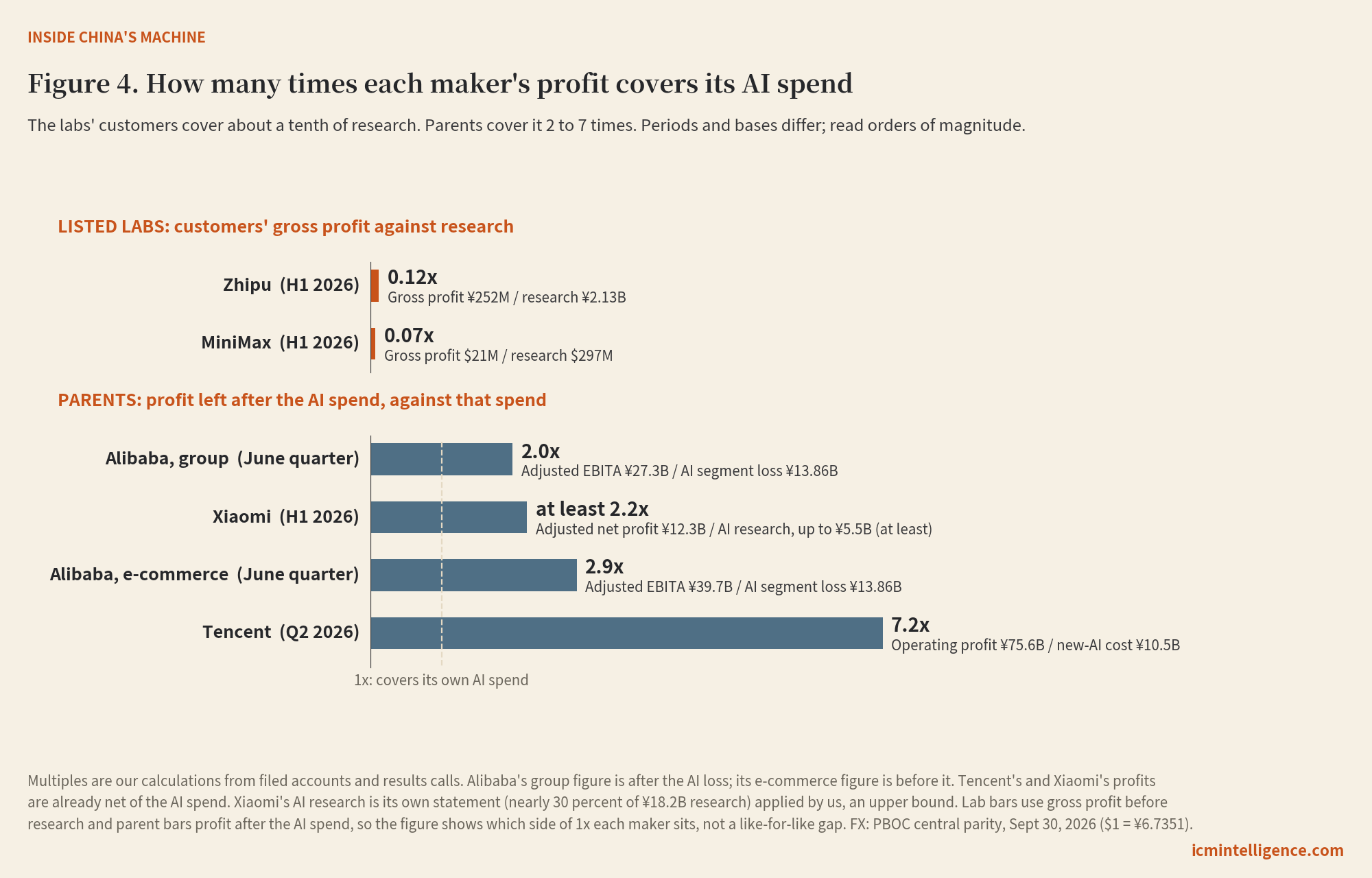
In the second quarter, Tencent’s operating profit before certain items, its own adjusted measure, rose 9 percent to ¥75.6 billion, already net of about ¥10.5 billion ($1.56 billion) of cost from new AI products, which include its Hy models, the Yuanbao assistant and coding tools. The ¥10.5 billion is a cost line with some revenue inside it, and Tencent reports no AI revenue line. Cash is where the strain shows: its free cash flow, a cash measure the company defines for itself, was negative ¥13.8 billion ($2.0 billion) because of prepayments for computing, and would have been positive ¥37.6 billion without them. Its Hy3 model scores 25 on the index, against 44 to 46 for the five leaders, and its newer Hy4 preview is not placed, so the parent with the highest cover here does not hold a placed leading model.
Alibaba’s new AI Labs and Applications segment holds its model labs together with the Qwen consumer app and its QwenWork product, so its revenue covers more than model sales. In the June quarter the segment lost ¥13.86 billion ($2.06 billion) at adjusted EBITA, Alibaba’s operating profit measure, on revenue of ¥3.34 billion ($0.5 billion). Its e-commerce group earned ¥39.7 billion ($5.9 billion) of adjusted EBITA, about three times that loss, while Alibaba’s total adjusted EBITA, after the AI loss, fell 30 percent to ¥27.3 billion ($4.1 billion), about twice it.
Xiaomi, the opening’s test case, reports its profit after research. Adjusted net profit for the half was ¥12.3 billion ($1.83 billion), down 42.8 percent. Against up to ¥5.5 billion of AI research by our estimate, that is at least about 2.2 times, close to Alibaba’s group figure and well below Tencent’s. Xiaomi told analysts that revenue from selling access to its model had begun, and that it is not treating monetization as the main goal yet. A $0.87 output price is one a profitable parent can choose to hold, whatever it costs to serve.
By our calculation, on different bases and periods (quarters for Tencent and Alibaba, the half for Xiaomi), the cover is about 7 times at Tencent, about 2 times at Alibaba’s group level and at least 2.2 times at Xiaomi. On the same inputs, cover would fall to one only if profit after the AI spend dropped a further 50 percent from today’s level at Alibaba’s group level, at least 55 percent at Xiaomi and 86 percent at Tencent, with the spend unchanged. Xiaomi’s adjusted net profit has already fallen 42.8 percent, and the 2.2 times is measured after that fall. Figure 4 puts unlike measures on one scale: the lab bars use gross profit before research and the parent bars profit after the AI spend, so it shows which side of one each maker sits, not a like-for-like gap.
Baidu and ByteDance, the two largest remaining parents, cannot be sized. Baidu’s release gives revenue lines for its AI business but no AI cost figure. Its online marketing revenue fell 19 percent in the second quarter while its AI-powered line, mostly AI cloud infrastructure, grew 25 percent. ByteDance does not file. It says its Doubao models process 180 trillion tokens a day, a measure of use, and The Information reported, citing insiders, that its profit is slipping.
A parent’s cover is a moving number. Xiaomi’s adjusted net profit fell 42.8 percent in the half, Baidu’s online marketing fell 19 percent in the quarter, Alibaba’s group profit fell 30 percent with the AI loss inside it, Tencent’s rose 9 percent, and ByteDance’s profit is reported slipping. No parent’s filing says whether its model earns its keep. A lab has no parent profit to lean on, so who covers it there?
A Lab Pays With Shares, on Figures a Reader Cannot Check
A lab has no other business to draw on, so it pays with shares and bonds. Zhipu’s path ran like this. Its shares closed at a peak on June 22. In July it completed a share sale of about ¥27 billion ($4 billion), according to press reports. By September 9 the shares closed 62 percent below that peak close. On September 12 it agreed a placing of about ¥13.5 billion ($2 billion), a sale of new shares to investors, and a ¥20.14 billion ($3 billion) convertible bond, a loan that can turn into shares. That is ¥33.6 billion agreed after the fall, not yet shown as closed. The notice puts 60 percent of the placing’s proceeds to research and infrastructure, 15 percent to expansion and strategic investments and 25 percent to working capital. By September 30 the shares were 73 percent below the peak close.
Zhipu’s raises total about ¥61 billion ($9 billion) by our sum, nearly 30 times its half-year loss, so if the September deals close it is not short of cash on first-half spending. At the first-half loss rate that cash would last for years, so first-half spending does not force another sale. The loss is not standing still, though: Zhipu’s adjusted loss, which leaves out items such as share-based pay, widened by 12.1 percent from the first half of 2025. What stays open is the price of the next sale. At the September 30 close a new sale would price off shares down 73 percent. MiniMax raised about $2.0 billion in July through a placing and a convertible bond, about 5.6 times its half-year loss.
Alongside the shares, the figures that come with the funding cannot be checked. The most checkable is Zhipu’s. It stated an annualized $1.6 billion on its model-access platform in August, nearly 6 times the roughly $283 million implied by doubling its ¥954 million ($142 million) of first-half revenue, all products included. A run rate annualizes a recent period, so it runs above a half-year average at a fast-growing business, and Zhipu’s full-year accounts will test it.
Private labs publish no accounts at all. The Information reported on September 24, as relayed by other outlets, that DeepSeek’s API, the paid channel through which developers call its models, earned an 82.9 percent gross margin in the first seven months of the year. That is a margin on selling tokens, with research and training outside it, on a different base from the filed 26.4 percent at Zhipu and 17.9 percent at MiniMax, and DeepSeek has not confirmed it. A margin that high would still leave the question open, because DeepSeek does not report what its research costs. Its first funding round, according to Caixin, valued it at ¥350 billion ($52 billion) after about ¥50 billion ($7.4 billion) came in. Moonshot reportedly closed $3.5 billion at a $35 billion value in July, per Bloomberg. Neither round came with a filed account. None of these figures, filed or reported, shows a model covering its cost. What would?
Only a Model-Level Account Would Settle It
One filing would show it: a segment in which model revenue exceeds model build-and-run cost, research included. Alibaba’s AI Cloud and Compute segment sells compute and cloud services, so it does not qualify. Three nearer readings would show whether the gap is closing. Zhipu’s and MiniMax’s full-year accounts, due next year, will show whether gross profit is rising against research. Gross profit covered about one-eighth of research at Zhipu and one-fourteenth at MiniMax in the first half. Full-year gross profit reaching research, the point where gross profit alone pays for it, or a model-level account showing revenue above cost, would end the thesis. A share of at least double the first-half figures, about one-quarter at Zhipu and one-seventh at MiniMax, but short of one would show the gap narrowing with the thesis still standing. A share at or below the first-half figures would show no progress. A listing document from a private lab, with audited gross margin and research spending, would test claims like DeepSeek’s. A parent that reports a line where model revenue and model cost sit together would show it from the other side. Only the labs’ full-year accounts have a due date.
Until these arrive, staying power can be judged from two things: how well a parent’s other business covers its model, which Tencent’s, Alibaba’s and Xiaomi’s reports let a reader check, and how a lab’s share price stands when it next sells shares, which cannot be read in advance. An operator building on a Chinese model is exposed to the same two, and can ask who funds its vendor and keep a second model ready. On July 19 Moonshot said it had paused new consumer subscriptions because requests to Kimi K3 were approaching the limit of its computing clusters. Its statement did not mention the API, so an operator on Kimi should ask whether API capacity is limited too. An investor can size exposure by asking how well a maker’s other business covers its AI spending and when it next needs to sell shares.
Xiaomi, the maker with the lowest bill, covers its AI research at least 2.2 times from adjusted net profit that fell 42.8 percent in the half. Zhipu has raised or agreed to raise nearly 30 times its half-year loss while customers’ gross profit covers one-eighth of its research, so its staying power rests on those raises closing and on the price of its next sale, with its shares 73 percent below their peak.
Data covers developments through September 30, 2026; Artificial Analysis’s board and model pages were read on October 1, 2026 (Intelligence Index v4.3.2, effort settings as Artificial Analysis labels them, no update date shown on the board). Share prices are frozen at the September 30 close. Currency conversions use the People’s Bank of China central parity rates for September 30: $1 = ¥6.7351 and HK$1 = ¥0.85842. Private valuations, run rates and insider figures are reported, not filed. Xiaomi’s AI research amount, the Zhipu raise total (including the ¥33.6 billion agreed in September and the HK$ placing converted to yuan), gross profit against research at Zhipu and MiniMax, the Tencent, Alibaba and Xiaomi cover multiples and breakeven declines, the run-rate and raise multiples (nearly 6, 5.6 and nearly 30 times), the 62 and 73 percent share price declines, and the bill ratios are ICM calculations from the inputs shown.
Inside China’s Machine is independent research, not investment advice.
Sources and Data Attribution
Scores, costs and token counts: Artificial Analysis leaderboard and model pages (artificialanalysis.ai), read October 1, 2026; effective prices and ratios are ICM calculations from those fields. List prices: Artificial Analysis for Step 5 Preview and GLM-5.3 output prices; Moonshot (platform.kimi.ai); Alibaba Cloud Model Studio (Singapore tier).
Filings and company statements: Zhipu and MiniMax interim reports and HKEX announcements (2026), including Zhipu’s September 12 to 18 placing and convertible announcements; SenseTime interim results (HKEX, August 26, 2026); Alibaba June-quarter results (Form 6-K, August 2026); Tencent second-quarter results release and call (August 12, 2026); Baidu second-quarter results (August 18, 2026); Xiaomi results announcement and second-quarter call (August 2026); Kuaishou second-quarter results release (for Figure 1’s Kling row). Zhipu closing prices: Yahoo Finance.
Reported figures: The Information (September 15 and 24, 2026), as relayed by other outlets; South China Morning Post, Bamboo Works and Bloomberg for Zhipu’s July share sale; Caixin (May and July 2026); Bloomberg as relayed by Silicon Republic and TechWire Asia; Yicai (July 19, 2026) for Moonshot’s statement; LatePost and 36Kr via Sina for Kling’s 2025 loss (Figure 1); ByteDance’s token figure as relayed by Sohu, IT Home and Tencent News from its June 23 event; iFlytek and Meituan figures as reported by Chinese financial media; Wang Xiaochuan to 36Kr (May 23, 2026); Bloomberg via TNW for 01.AI.
Zhipu’s August annualized figure and Figure 1’s remaining rows: company statements as relayed by Chinese financial media.
Currency: People’s Bank of China central parity, September 30, 2026, as published by Xinhua.