


In October 2023, six Chinese ministries led by the Ministry of Industry and Information Technology (MIIT) set a target for the country’s computing infrastructure. By 2025, total computing power should exceed 300 EFLOPS, and “intelligent” compute, the kind built for AI, should make up 35% of it. An EFLOPS is a billion billion arithmetic operations a second, and 35% of 300 is about 105 EFLOPS of AI compute. MIIT’s 15th Five-Year plan for information and communications, its blueprint for the next five years, opens its indicator table with a figure for the same year. China’s intelligent compute at the end of 2025 stood at 1,590 EFLOPS. That is about fifteen times the AI compute the plan implied. It is more than five times the plan’s total target for every kind of compute combined.
The obvious reading is that China beat its target fifteen-fold, but the published figures do not establish that. The 2023 plan counted compute in FLOPS and named no precision, meaning the number format the chips work in. Some MIIT briefings since 2025 label their figures FP16. Nothing cited here explains how one series becomes the other. The one official figure that comes close to measuring use is a 71.4% “rack occupancy” for mid-2026, and it counts racks, not the work done on them.
My judgment is this. China’s official compute numbers report what was built, and they cannot yet tell an investor or an operator how much of it is used. That matters because compute is a base cost for every Chinese model company and cloud provider, and it underpins much of the demand story for domestic chips. A stock figure on an undocumented basis is a supply claim, not evidence of demand or of a return on the clouds’ data-centre spending. This is a reading of the published numbers, not a verdict on any ministry or company.
Two yardsticks for one year
A chip counts more operations each second when the numbers it works on carry fewer digits. FP16, a half-precision format common in AI work, is one such format. The same chip can therefore carry different FLOPS ratings, and two ratings compare only when both rest on the same basis.
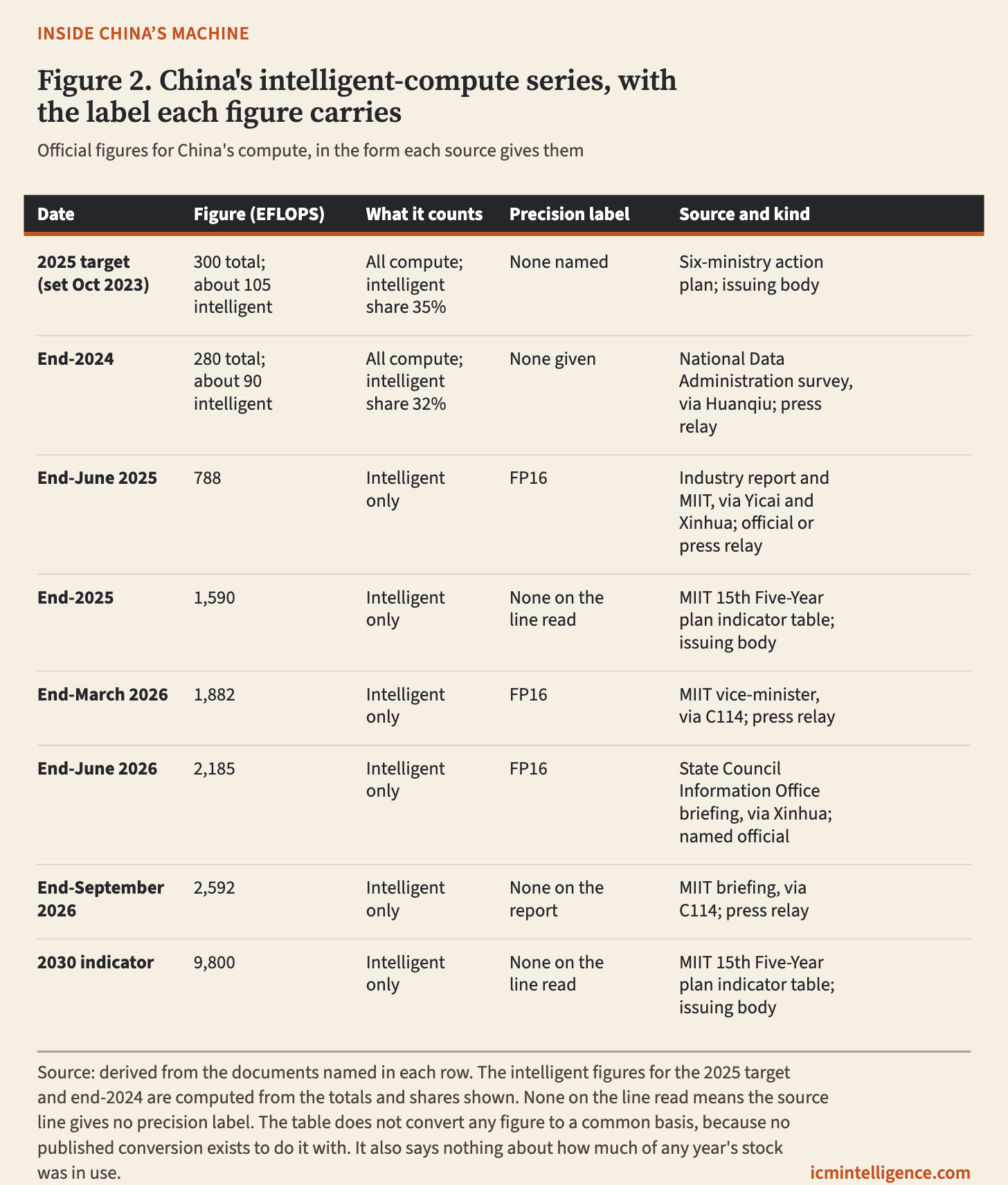
The 2023 plan defined national compute as the sum of three parts: general compute, supercomputing and intelligent compute. Its unit was FLOPS, with no precision attached. Its annex set out a path of 220, 260 and 300 EFLOPS in total for 2023, 2024 and 2025. Over the same years, the intelligent share was to rise from 25% to 30% to 35%.
For a while, the reported numbers tracked that path. The National Data Administration’s survey for 2024, as relayed by Huanqiu, put total compute at the end of that year at 280 EFLOPS with a 32% intelligent share. That works out to about 90 EFLOPS of AI compute, slightly ahead of the plan’s 2024 step. Six months later, an industry report presented at the 2025 China Computing Power Conference, alongside MIIT figures, gave intelligent compute alone as 788 EFLOPS, labelled FP16. On paper, AI compute rose almost ninefold in half a year. The figures alone do not show how much of the jump from about 90 to 788 EFLOPS came from building and how much, if any, from a change of yardstick, and no official text read here explains it.
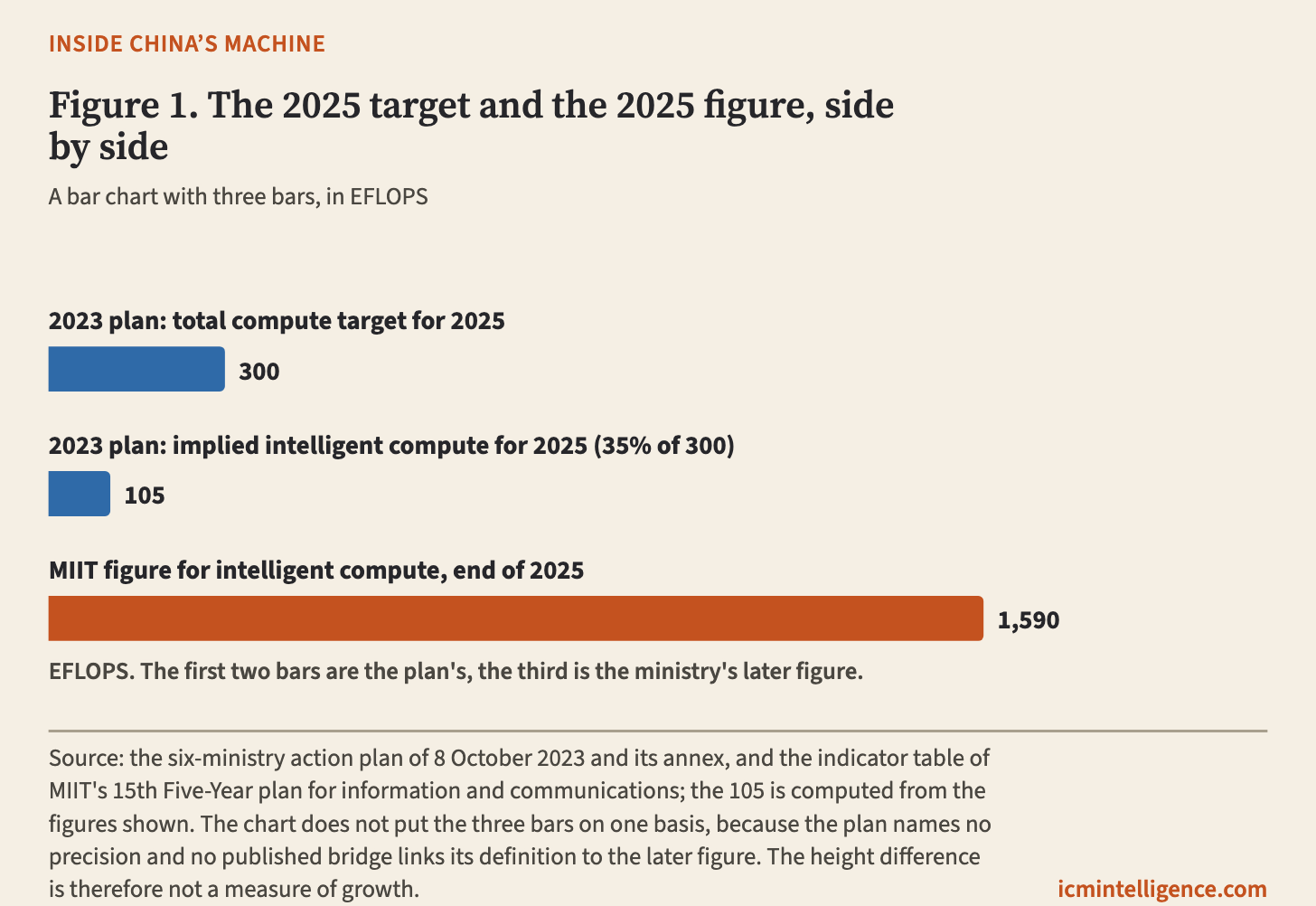
There is one reading that would make the gap simple, and it should be stated plainly. Perhaps the plan’s 300 was always meant on the same basis as the later series. In that case, China did not change its yardstick and the target was simply beaten. If that is true, the rest of this argument loses its first leg. The published record does not settle it either way. The documents cited here contain no 2025 figure for total compute across all three kinds, and no statement that the 2025 target was met on the plan’s own terms. A target that may have been exceeded fifteen-fold, or for which no comparable result has been published, is still unresolved as a target.
What 71.4% counts
At the State Council Information Office briefing in July 2026, MIIT’s head of information and communications gave two numbers together. Intelligent compute had reached 2,185 EFLOPS at FP16, up 177% on a year earlier. “Overall rack occupancy” stood at 71.4%. The first is a stock. The second sounds like it might say how much of the stock is used, and it is the only official national figure cited here that comes near that question.
Read on its face, the term describes how many of the country’s standard racks, the cabinets that hold servers, are taken; the Xinhua report of the briefing does not define it. There were 10.85 million standard racks in use at mid-2025, 13.73 million in operation at year-end, and 42 clusters of ten thousand computing cards or more.
An occupied rack is filled whether its chips run flat out or sit idle. If occupancy means what it appears to mean, about 29% of racks were empty at mid-2026. Even then, the 71.4% says nothing about how hard the full ones work. The ministry has not said that the figure measures workload, and it should not be read as one.
A figure that does sound like workload has circulated widely. Securities Times and 36Kr reported a 2025 national “use rate” of 36.8%, about 1.4 billion card-hours used out of 3.8 billion supplied, and attributed it to the China Academy of Information and Communications Technology (CAICT). A card-hour is one computing card used for one hour. CAICT’s own April 2026 report on intelligent-compute services contains no utilisation, idle or usage figure. Yicai later reported the same 36.8% as an end-June number. A figure with no traceable primary source and two stated periods is a press figure. It is not a measurement a reader can check.
The strongest case that the policy worked
The best argument against this reading, as its holders would put it, runs as follows. The idle part of China’s compute is old: general-purpose centres and local projects built ahead of demand. Experts quoted by Securities Times in September 2026 described exactly that split, with top-end AI compute in short supply and low-end compute largely idle, and Xinhua and Shanghai Securities News reported the same pattern in April 2025. They would point to prices: Economic Daily, carried by Xinhua in September 2026, reported that Tencent Cloud, Alibaba Cloud, Baidu AI Cloud and other providers had raised compute prices since the start of the year, some services by more than 30%, and a think-tank head put the cause down to supply and demand being out of balance. On this reading, the stock grew 146% in the year to September 2026 because the policy worked.
That may well be right. My objection is narrower. The official numbers cannot tell this story apart from one in which much of the new capacity finds little work. A national stock figure adds older AI clusters and new ten-thousand-card ones into a single EFLOPS total. An occupancy rate counts occupied racks. Neither separates the tier that is short from the tier that is idle, which is exactly the distinction the rival reading depends on.
CAICT’s April report expects demand to shift from today’s mix, over 70% centralised training, toward one where over 70% comes from distributed inference, the everyday running of models once they are trained. A stock total cannot show whether the stock fits the demand that is coming.
The stock, meanwhile, keeps growing. From 2,185 EFLOPS at the end of June 2026 to 2,592 at the end of September is about 19% in a quarter, if the two figures are comparable. The second figure carries no FP16 label in the report. If top-end prices stay up while supply grows at that pace, that would support a real and large shortage at the top. If they ease, that would suggest the scarcity was a moment and supply had outrun demand. The price list can speak to that question; an official stock figure alone cannot.
Paying buyers to show up
Two provinces offer a different kind of evidence: money that flows from government to buyers of compute rather than to its builders.
Hubei’s 2025 scheme offered RMB 50 million of compute vouchers. These covered 10% of a buyer’s compute fees, capped at RMB 1 million per entity, for intelligent compute or supercomputing only, with a claims window from 12 to 25 November. Its 2026–2028 scheme, issued at the end of September 2026 and described by a provincial Data Bureau official in Hubei Daily, doubles the rate to 20% of actual fees. The rate rises to 30% where the buyer chooses domestic, self-controllable compute, and the cap per entity triples to RMB 3 million. In October, Hubei’s Development and Reform Commission met to study the “insufficient effect of provincial compute resources in supporting innovation”. It also set out to break what it called the compute-use bottleneck facing universities, institutes and technology firms.
Liaoning’s rules, reported on the provincial government site in October 2026, cover up to 30% of a contract’s actual value, capped at RMB 2 million per entity per year. Buyers must spend at least RMB 250,000 a year on compute. Suppliers must list at least 50 PFLOPS of intelligent compute on the provincial platform. The stated purpose is “demand pulls supply”, steering the province’s compute centres toward capacity people will actually pay for.
Neither scheme comes with a published figure for claims or payouts. The vouchers therefore show what the provinces are trying to do: in Liaoning, pull supply with demand, and in Hubei, raise the rate and cap a year after its first round. They do not show whether buyers came.
The number to wait for
Three things would help settle the question. The first is any national utilisation measure on a single stated definition, split between general-purpose stock and top-end clusters. The second is a province publishing how much of its voucher money was claimed, and by whom. The third is whether top-end prices hold or fall as the stock grows.
China’s 2030 indicator is 9,800 EFLOPS, and the mid-2026 stock is already about 22% of it, if the two rest on one basis. A record capacity figure says what was built, not what it does. A country that counts capacity will keep building capacity. The number worth waiting for is use, by tier.
Sources
Ministry of Industry and Information Technology and five other bodies, Action plan for high-quality development of computing infrastructure (8 October 2023), annex PDF at https://www.miit.gov.cn/cms_files/filemanager/1226211233/attach/20238/1f932a10298244da844cacef2baa63c7.pdf and notice at https://www.miit.gov.cn/zwgk/zcwj/wjfb/tz/art/2023/art_fcb3aa793e674960b1c00d7e3b6ad448.html, captured 2026-11-12. The 2025 targets, the annex path and the definition of compute.
MIIT, 15th Five-Year plan for information and communications, indicator table, PDF copy on the State science and technology platform at https://www.ncsti.gov.cn/zcfg/zcwj/202609/P020260908509315499261.pdf, captured 2026-11-12. The 1,590 EFLOPS base figure and the 9,800 EFLOPS indicator for 2030.
Huanqiu, report on the National Data Administration’s 2024 data-resource survey, https://scroll.huanqiu.com/article/4MTQpeFIiFZ, captured 2026-11-12. Total compute of 280 EFLOPS and a 32% intelligent share.
Yicai, report on the 2025 China Computing Power Conference (August 2025), https://www.yicai.com/news/102790186.html, and Xinhua, 25 August 2025, https://www.news.cn/fortune/20250825/6eb8bc765b6f4f00b6a543f732e505f3/c.html, captured 2026-11-12. Intelligent compute of 788 EFLOPS (FP16) and 10.85 million standard racks at the end of June 2025.
C114, 21 April 2026, https://m.c114.com.cn/w16-1308857.html, captured 2026-11-12. The 1,882 EFLOPS figure at the end of March 2026.
Xinhua, 20 July 2026, reporting the State Council Information Office briefing, https://www.news.cn/tech/20260720/63025e398f234092b9876272271417fb/c.html, captured 2026-11-12. 2,185 EFLOPS (FP16), up 177%, and the 71.4% rack occupancy.
Xinhua, 22 August 2026, https://www.news.cn/tech/20260822/c2ed1d77f03a421d85c064f39536fa88/c.html, captured 2026-11-12. 13.73 million standard racks in operation and 42 ten-thousand-card clusters at the end of 2025.
C114, 20 October 2026, https://m.c114.com.cn/w16-1319458.html, captured 2026-11-12. 2,592 EFLOPS at the end of September 2026, up 146%.
China Academy of Information and Communications Technology, report on intelligent-compute services (April 2026), https://www.caict.ac.cn/kxyj/qwfb/ztbg/202604/P020260430517209165899.pdf, captured 2026-11-12. The shift in demand from training to inference.
Securities Times via 21jingji, 29 September 2026, https://www.21jingji.com/article/20260929/herald/33e985765b61482bc02bad2277138183.html; 36Kr, 16 October 2026, https://eu.36kr.com/zh/p/4027768097592961; Yicai, https://www.yicai.com/news/103409871.html, captured 2026-11-12. The 36.8% use-rate figure and the idle-compute accounts.
Xinhua, 29 April 2025, https://www.news.cn/finance/20250429/3df0c33317d2499ab3a297a413e0acce/c.html, captured 2026-11-12. Old compute centres idle while AI compute fitting demand is short.
Economic Daily via Xinhua, 8 September 2026, https://www.news.cn/tech/20260908/f69aab8785b54ae6b335ed366589927d/c.html, captured 2026-11-12. Cloud price rises.
Hubei provincial compute-voucher measures (26 September 2025), published on the provincial economy and information technology department site, http://jxt.hubei.gov.cn/fbjd/zc/gfxwj/202509/t20250926_5780859.shtml, and Hubei Provincial Data Bureau FAQ (November 2025), https://sjj.hubei.gov.cn/bmdt/tzgg/202511/P020251113608984962861.pdf, captured 2026-11-12. The 2025 scheme.
Hubei Daily via Jimu News, 1 October 2026, https://www.ctdsb.net/c1676_202610/2869638.html, captured 2026-11-12. The 2026-2028 scheme.
National Development and Reform Commission, report of 28 October 2026 on the Hubei Development and Reform Commission meeting, https://www.ndrc.gov.cn/xwdt/dt/dfdt/202610/t20261028_1408420.html, captured 2026-11-12. The compute-use bottleneck.
Liaoning provincial government site, report on the compute-voucher rules (14 October 2026), https://www.ln.gov.cn/web/zwgkx/zcjd/mtjd/2026101408290033228/index.shtml, captured 2026-11-12. The Liaoning terms.
Inside China’s Machine · Frontier, Episode 8
Disclaimer: This article is for informational and educational purposes only. It is not investment, financial, legal or tax advice, and it is not a recommendation or solicitation to buy or sell any security. Do your own research, and consult a licensed professional before making investment decisions.