

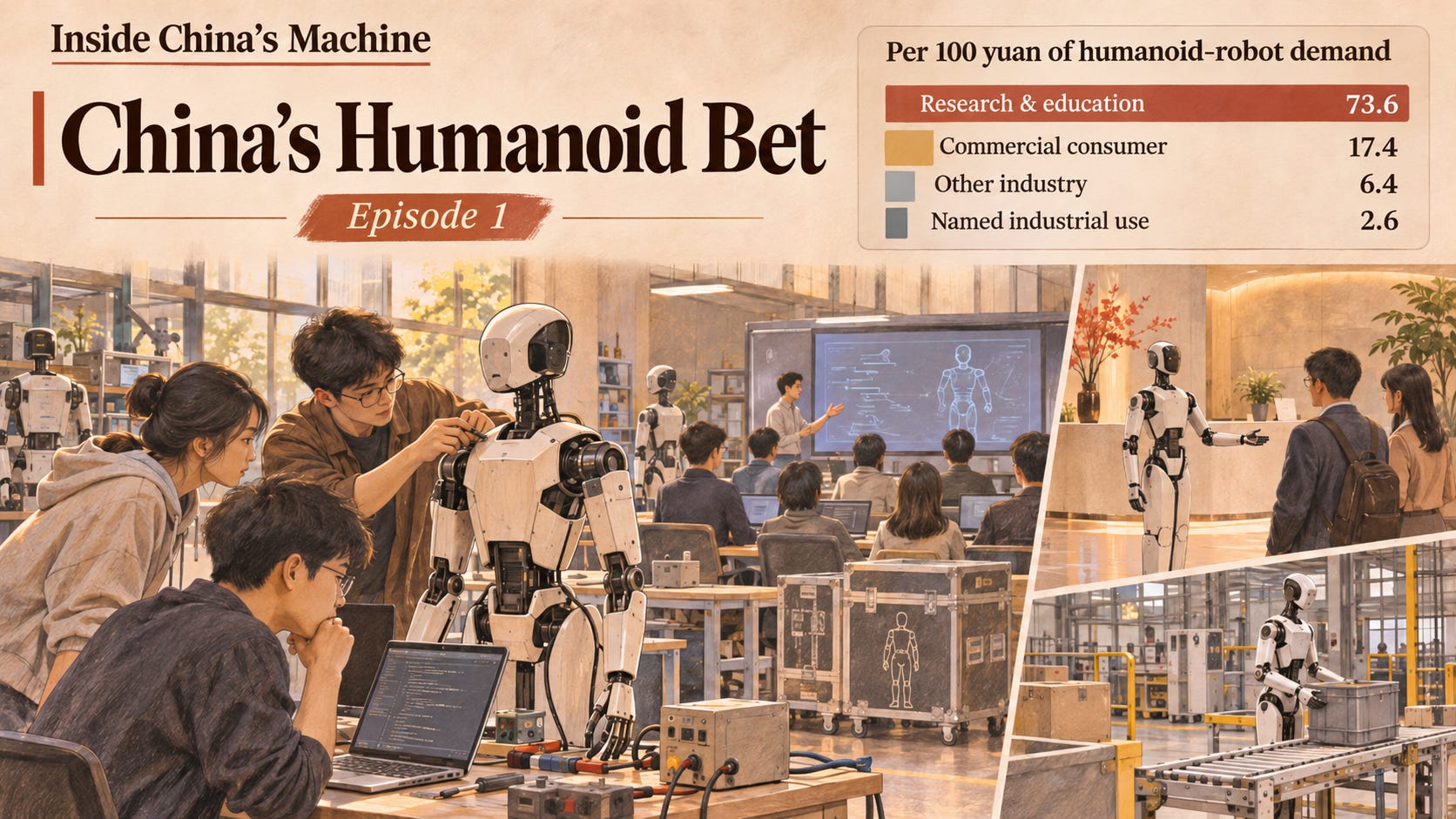
Inside China’s Machine · China’s Humanoid Bet, Episode 1
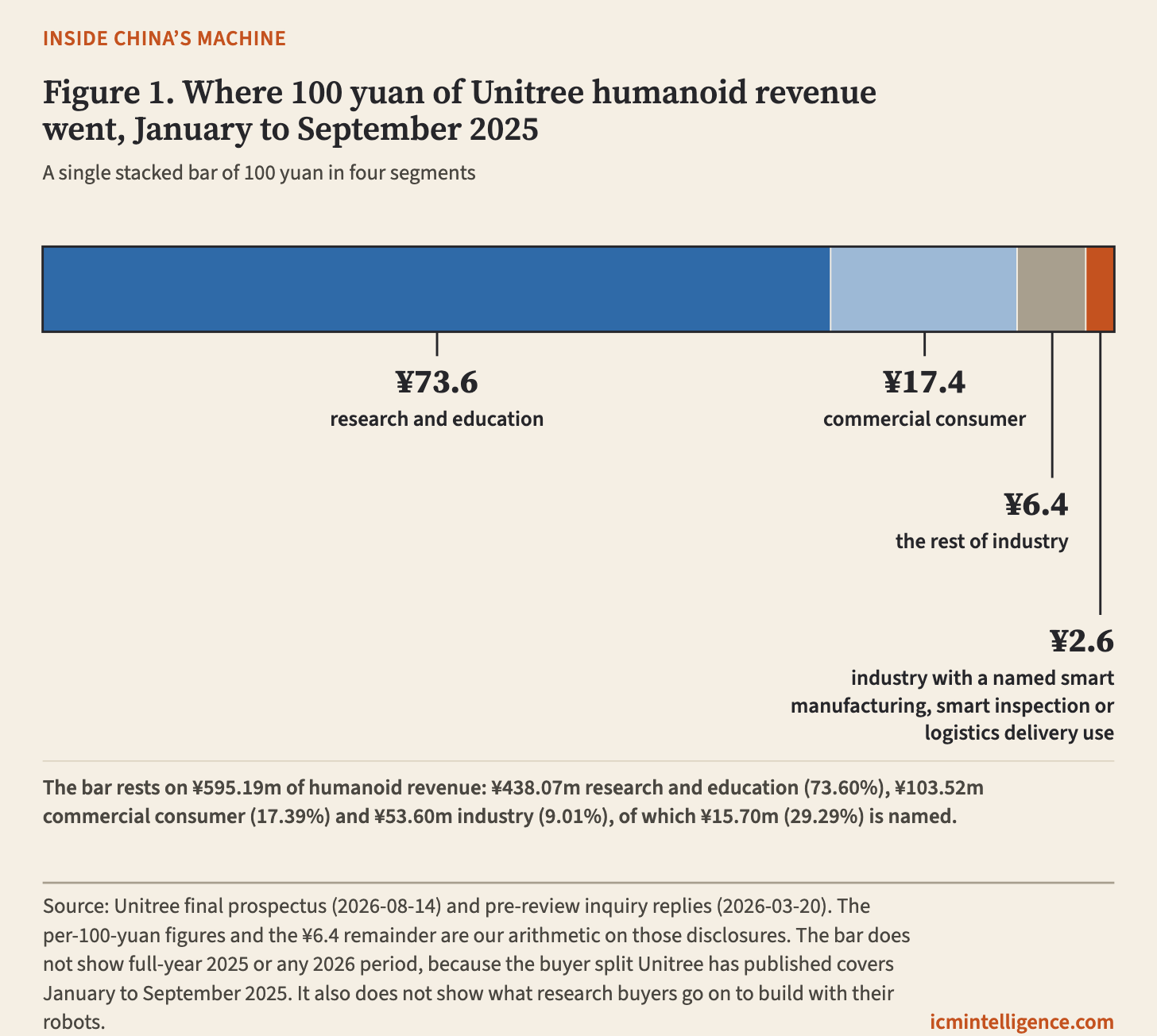
Take 100 yuan of Unitree’s humanoid revenue in the first nine months of 2025. About 73.6 yuan came from research and education buyers, 17.4 from commercial consumer buyers and 9.0 from industry. Of that 9.0, the company can name a factory, inspection or logistics job for about 2.6 yuan. The rest of the industry money, as far as Unitree understands it, mostly paid for robots that greet visitors in company buildings. So out of every 100 yuan, about 2.6 came from a named job and roughly 97 from everything else, mostly robots bought to learn on, to show, or to greet visitors. “To show” is our shorthand for the commercial consumer money, which the filings do not break down further. Unitree’s split is one maker’s, and it suggests, without proving, how to read the thousands of humanoids China reports shipping. The paying demand today is for platforms to learn on and to show. A unit count measures that demand. It does not measure demand for labour.
The arithmetic and its limit
The 2.6 is ours, so here is the calculation. Unitree’s inquiry reply says that, by its preliminary count, revenue from humanoids sold for smart manufacturing, smart inspection and logistics delivery came to ¥15.70m. That is 29.29% of the ¥53.60m industry figure. Both figures cover January to September 2025. The ¥15.70m is a preliminary count, so the share could move if the final count differs. Industry was 9.01% of humanoid revenue, and 29.29% of 9.01% is 2.64%. Nothing more is involved. The point of doing it is that the share is never printed anywhere as one number, and it is the number that matters most to anyone sizing a market for humanoid labour.
The rest of the industry money went mainly to what the company calls enterprise guiding. The reply defines it as reception, route guidance, explanation and question answering, and puts it at about 50 to 70% of industry use. This is a real job that a buyer pays for: a robot meets visitors, shows them where to go, and answers what they ask. It is also not the factory, warehouse or inspection-round work that the labour story for humanoids is about. A parts supplier planning for robots on assembly lines should keep the two apart.
The company says plainly that its own view is incomplete. Unitree does not fully know what customers do with the robots, because customers develop their own applications. Its five largest humanoid customers from January to September 2025 were all distributors, in Japan, Korea, Beijing, Hangzhou and Germany, each between 1.66% and 2.49% of humanoid revenue. When you sell through distributors to buyers who write their own software, the final use sits two steps away from the seller. The 2.6 may therefore undercount real industrial use, or overcount it. Still, the ¥15.70m behind it is stated in Unitree’s inquiry replies, and Unitree’s own description of the market fits it. The prospectus says humanoids on the market “mostly remain at the application-scenario verification-and-testing stage”. The inquiry reply says large-scale industry application “is in the development-and-training stage”. UBTech’s 2026 interim results announcement names uses, not a comparable share.
“Research and education” also needs a closer look, because it is broader than it sounds. The inquiry reply counts universities and research institutes, and also technology companies and individual developers who buy for research, development or secondary development. Some of the 73.6 yuan may therefore come from companies building industrial applications that the 2.6 yuan does not yet show. That cuts both ways. It is the strongest evidence that labour demand may be coming. It is also the clearest sign that, for those purchases, it has not arrived: the buyer is paying to find out whether the robot can do the job, not paying it to do one.
Why units and scenarios do not answer the question
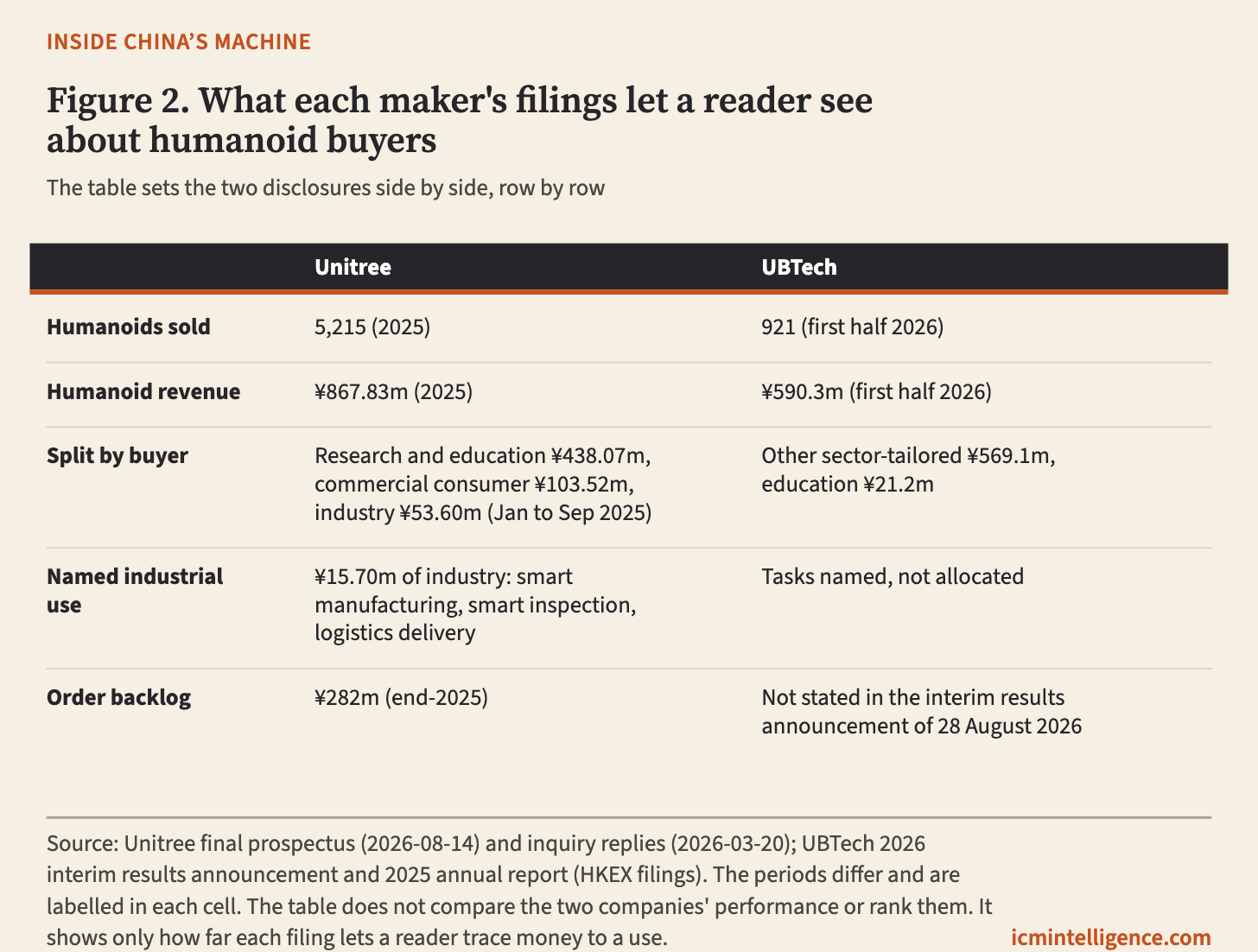
In 2025 Unitree sold 5,215 humanoids and shipped 5,511. Shipped is higher than sold because some robots had been delivered but not yet accepted by the customer. Humanoid revenue was ¥867.83m, just over half of main-business revenue, at a gross margin of 63.18%. The average price fell from ¥260,400 in 2024 to ¥166,400, as the mix moved to the mid-size G1, whose base version starts at ¥85,000 in the prospectus of 14 August 2026, and as prices were cut moderately. The order backlog stood at ¥282m at the end of 2025. Each of these is a different kind of number: a shipment, a sale, booked revenue and unbooked orders. None of them says who the buyer was or what the robot does. The buyer split Unitree has published covers January to September 2025. Its third-quarter report of 29 October 2026 shows company-wide revenue up 55.71% in the first nine months of 2026, with no buyer split.
UBTech, listed in Hong Kong, sold 921 full-size humanoids in the first half of 2026 for ¥590.3m, which was 46.5% of group revenue. Its interim results announcement puts ¥21.2m of that in education and ¥569.1m in a line called “other sector-tailored”. The announcement names production-line tasks but does not split that line among them. One unnamed customer accounted for 24% of first-half group revenue, ¥308.5m. UBTech’s interim results announcement of 28 August 2026 gives no order or backlog amount. The loss for the period was ¥338.8m. The same announcement refers to “achievement of annual production target of 10,000 units”, against the 1,079 humanoids its 2025 annual report records as sold that year. A production target is not a sales result. None of this tells us UBTech’s robots are not working in factories. It tells us the announcement does not say how many. A reader cannot get from UBTech’s largest line to a named-use share.
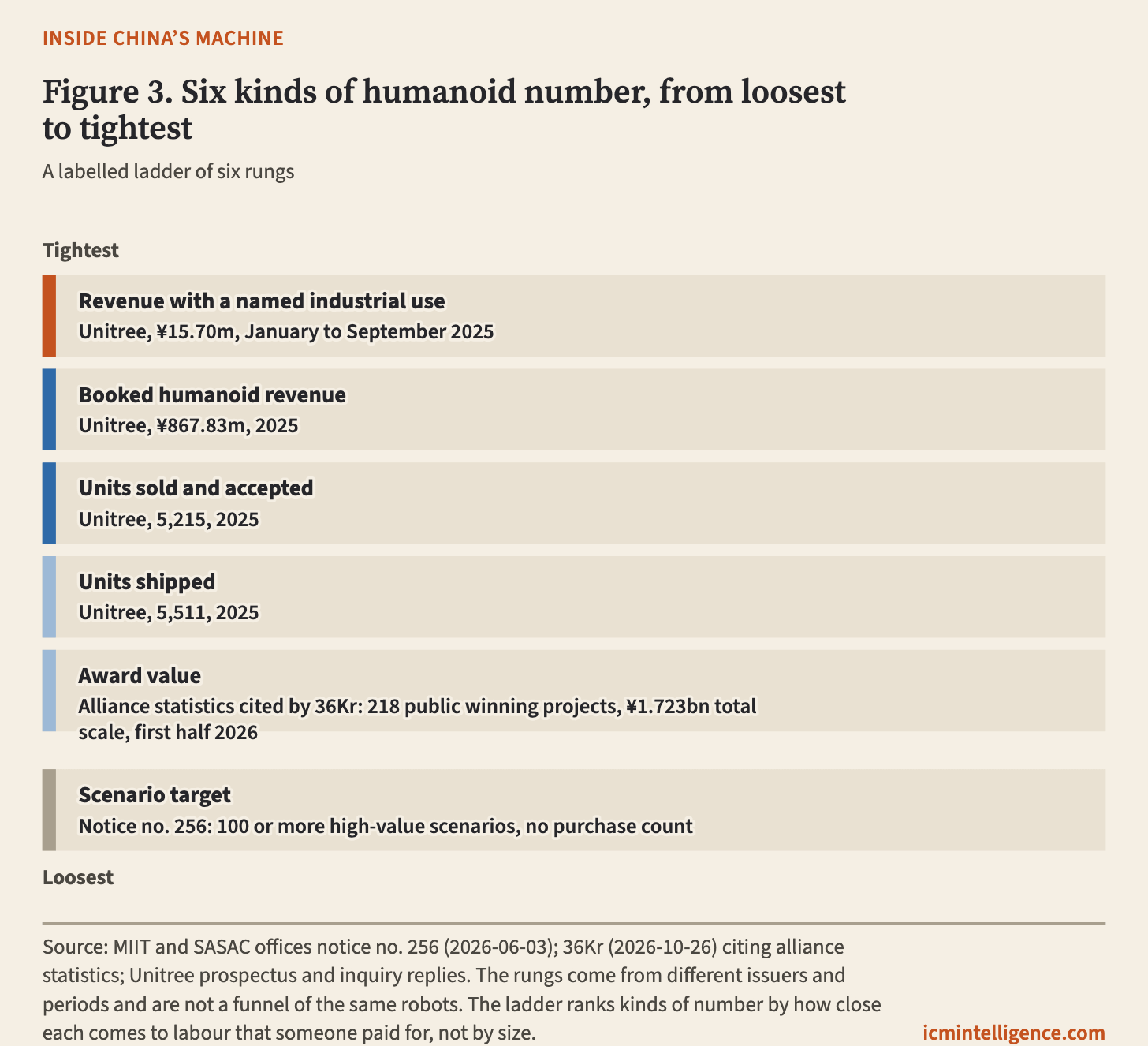
The state’s numbers count something else again. The joint notice no. 256 from the offices of MIIT and SASAC, dated 3 June 2026, aims at “100 or more high-value application scenarios”. It speaks of driving “the formation of” a ten-thousand-unit capability to put robots into use. It is addressed to the industry authorities of ten provincial-level regions, from Beijing to Sichuan, and to the relevant central state-owned enterprises. It asks each provincial-level region for at least 20 key scenario units across at least two of three domains, and each central state-owned enterprise for at least 10. It sets no purchase count. A scenario is a setting proposed for robot use, not an order for one. In November 2025 the National Development and Reform Commission counted more than 150 humanoid robot companies, more than half of them start-ups or entrants from other sectors. It warned of duplicated products crowding in and used the word “bubble” in its framing.
Tender data adds one more kind of number. A 36Kr article of 26 October 2026 on AgiBot’s postponed IPO cites Humanoid Robot Scene Application Alliance statistics: 218 public winning humanoid projects with a total scale of ¥1.723bn in the first half of 2026. By that tally the shares were 55.5% for education and research, 20.6% for government and state platforms and 21.1% for industry. Even taken as reported, an award value records a contract awarded, not necessarily one signed, and not revenue booked or a robot delivered. An “industry” award does not say what the robot will do once delivered.
The case against our reading
The strongest objection is that this is how hardware platforms start. Research and showcase buyers come first, developers build the applications, and industrial buyers follow. On this view, the right test is not today’s mix but whether buyers come back. Repeat buying does exist in every segment. In Unitree’s offline channel over the first nine months of 2025, the repeat-purchase rate was 56.58% for research and education, 30.94% for industry and 21.25% for commercial consumer. Those rates combine humanoids with quadruped robots, so they do not isolate humanoid buyers. Unitree itself expects research and education growth to slow, and commercial consumer and industry revenue to “become the main part of humanoid revenue”. Industry also went from nothing in 2024 to 9.01% of humanoid revenue in the first nine months of 2025.
That objection concerns the future, and the question here is who pays now. For a plant manager deciding whether to wait, an investor reading unit growth, or a supplier sizing an order book, the difference is the whole point. Thousands of robots bought to learn on can be the start of a labour market. They are not yet one, and counting them as one overstates it.
What would change it
The test arrives in the next full-year filings, and Unitree’s is the one that splits buyers. Two figures would show which way the argument is going. The first is named industrial use as a share of humanoid revenue: the 2.6 yuan in 100, recalculated on a full year. The second is the repeat rate among industry buyers, ideally reported for humanoids alone. If the named share climbs well clear of a few yuan in 100 and industrial buyers reorder, the platform reading gains ground and the labour market is forming in the filings. If the named share stays small while units climb, the units are measuring something else. For UBTech, the equivalent signal would be any statement of what “other sector-tailored” robots actually do.
Until then, a humanoid unit count tells you how many buyers wanted a robot to learn on or to show, not how many wanted one to do a shift.
Sources
Unitree final prospectus (2026-08-14), http://static.cninfo.com.cn/finalpage/2026-08-14/1225472621.PDF; Unitree pre-review inquiry replies (2026-03-20), https://static.sse.com.cn/stock/disclosure/announcement/c/202603/002178_20260320_OE27.pdf and https://static.sse.com.cn/stock/disclosure/announcement/c/202603/002178_20260320_BLK4.pdf; Unitree third-quarter report (2026-10-29), http://static.cninfo.com.cn/finalpage/2026-10-29/1225637442.PDF
UBTech interim results announcement 2026 (HKEX, 2026-08-28), https://www1.hkexnews.hk/listedco/listconews/sehk/2026/0828/2026082801691.pdf; UBTech annual report 2025 (HKEX, 2026-04-14), https://www1.hkexnews.hk/listedco/listconews/sehk/2026/0414/2026041401168.pdf; UBTech annual results announcement 2025 (HKEX, 2026-03-31), https://www1.hkexnews.hk/listedco/listconews/sehk/2026/0331/2026033102607.pdf
MIIT and SASAC offices joint notice no. 256 (2026-06-03), https://www.miit.gov.cn/zwgk/zcwj/wjfb/tz/art/2026/art_f291ccd3da4c47ce95741de63cc088e6.html
National Development and Reform Commission press conference transcript (2025-11-27), https://www.ndrc.gov.cn/xwdt/wszb/11yxwfbh1/wzsl/202511/t20251127_1401983.html
36Kr, article on AgiBot’s postponed IPO (2026-10-26), citing Humanoid Robot Scene Application Alliance statistics (first half 2026), https://www.36kr.com/p/4041951328310150
Inside China’s Machine · China’s Humanoid Bet, Episode 1
Disclaimer: This article is for informational and educational purposes only. It is not investment, financial, legal or tax advice, and it is not a recommendation or solicitation to buy or sell any security. Do your own research, and consult a licensed professional before making investment decisions.