


Inside China’s Machine · China’s Humanoid Bet, Episode 2
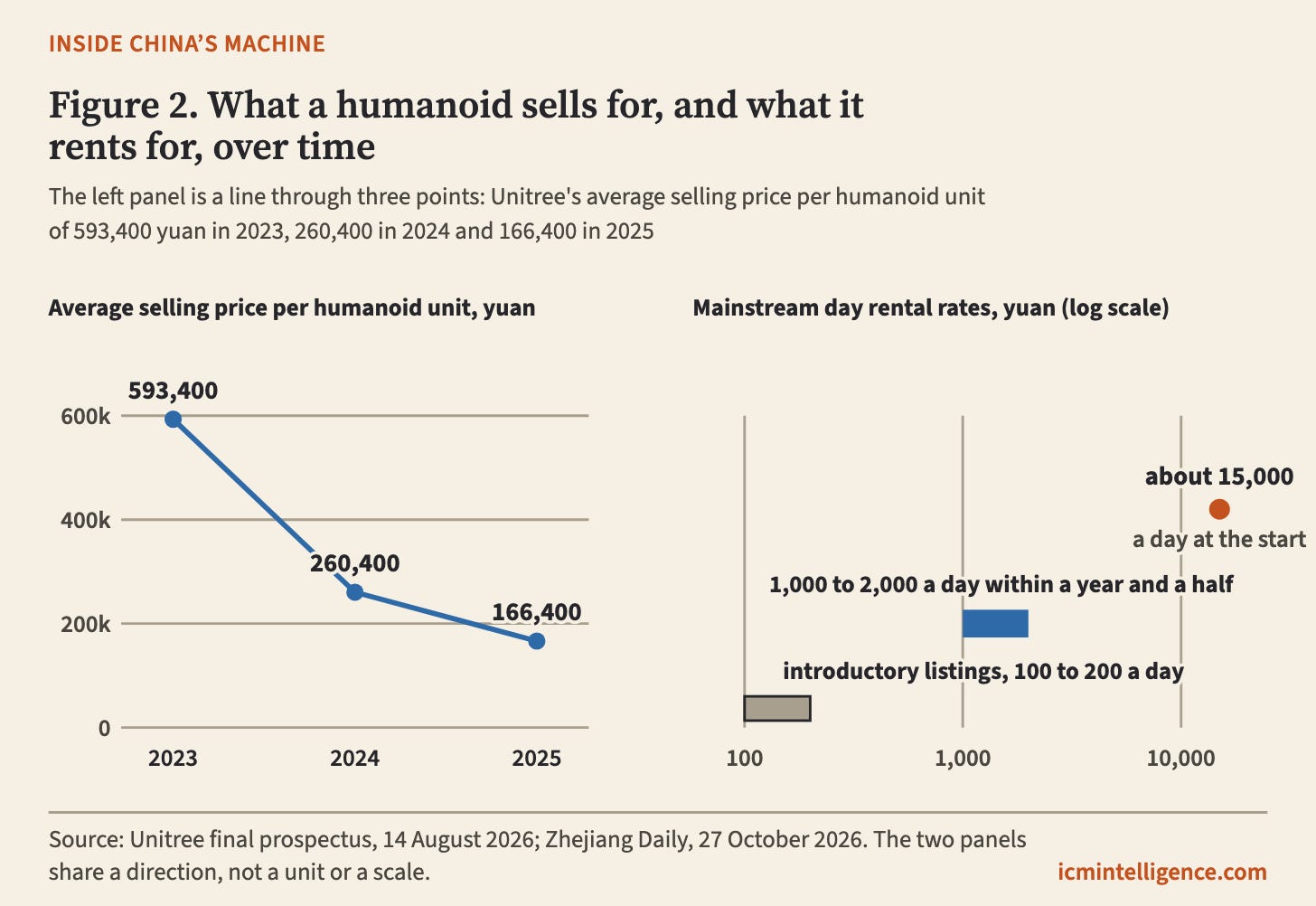
In 2023, Unitree sold its humanoid robots for an average of 593,400 yuan each. In 2025, the average was 166,400. That is a fall of 72% in two years, our arithmetic on the figures in the company’s final STAR Market prospectus, dated 14 August 2026. The 2023 average rests on five units. The prospectus points to a shift toward the cheaper G1 and a moderate price cut, among other factors such as lower manufacturing cost and more competition. The same document says that humanoids on the market “mostly remain at the application-scenario verification-and-testing stage.” So the price has fallen by nearly three quarters, and the maker still describes the robots as being tested rather than put to work.
Our answer to the title question is not yet, on anything disclosed. A buyer who wants to use a Chinese humanoid for real work in a factory or warehouse cannot show payback from published numbers today. Price is not what blocks the answer. The deciding number is how much work a robot does per hour, and no maker or buyer publishes it together with the hours and costs behind it. The few figures on offer run from about 20 to 30% of a person to more than 85%, and none comes with hours, a wage or a cost. If you are handed a payback claim, ask for that number first.
The four-number test
Payback on a machine that replaces labour is simple arithmetic. You divide what the robot costs by what it saves each year. Before running costs, what it saves is the wage of the work it takes over. Payback therefore depends on four things: the price, the wage it replaces, the share of a worker’s output the robot delivers, and the hours it runs. The price and the wage are published; the output share is unsettled, the hours unpublished. If two of the four are guesses, the payback is a guess too.
Price is the number we have, though it comes in several kinds. The G1’s base version starts at 85,000 yuan. It launched in May 2024 at 99,000. That is a list price, the cheapest configuration on the menu. Unitree’s 166,400 for 2025 is an average selling price across all the humanoids it sold, 5,215 of them, so it includes the dearer models and options. UBTech, listed in Hong Kong, does not publish a list price. Its interim results for the first half of 2026 report 921 full-size humanoid robots sold and RMB590.3m of revenue from full-size humanoid products and services, which was 46.5% of group revenue. Dividing one by the other gives about 641,000 yuan per unit. That is our arithmetic, and it is revenue per unit including services. UBTech lists those services as solution design, teleoperation validation, data collection and model training. The 921 units also span several models. So the 641,000 is not the price of any robot.
The wage side is also published. The National Bureau of Statistics gives 2025 average annual manufacturing wages of 113,594 yuan in urban non-private units and 76,055 yuan in private units. For production, manufacturing and related personnel at above-scale enterprises across all industries, the figure is 80,739 yuan; within manufacturing alone it is 79,182. These are wages, not the full cost of employing someone. Employer social insurance and other on-costs sit on top of them, and no on-cost rate is used here. Adding on-costs would make a worker dearer and shorten any payback. Adding the robot’s own running costs would lengthen it: maintenance, energy, integration, supervision and downtime. None of those costs is disclosed, so none is in our arithmetic.
The third number, the robot’s share of a worker’s output, has a few public figures, and they differ, partly because they describe different robots and tasks. In January 2026, a UBTech brand officer told the Financial Times, as reproduced by the Irish Times on 29 January, that the company’s Walker S2 robots were “30 to 50 per cent as productive as humans and only in certain tasks, such as stacking boxes and quality control.” The company’s target is 80% by 2027. This is one maker’s remark about one model, made in conversation rather than in a filing. Three other figures exist. China Securities Journal reported on 19 August 2026 that since March, China Post’s Jianggao parcel centre in Guangzhou has deployed 8 humanoid robots to feed parcels, from a maker it did not name. One robot feeds a steady 800 parcels an hour, up to 1,000 at peak, against 1,700 an hour for a skilled worker. That is about 47%, our arithmetic. Jinrongjie reported on 9 June 2026 that the chief executive of Aitu (Zhejiang) Intelligent Sewing Technology said its humanoid can do only simple loading and unloading, at roughly two to three tenths of a human’s efficiency, and that catching a person will take some time. Whether this is the robot in the 18-month payback story below is not stated. Guangming Daily, reproducing Beijing Fabu, reported on 18 May 2026 that at a China Post Guangzhou mail centre a representative of the robot maker Robotera said its Starmind M7, feeding parcels, had reached more than 85% of a human’s working efficiency, at up to 1,200 parcels an hour at peak, and described the robot as economically feasible. That is the maker’s own claim, and it gives no hours, wage or cost. Unitree’s G1 has no published productivity figure, from Unitree or from anyone who owns one. No maker or buyer has published an output figure together with its hours and costs. The figures that exist run from about 20 to 30% of a person to more than 85%, they disagree widely, and they cannot be combined into a payback.
Put the numbers together and you get the grid below.
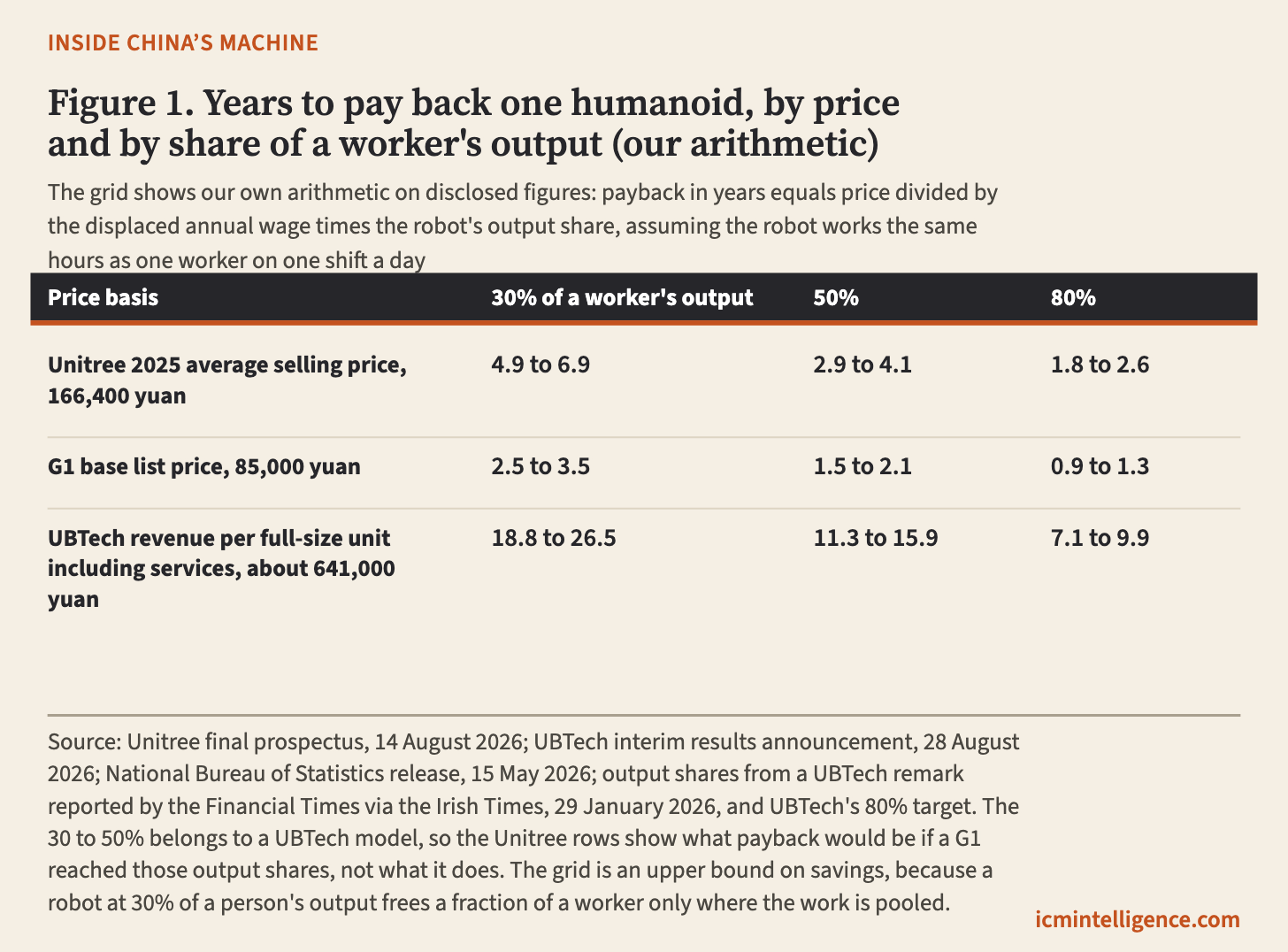
Read the grid across a row, then down a column. Across a row, the price is fixed and only the output share changes. On Unitree’s average price, the move from 30% to 80% cuts payback from roughly five to seven years down to roughly two. Down a column, the output share is fixed and the price changes from the 2025 average to the base list price. That compares two kinds of price, an average across models sold and the cheapest configuration, not a fall over time. Payback roughly halves. The real fall, from 593,400 to 166,400 yuan, a factor of 3.6, is not in the grid, and it still matters. But the 30-to-80% span is a range of guesses about a number nobody has measured for these robots. The G1 list price, by contrast, is published by the maker.
Hours stretch the range further. A robot that runs two shifts at the same output share doubles the saving, so every cell divides by two. Three shifts divide it by three. The grid’s best case could fall well under a year, and its worst case could stay as written, depending on whether the robot runs eight hours or twenty-four. Unitree’s own G1 product page lists a battery life of about 2 hours, a maker’s specification rather than a paid-deployment figure. UBTech says on its product page that Walker S2 swaps its own battery in 3 minutes, a vendor claim. No maker or buyer has published daily operating hours or uptime for a robot in paid work. The price fall has stopped being the main reason the payback answer is unknown. The output share and the hours now are.
What the buyers are doing
If humanoids were paying back on factory floors, the buyer mix would show it. In its replies to the exchange’s inquiry of 20 March 2026, Unitree breaks down its humanoid revenue for January to September 2025: 73.6% research and education, 17.4% commercial consumer, and 9.0% industry. In the same replies, the company said it does not fully know what its customers do with the robots. In the same Financial Times report that carried UBTech’s productivity remark, an analyst said most humanoid deployments in China are in government-sponsored research centres. A university lab buys a humanoid to study it, not to replace a worker, so its purchase says nothing about payback either way. Of the 9.0% labelled industry, the replies name a factory, inspection or logistics use for about 15.70 million yuan, about 2.6% of humanoid revenue, and the company understands the rest to be mainly enterprise guiding: reception, route guidance and explanation. Those buyers have not published output figures.
The one place a return is visible
There is one market where you can watch a humanoid earn money: rental. A rental return is visible because the price per day is quoted. On 14 October 2026, Daily Business News surveyed rental rates and found the Unitree G1 renting for about 2,000 yuan a day and the U2 for about 3,000. At 2,000 a day, a G1 grosses its 85,000-yuan list price in 42.5 days of rent, by our arithmetic. That is gross revenue, not payback after costs.
That return is collapsing. Zhejiang Daily reported on 27 October 2026 that mainstream humanoid day rates fell from about 15,000 yuan, the paper’s average day rate at the market’s peak, to 1,000 to 2,000 yuan within a year and a half, a fall of roughly nine tenths: 87% to 2,000 and 93% to 1,000, by our arithmetic. It added that some platforms list 100 to 200 yuan a day as an introductory price. At those introductory rates, grossing the G1’s list price takes 425 to 850 days of rent, again our arithmetic. At the mainstream 1,000 to 2,000 a day, it is 42.5 to 85 days. And that assumes the robot is booked every day. Kuai Keji, a tech outlet whose figures are unsourced, reported in September that over 60% of rental orders are for shows, expos and weddings. It also reported that over 90% of the rental stalls in Shenzhen’s Huaqiangbei electronics market have withdrawn. Unitree’s own reply to the exchange’s review centre, dated 25 May 2026, says a fall in short-term demand such as robot leasing could pass up the chain and cause price competition among robots.
There are still new entrants. Zhejiang Daily’s article of 27 October reports that China Mobile’s embodied-AI innovation centre has launched a rental platform. The same article carries a forecast, attributed to “some institutions,” that the national robot rental market could grow from about 1bn to 10bn yuan in 2026. If the reported order mix is representative, the paying rental customer mostly hires the robot to be watched, not to work. So the one visible return comes mainly from spectacle, not labour, and its price has fallen faster than the purchase price did.
The case against our answer
The strongest rival reading is that payback is already plausible wherever the task is fixed and the robot is narrow. Two vendor statements support it. Both appeared in the Xinhua Daily Telegraph, a state outlet, on 22 July 2026, and neither comes with cost inputs.
The first is from Zhejiang Aitu Embodied Intelligence, a unit of the sewing-equipment maker Jack Technology. “Under a single category and single fabric,” the company says, its humanoid reaches 97% success at separating fabric panels and a sewing pass rate above 98%. Its general manager said that “on this efficiency” the robot pays back in about 18 months. The article says the robots have been installed in several domestic garment factories and are in trial production on several lines. The success and pass rates say how often the robot gets the work right, not how much it completes in an hour. It gives no robot price, no wage, no hours and no shift pattern. It also quotes the same manager making a point a wage table cannot: “the number of workers who retire or leave the garment industry each year is far larger than the number robots would replace.” If that is the buyer’s situation, the comparison is against an empty station, not against a cheaper worker. That is a different payback calculation, and nobody has published its numbers either.
The second is from Junpu Intelligence, about its Puzhi Future G2. The company reports an 8-hour test of 2,283 tasks with zero errors at an unnamed leading 3C-electronics company. On a car-safety-line station that taps aluminium seat-belt parts, the robot cut the manual cycle of about 18 seconds to as little as 12.9 seconds, which the article calls “about one third” more efficient. The 12.9 seconds is the best cycle, and going from 18 to 12.9 seconds is a 28% cut in cycle time, our arithmetic. A shorter cycle fits more operations into an hour, if the pace holds, so a cycle time bears on output per robot-hour without measuring it. On this one station, it says the robot beats the person. But it is the vendor’s figure from a test at an unnamed customer. It gives no price, no hours in paid service and no uptime across weeks. Junpu’s Wuxi unit produced its first G2 robots in June and expects capacity of 2,000 to 2,500 a year.
Take these two seriously. Both are narrow: one fabric, one station. That narrowness is exactly the setting where a high output share is believable. If the 18-month claim came with its price, its wage and its shift pattern, our answer could change. A buyer or a maker could also publish hours worked, tasks per hour and costs for a paid deployment that pays back within a few years. Until one of those happens, these are vendor claims, and the reader can weigh them as such.
What to ask for
None of this says humanoids will not pay. Over a long enough run, a robot that is cheap and capable enough could pay back while running only one shift a day. Of the inputs, the price and the wage are published numbers, the output share rests on vendor remarks and press reports, and the hours and running costs are missing. Price has fallen to the point where it moves the answer less than the unknowns do. A plant manager handed a quote, a lender handed a business plan, or an investor handed a deck should look past the price. Ask how much work this robot does per hour on a named task, how many hours a day it runs, and what costs the payback assumes. Then watch for the first buyer or maker to publish output per robot-hour from a paid job, together with the hours worked and the costs.
The humanoid’s price is now the easy number; the one that decides whether it pays is how much work it does in an hour, and nobody has published it with the hours and costs that would settle it.
Sources
Unitree final prospectus (2026-08-14); Unitree replies to the exchange’s inquiry (2026-03-20) and second document; Unitree reply to the review centre (2026-05-25)
National Bureau of Statistics, 2025 average wage release (2026-05-15)
China Securities Journal, report on the China Post parcel-centre pilot in Guangzhou (2026-08-19), via 10jqka; Jinrongjie, report on Aitu (2026-06-09), via Tencent News; Guangming Daily, reproducing Beijing Fabu, on the Starmind M7 at a China Post Guangzhou centre (2026-05-18)
Xinhua Daily Telegraph, “From the stage to the factory” (2026-07-22)
Daily Business News, humanoid rental rates (2026-10-14); Zhejiang Daily, robot rental after the price war (2026-10-27); Kuai Keji via Sina (2026-09-18)
Inside China’s Machine · China’s Humanoid Bet, Episode 2
Disclaimer: This article is for informational and educational purposes only. It is not investment, financial, legal or tax advice, and it is not a recommendation or solicitation to buy or sell any security. Do your own research, and consult a licensed professional before making investment decisions.