Inside China’s Machine · China’s Humanoid Bet, Episode 4
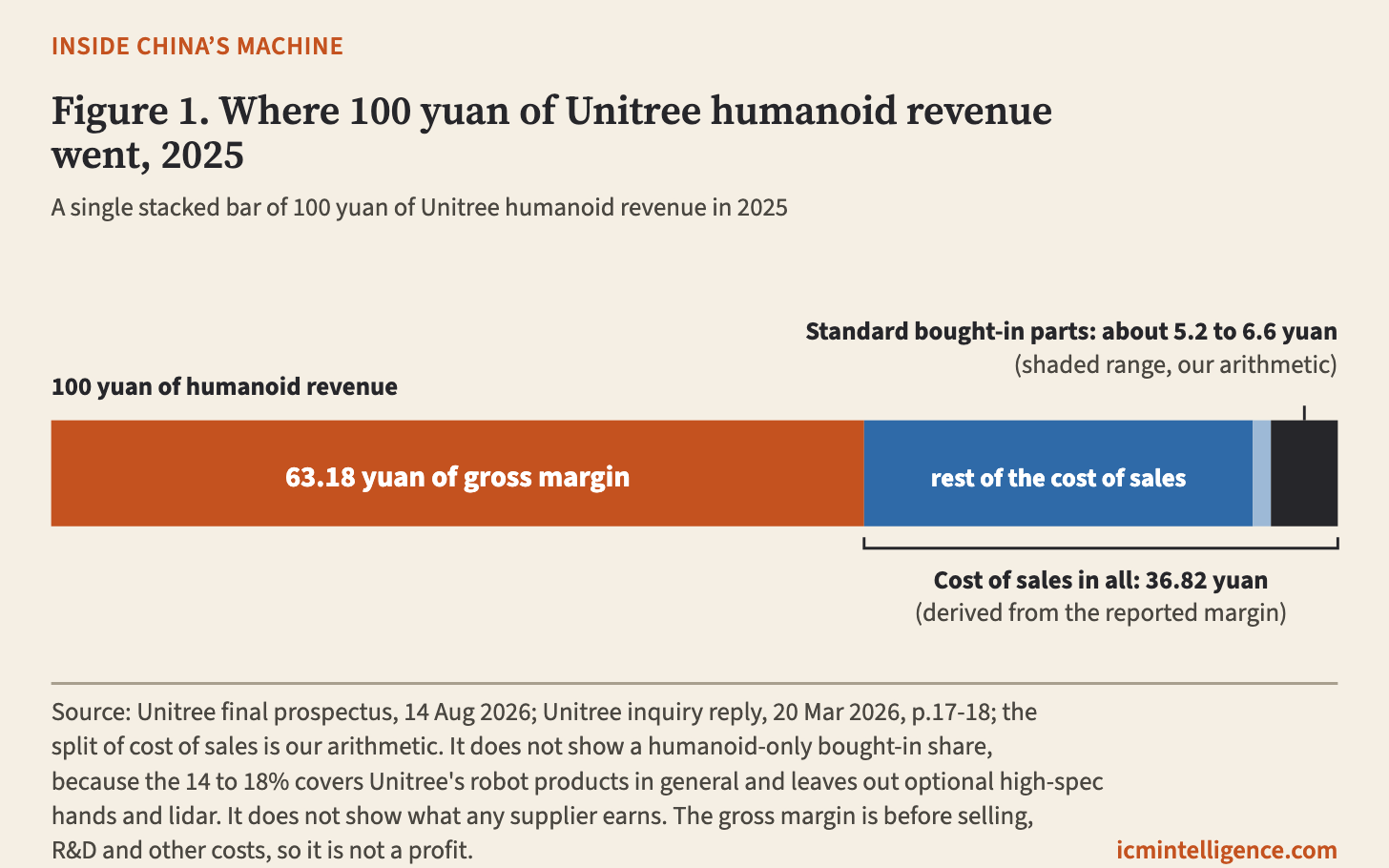
Take 100 yuan that a buyer paid Unitree for a humanoid robot in 2025. The company’s STAR Market prospectus, finalised on 14 August 2026, puts its humanoid revenue for that year at RMB867.83m and the cost of sales on that revenue at RMB319.57m. That is a gross margin of 63.18%. So of the 100 yuan, about 63 stays with Unitree after the cost of making the robot, before its other expenses, and about 37 goes on making the robot. The question for anyone sizing the “humanoid supply chain” is who receives that 37, and whether any of them keeps money on the scale Unitree does.
Unitree answered part of it in a reply to the exchange’s questions on 20 March 2026. It said that, leaving aside a higher-spec lidar or dexterous hand bought from outside, bought-in parts make up about 14% to 18% of total cost. Bought-in here means standard parts it buys off the shelf: battery cells, compute and storage modules, cameras, and, as options, hands and lidar. Apply that range to the 36.82 yuan of cost of sales and you get about 5.2 to 6.6 yuan, call it 5 to 7, of standard parts bought from outside per 100 yuan of humanoid revenue. That is our arithmetic, not a company figure, and it has limits. The 14 to 18% is Unitree’s figure for its robot products in general, not for humanoids alone. It leaves out the optional high-spec hands and lidar. And the prospectus says materials account for a higher share of humanoid costs than of costs for Unitree’s other products. Even so, the gap is large. On one side, 63 yuan of gross margin goes to the company whose name is on the robot. On the other, a few yuan buy the standard parts.
Our judgment is that the margin in a Chinese humanoid today sits with the integrator that designs its joints in-house, not with the parts makers. The other side of the ledger supports it. The four listed parts makers examined here have published 2026 half-year results (three reports and one press release), and only one shows a separate robot revenue line. Ningbo Tuopu reports “robot actuators” as their own product line: RMB14.05m of revenue in the first half of 2026 at a 27.03% gross margin. That is about 0.1% of its main-business revenue, on our arithmetic. None of the four reports humanoid-only revenue or a humanoid-only margin. A gross margin is revenue minus the cost of sales, before selling, R&D and everything else, so it is not net profit. And gross margins at different companies are not like for like. Within those limits, the only sizeable humanoid margin a reader can see in these filings is the integrator’s.
The figure worth tracking is a parts maker’s disclosed robot or humanoid revenue as a share of its sales, and its gross margin on that revenue. Right now, most of the makers examined here do not disclose it.