

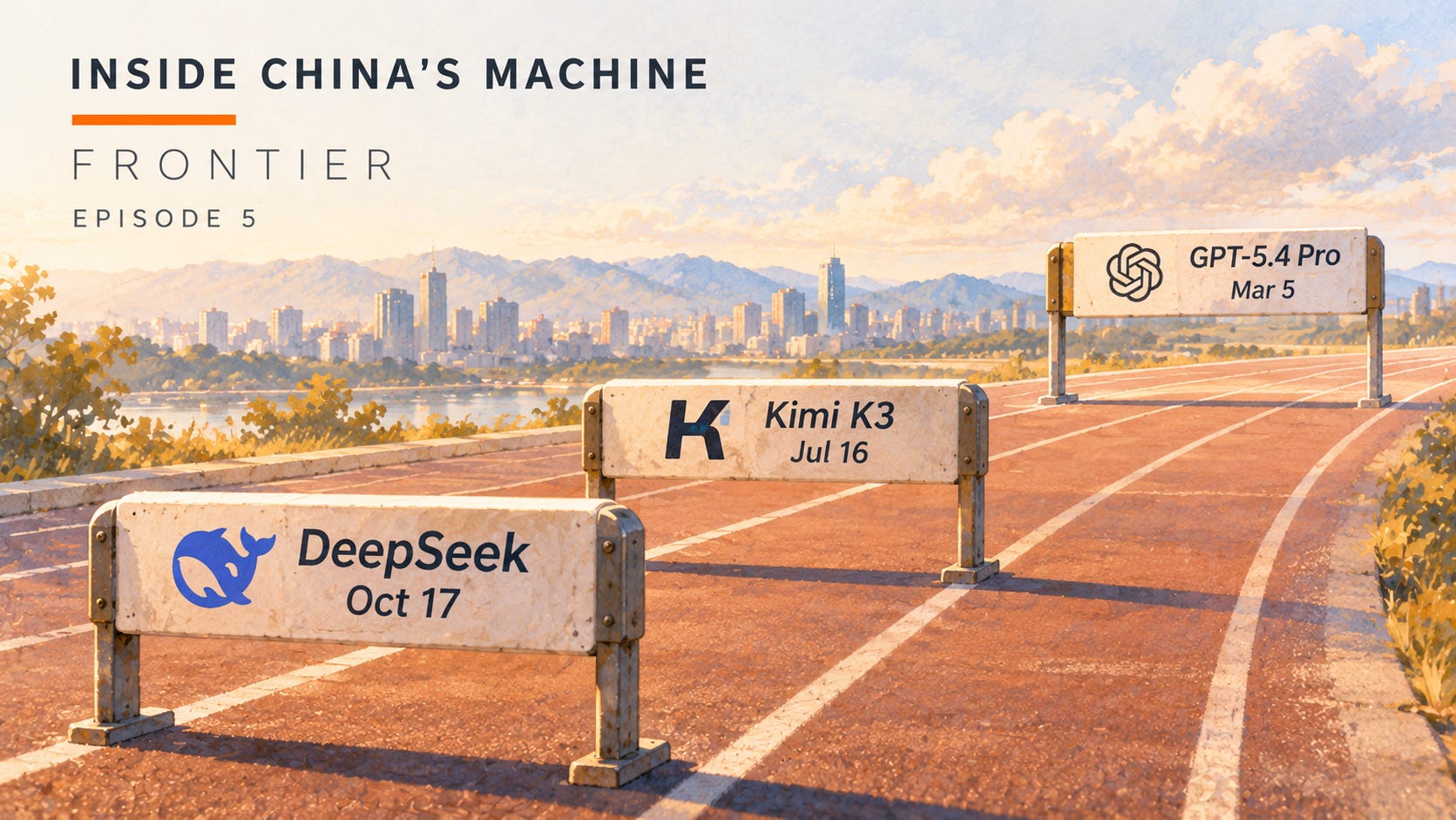
On 16 July, Moonshot released Kimi K3, and for a few weeks China’s best AI model looked closer to America’s frontier than it had in almost a year. A July account of the AI researcher Nathan Lambert’s argument put the gap at roughly three to five months, down from a debated six to nine.
Epoch AI’s capabilities index puts models from every lab on a single scale. In that file, Kimi K3 scores 158.33. On 17 October DeepSeek released V4.1 Flash 1017, which scores 158.83. That is half a point higher, and it makes DeepSeek’s model the best Chinese model in Epoch’s file. By the measure that matters for anyone planning around it, DeepSeek’s model is also further behind.
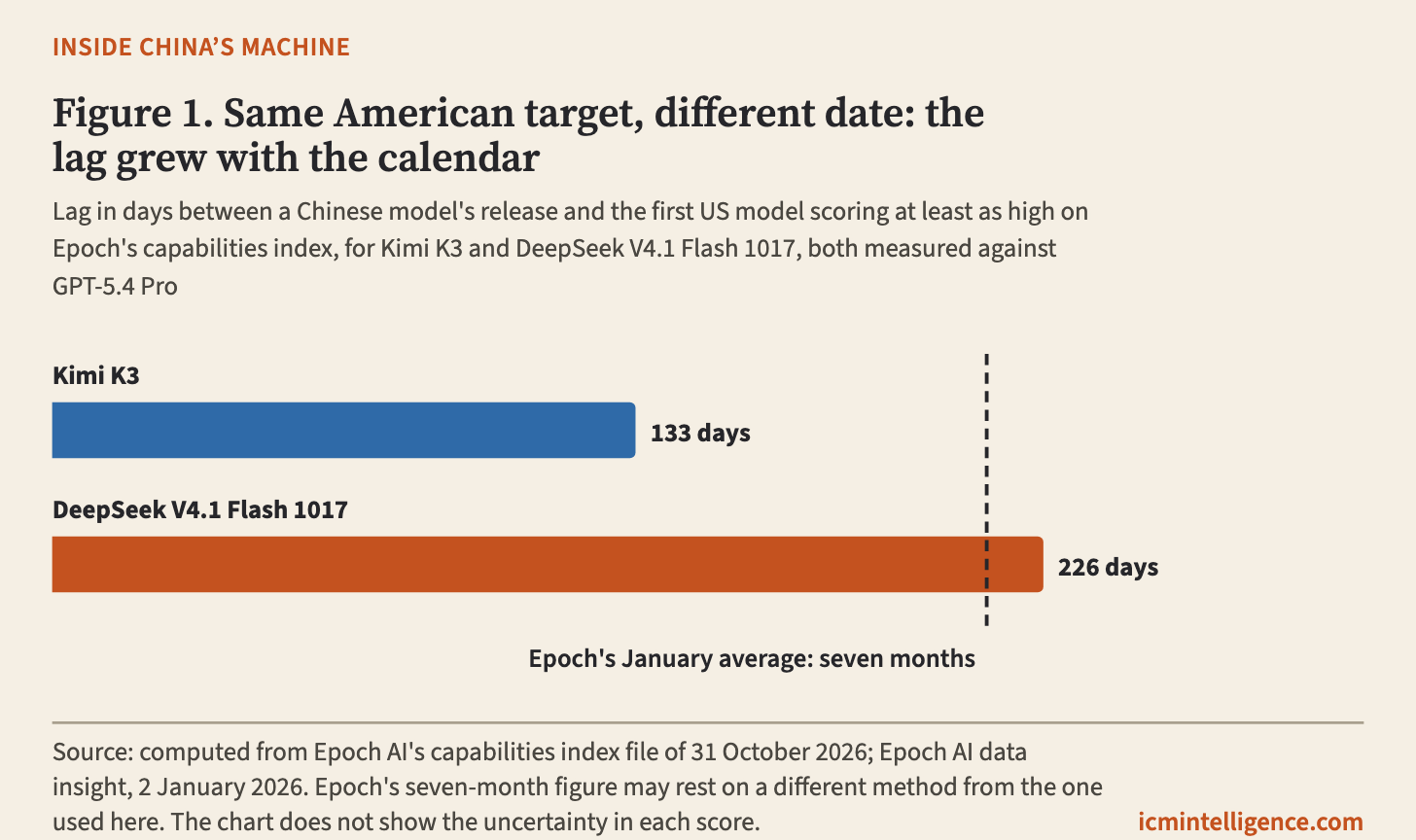
The measure is time. An American model first reached Kimi K3’s score 133 days before Kimi K3 shipped. By the time DeepSeek’s newer, slightly better model shipped, America had already offered that level for 226 days, about seven months. Seven months is also the average Epoch itself reported in January: “Chinese models have trailed US capabilities by an average of seven months, with a minimum gap of four months and a maximum gap of 14.” Kimi K3 caught the gap near its floor. On two Chinese models and five dates, “nearly caught up” describes a moment in July, not a trend.
This matters to anyone whose decision assumes convergence. You might be sizing demand for domestic chips, choosing which models a product will run on, or arguing about whether export controls are working. Each of those decisions needs to know how far behind the top Chinese model sits, and whether that distance is shrinking. On today’s evidence it is not shrinking.
The target did not move
The calculation is simple. Take a Chinese model’s score. Find the first American model that scored at least as high, and count the days between the two releases. For Kimi K3, the first American model above 158.33 was OpenAI’s GPT-5.4 Pro, released on 5 March at 159.81.
For DeepSeek’s October model, the answer is the same GPT-5.4 Pro. The American model being chased did not change. The Chinese score barely changed. Only the release date changed. DeepSeek shipped three months after Kimi, so the lag grew by those three months, 93 days, almost exactly. On a clock, matching last spring’s American level in October puts you further behind than matching it in July. A lab that improves by half a point while the calendar moves a quarter of a year has lost ground.
The March level is still out of reach. No Chinese model in the file has reached 159.81, so on 31 October that score has been American-only for 240 days. Epoch’s 90% interval for DeepSeek’s model runs from 156.71 to 162.20. That band takes in 159.81, so the shortfall from the March level sits inside the margin of error. The gap at the very top does not. The upper end of DeepSeek’s band is below 165.88, the lower end of the interval for GPT-6 Astra, the best American model.
Who shipped last
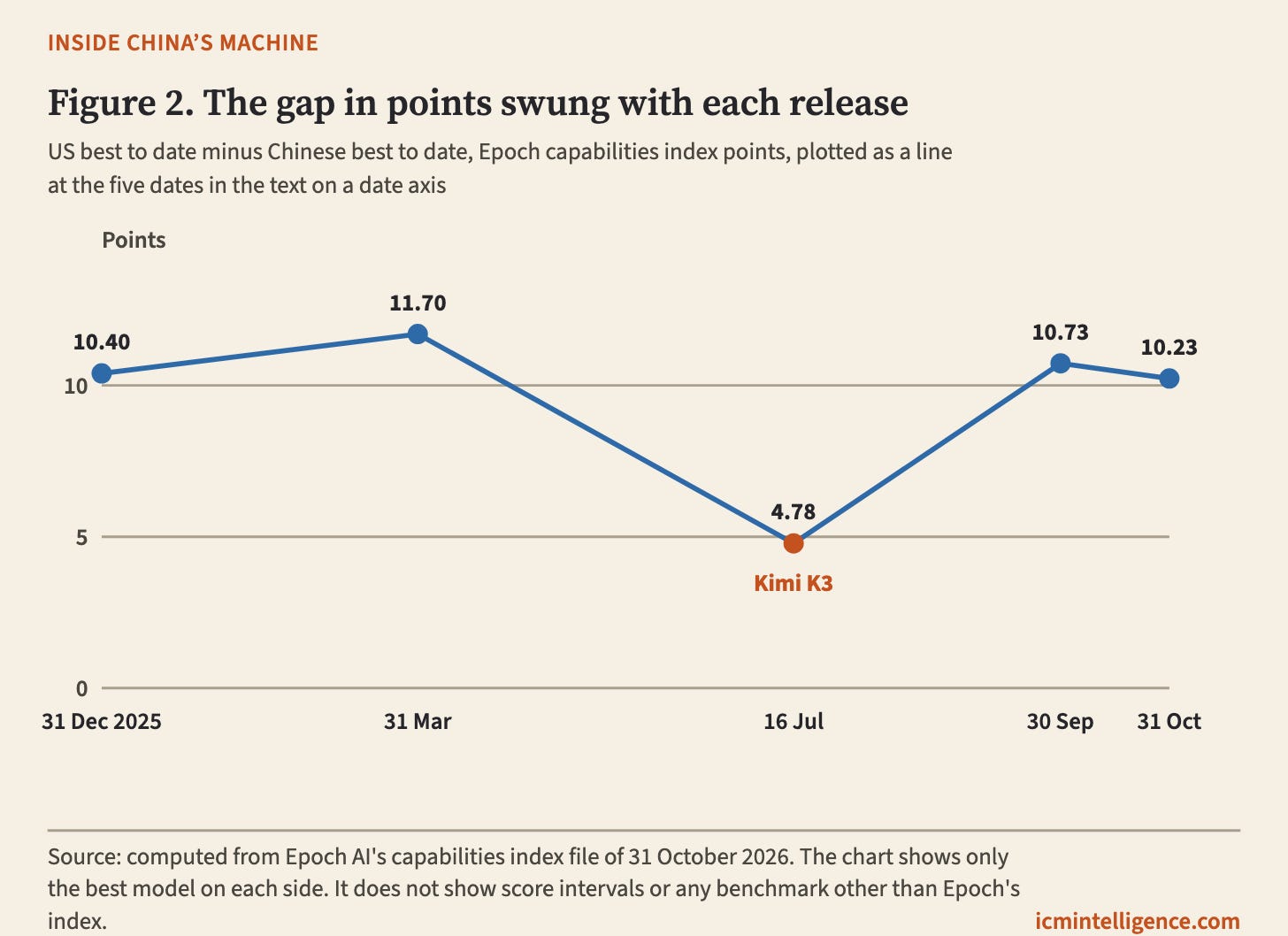
A second measure compares scores rather than dates: at each date, the American best to date minus the Chinese best to date. This points gap tells the same story with more noise. It was 10.40 at the end of December and 11.70 at the end of March. On 16 July, the day Kimi K3 arrived, it was 4.78. By the end of September it was back to 10.73, and on 31 October it stood at 10.23. Ten months after December, the gap is almost exactly where it started.
Each move tracks a release. GPT-5.4 Pro widened the gap in the spring and Kimi K3 narrowed it in July. Then three American models arrived between July and early September, the last of them GPT-6 Astra on 3 September, and lifted the American ceiling from 163.11 to 169.06. Between July and October the Chinese ceiling rose by half a point. July’s narrow gap was real. It was also the moment just after a Chinese release and just before three American ones.
What a seven-month lag sells
If the best Chinese model usually sits behind the American frontier, think about what a Chinese lab offers a buyer who could also use the American model. It is not the top of the capability curve. It is something else: a licence, a price, or availability where American models are not offered. The licences in Epoch’s file already differ in this way. DeepSeek’s October model comes with open weights and no restriction on use. Kimi K3’s weights are open but non-commercial. Alibaba’s Qwen 3.8 Max is available only through its API. The licences show the labs differing on terms; whether that is a strategy is an inference, since the index measures neither pricing power nor sales.
For a forecast, the consequence is narrower and firmer. Some plans assume Chinese models are converging on the frontier. They include revenue models for Chinese labs, valuations that price in parity, and export-control arguments that treat July as proof the controls failed. Leaning on July alone means choosing the single reading most favourable to that assumption. A plan that needs the frontier itself, rather than a model that is good enough on attractive terms, should assume, on this record, a lag of seven months or more, growing by the day until a Chinese model reaches the level America passed in March.
The case for July
The strongest rival reading says the long-run lag is shrinking and July showed where it is heading. On this view, one more Chinese release closes the distance. The evidence that could support it is easy to name. A new Chinese model released now and scoring at least 163.11, the score of OpenAI’s April model GPT-5.5 Pro, would cut the lag to about six months. A model scoring at least 169.06 would close the gap at the top altogether. Neither has appeared in Epoch’s file.
I expect the lag at the top to keep swinging with release timing rather than closing in a straight line. That view would be wrong if Chinese releases began, one after another, to land within a few months of America first reaching the same level, the way Kimi K3 did once.
Both headlines were true. In July China’s best model was about four months behind. In October it is about seven, and the better model is the one further back. Nothing collapsed between the two readings; DeepSeek simply shipped in October rather than July. A claim of parity is a photograph of whoever shipped last.
Sources
Epoch AI, Epoch Capabilities Index scores (eci_scores.csv; latest model date 2026-10-26), https://epoch.ai/data/eci_scores.csv, captured 2026-10-31 and re-pulled 2026-11-04 (byte-identical). Every score, interval, release date and licence group used here; the day lags and the points gaps are computed from it.
Epoch AI, “US vs China ECI” data insight (2 January 2026), https://epoch.ai/data-insights/us-vs-china-eci, captured 2026-11-04. The January average of seven months, with a minimum of four and a maximum of 14.
AI Weekly, “Moonshot’s Kimi K3 Compresses Open-Weight Gap to 3-5 Months” (published 21 July 2026), https://aiweekly.co/alerts/moonshots-kimi-k3-compresses-open-weight-gap-to-3-5-months, captured 2026-11-04. A secondhand summary of Nathan Lambert’s argument.
Epoch AI, ECI public code and documentation (eci-public README), https://github.com/epoch-research/eci-public, captured 2026-11-04. The interval columns of the scores file are 90% intervals (the 5th and 95th percentiles).
Inside China’s Machine · Frontier, Episode 5
Disclaimer: This article is for informational and educational purposes only. It is not investment, financial, legal or tax advice, and it is not a recommendation or solicitation to buy or sell any security. Do your own research, and consult a licensed professional before making investment decisions.