

Estun’s half-year report for 2026 makes two statements that sit awkwardly together. It says Estun ranked first by shipments among all brands in China’s industrial-robot market, for the sixth quarter running. And it shows Estun’s revenue in China falling 8.82%, to RMB 1,641.0m, in a market whose unit sales grew 15.8%.
My view is that winning the volume in China’s industrial robots has not yet turned into money for China’s makers. This is a judgment about the industry, not a verdict on one company, and not a forecast. Its basis is in three numbers. Domestic brands held 58% of the 189,000 industrial robots sold in China in the half-year, about 110,000 units. Estun, the leader among them, reported net profit to the parent excluding non-recurring items equal to 2.72 yuan per 100 yuan of sales. And Fanuc, the Japanese maker, reported that its robot division’s sales to China in the April to June quarter rose 21.1% in yen on the same quarter a year earlier.
Share is the number everyone quotes, and it is a count of robots. What a maker keeps from each one decides who can fund the next generation of products and who cannot.
More robots in the market, less revenue at home
Start with Estun’s revenue. The half-year total was RMB 2,577.5m, up 1.14% from RMB 2,548.6m. Underneath that flat line, two things moved in opposite directions. Domestic revenue fell RMB 158.8m. Overseas revenue rose RMB 187.7m, up 25.06% to RMB 936.5m. The two add up to the RMB 28.9m by which the total rose.
So the market grew by about a sixth in units, domestic brands took 58% of it, and the domestic leader’s revenue at home shrank. Estun’s revenue covers the whole company, not robots alone, and its report gives no robot-only line or unit growth of its own. And part of the fall was chosen: Estun says it reduced low-gross-margin business in an orderly way, and the transfer of a controlled subsidiary also lowered domestic revenue. Its first place by shipments, as counted by MIR, the market-data source both Estun and Inovance cite, is not in doubt.
When a leader’s best use of its position is to sell less of some business at home, the unit count has stopped telling you what the business earns.
A foreign maker in the same market
Fanuc is the contrast, with a different calendar and a different currency. In the three months to 30 June 2026, its robot division’s sales to China rose 21.1% in yen on the same three months of 2025, to about ¥26.6bn from about ¥21.9bn. China was 27.7% of the division’s sales. The yen was weaker, ¥159.49 to the dollar against ¥144.59 a year before, so converted at those rates the rise is about 9.8% in dollars. The rate depends on the currency; the direction does not. Fanuc’s report puts steady growth in the Americas and China behind the higher sales.
Figure 1 sets the pieces side by side. They are not one measure, and the periods differ, so read it for direction, not as a league table.
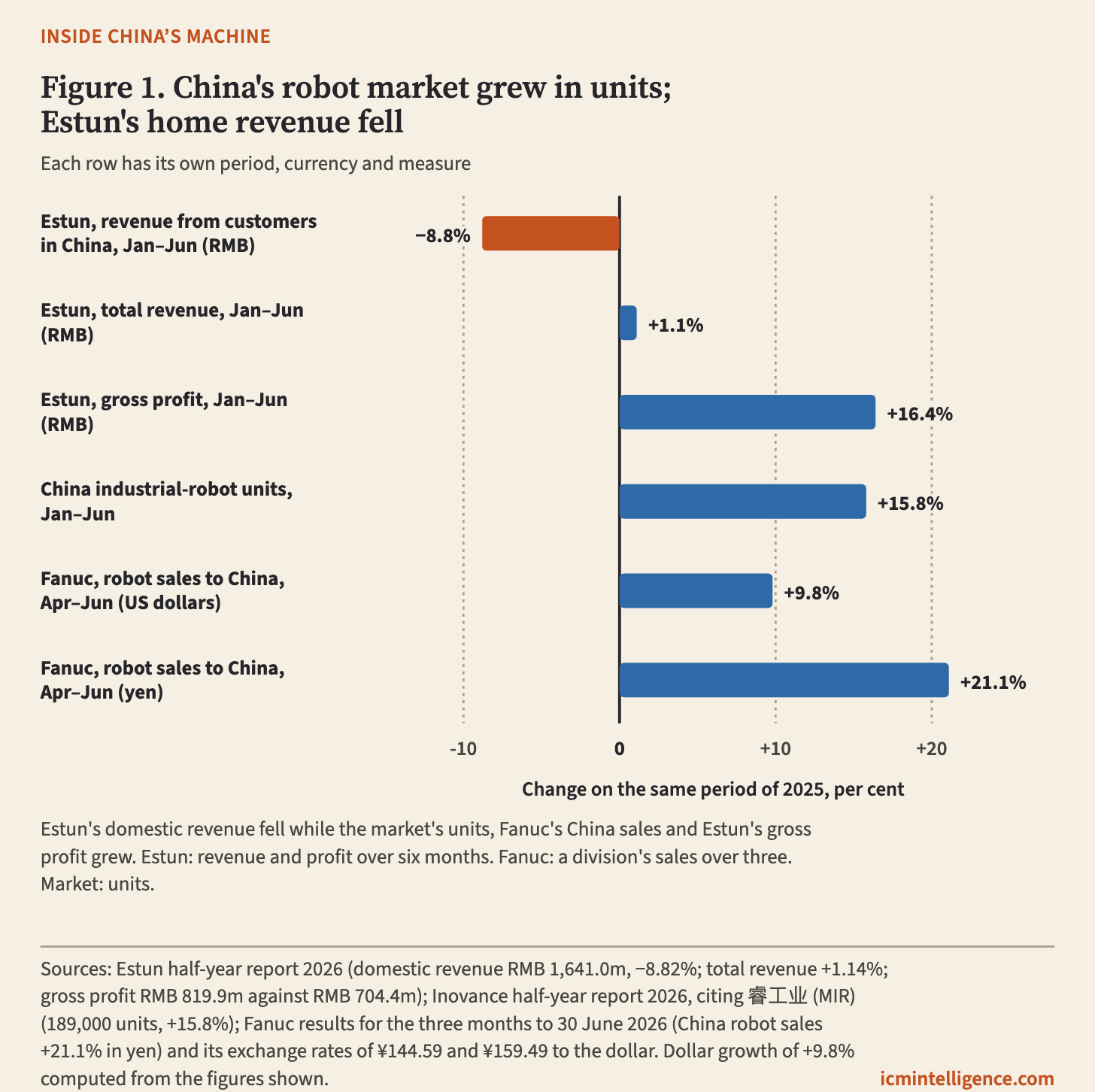
Sources: Estun half-year report 2026 (domestic revenue RMB 1,641.0m, −8.82%; total revenue +1.14%; gross profit RMB 819.9m against RMB 704.4m); Inovance half-year report 2026, citing 睿工业 (MIR) (189,000 units, +15.8%); Fanuc results for the three months to 30 June 2026 (China robot sales +21.1% in yen) and its exchange rates of ¥144.59 and ¥159.49 to the dollar. Dollar growth of +9.8% computed from the figures shown.
Inovance, the other large domestic name, cannot be added to this table. It holds 9.2% of China’s industrial-robot shipments, third overall and second among domestic makers, but its report folds robots into one “emerging industry” line with energy storage: revenue RMB 1,467.1m, up 96.29%, at a gross margin of 28.38%, down 5.40 points as low-margin storage grew. Its robot margin is not published. It does describe the industry as one where competition is intensifying and profits are under pressure.
What 31.81% became
The strongest evidence against my view is Estun’s gross margin, which rose 4.17 points to 31.81%. At home it rose 7.04 points to 31.49%, because domestic cost of sales fell 17.32% while domestic revenue fell 8.82%. Gross profit was RMB 819.9m against RMB 704.4m, up 16.4% on revenue up 1.1%, and domestic gross profit rose by about the same proportion, to roughly RMB 517m. Estun booked less revenue at home and made more gross profit from it. If that margin holds while domestic revenue returns to growth, the view is wrong.
But gross profit is the start of the bill. Of every 100 yuan of sales, Estun keeps 31.8 as gross profit. Selling costs take 7.8, administration 8.0, R&D 8.5, finance costs 2.9 and taxes and surcharges 0.5. Together those five lines come to RMB 715.0m, 87.2% of gross profit, and leave about 4.1 yuan before impairments, other income, the fair-value gain and income tax.
The profit lines show where that ends up. Net profit to the parent was RMB 161.3m, up 2,314%. But RMB 99.5m of the company’s pre-tax profit, 50.69% of it, was a fair-value gain that the report says is not sustainable. It arose when Estun’s stake in Nanjing Gongyi was swapped for shares of listed Nanjing Chemical Fibre, not from selling robots. Net profit to the parent excluding non-recurring items was RMB 70.2m, up 498.64%: 2.72 yuan per 100 of sales, 8.6% of gross profit. It is a real improvement. It is also a small one.
What the share headline leaves out
“Domestic brands hold 58%” is a share of units. It does not say what the makers earn, whether the growth is theirs, or whether it was paid for in margin given up elsewhere. In this half-year it sits beside a leader whose home revenue fell, a foreign rival whose China sales rose, and a second domestic name whose robot margin is hidden inside an energy-storage line.
Four things in the next half-year’s reports will say whether the view holds. Whether Estun’s domestic revenue moves with the market’s units, or keeps moving the other way. Whether its net profit to the parent excluding non-recurring items grows past 2.72% of revenue. Whether Fanuc’s China robot sales keep rising in both yen and dollars. And whether Inovance, or anyone else, publishes a robot margin by itself.
Share counts robots. Survival counts what is left after the bill. China’s makers have the first; the evidence for the second is still thin.
Sources
Nanjing Estun Automation Co., Ltd., 2026 half-year report (cninfo), read 2026-10-22: http://static.cninfo.com.cn/finalpage/2026-08-22/1225490661.PDF. Revenue by region, cost of sales and gross margin, profit excluding non-recurring items, the fair-value gain, the company’s account of the fall in domestic revenue, and its first place by shipments (citing MIR DATA BANK).
Shenzhen Inovance Technology Co., Ltd., 2026 half-year report (cninfo), read 2026-10-22: http://static.cninfo.com.cn/finalpage/2026-08-29/1225524610.PDF. China industrial-robot units and domestic share (citing 睿工业, MIR), its own share, and the “emerging industry” segment.
FANUC Corporation, Financial Results for the Three Months Ended June 30, 2026 (presentation of 31 July 2026), read 2026-10-22: https://www.fanuc.co.jp/en/ir/announce/pdf/2026/reference202606_e.pdf. Robot division sales to China, the division’s regional share and the exchange rates.
Inside China’s Machine · Frontier, Episode 3
Disclaimer: This article is for informational and educational purposes only. It is not investment, financial, legal or tax advice, and it is not a recommendation or solicitation to buy or sell any security. Do your own research, and consult a licensed professional before making investment decisions.