

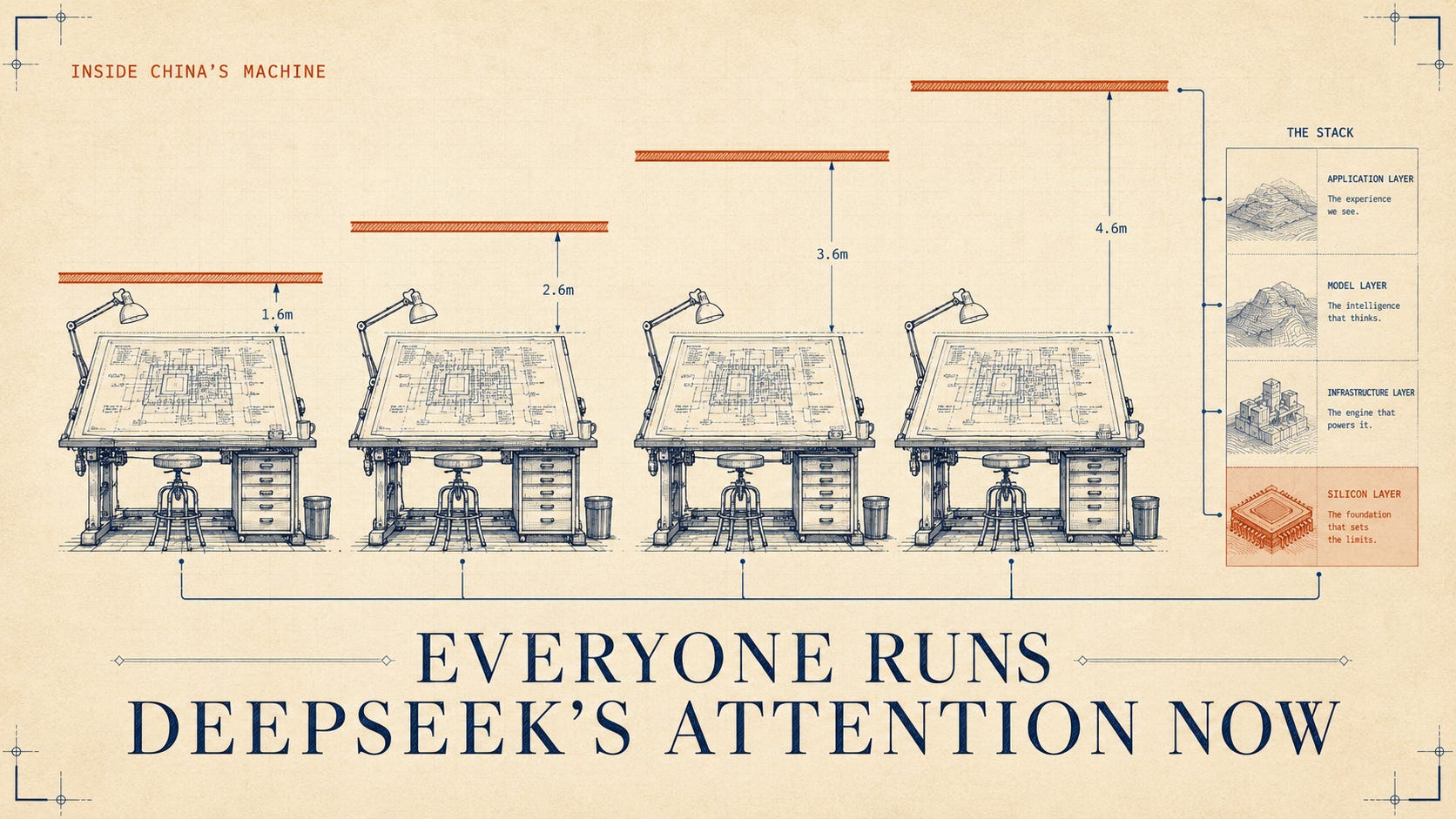
1. Zhipu’s Flagship Runs on DeepSeek’s Attention
Open the GLM-5 technical report and read the first technical contribution the authors list. It says they adopt DSA. Next to DSA is a citation number, and the citation points to DeepSeek.
One of China’s strongest open-weight models runs its core efficiency mechanism on something its largest rival open-sourced three and a half months earlier. DeepSeek released DeepSeek Sparse Attention on 29 September 2025, as the only architectural change in its V3.2 model. Zhipu released GLM-5 on 11 February 2026, and its own paper describes the model as adopting that same mechanism, by name, with the reference attached. The GitHub repository says it plainly: GLM-5 integrates DeepSeek Sparse Attention.
This is not plagiarism. It is an open-source ecosystem working exactly as designed, and DeepSeek published DSA under a permissive licence precisely so that others would use it. But it raises a question that the benchmark tables do not answer. If the efficiency advantage under your flagship model is one your competitor handed you for free, in what sense is it your advantage?
That question is the whole piece, and by the end it will have moved the moat from the model layer down to the silicon.
2. What DSA Is, and Why It Was Worth Copying
Attention is the operation that makes a language model expensive to run. For every new token, the model compares that token against every token already in the context, so a sequence of length L costs on the order of L squared. Double the context and you quadruple the work. On a long document this is where the compute and the memory traffic go.
DSA breaks the quadratic. It adds a small, fast component that DeepSeek calls a lightning indexer, which runs ahead of the expensive attention step and scores which earlier tokens actually matter for the current one. The model then computes full attention over only the top few thousand selected tokens rather than the entire context. The cost falls from quadratic in the sequence length to roughly linear. DeepSeek’s report gives the mechanism as an indexer plus fine-grained token selection, taking attention from order L squared to order L times k, where k is the small number of tokens kept.
Here is why it matters for everything this publication has argued about silicon. The tokens a model attends to are the tokens it must stream out of memory during decode, the answer-writing phase that the ninth issue established is bound by memory bandwidth rather than compute. Cut the number of tokens attended to, and you cut the data moved per output token. GLM-5’s report puts the saving at 1.5 to 2 times on long sequences. That is a memory problem being solved in software.
And it is the same memory bottleneck the ninth issue traced to Huawei’s roadmap. Huawei’s fix is hardware: the 950DT, with wider memory, arriving in Q4. DSA is the software fix, and it is available now. It does not wait for a fab. It moves less data per token, on the silicon you already have.
3. It Took Four and a Half Months to Become Everyone’s
DeepSeek published DSA on 29 September 2025, with a paper, open weights, and an MIT licence. Zhipu shipped it inside GLM-5 on 11 February 2026. Four and a half months from one company’s research result to the efficiency core of a rival’s flagship.
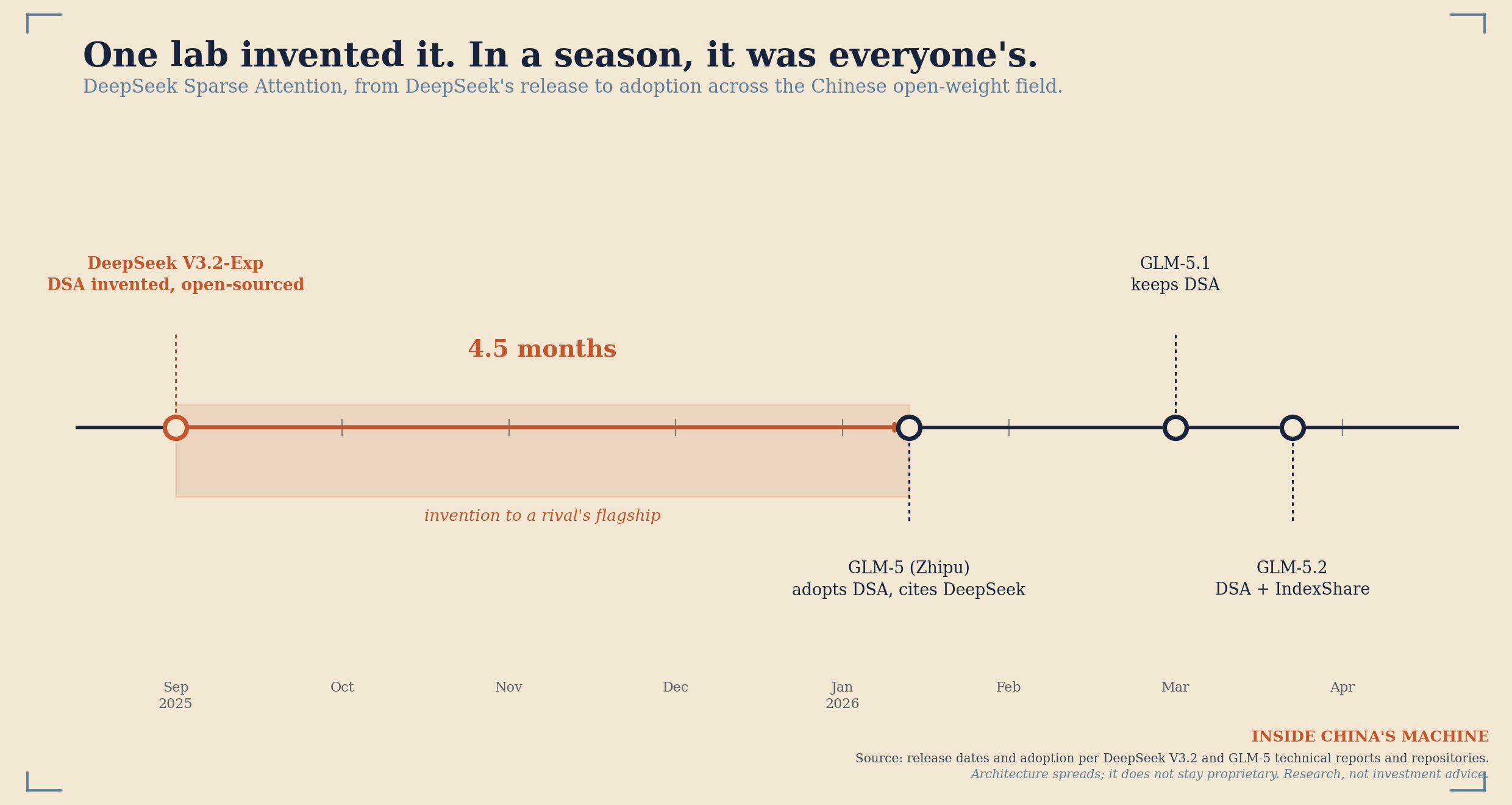
And the adoption is explicit rather than reinvented. GLM-5’s technical report does not describe an independently discovered mechanism that happens to resemble DSA. It names DeepSeek Sparse Attention and cites the DeepSeek paper, the way you cite a dependency you have imported. Zhipu’s subsequent releases keep it: GLM-5.1 carries DSA forward, and GLM-5.2 adds a refinement on top of it called IndexShare that reuses the indexer across layers, which is an optimisation of DSA, not a replacement for it. MiniMax and Qwen have moved along the same sparse-attention path.
So within one release cycle, a single company’s architectural advance became the shared default of the Chinese open-weight field. This is what open source does, and it does it fast.
A thing that becomes everyone’s in four and a half months is not a moat. It is public infrastructure. The company that invented it gets a few months of lead and a citation. It does not get a durable cost advantage, because the mechanism that produced the advantage is now running inside every competitor that wanted it.
4. The Precision Is Not Free
Sparse attention has a cost, and the balance of this piece depends on naming it.
When a model keeps only the top few thousand tokens and discards the rest of the context from each attention step, it is making a bet that the discarded tokens did not matter. Usually that bet is fine. Sometimes it is not, and the model loses information it would have used. DeepSeek’s own ablations on V3.2 show a mixed picture against the dense baseline: performance holds on most tasks, improves on some, and regresses on a few. Zhipu reports a related difficulty from the memory-compression side, that its latent-attention variant initially underperformed standard grouped-query attention until an optimisation it calls Muon Split closed the gap.
The point is not that DSA is flawed. It is widely adopted because it works. The point is that architectural efficiency runs into a floor. You cannot compress the KV cache to nothing, and you cannot drop attention to no tokens at all without the model getting worse. There is a limit to how much data movement software can remove, and once a design is near that limit, the only way to serve tokens more cheaply is better silicon underneath.
5. If Everyone Has the Architecture, Where Does the Margin Come From
Follow the logic to its end. If DeepSeek, Zhipu, MiniMax and Qwen are all running the same sparse-attention mechanism, then at the architecture level their per-token cost structures are converging. The efficiency that DSA delivers is available to all of them, on the same terms.
A cost advantage cannot come from a thing everyone has. So if these companies earn different margins on inference, and the eighth issue showed they earn very different margins, the difference has to come from somewhere the architecture is not.
There are two places left, and both are silicon.
The first is how deeply a company’s model is fitted to its chips. The same DSA mechanism does not yield the same throughput on every accelerator. It has to be compiled, quantised and scheduled onto the specific hardware, and the quality of that model-silicon integration decides how many tokens per second actually come out. Running a model at low precision without losing accuracy, fusing the attention kernels to the memory system, keeping the accelerator fed: this work is worth real points of gross margin, and it does not transfer with the open-source weights.
The second is which silicon a company can get at all. Better memory bandwidth, a newer process, more of it. That is the ceiling the sixth and ninth issues described, and it is set in fabs and export-control offices, not in model architecture.
Architecture pulled everyone up to the same line. Then the gap reopened on silicon. The moat did not disappear when DSA became universal. It moved down a layer, from the model to the chip, where it is harder to copy because you cannot fork a fab.
6. Re-diagnosing Zhipu’s 18.9 Percent
The eighth issue of this publication found Zhipu earning an 18.9 percent gross margin on its cloud and API line, the figure it reported as roughly 19 percent, against far higher margins elsewhere, and could not fully explain the number from the income statement alone. The ninth issue traced part of it to silicon: Zhipu runs on domestic accelerators whose memory bandwidth caps its decode throughput, and the chip that would lift that cap does not ship until Q4. That issue left one thread deliberately loose. It said the ceiling is set by the silicon, but the distance to the ceiling is set by engineering, and that distance is the part Zhipu still owns.
This piece closes that thread, and the answer is not the one the loose end implied.
The tempting story was that Zhipu earns less because it did less of the architectural work, that DeepSeek compressed its memory traffic and Zhipu did not. That story is false. Zhipu runs DSA. It adopted DeepSeek’s mechanism in GLM-5 and carried it through every release since. On sparse attention, the thing that determines how much data decode moves per token, Zhipu and DeepSeek are running the same design. The architectural distance between them, on what matters most for inference cost, is close to zero.
So the 18.9 percent is not a verdict on Zhipu’s architecture, because its architecture is DeepSeek’s architecture, and DeepSeek’s is available to everyone. Once the model layer converges, the margin stops being a statement about the model. It becomes an almost pure reading of something underneath it: how well Zhipu’s identical-on-paper model is fitted to the domestic silicon it is required to run on, and how good that silicon is.
That is the sense in which the distance Zhipu owns is real but small, and shrinking. It does not own an architectural edge, because there is no architectural edge left to own. What it owns is the integration work between a model everyone has and a chip it did not choose. That is a narrower thing to compete on than a better model, and it is silicon work, not model work.
7. The Strongest Objection: Does Open Diffusion Erase the Silicon Gap
Here is the case against this entire thesis, stated at full strength, because it is a good one.
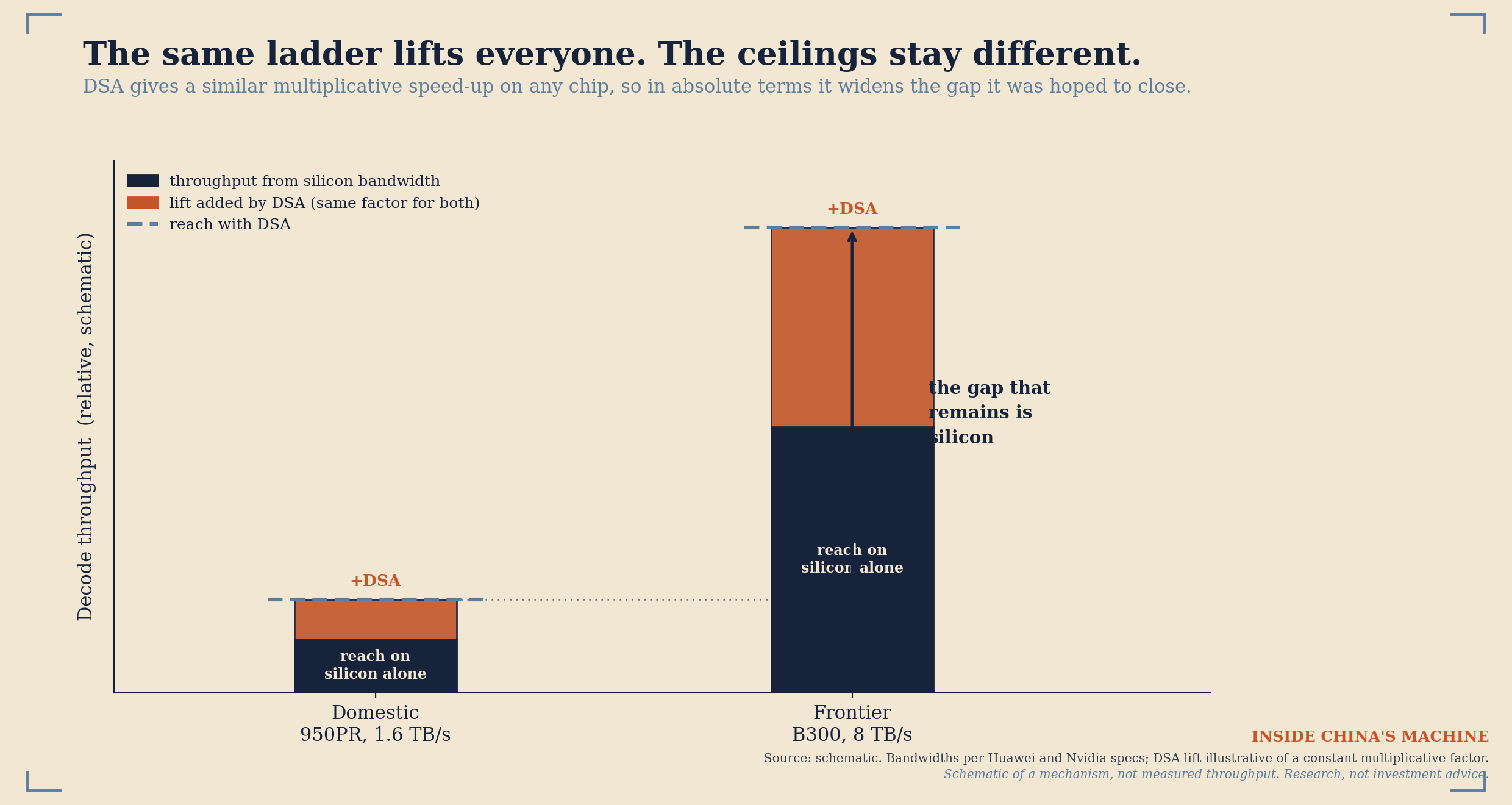
If DSA lets every model move half as much data per token, then it helps the memory-constrained domestic chips most. A company running GLM-5 on a 1.6-terabyte-per-second Ascend 950PR, cutting its memory traffic in half with sparse attention, might reach the throughput that a competitor gets from twice the raw bandwidth without sparse attention. On this reading, open-source architecture is not a sideshow to the silicon story. It is precisely how China routes around the export controls: if you cannot buy the memory bandwidth, you open-source the software that halves your need for it. Diffusion is not eroding the moat. It is China’s answer to not having one.
That objection is partly right, and it matters. DSA genuinely does relieve the domestic bandwidth constraint, and the fact that it spread across the Chinese field in a single release cycle is a real strategic asset that a closed ecosystem would not have.
But the relief is not exclusive, and that is where the objection fails. Attention is symmetric. DeepSeek open-sourced DSA to the entire world, not to China alone. The same mechanism that halves memory traffic on an Ascend 950PR halves it on a B300, and the B300’s memory bandwidth was about five times higher to begin with, so the tokens-per-second a frontier operator gains from adding DSA is larger, not smaller. Software that helps everyone helps the operator with the better silicon at least as much. DSA lifted the whole field, including the part of the field that was already ahead. It shortened China’s distance to the ceiling. It did not raise China’s ceiling, because the ceiling is bandwidth, the bandwidth is silicon, and the fast silicon still ships in Q4 to one side and is already shipping to the other.
8. The Moat Went Down a Layer
Step back to the machine, because this is where the three issues close.
The sixth issue argued that China’s compute ceiling is a memory ceiling, not a logic one. The eighth found that ceiling resting on a model company’s gross margin, on Zhipu’s 18.9 percent. The ninth showed Huawei splitting a chip in two along the memory seam, with the half that lifts the ceiling scheduled for Q4. This issue adds the last turn: software can help you reach the ceiling faster, but it cannot raise it, and the software that helps is shared, so it does not separate you from anyone.
The forward marker is the diffusion clock itself. Watch the next architectural advance after DSA, whatever compresses memory traffic further, and time how long it takes to appear across the open-weight field. If the answer is again a few months, then architecture as a non-moat is not an observation about one mechanism, it is a standing property of an open-source ecosystem, and every efficiency story in Chinese AI should be read as temporary by default. If some lab instead holds a real architectural advance closed for a year and no one can reproduce it, this thesis needs revising, and I will say so.
A model company’s margin is not set inside its model, and now we can say why with the last piece in place. It is not set there because the model is not where the difference is. Everyone downloaded the same attention. What is left to compete on is the fit between a shared model and an unshared chip, and the quality of the chip, and both of those are silicon. DeepSeek open-sourced the ladder to the ceiling, so everyone has the ladder. The ladder is not the moat. The height of the ceiling is, and it is written on a fab’s roadmap, not in a model’s weights.
Inside China’s Machine is research, not investment advice. Nothing here is a recommendation to buy or sell any security.