

Inside China’s Machine · ICM Frontier, Episode 1
On 9 August 2026, Qwen put a model on Hugging Face, the site where labs post models for download, with no licence file. Its model card says: “For the first time, Qwen3.8 brings a Qwen-Max-class model to open release.” Three days later, on 12 August, Qwen added the licence. Any company that sells access to the model, usually through an API, and whose group revenue passes US$50 million over any twelve months, must first get a separate licence from Qwen. The count is the revenue of the company and its affiliates, not what the model earns.
Moonshot’s Kimi K3 draws a line of the same kind at US$20 million. Z.AI’s GLM-5.3 draws it at US$10 billion, 500 times Moonshot’s.
Why would Chinese labs let anyone download their models and still keep a say over who sells them? Was giving the weights away a strategy the labs chose, or something the market forced on them? The question matters to a company that wants to sell these models: how much say a lab keeps over who sells them, and which sellers have to ask.
The files show what each lab kept: at the top of their range, Moonshot, Qwen and Z.AI publish the weights and keep the decision over whether a seller above a revenue line may sell, and the terms differ by lab and by release. Each licence draws a line, and the line shows which sellers the lab wants to hear from first.
Picture the one who has to ask: a cloud company of Kingsoft Cloud’s size (US$1.37 billion of revenue in 2025) that wants to sell access to Kimi K3. It is over Moonshot’s line and Qwen’s, and under Z.AI’s. And Moonshot’s clause and Z.AI’s turn out to be the same sentence with two edits.
What the cloud must do first
Moonshot’s clause targets a business it calls Model as a Service: giving a third party access to a model’s inference or fine-tuning, say through an API, with meaningful control over inputs, parameters or training data. Relaying requests to a model someone else hosts is outside it. A cloud that sells customers the model through an API is inside.
Now take a retailer that does not exist. Its engineers download Kimi K3 and build it into a feature its customers see, an advice box on the shop pages. Elsewhere in the same group, a separate company sells an inference API on other labs’ models. It has nothing to do with K3.
Read the clause against that group. It applies when the licensee or any of its affiliates runs a Model as a Service business, and it does not say that business has to serve Kimi K3. The sister company’s API business is such a business, and its revenue counts toward the group’s. Once the group’s revenue passes US$20 million over any twelve months, the retailer must enter into a separate agreement with Moonshot before using K3 for any commercial purpose.
The retailer might reach for the exemption for internal use, which covers use that gives no third party the software, its outputs or its capabilities. An advice box that answers customers hands them K3’s outputs. That is not internal use, and the exemption does not cover it. So a company that sells no access to anything stands in front of Moonshot because of what its sister company sells.
GLM-5.3 has the same affiliate trigger and the same revenue base, and its file has no internal-use exemption.
Back to the cloud company. Above US$20 million of group revenue, the licence requires a separate agreement with Moonshot before any commercial use. Any twelve months can qualify, so a year of Kingsoft Cloud’s US$1.37 billion counts. That is 68 times Moonshot’s line and 27 times Qwen’s, so the same cloud also needs a separate licence from Qwen. Under GLM-5.3 it is below the line, and Z.AI’s clause does not reach it.
Same sentence, two edits
Put Z.AI’s clause for the same business beside Moonshot’s. Of Kimi K3’s 132 words, 122 appear in GLM-5.3’s, in the same order. Two places differ.
The first is the line: US$20 million against US$10 billion, 500 times apart. The second is what a seller above the line must do. Moonshot’s seller must “enter into a separate agreement with Moonshot AI”. Z.AI’s must “pass Z.AI’s security review”, and Z.AI sets the scope and method of that review. Qwen’s line is 2.5 times Moonshot’s, and its remedy is a separate licence from Qwen.
So the widest gap among the three licences sits in a clause whose wording is otherwise shared.
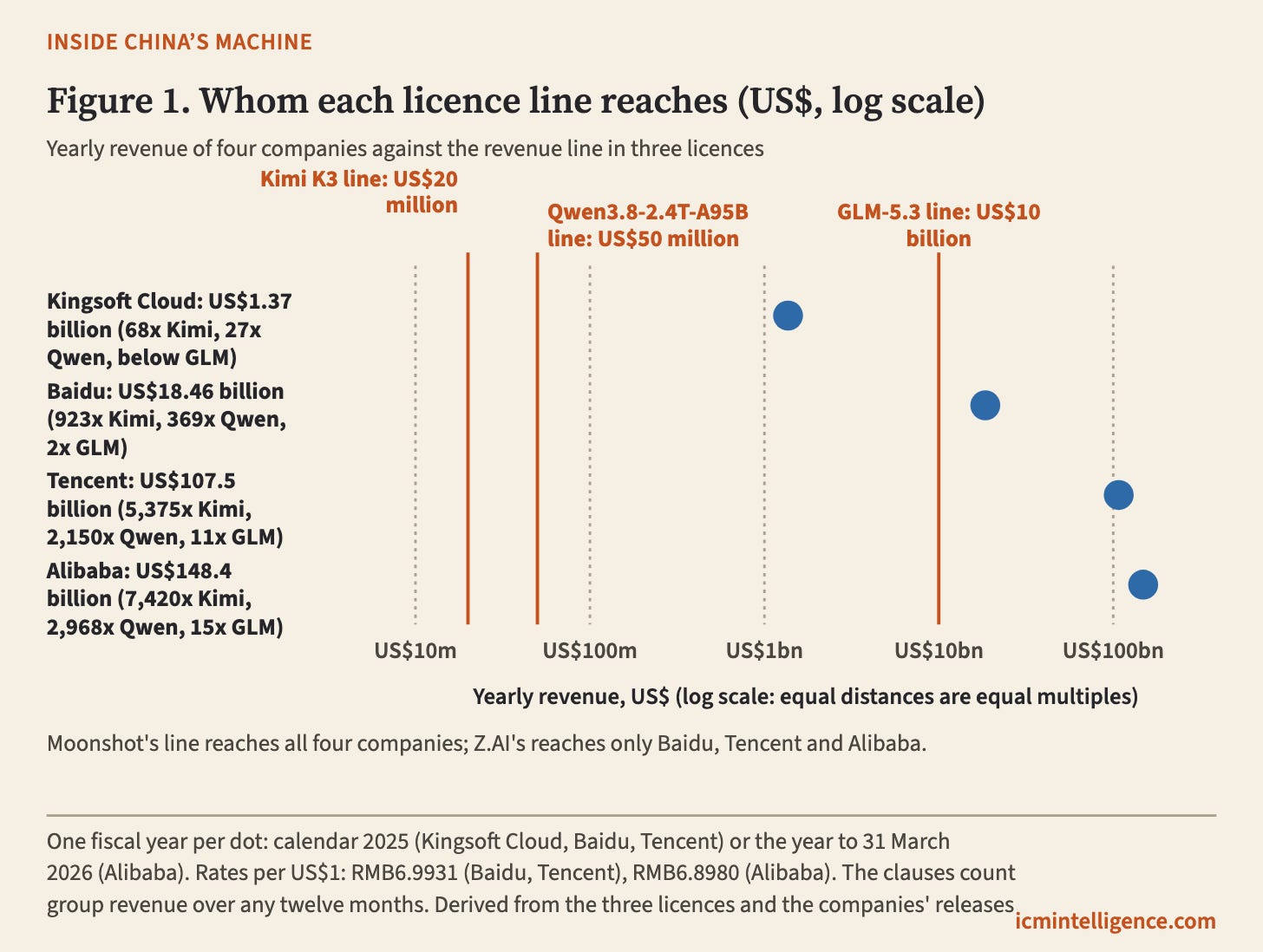
Moonshot’s line reaches every company on the chart, and Z.AI’s reaches only the three largest.
What each lab keeps
Each lab leaves a different way past its line.
Besides internal use, Kimi K3’s licence exempts any use accessed through Moonshot’s official products or certified inference partners. For a seller above the line, the way past the agreement runs through Moonshot’s own channel.
Qwen’s model card sends anyone who wants managed inference to the official Qwen API service from Qwen Cloud. Alibaba’s own results describe a platform, Model Studio, that offers Qwen models to users from individual developers to large enterprises. A seller above Qwen’s line asks permission of a lab whose own cloud sells the same service.
Qwen’s line also reaches products that are not APIs. A company above US$50 million of group revenue that runs an independent coding or office product of the kind the licence calls an AI Work Assistant needs a separate Qwen licence before commercial use, even if it hosts the model for nobody. Internal use is exempt. The category is an independent AI product made mainly for coding or office productivity, with Qoder and QwenWork as the licence’s examples. Caixin reports that Alibaba created QwenWork. The category excludes an assistant made mainly for another domain, and the licence’s example of that is Taobao’s shopping assistant. Taobao sits in Alibaba’s China e-commerce group.
GLM-5.3’s licence file names no exemption for Z.AI’s own products or partners. For a seller above Z.AI’s line, the file offers the review and nothing else.
Strategy, or forced?
The strategy case says a lab gives the weights away because it earns elsewhere. Alibaba’s chairman put it most plainly. At the World Government Summit 2026, as Alibaba’s site reported on 6 February, Joe Tsai said: “Our Qwen model is open source, but we also run our cloud business”. Alibaba earns, he said, because people train, develop and run inference for their models on its infrastructure. Kyle Chan of the Brookings Institution says the same of Moonshot in Scientific American (23 July 2026): it can keep selling access through its API and subscription products even after other companies host K3.
The forced case says the lab had no choice, and Moonshot supplies its sharpest evidence. Scientific American reported that three days after Moonshot unveiled Kimi K3 on 17 July, it stopped accepting new subscriptions because demand had overwhelmed its computing capacity, and that Moonshot said it planned to release the full weights by 27 July. The first commit is dated 27 July. Chan gives the general mechanism: US export controls do not fully explain Chinese developers’ embrace of open weights, but limited compute makes the strategy more attractive, because releasing weights puts to work compute that others have built.
A Takshashila Institution discussion paper dated 7 August 2026 answers with Alibaba. It has the largest cloud and GPU footprint in China and is the country’s most prolific open-weight releaser, so the paper argues that inference constraints are at most a secondary factor.
The licences can tell the two readings apart on one point. If the weights feed the lab’s own sales, the licences should guard those sales. If pressure put the weights out, the pressure still does not write the terms that ship with them: neither the capacity shortage nor Chan’s mechanism says what a licence contains. The licences fit the first reading: Kimi K3’s exemption for Moonshot’s own products and Qwen’s pointer to Qwen Cloud both send a seller to the lab’s own channel. And the forced case’s best example ships with the lowest of the three lines. Whatever pressure put K3’s weights out, the licence that came with them draws a line at US$20 million.
So I read it this way. The timing of K3’s release may well have been pushed by Moonshot’s short capacity. The terms are the labs’ own, written release by release. Kimi K2.6 shipped with no hosting clause and K3 with the gate; GLM-5.2 shipped as plain MIT and GLM-5.3 with the gate.
What the three gated labs kept is the same in each. The weights go out, which in MIT Technology Review’s account wins developers’ goodwill and free advertising. The decision over selling access to them stays with the lab. Moonshot’s and Z.AI’s gates fall on one business, selling access to a model, wherever in the licensee’s group it sits, and Qwen’s adds independent coding and office products. Selling access is also the business a lab’s own API or cloud runs, as Tsai describes for Alibaba and Chan for Moonshot. Z.AI’s gate falls on the same defined business, and its file names no exemption for its own products. For these labs, then, open weights are a strategy, and the gate protects what the lab itself sells.
What the twelve licences show
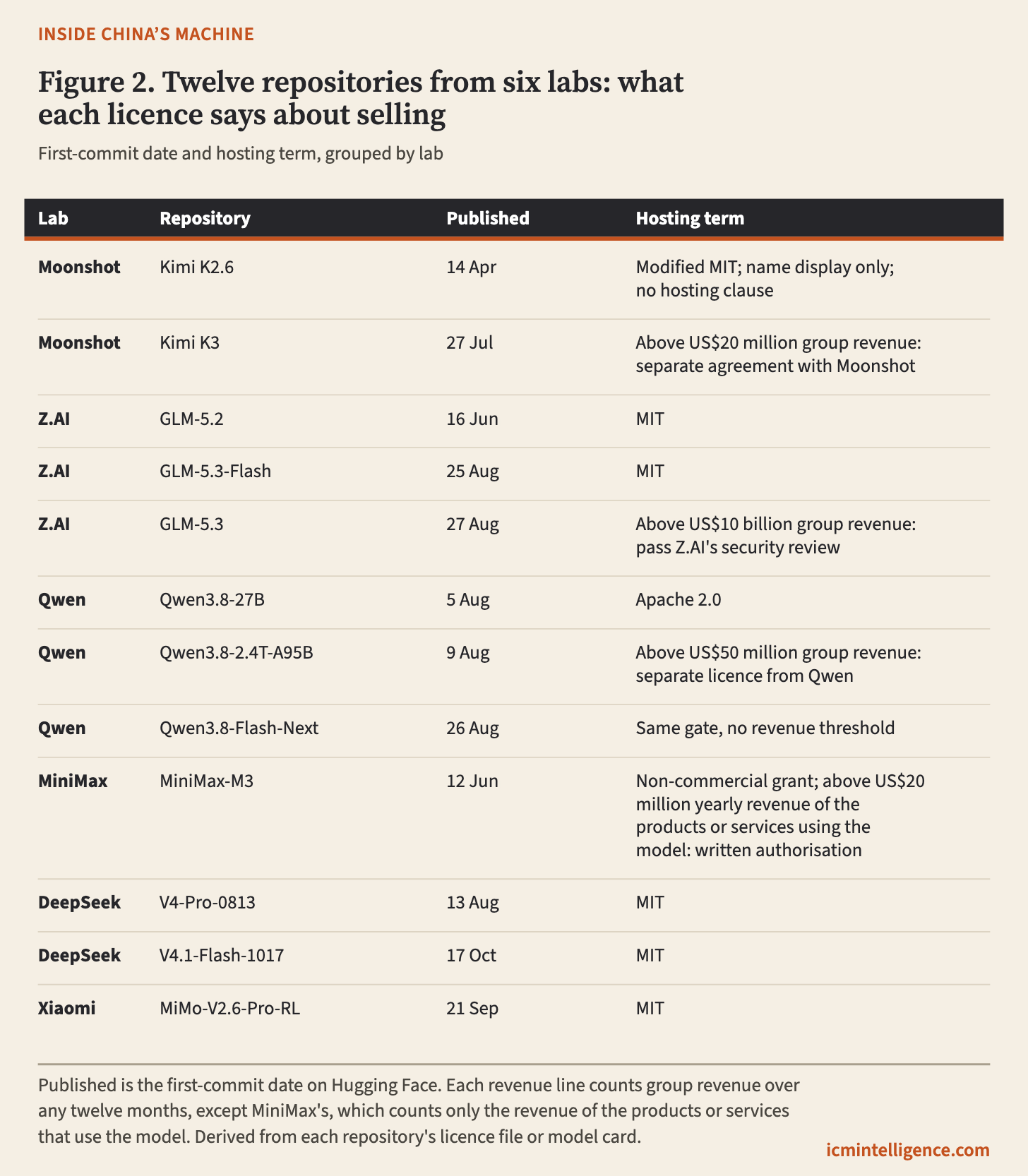
Figure 2 sets the repositories side by side. Of the six labs in it, four (Moonshot, Z.AI, Qwen and MiniMax) have a licence that draws a revenue line, and two, DeepSeek and Xiaomi, have none. The lines that exist sit 500 times apart.
The answer is a reading of the four. DeepSeek and Xiaomi make the opposite choice: they ship top-tier weights with no line at all. DeepSeek published V4-Pro-0813 on 13 August under the plain MIT licence, and its own benchmark table sets the model against Kimi K3 and GLM-5.2. Xiaomi’s MiMo-V2.6-Pro-RL, published on 21 September, is MIT too. For DeepSeek, its founder Liang Wenfeng gave a reason in a July 2024 interview with Waves, a 36Kr outlet, that is neither revenue nor necessity: open source “is more of a cultural behavior than a commercial one” (ChinaTalk’s English translation).
What it changes
For a company that wants to sell access to these models, “open” no longer answers the question. The same download means three different things to a seller the size of that cloud: an agreement to make with Moonshot, a licence to get from Qwen, and nothing yet to ask of Z.AI.
A business growing toward a line is growing toward a conversation with the lab.
The weights are open to everyone. The right to sell them at scale is still the lab’s to give.
Sources
Hugging Face repository licence files, read 2026-10-20, at https://huggingface.co/REPOSITORY/raw/main/LICENSE: moonshotai/Kimi-K2.6, moonshotai/Kimi-K3, zai-org/GLM-5.2, zai-org/GLM-5.3, zai-org/GLM-5.3-Flash, Qwen/Qwen3.8-2.4T-A95B, Qwen/Qwen3.8-27B, Qwen/Qwen3.8-Flash-Next, MiniMaxAI/MiniMax-M3, deepseek-ai/DeepSeek-V4-Pro-0813, deepseek-ai/DeepSeek-V4.1-Flash-1017.
Hugging Face repository commit histories, read 2026-10-20, at https://huggingface.co/api/models/REPOSITORY/commits/main: the eleven repositories in line 1 and XiaomiMiMo/MiMo-V2.6-Pro-RL.
Hugging Face repository records, read 2026-10-20, at https://huggingface.co/api/models/REPOSITORY: the same twelve repositories.
Hugging Face, moonshotai/Kimi-K3, LICENSE at its first commit, read 2026-10-20: https://huggingface.co/moonshotai/Kimi-K3/raw/c5d1dd4c428bd1ce8b88c5044f3b6ccde9e3b721/LICENSE
Hugging Face, zai-org/GLM-5.3, LICENSE at its first commit, read 2026-10-20: https://huggingface.co/zai-org/GLM-5.3/raw/7cda81930d6e4cef42f48555de830aa32ecdde28/LICENSE
Hugging Face, Qwen/Qwen3.8-2.4T-A95B, LICENSE path at its first commit (no file at that commit), read 2026-10-20: https://huggingface.co/Qwen/Qwen3.8-2.4T-A95B/raw/f84a3dbf08869f3a91d9d514c573cdecbd7e03bd/LICENSE
Hugging Face, Qwen/Qwen3.8-2.4T-A95B, model card (README.md), read 2026-10-20: https://huggingface.co/Qwen/Qwen3.8-2.4T-A95B/raw/main/README.md
Hugging Face, XiaomiMiMo/MiMo-V2.6-Pro-RL, model card (README.md), read 2026-10-20: https://huggingface.co/XiaomiMiMo/MiMo-V2.6-Pro-RL/raw/main/README.md
Hugging Face, deepseek-ai/DeepSeek-V4-Pro-0813, model card (README.md), read 2026-10-20: https://huggingface.co/deepseek-ai/DeepSeek-V4-Pro-0813/raw/main/README.md
Alibaba Group, “Alibaba Group Announces March Quarter 2026 and Fiscal Year 2026 Results” (company press release as distributed on Seeking Alpha), read 2026-10-20: https://seekingalpha.com/pr/20512712-alibaba-group-announces-march-quarter-2026-and-fiscal-year-2026-results
Tencent Holdings, 2025 results announcement (PDF), read 2026-10-20: https://static.www.tencent.com/uploads/2026/03/18/bd32d8ee320b72f0d72d545fd2d65851.pdf
Baidu, “Baidu Announces Fourth Quarter and Fiscal Year 2025 Results”, as distributed on Seeking Alpha, read 2026-10-20: https://seekingalpha.com/pr/20414723-baidu-announces-fourth-quarter-and-fiscal-year-2025-results
Kingsoft Cloud, “Kingsoft Cloud Announces Unaudited Fourth Quarter and Fiscal Year 2025 Financial Results”, as distributed on Seeking Alpha, read 2026-10-20: https://seekingalpha.com/pr/20450479-kingsoft-cloud-announces-unaudited-fourth-quarter-and-fiscal-year-2025-financial-results
Alibaba Group, “Joe Tsai on the Future of Open-Source AI: Why Full-Stack Companies Will Excel”, 2026-02-06, read 2026-10-21: https://www.alibabagroup.com/document-1956438710056648704
Waves (36Kr), interview with Liang Wenfeng, July 2024, in ChinaTalk’s English translation, “DeepSeek: The Quiet Giant Leading China’s AI Race”, 2024-11-27, read 2026-10-21: https://www.chinatalk.media/p/deepseek-ceo-interview-with-chinas
Scientific American, “China’s Kimi K3 and the rise of open-weight AI models”, 2026-07-23, read 2026-10-21: https://www.scientificamerican.com/article/china-kimi-k3-and-the-rise-of-open-weight-ai-models/
Takshashila Institution, “Why Is China Giving Away Its AI Models?”, discussion paper, 2026-08-07, read 2026-10-21: https://takshashila.org.in/content/publications/20260807-why-is-china-giving-away-its-ai-models.html
MIT Technology Review, article on China’s open-source models, 2026-04-21, read 2026-10-21: https://www.technologyreview.com/2026/04/21/1135658/china-open-source-models-ai-artificial-intelligence/
Inside China’s Machine · ICM Frontier, Episode 1
Disclaimer: This article is for informational and educational purposes only. It is not investment, financial, legal or tax advice, and it is not a recommendation or solicitation to buy or sell any security. Do your own research, and consult a licensed professional before making investment decisions.