Inside China’s Machine · Where China’s Tokens Go, Episode 4
About a month after Seedance 2.5 came out, the founder of an AI-animated drama studio, Wang Ran, said he still mostly used the older 2.0 version of the video model. His reason was a contract. His studio had signed an RMB 10 million annual API purchase framework with Volcano Engine, which sells the model, and was, as he told Tech Star / Jiemian in a report of 27 August, “still consuming the earlier annual framework”. Consider what kind of bill that is. It was agreed before the clips were generated, and the clips exist before anyone has watched them. When the studio that owns a drama made that way releases it on a free app, its money comes back later, as a settlement from the platform, in whatever amount the plays turn out to pay.
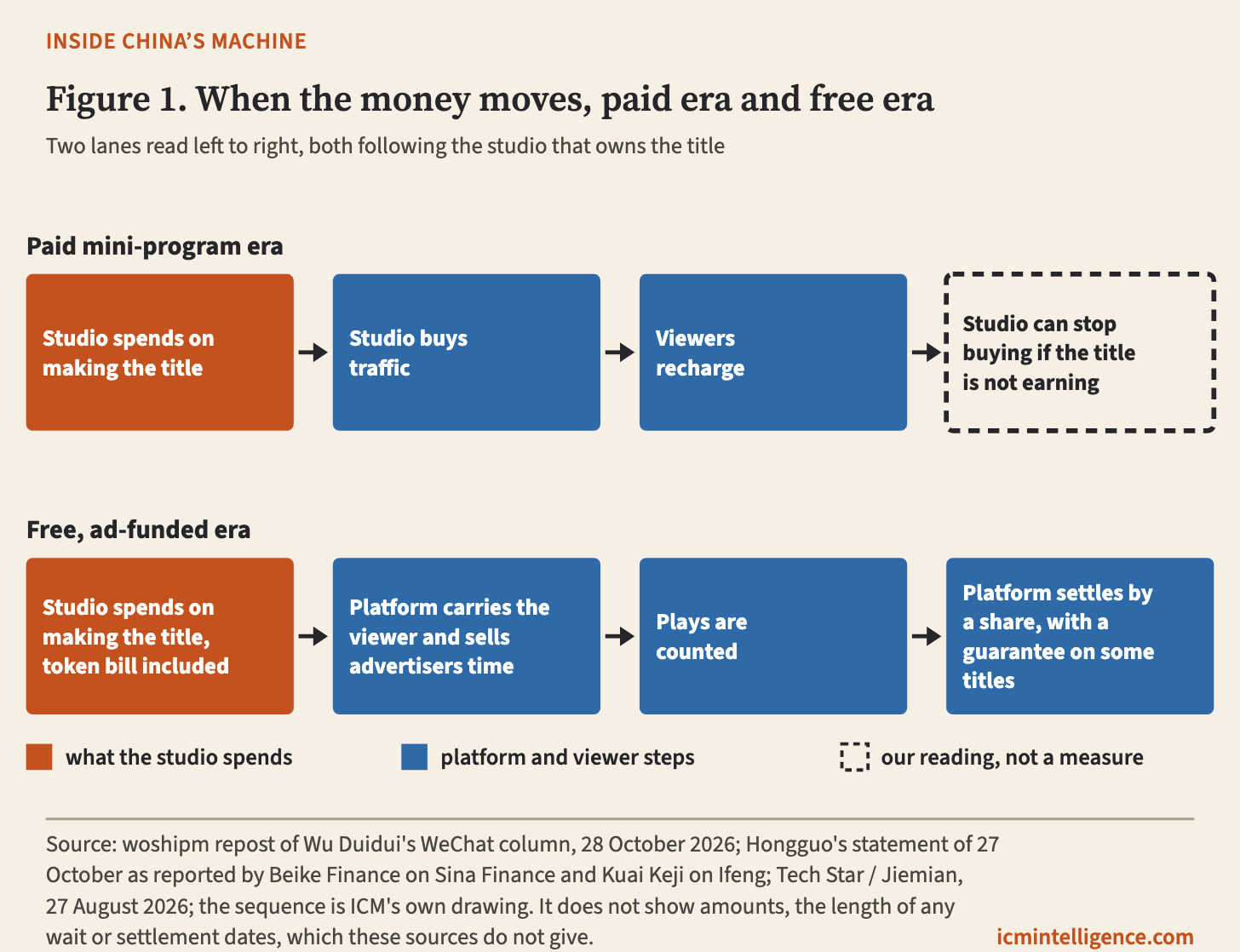
Hongguo, the free short-drama app of Douyin Group, and other platforms let people watch micro-drama at no charge and fund it with advertising. That changed two things: who pays for the viewer, and when the studio that owns the title is paid. In the older paid model, viewers topped up inside a mini-program and a studio bought its own traffic to find them. That studio carried plenty of risk, and it could stop buying when a title was not earning. On free terms the studio that owns the title has already spent on making it, token bill included, and waits to see what the platform’s plays pay. The platform brings in the viewer and settles afterwards through revenue sharing, with a guarantee kept for some titles and withdrawn for others. We cannot say whether the studio now carries more risk or less. We can say the risk has a different shape: a tap that could be turned off has become a sum already spent.
The next question is who keeps the margin, and from the outside it has no answer yet. On the evening of 27 October, according to Beike Finance on Sina Finance and Kuai Keji on Ifeng, Hongguo denied as untrue viral claims of annualised revenue near RMB 40 billion and of RMB 42-45 billion this year, and said the “institution data, industry data, expert estimates” in them are not official information. ByteDance, whose product it is, has never disclosed Hongguo’s revenue. None of the platform statements, notices and reports described here gives ad revenue per minute, per play or per user, the current formula for a studio’s share on a free title, or a margin, and no settlement data show what a studio nets on free terms. The only formula reported is a past one. Whose side the margin is on is not something these reports can say.
Selling the viewer’s time
Wu Duidui, a columnist whose WeChat piece was reposted on woshipm on 28 October, summarises the shift as a move from “charging the user” to “selling time to advertisers”. The plumbing is simple. Hongguo charges the viewer nothing, sells advertising, and settles with rights holders from the ad revenue. The quantity on sale is large. QuestMobile, quoted by Caijing on Sina Finance on 20 October, found that in what QuestMobile labels the third quarter of 2026 Hongguo’s free short-drama users spent about 151 minutes a day each, across hundreds of millions of monthly users. That number is minutes per user per day. It tells you how much time exists to sell and leaves open what a minute sells for.
Now the paid era. A producer made a drama, bought ads on traffic platforms to send viewers to a mini-program, and collected the money those viewers paid in, known as recharge. It was a risky way to earn a living. The drama was already paid for, and ad money already spent was gone. But ad buying was a decision made over and over, and a producer watching a title fail could decide differently the next day. None of the reports described here describes producers stopping their ad buying on a failing title; this is how the model works as we read it, and Wu Duidui’s line on the traffic platform’s income fits that reading without proving it.
On free terms the studio that owns the title buys no traffic, which removes a very large bill and also the one lever that came with it. The platform brings in the viewer. The studio’s production spending is committed before the first play is counted, and what comes back arrives on the platform’s schedule. None of the reports described here gives the usual time between a counted play and settlement on a free platform, so the wait cannot be put in days or months.