

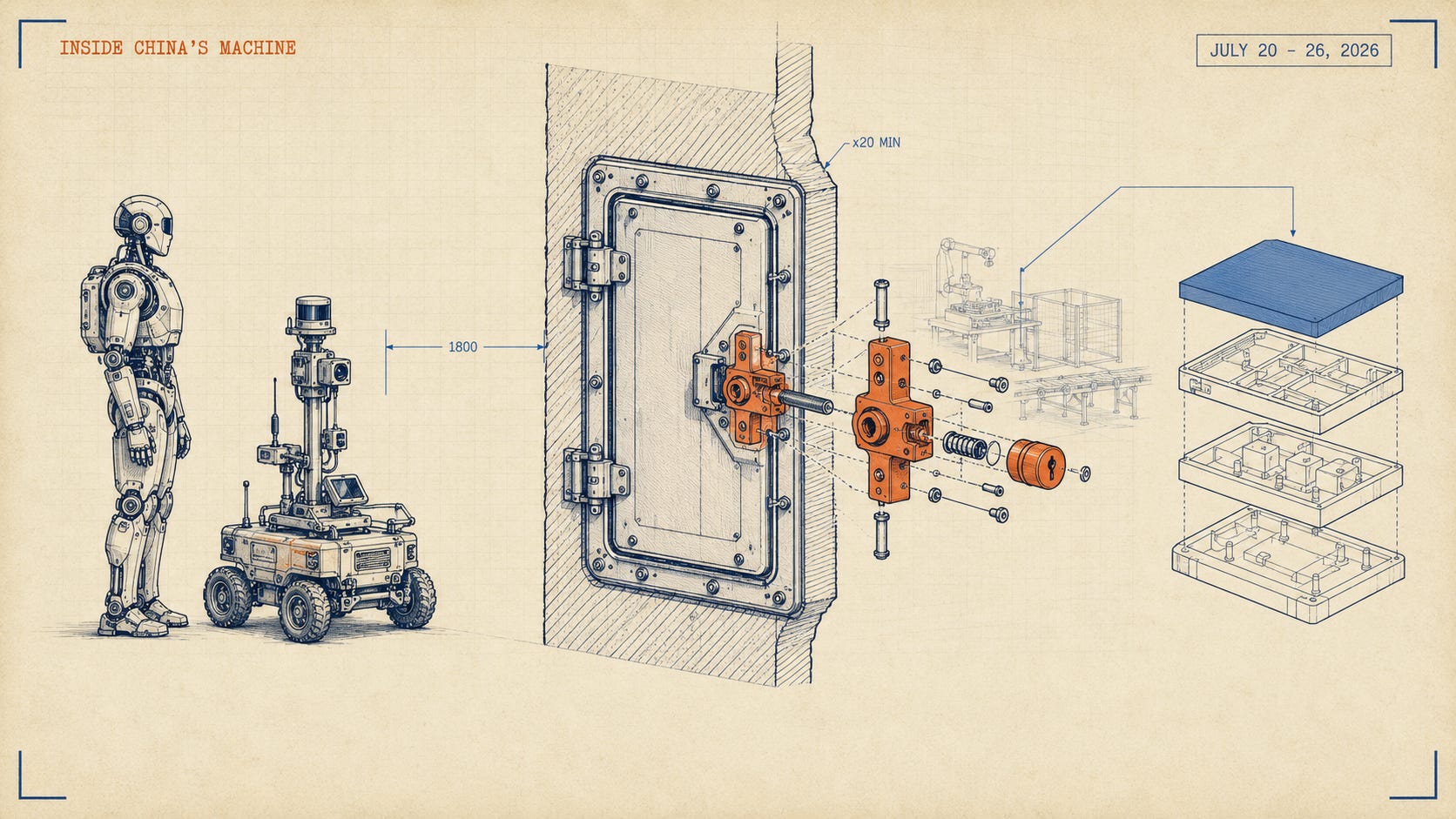
XPeng began small-batch trial production of a humanoid on Friday, and the interesting fact is where the machines are going. Not to a factory floor. To 487 car showrooms, to greet customers and explain vehicles. That is the shape of this layer right now: capacity is arriving on schedule, into places that generate no manipulation data. So the document that matters this week is not a production announcement. It is a ministry notice from June whose first physical instances went up at WAIC on Monday, and what it allocates is not money but access to workplaces. Read against the three prospectuses this publication has now read in full, it says China’s answer to the trajectory shortage is administrative rather than commercial, and that changes what a model earmark is worth.
The capacity is real and it lands in the wrong place. XPeng’s IRON entered small-batch trial production at its Guangzhou plant on 24 July, with the mass-production line in final commissioning, a target of over 1,000 units a month by year-end and roughly 5,500 units planned across 2026. First deployment, in Q1 2027, is into 487 company stores for greeting and guiding. [Reported: company statements via Guandian and Sina, 24 July; not a filing]
Hold that against the market structure. Deep Robotics’ prospectus carries IDC’s split of the roughly 18,000 humanoids shipped globally in 2025: four scenarios take close to 90%, being entertainment performance, research and education, data collection, and guided retail. Industrial manufacturing takes about 9%, so the whole world put on the order of 1,600 humanoids into manufacturing work last year. XPeng’s single-company 2026 plan is more than three times that, aimed squarely at one of the four. Shipments are compounding. The share of them touching an unstructured object is not.
The state wrote the diagnosis into the operative section of a document. MIIT and the SASAC issued a joint notice on 3 June, number 256, launching a real-scenario training programme for humanoids and embodied intelligence. Its stated purpose is to accumulate high-quality real-machine data through training in genuine environments, and its end-2026 target is to move representative products out of demonstration into what it calls operating mode, at ten-thousand-unit scale.
The allocation clause is the part that has not been widely read. The notice is addressed to ten provincial industry departments, Beijing, Tianjin, Shanghai, Jiangsu, Zhejiang, Shandong, Hubei, Hunan, Guangdong and Sichuan, and to central state-owned enterprises. Each province must select no fewer than 20 real scenario units across at least two of the industrial, service and special-operations domains. Each central SOE must select no fewer than 10. That is a floor of 200 workplaces from the provinces alone. The scenario unit is defined physically: a production workstation, a service point, an emergency response station.
And it specified the file format. The third task instructs the consortia to build high-fidelity datasets, then names the fields: whole-body motion trajectories, force-position control curves, operation execution sequences and their temporal logic, plus spatial semantics, object attributes, and the handling of anomalies, interruptions and edge conditions.
That is a trajectory-data specification written by a ministry, describing the same object the trade quotes at 500 to 1,000 yuan an hour more precisely than any commercial listing this publication has found. A state that subsidises an industry funds capacity. A state that writes the schema is specifying a product.
The instrument the state holds is the door. Collection rigs can be bought and collectors hired at the wages documented earlier in this series. What cannot be bought is permission to instrument a working substation, a hospital ward, a casting line or a fire station, because the owner of those premises has no commercial reason to let a robotics company record inside them. The notice solves that by instructing the owner to open up and making it a named party to the consortium.
The first instances are physical. At WAIC on 20 July the National and Local Co-built Humanoid Robot Innovation Centre unveiled the country’s first embodied-intelligence training-ground demonstration site with Huawei, running on Ascend compute, alongside six scenario agreements spanning emergency rescue, power, retail, automotive manufacturing, city services and precision casting. Its Linglong robots are already inside Yanfeng, an automotive interiors manufacturer, doing frontline collection and autonomous-operation validation. [Reported: institution and partner announcements, 19 and 20 July]
Why the private build continues anyway. The notice requires each consortium to specify intellectual property ownership and division of benefits, and separately calls for the data to be opened and shared in an orderly way. Those provisions pull against each other, and the tension is the investable part. Shared data is non-exclusive, and non-exclusive data converges a model rather than differentiating it. The programme reliably produces parity, which is worth having only if the alternative is nothing.
Which is why Lejuu, whose prospectus this publication read last week, is doing something else in parallel. Its six collection joint ventures with local state capital, none majority-held, began forming in June 2025, a year before this notice. Those are staged facilities: build the scene, hire the collector, own the output. The ministry programme is the other production method, instrumenting workplaces that already exist. The first costs more per hour and yields exclusivity; the second is cheaper and yields a shared asset. A company running both is saying how little either delivers alone.
The consequence for the queue. The three companies in the listed queue have earmarked 48.13%, 46.72% and 59.84% of their raises for model development and the data to feed it, every figure from their own use-of-proceeds tables. Those earmarks assume trajectories will be available to spend the money on. Two supply mechanisms are now visible and neither is commercial: state-capitalised collection ventures, and administratively allocated premises. Both are access problems, not purchasing problems.
What follows is uncomfortable for how this sector is priced. Shipment leadership and data access have come apart. Unitree ships the most humanoids in the world, and that fact alone says nothing about its position in the trajectory supply, because the units go to researchers, performances and showrooms. Consortium membership and premises relationships are the asset, and they appear on no balance sheet, in no comparable-company table, and as a line item in none of the three prospectuses.
What to watch. The notice sets 30 November for provinces and SOEs to file outcome summaries and requires a scenario inventory throughout. The settling disclosure is any provincial publication of that inventory naming consortium members per scenario, because that shows who actually got the doors opened. Second, whether the orderly-sharing provision yields a dataset with a stated licence or stays inside the consortia. Those outcomes have opposite implications for whether this creates a public good or a private allocation.
Last week’s two open items remain open. Lejuu’s inquiry response has not appeared at Shenzhen, where the file list is still empty. Unitree’s registration took effect on 2 July with no pricing published, leaving the first public valuation of this layer unobservable four weeks on.
The MIIT and SASAC notice, 工信厅联科函〔2026〕256号, dated 3 June 2026, was read in full this week from the ministry text. Prospectus figures come from the filed applications of Unitree (STAR Market, 20 March 2026), Deep Robotics (STAR Market, 18 May 2026) and Lejuu (ChiNext, 19 May 2026), read in full in earlier sessions. Items marked Reported are company or institutional announcements, not checked against a filing.
Inside China’s Machine. China is building the machine that builds physical intelligence. Silicon, models, robots, factories. We read it one layer at a time and turn each into capital judgment.
This is investment research, not investment advice.