

This was the week the brain got a valuation before it got a body of evidence. Unitree’s registration took effect, the pricing window opened, and every other humanoid company in the listing queue now has an anchor to be priced against. Read the three filings side by side and they tell one story from three angles: the money is flowing to the model, the model’s input is not there, and the input has become so scarce that it is now being sold as a product line. The exchange has already noticed. Its inquiry letters are the best sell-side research being published on this sector, and they are free.
The anchor is set. The CSRC approved Unitree’s registration on 2 July, and the exchange updated the file to effective on 6 July. The offering is at least 40,446,434 new shares for at least 10% of the enlarged capital, with RMB 4,201.71mn of proceeds, which sets an implied floor market capitalisation of roughly RMB 42bn. [Confirmed: prospectus. The price line is still blank, so RMB 42bn is a floor derived from the raise and the minimum float, not a market capitalisation.] Preliminary inquiry and pricing land in the next fortnight. From that moment, Deep Robotics, Lejuu, and everything behind them get priced off a single multiple.
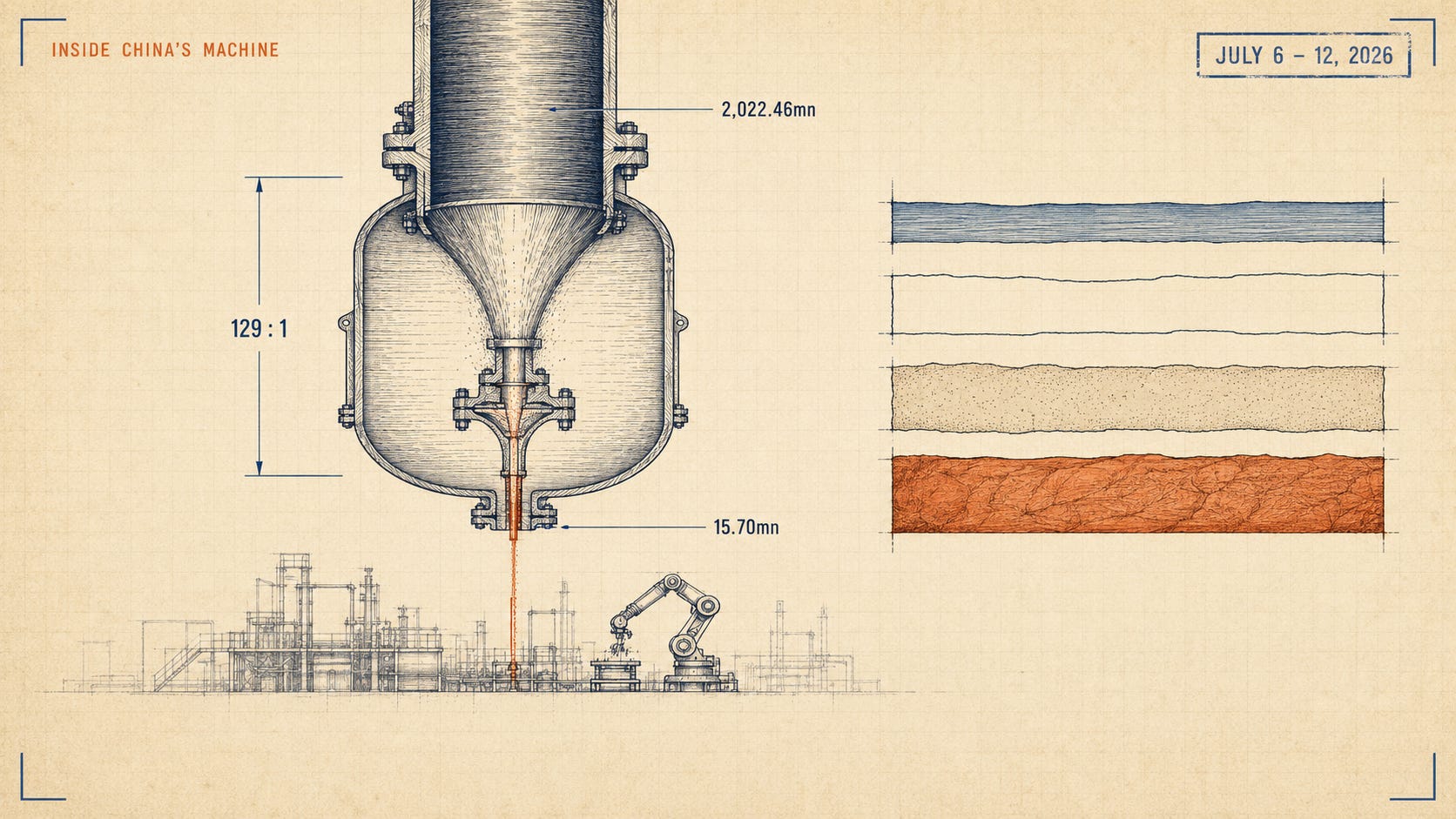
The anchor’s own filing prices a brain it has not deployed. Unitree has earmarked RMB 2,022.46mn, 48.13% of the raise, for embodied model R&D. [Confirmed: prospectus, use-of-proceeds schedule] Against that, industrial deployment of its humanoids produced RMB 15.70mn of revenue in the first three quarters of 2025, which is 2.64% of a humanoid line worth RMB 595.19mn. [The humanoid revenue line is confirmed in the prospectus. The RMB 15.70mn figure is disclosed in the second-round inquiry response and is reproduced here as reported, reconciled against the prospectus denominator.]
That is 129 yuan committed to building the brain for every one yuan the body has earned doing the work the brain is supposed to enable.
Research and education account for 73.6% of that humanoid line. Industry applications account for 9.01%, and between half and seventy percent of those are corporate tour guiding: a humanoid standing in a company showroom, greeting visitors. What remains resolves into three named pilots. Live-line work at a 500kV substation in Zhejiang. Materials handling at CRRC Zhuzhou. Handling and assembly at NIO.
Three projects. Fifteen million yuan. That is the entire industrial trajectory pipeline of the company that shipped more humanoids than anyone on earth last year, over 5,500 units, bipedal, excluding wheeled dual-arm. [Confirmed: prospectus, definition as stated]
The company does not hide any of this. Its risk factors state plainly that it has not yet applied its self-developed general embodied model at scale in any product, and has run it only as a pilot inside its own facilities. [Confirmed: prospectus, risk factors] The gap is not an inference. It is disclosed.
The data is now a product, which is the tell. Lejuu’s ChiNext application was accepted on 19 May, raising RMB 2.6bn. It is the first company to list under that exchange’s fourth standard, the one that does not require profit, and it lost RMB 69.78mn on RMB 258mn of 2025 revenue. Two details matter more than the losses. Its largest revenue application scenario is data collection. And its use of proceeds includes a project to build a large-scale, high-quality dataset. [Reported: prospectus, via Xinhua Finance and Sina. Not checked against the filing.]
Read those two facts against the one above. The second humanoid company in the queue earns its biggest revenue line by manufacturing training data, while the first is raising RMB 2bn to acquire it. Trajectories have become a traded good before the robots that were supposed to generate them as exhaust have been deployed. That is not a business model. That is what a supply shortage looks like at the moment it gets priced.
The company in the queue that makes money does not make humanoids. Deep Robotics was accepted on the STAR Market on 18 May. It earned RMB 337mn in 2025 and posted its first profit, RMB 28.68mn, against a loss the year before. Quadrupeds and wheel-leg machines are over 95% of revenue. Humanoids are 0.24%. [Reported: prospectus, via Xinhua Finance. Not checked against the filing.] The revenue comes from power inspection, mining survey, and emergency response, which is to say from machines doing work somebody was already paying to have done.
This is the layer connection, and it is the whole argument in one comparison. The industrial revenue that humanoids cannot find, quadrupeds already have. The binding constraint is therefore not the body, and it is not manufacturing, and it is not cost. It is the distance between what a cerebellum can do, which is locomotion and inspection along a known route, and what a cortex must do, which is manipulation in a space nobody mapped in advance. Unitree’s own numbers say the same thing from the inside. Its quadruped line completed this migration, with research and education down to 31.6% of quadruped revenue. Its humanoid line has not started.
The control group. UBTech took the opposite route and paid for it in cash. It shipped 1,079 Walker units in 2025, grew that revenue line by over 2,000%, and lost roughly RMB 790mn doing it, with machines on production lines at BYD, Geely, and SF Express. [Reported: company disclosures, via trade press. The weakest sourced item in this issue.] Two strategies, one variable. Unitree monetised the laboratory and is now buying the brain with IPO proceeds. UBTech bought the factory access first and paid in losses. Both are purchasing the same scarce input. Within four quarters we find out which one bought the cheaper trajectory, and the answer sets the multiple for the entire layer.
What to watch. The pricing itself, and the issue P/E it implies. But the disclosure that actually resolves this thesis is narrower. Watch whether Unitree’s H1 report breaks out revenue by application scenario. If the industrial share rises from 9.01%, the earmark has an input supply and the model bet is live. If it does not move, RMB 2,022.46mn is funding a research programme rather than a model, and the multiple should be a hardware multiple. Watch also for the inquiry responses to Lejuu and Deep Robotics, because the exchange will force from them exactly the disaggregation it forced from Unitree, and that is where the numbers nobody wants to publish get published.
The layer is being priced in the next month. The evidence that would justify the price is being generated at the speed of one factory pilot at a time.
Inside China’s Machine. China is building the machine that builds physical intelligence. Silicon, models, robots, factories. We read it one layer at a time and turn each into capital judgment.
This is investment research, not investment advice.