

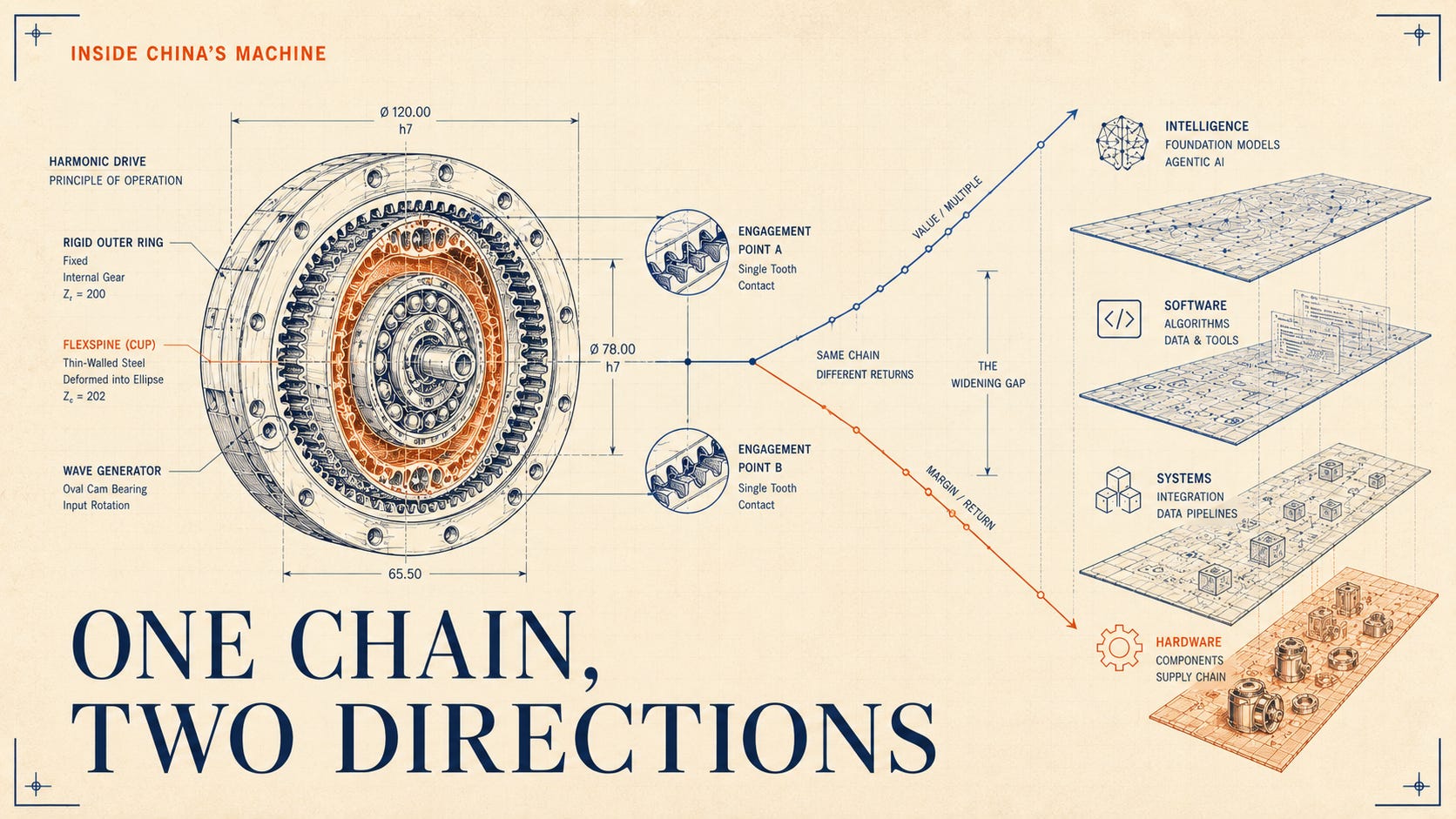
The consensus on China’s humanoid supply chain is that it rises together. Volumes arrive, the whole chain gets paid, and every name from the reducer maker to the robot maker is a way to own the same trend. The filings say something different. The two ends of this chain are running in opposite directions right now, on the record, and the market is pricing them off one shared assumption.
Start at the bottom, in the joint.
The hardest part of a humanoid is a gearbox, and Japan owned it until recently
A humanoid robot is a stack of actuators. Each actuator is a motor, a controller, and a reducer, the gearbox that converts fast, weak rotation into the slow, powerful, precise motion a joint needs. A humanoid needs dozens. The reducer is the part that decides whether the robot moves like a machine or like a body.
The hardest kind to build is the harmonic reducer. It works by flexing a thin steel cup into an ellipse so that its teeth engage a rigid ring at only two points, walking around the ring tooth by tooth. The flexspline has to deform millions of times without fatiguing, which makes the whole thing a metallurgy problem disguised as a gearbox. For decades this was effectively a Japanese preserve. Estimates of Harmonic Drive Systems’ global share vary by who is counting, but industry trackers place it somewhere between 70 and 85 percent, and no source puts it anywhere near contested.
That position is being pried open, and the company doing most of the prying is Leader Harmonious Drive, listed on the STAR Market as 688017. It is worth understanding exactly how, because the mechanism explains everything downstream.
Leader did not win on price alone, and it did not win on a subsidy. It came up through the opening that expiring Japanese patents left behind, developed its own tooth profile, and went after the metallurgy of the flexspline. Its reducers now sell at a substantial discount to the Japanese equivalents while industry teardowns put the performance gap at the margins rather than at the core. That is a real engineering achievement, and it should be called one. It is also, as we will see, a commercially punishing place to stand.
The supplier’s profits are recovering, and not for the reason you would guess
Here is Leader’s own reported history, from its annual reports.
2023: revenue 356 million yuan, net profit 84 million, a net margin of 23.6 percent
2024: revenue 387 million, net profit 56 million, a net margin of 14.5 percent
2025: revenue 571 million, net profit 124 million, a net margin of 21.7 percent
Revenue grew 47 percent in 2025 and net profit grew 121 percent. In the first quarter of 2026 the net margin reached 23.5 percent. On the surface, this is a company whose pricing power is returning.
It is not. Look at what actually moved.
Leader’s gross margin in 2025 was 36.9 percent, which is down slightly from the year before. The company did not raise prices, and it did not widen the spread on each unit it sells. What changed is that it sold vastly more units. Harmonic reducer shipments reached 425,000 in 2025, up 72 percent. Operating expenses fell by five percentage points as a share of revenue. The entire profit recovery is operating leverage on volume, running through a gross margin that is flat to slightly worse.
This distinction is the whole article, so it is worth stating in one line. Leader is not earning more on each gearbox. It is earning the same on each gearbox and selling far more of them. Its profitability is a function of somebody else’s shipment volume.
That somebody else is downstream.
The customer’s margin is falling exactly as the supplier’s rises
Now put Unitree next to it, from the prospectus we read in the first two issues of this publication.
Unitree’s gross margin is about 60 percent, well above Leader’s 37. Its adjusted net margin in 2025 was 34.8 percent, well above Leader’s 21.7. On every profitability line, the robot maker looks like the better business.
Then look at the direction.
Upstream, Leader: net margin 14.5 percent in 2024, 21.7 percent in 2025, 23.5 percent in the first quarter of 2026. Rising.
Downstream, Unitree: adjusted net margin 34.8 percent in 2025, 9.5 percent in the first quarter of 2026, with the company guiding the first half of 2026 to roughly 24 percent. Falling.
Same supply chain. Same demand wave. Same twelve months. The two profit curves cross.
The reason is not a mystery, and it is not a scandal. Leader’s costs scale with the units it makes. Unitree’s costs no longer do, because the money is going into an embodied-intelligence model build that has no unit economics at all yet. One company is spending its margin on gearboxes it will sell. The other is spending its margin on models it has not built. Both are rational. They are simply not the same business, and they will not respond to the same news in the same way.
The market has priced both ends off one number that only exists in the future
Here is where the capital judgment lands.
Ask what Leader’s valuation is actually assuming. On the July 8 close, Leader carried a market capitalization of about 71.7 billion yuan against 124 million yuan of net profit earned in 2025. That is a trailing multiple of roughly 570 times earnings.
Take a moment with that number, because it is easy to lose. Broker notes on Leader routinely quote multiples in the low hundreds. Those are forward multiples, calculated on earnings the analysts expect the company to earn in 2027 or 2028, not on earnings it has reported. Both figures are called a price-to-earnings ratio and they measure different things. The one built on money the company has actually made is around 570.
Now ask what Unitree’s roughly 42 billion yuan valuation is assuming, and the answer, as we showed last issue, is also that humanoid volumes arrive on schedule.
Two companies, one at each end of the chain, priced on the same forecast. That forecast is Projected, not Confirmed. Every shipment number for humanoids past this year is somebody’s model, and repetition by more analysts does not convert a forecast into a fact.
But the assumption is shared and the exposure is not, and that is the mispricing.
Leader has a floor underneath the humanoid story. Its harmonic reducers still go into industrial robots, machine tools, medical devices, and semiconductor equipment. Chinese industrial robot output grew 28 percent in 2025 by the National Bureau of Statistics count. If humanoid volumes disappoint, Leader is a precision-components business with a real installed market, growing off a base, trading at a valuation that would have to come down hard but resting on a business that still functions.
Unitree has no such floor. Humanoids crossed half of its revenue in 2025 and are rising. If humanoid volumes disappoint, Unitree is a company with a shrinking premium hardware market, still carrying the cost of a model-building program the IPO was written to fund. There is nothing underneath to catch it.
So the two ends of this chain are not two ways to own the same trend. They are a bet with a floor and a bet without one, sold on the same story, at prices that both require the story to be true.
But do not mistake the floor under the business for a floor under the price. Leader’s operations have somewhere to land. Its valuation does not. A company earning 124 million yuan is being asked to justify 71.7 billion, and the gap between those two numbers is filled entirely with humanoid units that have not shipped. On July 8 the stock fell almost 16 percent in a single session, from a 52-week high near 496 to 391. That is what the beginning of a repricing looks like when the assumption underneath it gets questioned, and it is a reminder that the safest business in a supply chain can still be the most dangerous stock in it.
The distinction matters because it tells you what each name is actually vulnerable to. Unitree is exposed to its own margin, which it is spending by choice on a model it has not built. Leader is exposed to a volume forecast it does not control, made by its customers, about a market that does not exist yet.
What this changes about the actuator moat
There is one more thing this does, and it runs backward into the first piece we published.
Unitree’s 60 percent gross margin comes substantially from making its own actuators rather than buying them. That was the whole finding of the inaugural issue, and it holds. But it is worth asking what that vertical integration is actually worth as the supply chain matures.
The value of building your own actuator is highest when the alternative is buying an expensive Japanese one. As Leader and its domestic peers scale, the alternative gets cheaper, and it gets cheaper structurally, because their pricing runs through a flat gross margin and improves with volume rather than with pricing power. The in-house advantage does not vanish. It compresses, from “we can build what others cannot buy affordably” toward “we save a supplier’s markup.”
That is still a real advantage. It is a smaller one than the market is paying for, and it shrinks in exactly the scenario the bulls are underwriting. The more humanoid volumes arrive, the more Leader scales, the cheaper the merchant actuator becomes, and the less Unitree’s vertical integration is worth as a differentiator. The bull case for the chain quietly erodes one of the pillars of the bull case for its most expensive company.
Read the layer, then read the seam
The lesson generalizes past these two names, and it is the reason this publication is organized the way it is.
Silicon and precision manufacturing sit at the bottom of the machine. The actuator is where that substrate becomes a body. The body is where intelligence is supposed to find somewhere to live. Each of those layers has its own economics, its own floor, and its own way of failing. A single-layer analyst can tell you the harmonic reducer is a good business or that the humanoid maker is expensive. Only reading both together tells you that one company’s margin recovery is the other company’s cost of goods, that they are priced on the same forecast, and that only one of them has anywhere to land if the forecast is wrong.
The chain does not rise together. It transmits. And the direction it transmits in is the thing worth pricing.
Inside China’s Machine is research, not investment advice. Confirmed figures are drawn from Leader Harmonious Drive’s annual reports and Unitree’s STAR Market prospectus. Leader’s market capitalization and share price are as of the July 8, 2026 close. The trailing multiple cited is computed from that capitalization against 2025 reported net profit, and is not the forward multiple quoted in broker notes, which is calculated on estimated future earnings. Forward humanoid volumes, and both companies’ forward earnings, are Projected. Current as of July 11, 2026.