


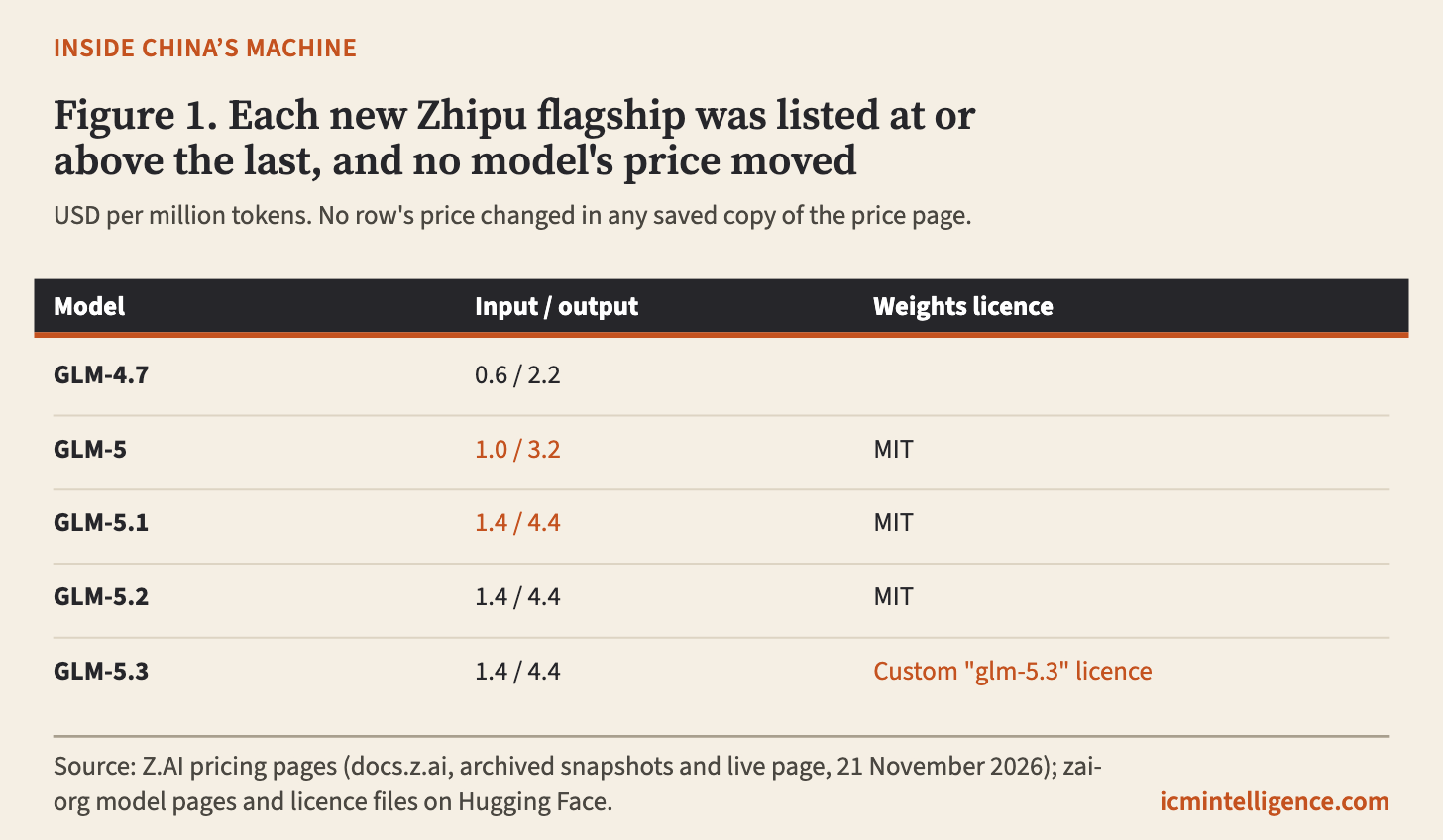
On 25 August, Z.AI put the weights of GLM-5.3, its newest flagship model, on Hugging Face. Weights are the learned numerical settings that make a model work; publishing them lets others run their own copy. Anyone can now download the model, change it and build a commercial service on it. A week earlier, it had gone on sale through Z.AI’s own API, where customers send requests to a copy Z.AI runs for them; by 20 August the price page listed it at USD 1.4 and 4.4 per million input and output tokens. Tokens are the pieces of text a model processes: input is what it receives, output is what it generates. In January, the flagship on that price page was GLM-4.7, at 0.6 and 2.2. The company that gives the model away now charges more than twice as much per input token for the copy it runs itself, and exactly twice as much per output token.
That is the opposite of what open weights are supposed to do. The usual intuition runs like this. Once the weights are public, anyone with servers can serve the model. So the model maker’s API price gets pinned to what it costs everyone else to run the same file, and the lab ends up selling a commodity. Z.AI, the company better known as Zhipu and listed in Hong Kong under the code 2513, has spent 2026 showing that the intuition is wrong in a specific way. Open weights do not cap what a model maker can charge for its next model. The price follows how far ahead its newest model is. Z.AI raised its prices by re-pricing the line rather than any one model: every model kept the price it was first listed at, and every new flagship matched or exceeded the previous flagship’s price. The weights are the front door. The API is the business, 86.5% of first-half revenue. But collecting that revenue has not yet made the model maker profitable.
The ladder
Start with the price page. All prices here are in USD per million tokens, input first and output second. GLM-4.7 was listed at 0.6 input and 2.2 output in January, and it still shows 0.6 and 2.2 on the live page today. GLM-5 arrived on 11 February at 1.0 and 3.2. That is 67% more on input and 45% more on output than the model it succeeded, and its weights went public the same day under the MIT licence, about as permissive as licences get. GLM-5.1 came in April at 1.4 and 4.4, another 40% on input and 37.5% on output, with weights on Hugging Face under MIT on 3 April. GLM-5.2 in June and GLM-5.3 in August were listed at 1.4 and 4.4. On Z.AI’s own price pages, from the day each model was first listed to this month, none of them changed price.
So no individual model got dearer. What changed was the price of choosing the flagship. GLM-5 is listed in November at its February price. A customer who wants the newest model pays the newest rung, and from January’s flagship to November’s that rung is 133% higher on input and 100% higher on output.
The ladder also runs downward. GLM-4.7-Flash was free in January. GLM-5.3-Flash arrived in August at 0.15 and 0.50, and Z.AI’s interim results say it “outperforms GLM-5.2 ... at one-tenth of the latter’s price.” A FlashX tier followed in September at 0.37 and 1.25, with no weights published on Hugging Face. The top of the line rose; the bottom stayed cheap. Z.AI did not raise prices across the board. It priced each new capability where the capability let it.
The 101%, and what the rival reading gets right
Z.AI’s interim results, filed on 31 August, put the ladder into one number. Under the heading “Volumes Surge While Prices Rise,” the company says token volume on its model-as-a-service platform rose more than 40 times from the beginning of 2026, while “the average API selling price increased by approximately 101%.” Elsewhere it ties that rise to “the gradual upward adjustment of pricing strategies in line with the increase in the upper bound of model intelligence.” In plainer words, the price goes up when the best model gets better. The filing gives no method for that average, so it does not show how much of the 101% came from customers moving up the ladder and how much from discounts and promotions ending.
That gap is where the strongest objection lives. The rival reading says the 101% is mostly mix: customers drifting to newer, dearer models, plus promotions running out. On that reading, it is not pricing power at all, and “open weights do not cap price” has not been shown.
The objection is half right. Because no model’s list price moved, a doubled average must come from what customers buy and how: dearer models, partly offset by the cheaper Flash tiers, a different input-output split, or discounts ending. Grant that the rise is migration. That does not settle the question, though. The question is why customers migrated toward the expensive rung when the cheaper rung was still on the price page, and when the same models’ weights were free to download and run elsewhere. Z.AI set each new flagship at or above the last, and volume grew more than 40 times anyway. When the product is replaced every two months, pricing power stops looking like a price increase on an existing product. It looks like a new model at a higher price, with customers following it there.
The same move, on a subscription
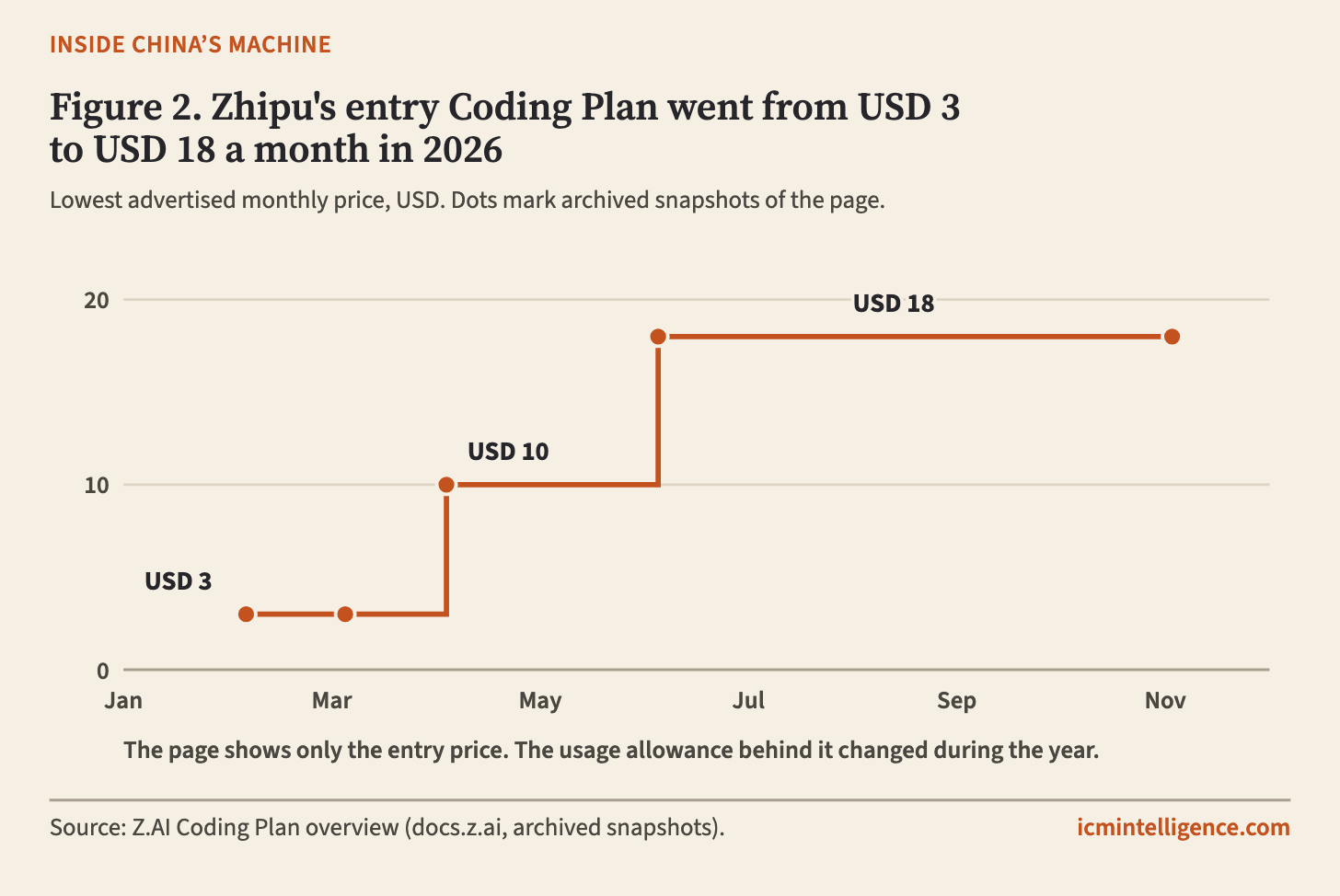
The Coding Plan, Z.AI’s monthly subscription for coding tools, shows the pattern without the averaging. In early February and still in early March, the international page said the plan started “at just 3 USD per month,” with Pro from 15. By 4 April the entry plan was 10 dollars and Pro was 30. From June the page read “Starting at just 18 USD per month.” CLS reported a February notice, quoting Zhipu, that raised Coding Plan prices “from 30%,” removed first-purchase discounts and let existing subscribers keep their price. Again, the old buyer kept the old deal and the new buyer paid the new rung.
The quota changed shape along the way. In early February the entry plan counted about 120 prompts every five hours. By November it counted credits instead: 2,000 per five hours and 10,000 per week, charged at half the rate off-peak, with GLM-5.3 using three times the credits of the cheaper GLM-5.3-Flash for the same tokens. Credits are the allowance each request spends, so a model that uses more of them runs the allowance down faster. The flagship is the expensive model inside the subscription too.
The licence moved too
The weights stayed public, but the terms on the newest ones tightened. GLM-5, 5.1 and 5.2 went out under MIT. GLM-5.3 went out under a custom licence that still allows free use, modification and commercial use. There is one exception. A licensee or its affiliate running a model-as-a-service business must pass Z.AI’s security review before using the model commercially if the licensee and its affiliates together have more than USD 10 billion of revenue in any 12 months. The threshold is group revenue, so an independent developer or start-up is outside it. Read on its own terms, it is aimed at the kind of buyer that could take free weights and run them as a competing API at scale. GLM-5.3-Flash, the cheap model, kept MIT. The tighter licence sits on the rung that sets the price.
Who keeps the toll
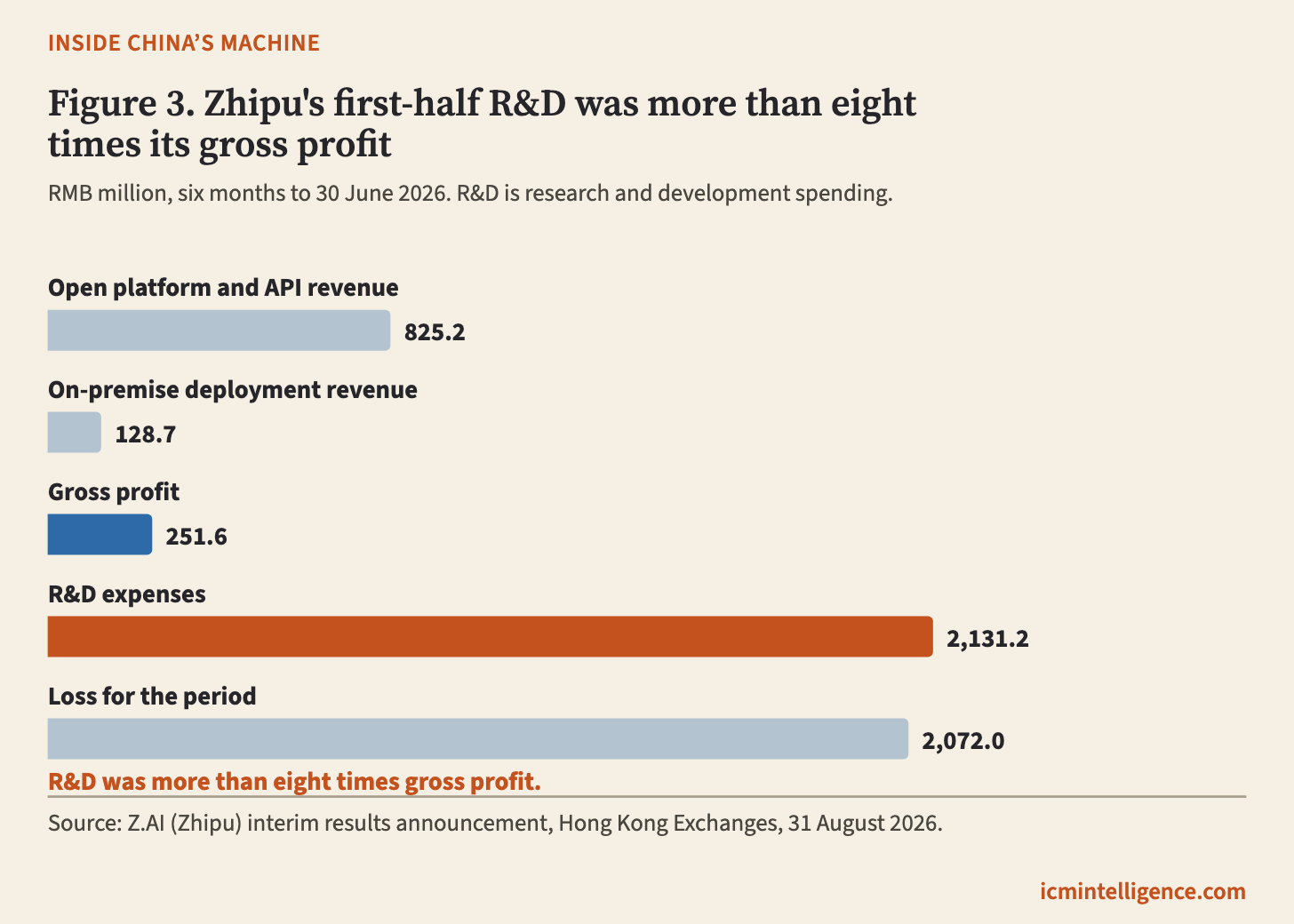
On the filing’s own numbers, the toll is real. First-half revenue was RMB 953.9 million, up from 190.9 million a year earlier. Open platform and API revenue went from RMB 29.1 million to 825.2 million, which moved it from 15% of the business to 86.5%. On-premise deployment, the older business of installing models inside a customer’s walls, shrank to RMB 128.7 million. The gross margin on cloud-based deployment went from minus 0.4% to 24.6%: revenue from that service now exceeds its direct cost, before research and other expenses. The company attributes that to scale, to the price increases and to engineering that it says cut unit inference cost, the cost of running a trained model to answer requests, by 80% since January.
Then follow the money one line further down. Gross profit was RMB 251.6 million. Research and development cost RMB 2,131.2 million. The half-year loss was RMB 2,072.0 million, more than double the revenue. Serving the models now earns something. Making them costs more than eight times what serving them earns.
The two halves of the business are one mechanism. On this evidence, the API price follows the newest model, and the newest model is what the R&D line pays for.
What it changes
For anyone building on a Chinese open-weight model, the practical rule is simple. The price is set at first listing, and it does not chase you backward. Last quarter’s model is listed at what it always cost. The Flash tier is the discount, and the weights are the exit if you would rather run the model yourself and bear the cost of doing so. The page prices rungs, not dates.
For anyone weighing a pure-play model maker, the shape of the growth is clear. Volume is surging, the flagship price has risen across successive releases, and the gross profit is still about one-eighth of what it costs to stay at the top of the ladder. Open weights did not stop the price rising. They did not, either, move the profit to the company that published them.
The weights are free and the toll has risen with the flagship line, but the toll keeper is still paying for the road.
Sources
Zhipu AI (Z.AI), interim results announcement for the six months ended 30 June 2026, Hong Kong Exchanges and Clearing, 31 August 2026, captured 2026-11-21. Revenue by line, gross profit, R&D, loss, the cloud-based deployment margin, the 101% average API price statement and the GLM-5.3-Flash price comparison.
Z.AI developer documentation, model pricing page, read from archived copies dated 5 January, 11 February, 10 March, 28 March, 7 April, 12 April, 16 June, 31 July, 20 August, 29 August, 23 September and 12 November 2026 and from the live page on 21 November 2026. List prices of each model in USD per million tokens.
Z.AI developer documentation, release notes, captured 2026-11-21. Release dates of GLM-5, GLM-5.1, GLM-5.2, GLM-5.3 and GLM-5.3-Flash.
Z.AI developer documentation, Coding Plan overview (international), read from archived copies dated 6 February, 5 March, 4 April, 5 June and 3 November 2026. The starting monthly price, the usage allowance and the credit multipliers.
Hugging Face, zai-org model pages, API records and licence files for GLM-5, GLM-5.1, GLM-5.2, GLM-5.3 and GLM-5.3-Flash, captured 2026-11-21. Weights release dates and licences, including the GLM-5.3 licence text.
Cailian Press (CLS), report on the Coding Plan price notice, 12 February 2026, captured 2026-11-21. The notice’s rise of “from 30%”, the removal of first-purchase discounts and the terms for existing subscribers.
Inside China’s Machine · Frontier, Episode 10
Disclaimer: This article is for informational and educational purposes only. It is not investment, financial, legal or tax advice, and it is not a recommendation or solicitation to buy or sell any security. Do your own research, and consult a licensed professional before making investment decisions.