

1. The Market Compared Two Numbers That Do Not Measure the Same Thing
Zhipu is priced on a gross margin, and the gross margin does not survive being taken apart.
The price is not a small thing to be wrong about. The stock has risen roughly 1,650 percent since it listed in January, closing on 9 July at a market value of about 906 billion Hong Kong dollars. That same day the company placed new shares at a 13 percent discount and raised 31.4 billion, six times what its IPO brought in six months earlier.
The consensus chain underneath that price is short. Zhipu told investors in March that it raised API prices 83 percent in the first quarter of 2026 and that call volume grew 400 percent anyway. Price and volume rising together is the textbook signature of pricing power. Pricing power means a model customers cannot substitute. And the proof appeared on the income statement: Zhipu’s blended gross margin for 2025 was 41.0 percent against 25.4 percent at MiniMax, the other Chinese model company that listed the same week. One company sets prices. The other takes them.
Both gross margins are audited and both are correct. Neither is a measurement of the same business.
Zhipu’s 41 percent is mostly a services margin. MiniMax’s 25 percent is mostly a consumer margin. On the one line where the two companies sell the same product, at almost exactly the same scale, the ranking reverses, and it reverses by fifty points.
2. What Is Inside Zhipu’s 41 Percent
Zhipu reports two deployment lines and discloses the gross margin of each. None of what follows is hidden. It is simply not what the market has been reading.
On-premise deployment produced 534 million yuan of revenue in 2025, 73.7 percent of the company. Cloud deployment produced 190 million yuan, 26.3 percent. Total revenue was 724 million.
On-premise ran at roughly 49 percent. Cloud ran at roughly 19 percent.
Now set the 49 against its own history, which is where the story is. In the accountants’ report filed with the prospectus, the on-premise line earned 68.2 percent in 2023, 66.0 percent in 2024, and 59.1 percent in the first half of 2025. The full-year 2025 figure is 49. The company’s own explanation is that serving customers required more delivery resource. More delivery resource means more people.
A margin that falls when you add people is not a software margin. It is a delivery margin, and it is priced in engineer-months. What Zhipu sells a state enterprise is a model. What it delivers is an installation. The gross margin of that line tells you how many engineers the last contract needed and almost nothing about the model.
Confirmed. Zhipu prospectus, accountants’ report, audited by KPMG. Full-year 2025 segment figures from the annual results announcement, read through broker research quoting the announcement.
3. What Is Inside MiniMax’s 25 Percent
MiniMax splits differently, and the split is just as decisive.
AI-native consumer products produced 53.1 million US dollars in 2025, 67.2 percent of revenue. The open platform and enterprise services line produced 26.0 million, 32.8 percent, growing 198 percent. Blended gross margin was 25.4 percent, up from 12.2 percent.
The consumer line ran at a gross margin of 5 percent through the first nine months of the year, and that number inverts the economics that made consumer software work. Software distribution has a marginal cost near zero, which is why user growth and margin expansion were historically the same event. Inference does not behave that way. Every conversation buys another block of compute. Every generated video is a bill. Users do not dilute the cost curve, they walk along it. MiniMax had 1.77 million paying users at the end of September against 212 million people using its products. Fewer than one in a hundred pays, and the other ninety-nine still cost money to serve.
So MiniMax’s blended 25 percent is a consumer inference margin with a high-margin enterprise business sitting on top of it. Zhipu’s blended 41 percent is a project delivery margin with a low-margin cloud business sitting underneath it.
The blends are what the market compared.
Confirmed. MiniMax 2025 annual results announcement, audited by EY. Segment gross margins from the prospectus, read through broker research quoting the prospectus.
4. The Only Line They Both Sell
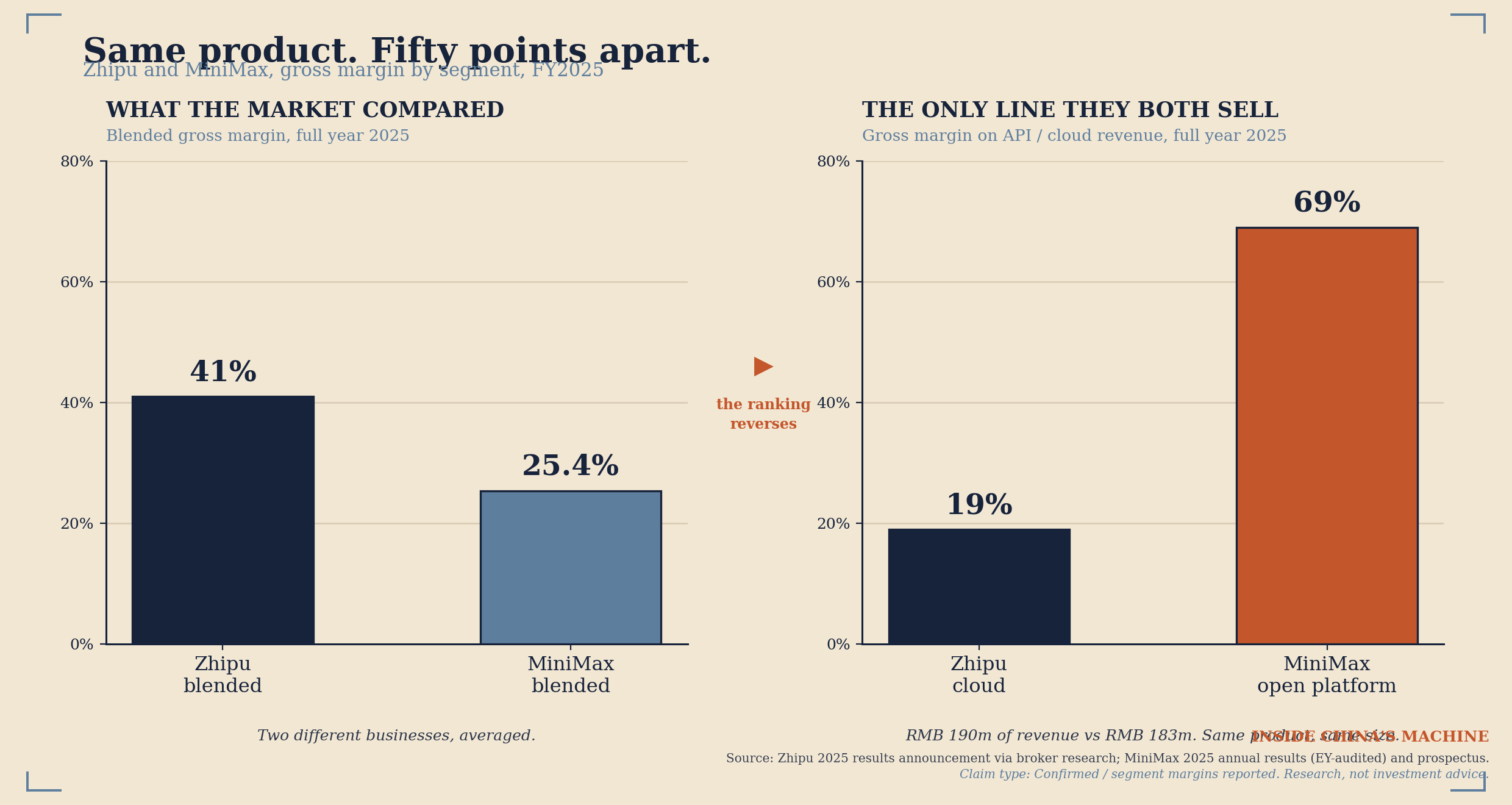
Strip out the parts that are not the same business and one line remains. Both companies sell access to a model through an API, metered by the token.
Zhipu’s cloud line, 2025: 190 million yuan.
MiniMax’s open platform line, 2025: 26.0 million US dollars, which at the 7.06 yuan to the dollar used in Zhipu’s own prospectus is 183 million yuan.
Two companies. Same product. Same year. The revenue on that line differs by under four percent.
Zhipu earned 19 percent on it. MiniMax earned 69.
The objection that arrives first is that the 69 percent must be a small-base artifact. It is not. The bases are the same size. The second objection is that MiniMax’s open platform line carries dedicated compute arrangements and model licensing alongside metered API calls, which will flatter it against pure inference. That one is fair, and it is worth something, and it is not worth fifty points. I have tried to construct a reclassification that closes fifty points and I cannot.
Which leaves the sentence the market has not said out loud. Zhipu’s 41 percent is not a report on its models. It is the accounting shadow of a services business, and the services business is the part that is shrinking as a share of the company.
5. What Is Actually Inside Cost of Sales
Here is where the comparison stops being an inference and becomes a fact, because both companies disclose the composition of the line the market was comparing.
MiniMax’s 2025 cost of sales was 59.0 million US dollars. The note to loss before tax gives cost of services provided, excluding employee benefit expenses, as 58.1 million. Read those two together, which is the reading the note invites, and the labour sitting inside MiniMax’s cost of sales is roughly 0.9 million dollars.
Under two percent of MiniMax’s cost of sales is people. The rest is compute.
Zhipu’s prospectus gives the same decomposition by nature. In the first half of 2025, salary cost was 39.4 percent of cost of sales and compute service fees were 37.6 percent.
Roughly four in every ten yuan of Zhipu’s cost of sales is payroll.
Two things have to be said about that comparison before it can be used, and the first is that I am about to be held to my own standard.
The periods do not match. MiniMax’s figure is full-year 2025. Zhipu’s is the first half, because that is where the prospectus stops and Hong Kong never required the rest. I cannot align them from outside, and the piece that opened by objecting to a period-blind comparison does not get to make one quietly.
And Zhipu’s salary share is falling. It was 54.4 percent of cost of sales in 2024 and 39.4 percent by mid-2025. The full-year number is very likely lower again. Extend the trend and Zhipu’s cost of sales converges on MiniMax’s shape: mostly compute, barely any payroll.
Follow that where it goes, because it does not rescue the 41 percent. It buries it. The more Zhipu’s cost of sales becomes a pure compute bill, the more honestly its cloud margin measures what inference actually costs the company. And that margin is 19 percent. The payroll inside cost of sales is not what is dragging the cloud line down. It is what is holding the blended figure up.
So the two numbers the market set side by side are not two measurements of the same thing under different conditions. They are two different line items wearing the same name. MiniMax’s cost of sales is an infrastructure invoice. Zhipu’s is substantially a wage bill with an infrastructure invoice inside it. A gross margin computed on the first tells you what inference costs. A gross margin computed on the second tells you how many engineers the last delivery took.
That is a definitional asymmetry. It is also, in this case, the valuation gap.
Confirmed. MiniMax 2025 annual results announcement, note to loss before tax, audited by EY. Zhipu prospectus, cost of sales by nature, audited by KPMG. The subtraction, and the reading of the note that permits it, are mine.
6. Pricing Power Is a Demand Curve, and Cost Per Token Is Set Somewhere Else
Now the other side of the argument, at full strength, because it deserves it.
Zhipu raised prices 83 percent and volume rose 400 percent. That is real, it is rare, and a company with a substitutable product cannot do it. And the cloud line has moved fast. The prospectus shows it earning 3.4 percent in 2024 and negative 0.4 percent in the first half of 2025, which is to say that eighteen months ago Zhipu was losing money on every token it sold. The full year came in at 19. Something changed in the second half, and it changed steeply.
Zhipu has also put a serious share of its research budget into what the filings call co-design, meaning adapting the model and the domestic accelerator to each other rather than porting one onto the other. As of June 2025 its models ran on more than forty chip platforms. That work is unglamorous, difficult, and the reason the models run at all under an export ceiling. It is not soft.
But two claims have been welded together, and the weld is where the mispricing lives.
The price went up. The unit cost did not come down enough to notice. After an 83 percent increase, the cloud line still earns nineteen cents on the dollar. Pricing power tells you what a customer will pay for a token. It tells you nothing about what the token cost to make.
And what the token cost to make is not, in the end, a question about the model.
Serving a large model is not compute-bound. It is memory-bound. At every generated token the accelerator streams the active weights and the accumulated context out of memory and into the arithmetic units, and the arithmetic finishes long before the data arrives. The chip idles, waiting. What sets throughput is memory bandwidth, not the headline compute figure on the brochure. Throughput per chip is how many tokens one accelerator produces per second. Divide the cost of owning and powering that accelerator by the tokens it produces and you have cost per token, which sits in the denominator under every gross margin in this industry.
Memory bandwidth sets throughput. Throughput sets cost per token. Cost per token sets the gross margin of anyone who sells tokens.
This publication has priced that chain before, from the other end. The sixth issue argued that China’s compute ceiling is a memory ceiling rather than a logic ceiling: the dies are fine, high-bandwidth memory is the scarce input, and a stockpile is not a capability. That was an argument about silicon.
It has arrived somewhere new. It is now sitting on an income statement.
7. Fifty Points Have Only Two Places to Come From
Two companies sell inference through an API at the same scale. One earns 69 percent and one earns 19. Given the mechanism above, a gap that size has exactly two possible sources: what the compute costs, and who sends the bill.
What the compute costs. Zhipu’s inference runs substantially on domestic accelerators, which is what the co-design spending buys and what the January 2025 Entity List designation makes necessary. Domestic accelerators are memory-constrained by construction. A memory ceiling is therefore a gross margin ceiling, and it has landed on the income statement of a company that never bought a wafer.
Who sends the bill. MiniMax’s cost of sales is, on its own disclosure, roughly 98 percent infrastructure. It buys that infrastructure from Alibaba Cloud. Alibaba was also its largest institutional shareholder before listing, holding roughly 15.66 percent. And Alibaba contributed approximately 22 percent of MiniMax’s revenue in 2024.
A supplier, an owner, and a customer, in one counterparty, sitting on top of a cost line that is almost entirely that supplier’s invoice.
I want to be careful here, because the careless version of this paragraph is worth nothing and the careful version is worth the subscription. I am not asserting that Alibaba subsidises MiniMax’s compute. Neither filing decomposes the fifty points, and I cannot decompose them from outside.
What I am asserting is narrower and much harder to argue with. A 69 percent gross margin, earned on a cost line that is 98 percent an invoice from your largest shareholder, is a number whose composition nobody has asked about. A 19 percent gross margin, earned on memory-constrained domestic silicon and diluted with the payroll of a delivery organisation, is a number the market has read as a verdict on the model. Both readings are unexamined. They point in opposite directions. And the valuation gap between the two companies has never rested on anything else.
8. The Two Lines Are Crossing, and Where They Meet Is a Silicon Number
The prospectus gives audited half-year figures. The results announcement gives the full year. Subtract the first from the second and the second half of 2025 falls out.
Cloud: 29.1 million yuan of revenue in the first half at negative 0.4 percent. 190 million for the year at 19 percent. The second half therefore ran roughly 161 million yuan at about 22 percent.
On-premise: 162 million yuan in the first half at 59.1 percent. 534 million for the year at 49 percent. The second half therefore ran roughly 372 million yuan at about 45 percent.
The two reconstructions add to 298 million yuan of gross profit against 297 million reported. The derivation holds.
It rests on two rounded full-year figures, so it is worth stating how much the rounding can move it. Flex the full-year cloud margin between 18.5 and 19.5 percent and the second half lands between 22 and 23. Flex on-premise between 48.5 and 49.5 and the second half lands between 44 and 45. The direction and the magnitude survive the rounding. The decimal places do not, and I am not claiming them.
Read the trajectory rather than the snapshot.
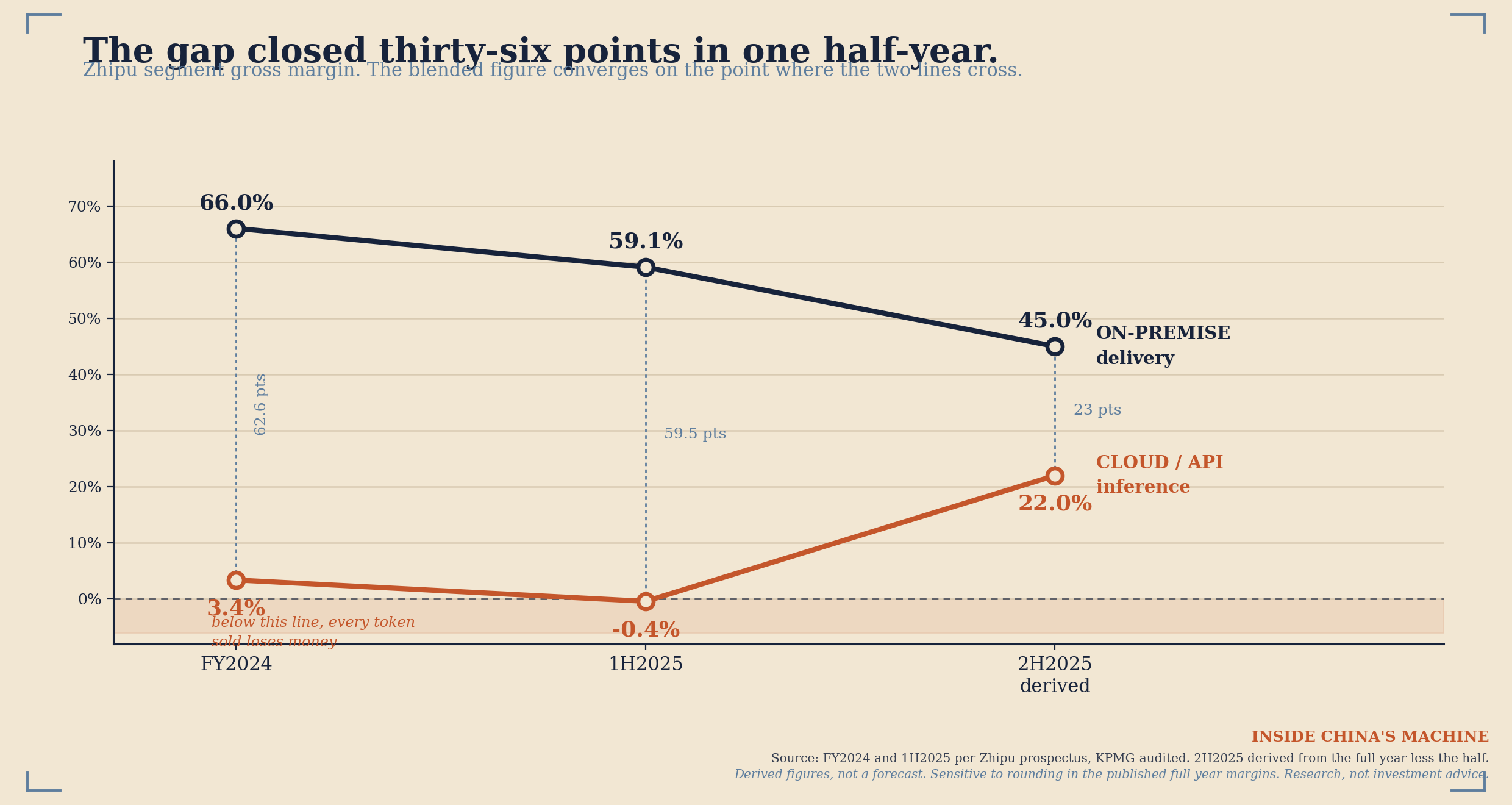
In one half-year the gap between Zhipu’s two business lines closed by thirty-six points. The high-margin line is falling and the low-margin line is rising, and they are converging on each other.
That matters because of an identity. Blended margin is on-premise margin times its revenue share plus cloud margin times its revenue share. When the two line margins are equal, the blend stops caring about the mix entirely. Zhipu’s blended gross margin is therefore converging on the point where its two lines cross, and it will get there regardless of what happens to the revenue mix.
The 49 percent full-year figure the market is anchored to is already stale. It contains a 59.1 percent first half. The exit rate is 45, and falling. The exit rate on the cloud line is 22, and rising. Naively extended, they meet somewhere in the mid-thirties.
Hold on-premise at its exit rate of 45 and vary the cloud line, and the blend looks like this.
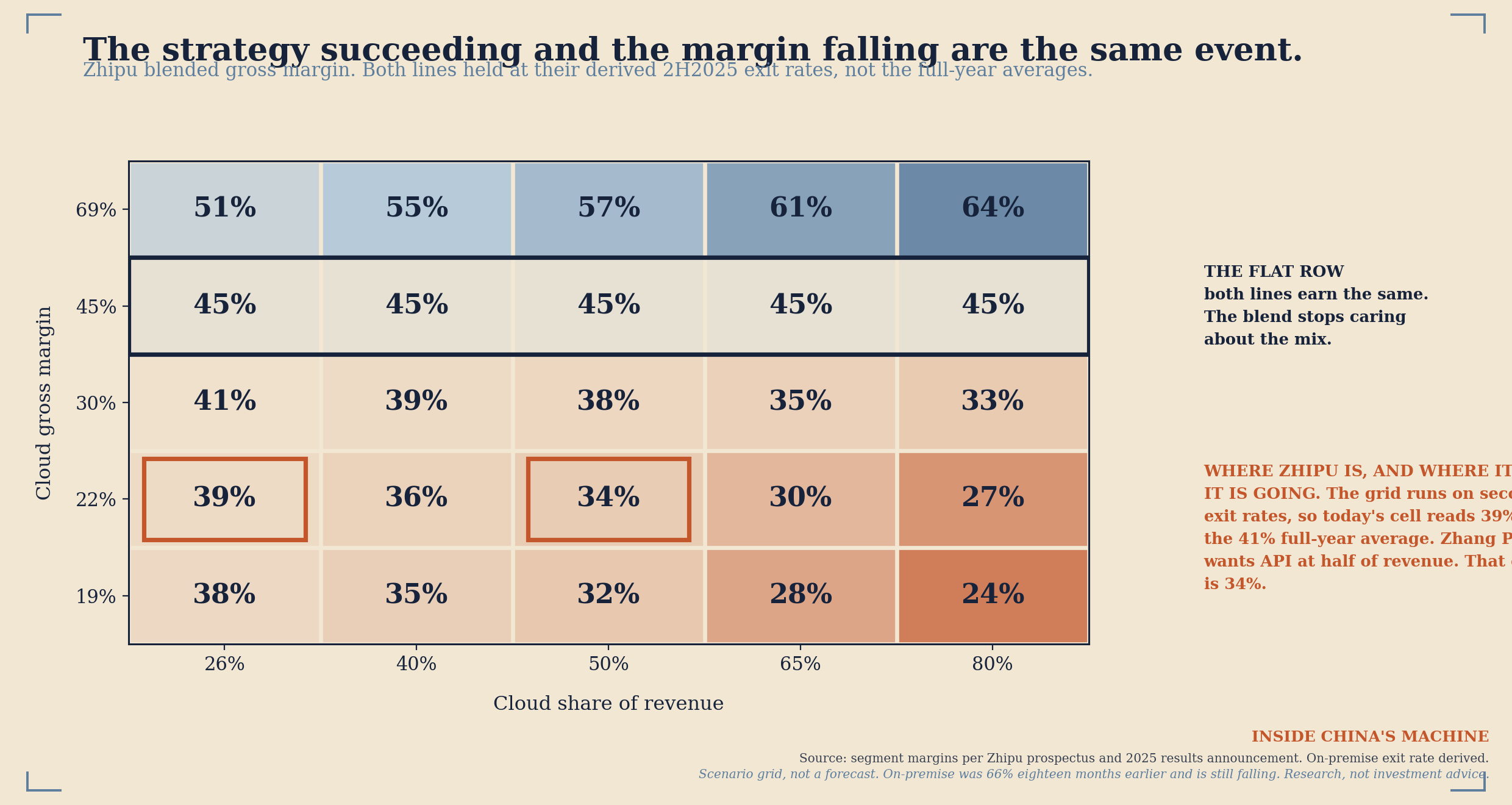
Scenario grid, not a forecast. On-premise held at its derived second-half exit rate of 45 percent, which was 66 percent eighteen months earlier and is still falling. Segment margins for full-year 2025 per broker research quoting the results announcement; half-year figures per the audited prospectus; the second-half derivation is mine.
Zhang Peng has said he wants API at half of revenue. Read the grid. At the cloud line’s exit rate, half of revenue puts the blend at 34 percent, seven points below what the market is capitalising.
The strategy succeeding and the margin falling are the same event.
Now the number that decides everything, and it is buried in the prospectus rather than the headline.
In the first half of 2025, Zhipu spent 1,145 million yuan on compute service fees inside research and development, 71.8 percent of its R&D budget. In the same six months it spent 35.8 million yuan on compute inside cost of sales.
Zhipu bought thirty-two times more compute to train with than to serve with.
The 19 percent cloud margin, and the 22 percent exit rate the bull case leans on, are earned on a serving business that consumes three percent of the company’s compute. It has never been tested at scale. Scale it ten times and the cost structure it rests on is an assumption, not a result. And the price at which that compute is bought is set by Ascend memory supply and Cambricon’s production ramp, not by GLM.
Layer on the open-source floor. DeepSeek released V4 in April, reported to run natively on Ascend and Cambricon with its Flash variant priced in single-digit yuan per million tokens. That specification comes from secondary technology press and I have not verified it against DeepSeek’s own release. If it is even directionally right, Zhipu’s 83 percent price increase has an open-source floor sitting directly above it, running on the same domestic hardware.
And then, in the week this piece was written, Zhipu answered the question itself.
On 9 July it placed new H shares at 1,588 Hong Kong dollars, a 13 percent discount to the previous close, raising 31.4 billion. That is six times what its January IPO raised. It comes after the company had already spent more than 93 percent of the IPO proceeds by the end of June. Six months of runway from a listing, then a raise six times larger.
Now read the stated use of proceeds. The two items the announcement leads with, in every account of it I have seen, are base model research and development and compute infrastructure. Commercialisation appears further down the list, and the accounts diverge on what sits beside it. I have not seen the announcement’s own allocation, and if it gives percentages I do not have them.
I do not need them. Zhipu has just told the market that twenty-seven billion yuan is going, first, into the base model and the compute to train it. That is the same place the thirty-two times ratio said the money was already going. Not into the cost of serving a token. Into the cost of training the next model.
9. What the STAR Market Will Force Zhipu to Disclose
There is a document coming that settles this, and it is worth waiting for rather than arguing about.
Zhipu’s board proposed a 15 billion yuan A-share issue on the STAR Market, with 12 billion earmarked for the base model, 2 billion for the model-as-a-service platform, and 1 billion for working capital. Shareholders approved it at the annual general meeting on 22 June 2026. Before a Chinese company can file to list domestically it must complete a supervised preparation period with a sponsoring broker, registered with the securities regulator. On 7 July Zhipu publicly denied press reports that it had withdrawn from that process, stating that the preparation is complete. MiniMax is pursuing a STAR listing of its own.
A STAR listing brings an exchange inquiry process, and the inquiry is where the Shanghai Stock Exchange forces companies to disaggregate what they would rather present blended. Cost of sales by nature, for the full year rather than the half. The unit economics of the cloud line under its commercial name. What twelve billion yuan of base-model spending actually buys.
Those are the three disclosures this piece turns on. Hong Kong required the first only up to June 2025, and the other two not at all.
10. The Best Argument Against This Piece Was Made by Zhipu, on 11 July
Tang Jie, one of Zhipu’s co-founders, circulated an internal letter on 11 July. Its reported content: while the industry rushes to monetise, Zhipu has decided to push upward instead, and will not chase near-term commercialisation of applications. The letter reached the press rather than the exchange, so treat it as reported and not as filed.
Take it at face value and the bull case becomes coherent in a way the gross margin cannot make it. A company that is not trying to earn a software margin cannot be faulted for failing to earn one. What shareholders are buying is not a cash flow. It is an option on capability. And a 1,650 percent return since January is the market saying, without ambiguity, that it was never reading the income statement in the first place.
That case is real. It is the one a reader should weigh against mine, and it may well be the one that pays.
But notice what it concedes. It concedes that the gross margin will not fix itself, and that nobody at the company is currently trying to make it. This piece has argued that the fifty points are set by silicon rather than by GLM. The letter answers that the fifty points do not matter. Those are not the same claim, and only one of them survives the day the market decides it wants to see a cash flow.
So the thesis is falsifiable on a date, by a filing, in public.
If the inquiry response shows cloud gross margin already through 40 percent, this piece is wrong and the next issue will say so, because more than half the required cost decline would already have happened and the bull case would be intact on its own terms rather than on the letter’s. If it shows compute rising as a share of cost of sales while salaries fall and the on-premise margin keeps compressing, then the 41 percent was always a services margin in retreat, and the fifty points were never about intelligence at all.
A model company’s gross margin is not set inside its model. It is set on a wafer it does not own, in a fab it does not run, under a memory ceiling it did not choose and cannot lift, and it is reported in a line item whose contents almost nobody opened. That is the machine. Zhipu is a cross-section of it, and so is the price.
Sources and Claim Types
Primary, audited. Zhipu prospectus of 30 December 2025, accountants’ report by KPMG: all segment revenues and gross margins through the first half of 2025, cost of sales by nature, research and development compute service fees. MiniMax annual results announcement of 2 March 2026, audited by EY: full-year revenue by segment, cost of sales, gross profit, the note to loss before tax, headcount.
Primary, reported through broker research. Zhipu’s full-year 2025 segment gross margins come from its annual results announcement, which I have read through Soochow Securities research quoting it rather than through the announcement itself. Those figures reconcile to the audited gross profit, which is the best check available without the filing in hand, and I have said where they are load-bearing. The Alibaba shareholding and revenue concentration reach me the same way, through research quoting the MiniMax prospectus.
Market data and July events. The placement of 9 July, its price, discount and size, the 93 percent utilisation of IPO proceeds, the 22 June shareholder approval of the A-share issue, the 7 July denial of the withdrawal reports, and Tang Jie’s letter of 11 July all reach me through Chinese financial press reporting company announcements, not through the announcements themselves. I have not read the placement announcement, and I do not have its allocation of proceeds by percentage. The accounts I have seen agree on the two items it leads with and diverge on what follows, and the piece claims no more than that. The market capitalisation and the return since listing are prices, not disclosures. They move daily, they are quoted as of 9 July 2026, and every conclusion here is about the numerator rather than the denominator. Tang Jie’s letter is internal correspondence reported by the press and is treated as reported throughout.
Company-reported, unaudited. The 83 percent price increase, the 400 percent volume increase, and the MaaS annual recurring revenue figure, all from the March 2026 results call.
Derived, mine. The second-half 2025 segment margins, the yuan-dollar comparison of the two API lines, the labour share of MiniMax’s cost of sales, the sensitivity grid, and the ratio of training compute to serving compute.
Secondary and unverified. The DeepSeek V4 specifications and pricing.
Inside China’s Machine is research, not investment advice. Nothing here is a recommendation to buy or sell any security.