Inside China’s Machine · Where China’s Tokens Go, Episode 7
In a section of the Business Review whose heading begins “Volumes Surge While Prices Rise”, the interim results Zhipu (Z.ai, HKEX 2513) published on HKEXnews on 31 August 2026 set two figures over what the filing calls “the same period”: the token invocation volume of its MaaS platform, the model-as-a-service business through which customers pay to call its models, “had increased over 40 times from the beginning of 2026”, and the average selling price of its API rose “by approximately 101%”, which by our arithmetic is about 2.0 times the starting price. The two figures have different scopes, one a platform’s volume and the other an API’s average price. The price has no stated unit, per token or otherwise, and neither measure has a level beneath it. In the volume figure, “over” marks a floor with no count behind it.
The filing also says something about what drives the business: “During the Reporting Period, the coding direction had already become the Company’s primary revenue source.” That is the firm statement, and it is a statement about revenue. The announcement has no coding segment and no coding revenue figure, so the rank comes without an amount. A second line goes further and says less: “Coding is currently the largest-consumption and most fully validated scenario.” The filing gives no level, no base and no split of consumption by scenario, and it does not say what coding is the largest of, whether tokens, calls or revenue, or on which platform.
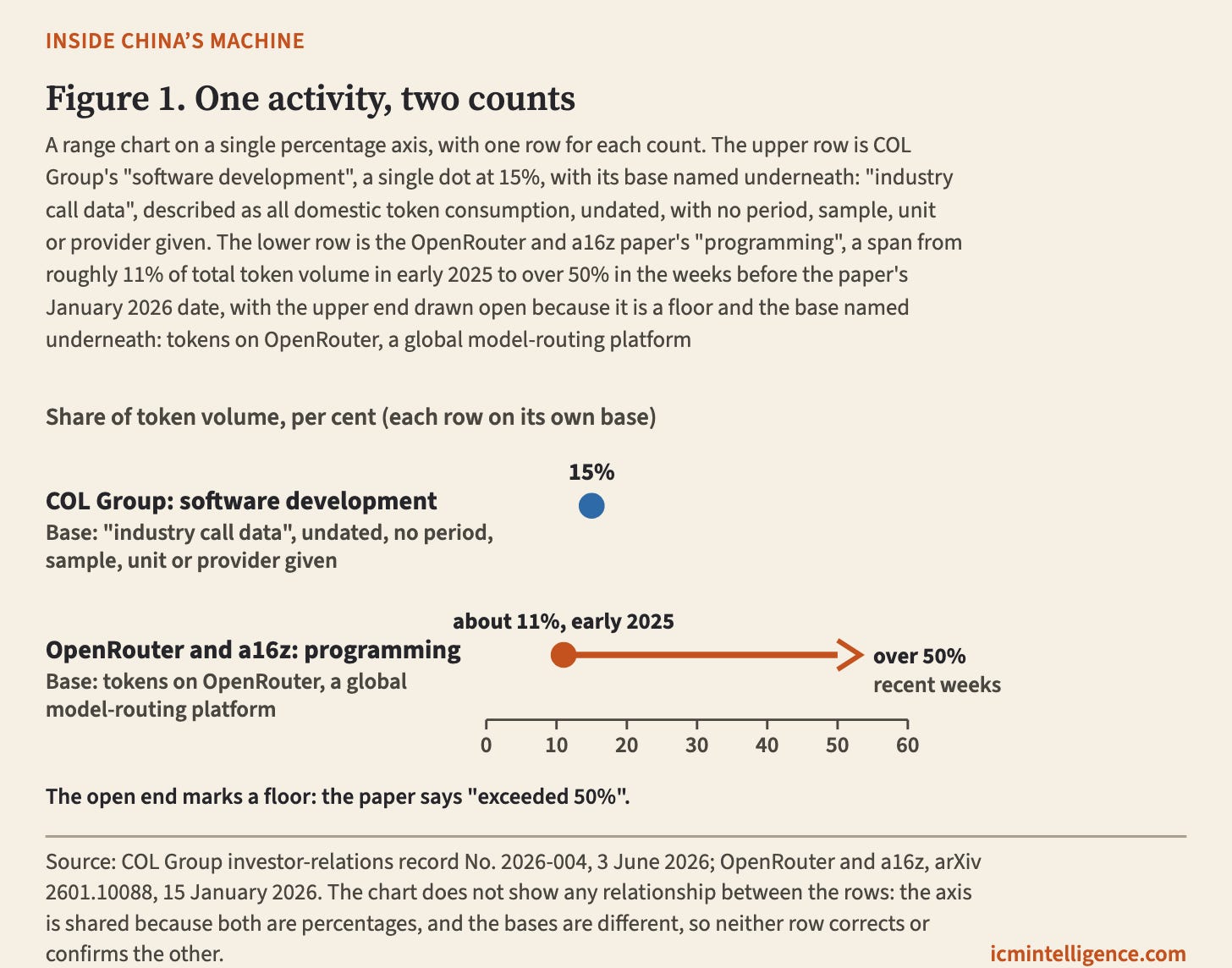
Now take the number that seems to answer the question. COL Group’s investor-relations record of 3 June 2026 says that “from the distribution of industry call data”, AI short drama and video generation takes 55% of “all domestic token consumption”, e-commerce and marketing 24%, and software development “only 15%”. That phrase, “industry call data”, is all the record says about its source. A paper by OpenRouter and a16z, posted on arXiv on 15 January 2026, offers a different count: “programming queries accounted for roughly 11% of total token volume in early 2025 and exceeded 50% in recent weeks.” Its base is OpenRouter, a global model-routing platform, and the paper says that activity there is shaped by model availability, pricing and user preferences. Call it software development, as COL does, or programming, as the paper does, and the word carries 15% in one count and over 50%, itself a floor, in another. Each figure holds only on its own base, and neither tells you anything about the other.
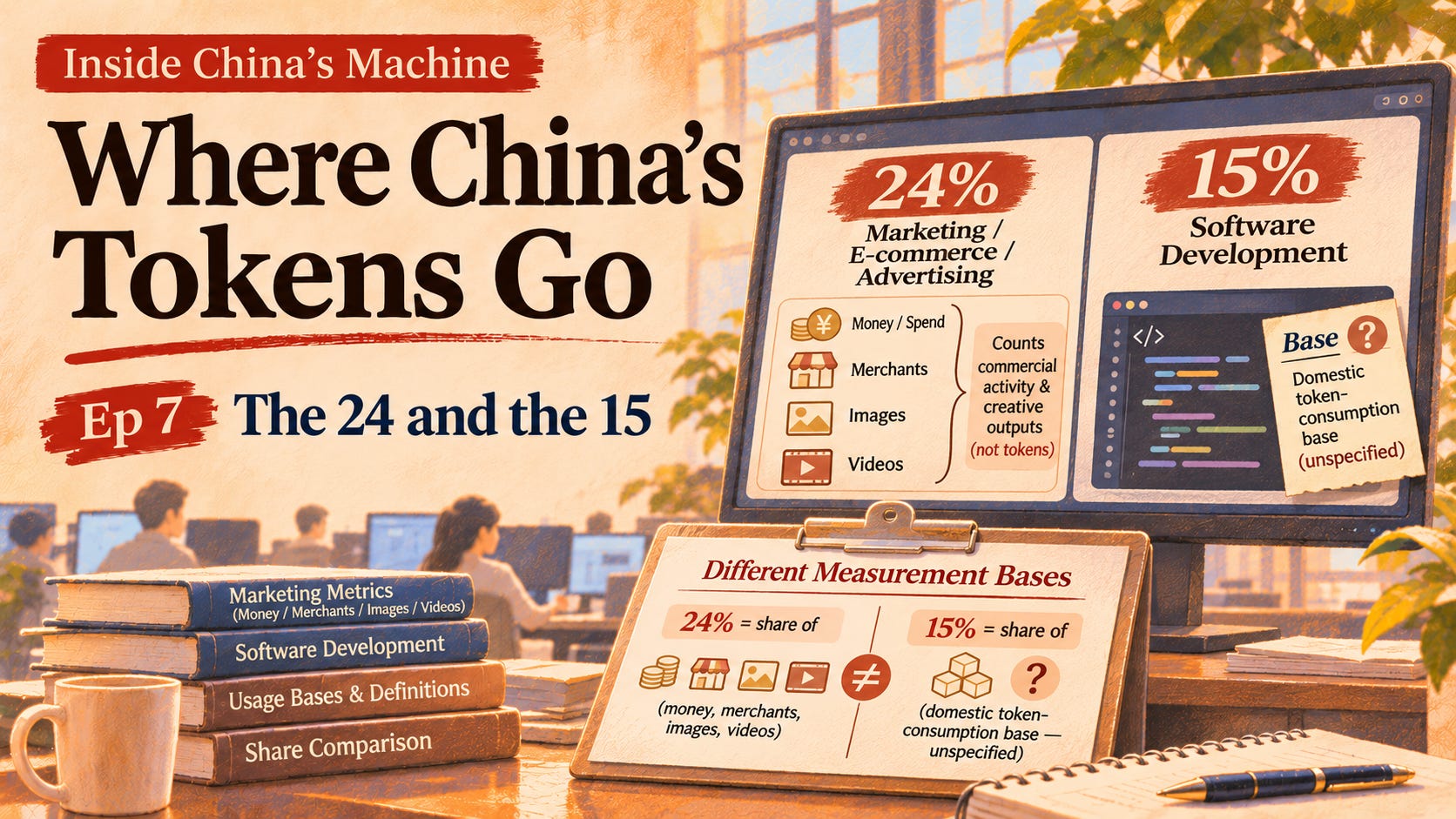
Our position is that neither the 24 nor the 15 can be read as the size of a use. The 15 is a share of “all domestic token consumption”, a total for which COL’s record gives no period, sample, unit or provider. The 24 sits on that same total and has a further problem: the marketing documents below count money, merchants, images and videos, and none of them counts tokens. Treat the 24 as unmeasured by those documents and the 15 as a statement about COL’s unspecified total, and ask of any share of tokens which platform, which unit and which period. Zhipu’s statements neither confirm COL’s 15 nor contradict it.