

The cost of a factory robot includes the people needed to keep it working. A lower purchase price reduces one part of that cost. Better autonomy can reduce another, repeatedly, for as long as the machine remains in service. Which improvement matters more depends on how much human support the task requires and whether the factory can actually remove the associated expense.
UBTECH provides a useful place to ask the question. On 21 January 2026, Reuters reported UBTECH’s statement that Airbus had purchased Walker S2 robots. Airbus told Reuters that the collaboration was at an early concept-testing stage. That description belongs to January; it should not be read as a verified account of the project’s position today. Reuters
A purchase establishes commercial interest. A production record would establish something different: how much acceptable work the machine completes, with how much assistance, at what cost. Both matter, but only the latter can substantiate a labor-saving calculation.
The financial stakes have become more concrete. UBTECH’s unaudited interim results for the first half of 2026 report RMB590.3 million in revenue from full-size embodied-intelligence humanoid robot products and solutions, representing 46.5% of group revenue. The category includes products and solutions; it is not a Walker S2-only revenue line. UBTECH interim results, printed page 3
For this article, the pivotal relationship is human support minutes per productive robot-hour. It connects a model’s ability to recover from an awkward situation to the factory’s operating bill. It also forces a distinction that shipment and revenue figures cannot make on their own: whether each additional installation requires another substantial allocation of human effort.
What this establishes
The filing establishes a reported revenue category; the product pages establish what UBTECH says its robots can do. Neither supplies a customer-validated staffing requirement. The cost comparison below is calculated from illustrative assumptions. Its economic inference depends on the weakest link: less assistance must reduce an actual expense or increase valuable output at comparable quality. Whether that happens for Walker S2 remains unresolved.
This continues ICM’s examination of what a robot-hour costs. Here the boundary is production: the human work needed to deliver an acceptable box, and the party that pays for it. The earlier article examines humans continuously driving robots to collect training data. Here, the question is how much intermittent assistance a robot needs while doing production work. A collector-to-robot ratio from the first setting cannot establish a support ratio in the second.
Define the work before counting the robots
Start with a box.
UBTECH’s Chinese industrial-solutions page lists box handling among the Walker S series’ applications. It describes carrying boxes of different sizes between pallets and production lines. This is the company’s description of an application, not customer-validated evidence of a particular installation’s productivity. It gives us a bounded task to examine without inventing an Airbus workstation. UBTECH industrial applications
For an illustrative assessment, define the job as moving an acceptable box from an agreed pickup position to an agreed destination. The payload, travel distance, permitted damage, handoff conditions, and required completion rate all belong in the definition. So does the point at which a human must intervene.
The task sounds simple until its boundary becomes explicit. Does someone straighten the boxes before pickup? Who removes damaged packaging? Does the robot recognize an obstructed destination, or does someone clear it? If the machine completes the transfer but the next process cannot use the result, should the movement count as output?
These are questions for a task study, not allegations about Walker S2. Their purpose is to make the comparison reproducible. The same payload and acceptance standard must apply to the existing process and the proposed robot cell.
A demonstration can establish that a movement is possible. A trial can expose the conditions under which it fails. Accepted production output can establish usefulness. A repeat order can show that a customer wants more. None automatically supplies the missing measurements from the other stages.
Time needs the same discipline. A powered robot can be waiting. A moving robot can be repeating a failed action. A robot completing useful transfers can still require a worker assigned to the cell throughout the shift. Count acceptable units per scheduled cell-hour alongside human support time. Otherwise, a slow machine can look impressively independent while producing too little to justify its cost.
There is also a choice before the humanoid comparison begins. The alternative might be manual handling, a conveyor, a mobile platform with a manipulator, or a redesigned process. Compare feasible systems serving the same task. Human shape is a design choice whose commercial value must survive that comparison.
The resulting question is precise: how much avoidable cost does this installation remove while maintaining the required output, quality, and operating conditions?
Autonomy has a staffing boundary
Human work enters a robot installation at different times and for different reasons. Putting all of it into a single support figure would obscure what can improve.
Integration comes first: laying out the cell, connecting equipment, teaching the task, and validating the result. For the economic model, treat that expenditure as part of installed capital and spread it across a disclosed useful life. A deployment that requires extensive initial work can still be attractive if that work is durable and inexpensive to repeat elsewhere.
Recurring support needs another ledger. It can include required supervision, remote operation, exception recovery, maintenance, calibration, and validation after software changes. Record both active work and staffing that must remain available even when nothing goes wrong. Use actual obligations and operating records to decide which categories apply.
The distinction becomes visible in battery management. UBTECH says Walker S2 can replace its own battery within three minutes and describes a system that selects swapping or charging according to task priorities. These are vendor-stated capabilities, not independently measured factory performance in this article. Walker S2 product documentation
Autonomous replenishment could remove a recurring human chore. Its economic contribution would depend on the work it displaces, the equipment it requires, and the effect on productive time. The same reasoning applies to recovering a grasp or selecting another route. Each solved problem changes a specific part of the operating process.
That is where task intelligence meets the robot’s body. In a possible failure chain, uncertain perception could produce a poor grasp; a compliant gripper could make that uncertainty tolerable; a fixture could remove it before the robot acts. Better software, better hardware, and a more structured workstation can therefore improve the same measured outcome. Their costs and transferability may differ considerably.
The useful measurement is how much human involvement remains after the whole system has been designed. It should preserve the reason for each intervention, because a maintenance stop and a planning failure call for different investments.
Even a good average cannot establish a staffing ratio on its own. Imagine, purely as an illustration, a robot requiring six active support minutes per productive hour. Dividing sixty by six produces ten. It does not establish that a worker can support ten robots.
Several machines could request help together. The worker may need to walk between them, finish an existing recovery, or remain available for another duty. Some interruptions can wait; others may stop a downstream process. The average reveals labor demand, while the distribution of interruptions helps determine staffing.
A viable staffing ratio therefore needs a defined task, a permitted delay, and an operating record. It cannot be extracted from a success-rate headline.
Price the acceptable box
The economic calculation can stay simple even when the operating process is not:
Cost per acceptable unit = annualized installed capital cost plus annual operating costs, divided by annual acceptable output.
Installed capital includes the robot, peripherals, integration, and commissioning. Annual operating costs include attributable staffing, maintenance, energy, software, and service fees. If a service fee already includes a technician’s work, do not add that labor again.
Downtime usually enters through reduced acceptable output. Additional losses, such as scrapped material or disruption elsewhere in the plant, belong in the numerator only when they have not already been counted. The calculation should make it possible to trace every cost back to a payment, resource, or stated assumption.
Here is an Estimated illustrative scenario, constructed for arithmetic rather than inferred from UBTECH or any customer. All input figures are assumptions. Currency is RMB, with no claim that the amounts reflect prevailing Chinese prices or wages.
Assume a cell’s robot purchase costs RMB500,000 and other installed capital costs RMB100,000. Spread both over five years with zero residual value and no financing charge. Annual support staffing costs RMB180,000, other operating costs RMB60,000, and annual acceptable output is 600,000 boxes.
Annualized capital is then RMB120,000. Total annual cost is RMB360,000, or RMB0.60 per acceptable box. That establishes a baseline for sensitivity analysis, not a claim of attractive payback: we have not assigned a cost to the existing process.
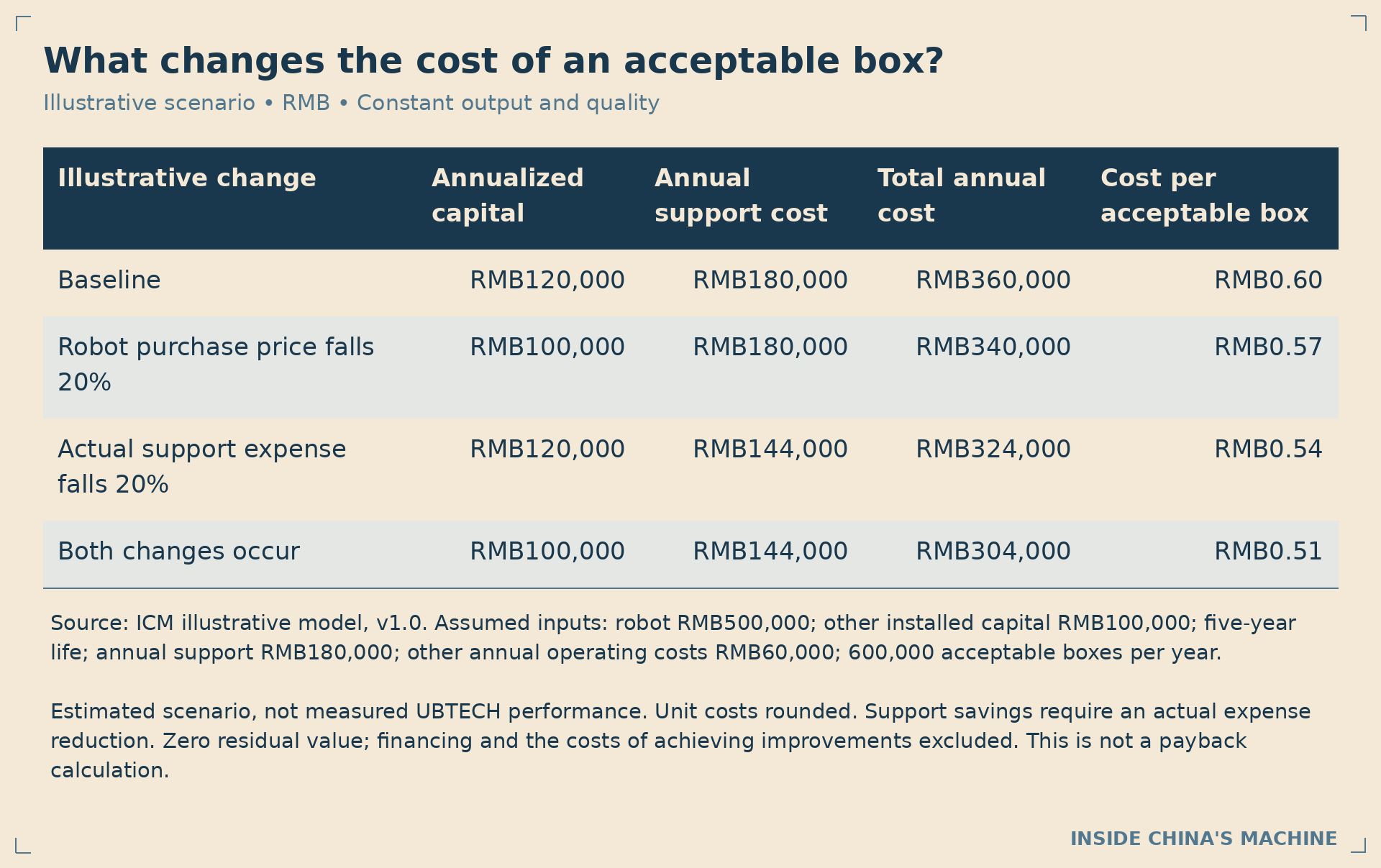
Estimated scenario, not measured UBTECH performance. Other annual operating costs remain RMB60,000; annual acceptable output remains 600,000. Per-box results are rounded. Support savings assume an actual reduction in recurring expense without a reduction in throughput or quality. Costs of achieving the improvements are excluded and must be added for an investment decision.
Test the assumptions. The companion cost calculator lets you change the purchase price, installed capital, useful life, support expense, and acceptable output. Its default figures reproduce this illustration; they are not measured UBTECH costs.
Under these assumptions, the hardware discount saves RMB20,000 annually after the purchase saving is spread over the assumed life. The support reduction saves RMB36,000 annually. The second is larger because the support bill exceeds the annualized robot purchase cost, not because autonomy is intrinsically more valuable than hardware.
The break-even relationship makes that limitation explicit. For equal percentage reductions, unchanged output, and the simple capital treatment above, support savings exceed purchase-price savings when annual avoidable support expense exceeds robot purchase price divided by useful life. Different financing, residual values, upgrade costs, or output effects change the comparison.
The result can reverse. If annual support expense in the same example were only RMB60,000, reducing it by 20% would save RMB12,000. The identical purchase-price reduction would still save RMB20,000 annually. Hardware would matter more.
It can also fail to appear in cash. A model update that cuts active recovery time by 20% may leave the same worker assigned to the cell. Then the support-cost row does not apply. The benefit might instead be more output, less overtime, lower strain, or capacity to handle another task. Each has to be measured on its own terms.
Nor does this table compare the return on engineering investment. A hardware discount and a reduction in support expense may cost very different amounts to achieve. A factory evaluating an upgrade must include its price and disruption. A supplier deciding where to spend research money must include development cost and the number of installations over which it can recover it.
The table identifies the variable worth investigating. Operating evidence determines whether the assumed saving exists.
Follow the bill across the contract
Once a factory can produce the same acceptable output at lower cost, a second question opens: how much of that improvement reaches the robot supplier?
UBTECH’s interim filing offers a useful accounting boundary. Its expense-by-nature note aggregates costs across cost of sales, selling, administrative, and research expenses. It separately lists an after-sales repair-service accrual. Neither that note nor the broad humanoid revenue category supplies a Walker S2 installation-level support account. This reading concerns those specific disclosures, not an assertion that the company has published no operational information elsewhere. UBTECH interim results, printed pages 3 and 40
The contract determines how operating burdens are divided. Under an outright sale, a supplier could collect the purchase price while the customer pays for routine operation. Warranty and integration obligations can still leave substantial work with the supplier. Under a service agreement, a recurring fee may cover specified support while excluding other work. Under an output-based arrangement, the supplier may bear more of the risk that the robot produces too little.
Those are possible structures, not descriptions of UBTECH’s Airbus agreement. The commercial terms needed to make that attribution have not been established here.
The distinction matters because identical customer savings can produce different supplier earnings. A fixed service fee can become more profitable if reliable operation reduces the supplier’s actual support expense. A competitive renewal could pass much of that saving back to the customer. A discount on the next robot could do the same. Technical improvement creates value; pricing and obligations determine who retains it.
Cash timing adds another dimension. Where payment depends on installation or acceptance, a longer commissioning period can leave the supplier funding equipment and engineering work before collection. Where a customer prepays, the funding burden can shift. Without the terms, revenue alone cannot tell us which situation applies.
Before assigning the benefit to model improvement, test the other explanations against the same operating record:
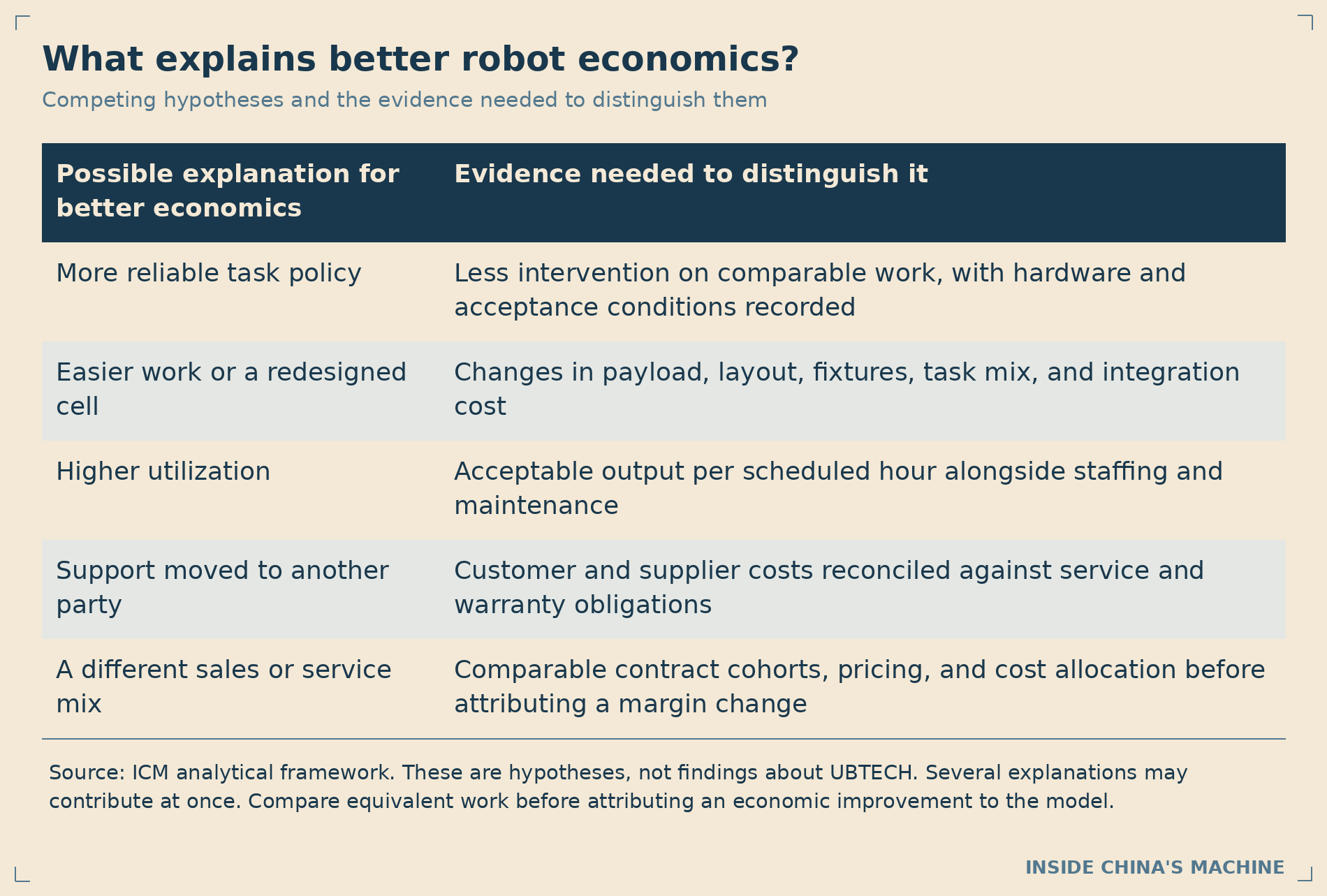
These are competing hypotheses, not findings about UBTECH. Several could contribute at once.
My capital judgment is conditional but consequential: delivery growth deserves a stronger earnings interpretation when repeat installations require less incremental support and the supplier retains some of the resulting benefit. If each installation still requires substantial bespoke work, the model should carry that labor and cash requirement alongside the sales forecast.
The earnings interpretation should follow the cost structure of the business being sold. A hardware company, an integration business, and a provider of guaranteed productive work can all be valuable. They earn their returns through different obligations.
Assistance can purchase a better next deployment
There is a strong reason to tolerate substantial support early: the assistance may help train the system.
Berkeley’s HIL-SERL research provides a concrete mechanism. Its published workflow combines demonstrations with human interventions during reinforcement learning. The researchers describe reducing intervention as the learned policy achieves greater task success and faster cycles. This is primary research evidence for a learning method, not evidence about UBTECH’s implementation or commercial fleet economics. HIL-SERL research project
The commercial possibility is straightforward. A correction made at one installation could help prevent similar failures later. If improvements transfer, early support expense can contribute to a capability whose value extends beyond the original customer.
But training expenditure and routine operating expenditure must remain distinguishable. Calling assistance “data collection” does not establish that it improves the next deployment. The evidence would be a comparable task performed with less intervention, less setup work, or better output after the update.
A convincing comparison would track recovery frequency, recovery duration, acceptable throughput, and required staffing together. It would also record changes to the gripper, fixtures, layout, payload, and acceptance standard. Otherwise, an easier task could be mistaken for a more capable model.
Engineering the environment is a legitimate success. A fixture that makes box pickup reliable may produce a better return than a more general policy. Its commercial limits are different: the fixture may need redesign for a new box or a new workstation, while a transferable policy could reduce work across several settings. The cost of that difference belongs in the expansion plan.
The next installation is therefore a particularly informative test. Does it inherit the earlier improvement, or does another team spend comparable time teaching and adapting the system? Does the customer need fewer paid support hours, or do engineers simply complete a more demanding task with the same resources?
Both outcomes can create value. Only the first supports a claim that support requirements are falling for equivalent work. The second requires a different calculation, based on the additional capability sold.
The strongest positive case for humanoids is not that they never need help. It is that help produces improvements that can be reused, and that reuse eventually changes the cost of deployment.
The answer belongs to an operating record
How many robots can one worker support? The evidence reviewed here does not establish a numerical answer for Walker S2. It establishes a commercial case worth investigating, a documented application to examine, and a set of costs whose allocation matters.
The decisive disclosure would pair a customer-validated operating period with the relevant service terms. It would identify the task, acceptable output, scheduled hours, staffing, interventions, and downtime. It would show whether reduced assistance changed an actual expense or increased valuable output. The contract would identify which party paid for the work that remained.
That record could strengthen the investment case. Low support requirements and repeatable commissioning would make the purchase price a more useful guide to installed economics. A measurable decline in support across comparable deployments would give the learning argument commercial weight.
It could also weaken the particular thesis advanced here. If recurring support is already inexpensive, hardware and integration costs may dominate. If staffing cannot fall, autonomy may create value through throughput or capability instead of payroll savings. The analysis should follow the measured benefit.
At the factory floor, the layers of China’s physical-AI stack meet in a practical result. The model must choose an action, the body must execute it, and the cell must deliver acceptable work under a cost structure the customer can repeat. The supplier must be able to support that repetition profitably.
The next box matters because it tests whether all of that can happen again, with less help.
Research boundary: This article develops a task-level economic framework. It does not estimate UBTECH’s actual intervention rate, factory payback, or Walker S2 margin. Company disclosures, reported statements, and illustrative estimates are distinguished below.
Inside China’s Machine is independent research, not investment advice.