

A price is being set right now, and it is hiding a contradiction
Unitree Robotics is being priced right now. China’s securities regulator cleared it for registration on Shanghai’s STAR Market in early July, and the company is finalizing its underwriting and share subscriptions for a debut that could come as early as late July. The band being discussed puts it near 42 billion yuan, roughly 6 billion dollars, on a raise of about 4.2 billion yuan. The shares have not priced yet.
That number is not a fact. It is a claim, and it is being negotiated right now between underwriters, institutions, and a regulator that fast-tracked the whole review in 73 days, the quickest on record under the STAR Market’s pre-review mechanism. This is the first time a pure-play humanoid maker will be priced on China’s mainland public market rather than by a venture round. Whatever number gets set becomes the benchmark every other humanoid maker is measured against.
So it is worth asking what the number is actually paying for. Because the case for Unitree being cheap and the case for Unitree being expensive rest on two different layers of the same machine, and almost nobody is pricing the seam between them.
The 60 percent margin is an actuator, not a robot
Start with the number the bulls love. Unitree runs a gross margin around 60 percent. In a field where most makers lose money outright and burn venture cash to ship at all, a 60 percent gross margin looks impossible. The lazy explanations reach for subsidies or cheap labor. Neither is the reason.
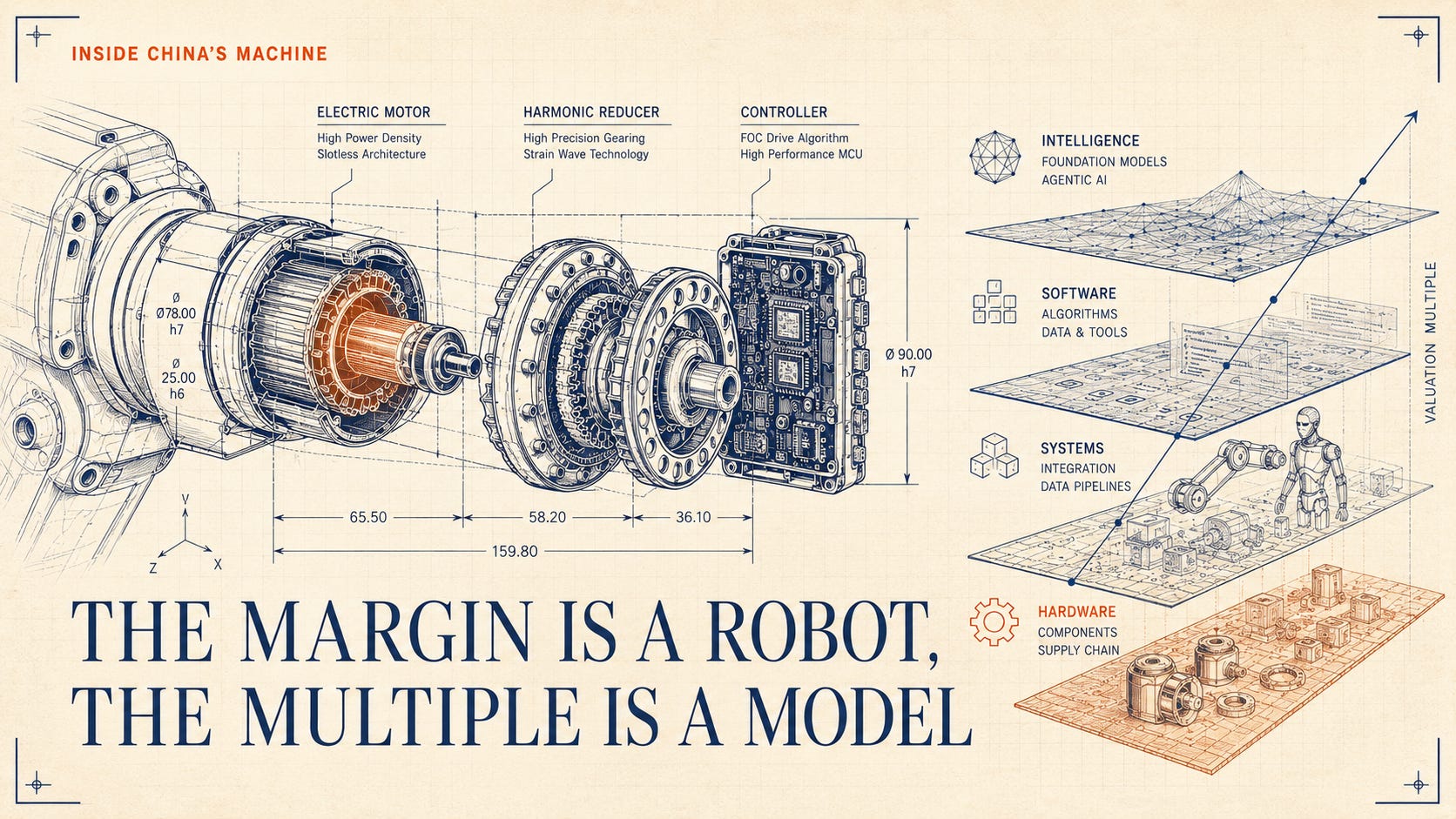
The reason is that Unitree makes its own actuators. In a humanoid robot, the actuator is the joint: the motor, the reducer that turns fast low-torque rotation into slow high-torque motion, and the controller that commands it. A humanoid needs dozens of them, and they are typically the largest and hardest-to-source part of the bill of materials. Most robot companies buy these, and the highest-precision reducers have long come from a short list of Japanese suppliers, Harmonic Drive and Nabtesco chief among them, at a price that quietly sets the floor under everyone’s cost structure.
Unitree does not buy them. It designs and builds the motors, the reducers, and the controllers in-house, the same components it also sells to other robot makers. That vertical integration is the main reason its gross margin climbed from 44 percent in 2023 to 57 percent in 2024 to roughly 60 percent in 2025 while the field around it stayed underwater. The margin is real. It is also, precisely, a hardware achievement. It lives at the bottom of the stack, in metal and torque, in the layer that turns silicon and precision manufacturing into a moving body. Read correctly, the 60 percent is not a robot margin. It is an actuator margin wearing a robot’s clothes.
The price tag is not for the robot you can see
Now look at what the IPO is actually being sold as. Unitree is not being marketed to the STAR Market as a company that makes very good hardware cheaply. It is being marketed as China’s first listed embodied-intelligence pure-play. The prospectus earmarks the proceeds for AI model research, robot body development, new product lines, and a smart manufacturing base. The order matters. The intelligence comes first.
The valuation follows the marketing. At the discussed band, Unitree would list at a forward price-to-sales multiple in the low-to-mid twenties on its 2025 revenue of about 1.7 billion yuan. That is not a hardware multiple. Comparable robotics names on China’s own STAR and ChiNext boards mostly sit in the mid-teens on revenue, and only the highest-growth names push past that. A multiple in the twenties is an option premium. The market is not paying for the actuators. It is paying for the belief that Unitree climbs from making bodies to making the intelligence that runs them, and that physical AI becomes a software business with hardware distribution.
The shareholder roster tells you serious money believes it. Meituan-linked entities hold the largest external stake at close to 10 percent, Sequoia China sits behind them, and Tencent, Alibaba, and Ant are all on the register. This is not a crowd that pays a hardware multiple for a hardware company. They are buying the climb.
The prospectus already priced the collision, and almost nobody read it
Here is the seam. The 60 percent margin is a body-layer fact. The twenties multiple is an intelligence-layer bet. And the two are not independent. The climb from one to the other is paid for out of the first.
Building embodied models is not a hardware activity. It is a compute-heavy, talent-heavy, loss-making activity, and the money to fund it comes out of the same hardware margin that makes the stock look cheap. This is not a theory. The collision already has its first data point, and it is sitting in the filing that everyone celebrated.
In the first quarter of 2026, Unitree’s revenue grew about 68 percent year on year. Its adjusted net profit fell 52 percent over the same period. The gap between those two numbers is the entire thesis of this article. Revenue is climbing and profit is falling because research and sales spending surged, directed by the company’s own account at robot hardware, embodied-intelligence large models, and motion-control algorithms. The intelligence layer is already eating the body layer’s margin, in the quarter, on the record, before the stock has even priced.
There is a second crack worth naming. For a company being valued as an AI franchise, Unitree’s defensible intellectual property is thin. It holds a few hundred registered patents and only around twenty domestic invention patents, having leaned historically on trade secrets. Management flagged this itself as a risk to fending off cloning in a domestic price war. A hardware lead can be out-manufactured. A software franchise is supposed to be defended by something. The filing is honest that the something is not yet there.
The valuation does not break on revenue. It breaks on a question.
This is where a hardware writer stops and a stock newsletter never starts, so let me be precise about where the risk actually sits.
The risk is not revenue. Unitree’s growth is not in doubt. It ranks first in the world by 2025 humanoid unit shipments in its own prospectus, it has a genuine product in the G1, and the demand curve for the next several years is not the question. Anyone pricing downside off a revenue miss is watching the wrong number.
The risk is the margin, and specifically the direction it now faces. A 60 percent gross margin is the load-bearing assumption under a 6 billion dollar valuation. That margin was earned at the body layer. The valuation demands the company spend it climbing to the intelligence layer. Every quarter of that climb applies gravity to the exact number the whole price rests on, and the first quarter of evidence shows the gravity is real and it is not gentle.
So the valuation does not break if Unitree sells fewer robots. It breaks on a single question: can a hardware margin survive being spent on a software race? At what rate of margin compression does the multiple stop being an AI option premium and start being an expensive way to own a manufacturer that is now also carrying a research lab it has to feed?
That question has a number attached to it. The margin trajectory, the research intensity, and the multiple’s sensitivity to both can be modeled, and the model tells you where the 6 billion dollar assumption actually lives and how far it can move before it does not hold. That teardown, the sensitivity table and the position it implies, is the work behind the paywall. It is the next issue.
The whole machine is on the tape for the first time
Step back, because Unitree is not really the story. It is the first instrument.
China is assembling a full stack of physical intelligence. Silicon is the substrate. The actuator is where silicon and precision manufacturing become a body. The body is where intelligence gets somewhere to live. And a factory floor is where all of it is supposed to land as capacity. Unitree is the first company in that stack to be priced by a public market on the mainland, which means this IPO is a live experiment in whether anyone knows how to value the seam between one layer and the next.
The evidence this week is that they do not yet. The market is pricing the actuator as if it were the model, and the model as if the actuator would keep paying for it forever. Those are two different layers of one machine, and the price being set right now assumes they are the same thing.
They are not. That gap, between what a layer is and what the market thinks it is, is the whole beat of this publication. We will read it one layer at a time.
Inside China’s Machine is research, not investment advice. Figures are drawn from Unitree’s STAR Market prospectus and filings as reported by Caixin, the Shanghai Stock Exchange, the South China Morning Post, TechNode, and other primary-sourced outlets, current as of July 10, 2026.