

The Allocation That Ignores the Income Statement
Of the robot makers now queued at China’s exchanges, Deep Robotics is the one whose business is built on robots holding jobs. Nearly 79 percent of its quadruped and wheeled-leg revenue over the past three years came from industry deployment: machines inspecting substations, entering fire scenes, walking police patrols, and crossing steel-mill floors. That revenue turned the company profitable in 2025, with RMB 28.7 million of net income on RMB 337.5 million of sales, and it did so on motion control, the layer of embodied intelligence the industry calls the cerebellum. Deep Robotics is the purest available proof that the cerebellum, on its own, is already a business.
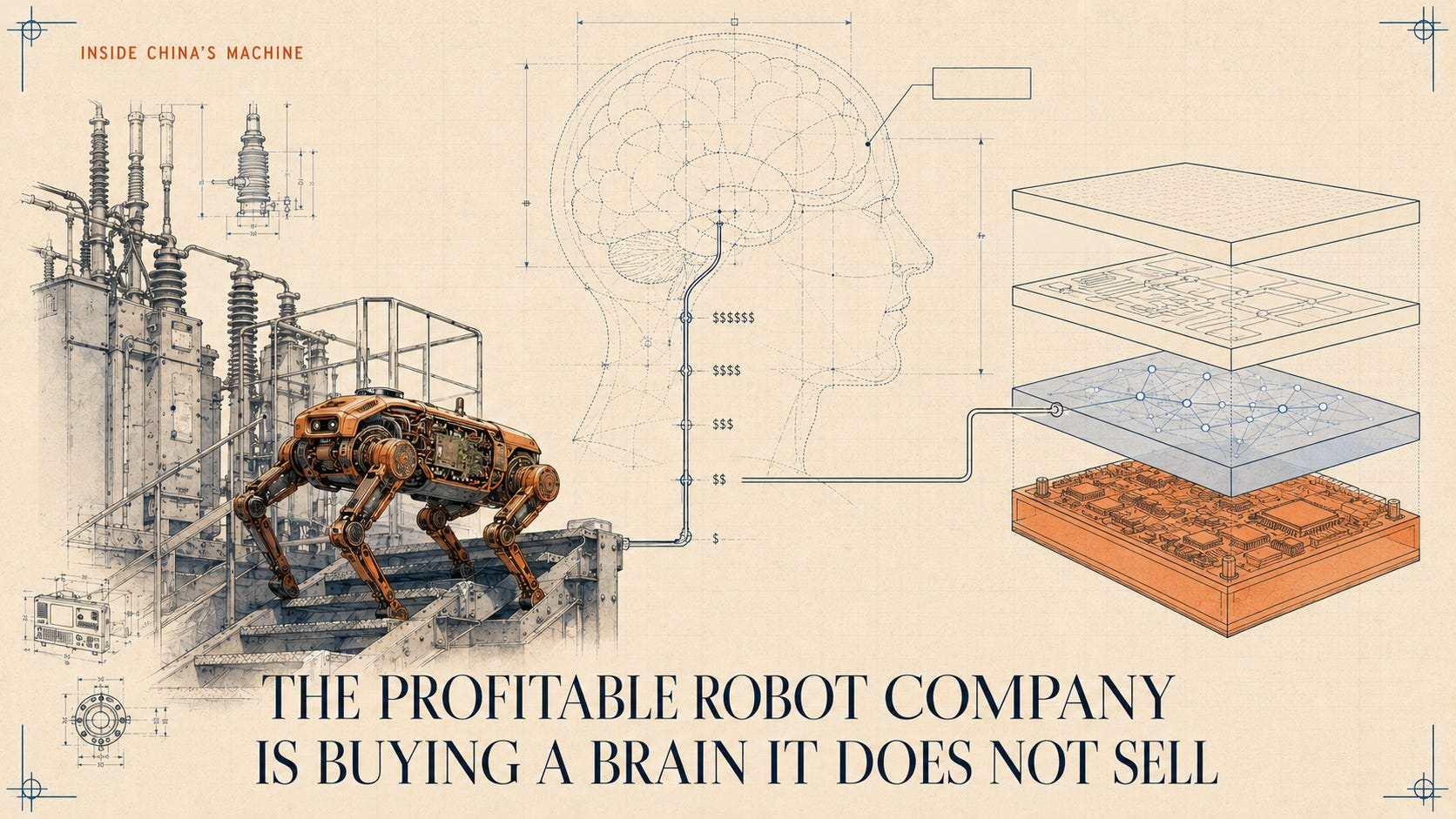
Now read the company’s fundraising table. Of the RMB 2.50 billion it is asking the STAR Market for, RMB 1.17 billion, which is 46.72 percent, goes to a single project: embodied algorithm and model research. The brain. The same filing reports that the company’s humanoid line, the product family a brain would ultimately animate, generated RMB 823,000 of revenue in 2025. That is 0.24 percent of sales, and it is lower than the year before. The model earmark is one thousand four hundred and twenty times the size of the revenue line it points at.
One company making that bet would be a strategy. What makes this a piece is that they are all making it, in nearly the same ratio. Unitree, whose revenue mix is the opposite of Deep Robotics’ in almost every way, earmarked 48.13 percent of its own STAR raise for model development. Leju, whose largest customer scenario is government data collection centers, directed 59.84 percent of its ChiNext raise to its research center and dataset projects combined. Three companies, three incompatible business models, one capital allocation. The income statements diverge and the fundraising tables converge, and the convergence is the finding: this is not a company’s strategy, it is a layer’s configuration, and the rest of this piece is about what enforces it and what it costs.
What a Cerebellum Business Looks Like When It Works
Before pricing the bet on the brain, establish what the working business actually is, because it is the only one of its kind with audited numbers.
In the industry’s own anatomy, the brain is the slow system: multimodal understanding, task decomposition, long-horizon planning. The cerebellum is the fast one: turning intent into joint torques, keeping the machine upright on stairs and rubble, recovering from a slip in milliseconds. Brains are where the frontier research lives. Cerebellums are where the products live, and Deep Robotics has spent eight years on exactly that layer, through three control paradigms the prospectus lays out in sequence: virtual model control to get robots walking outside a lab, model predictive control fused with whole-body control to cross unstructured terrain, and reinforcement-learning locomotion from 2023 onward to make the crossing robust to mud, gravel, and impact.
The commercial result is a machine that holds a job a human is glad to give up. A substation inspection route covers stairs, cable trenches, and equipment gaps that wheeled robots cannot pass, in weather a human inspector should not be out in. A collapsed building or a smoke-filled corridor is a place fire commanders would rather send a machine first. The filing counts the deployments product line by product line: over 300 units sold into power inspection across more than 100 State Grid and Southern Grid substations, over 150 into fire and emergency response units nationwide, over 300 into police and border systems, roughly 300 into industrial inspection at steel, aluminum, and warehouse sites, and about a hundred more across water, rail, and construction infrastructure. Cumulative production has passed 5,500 units, with 2,908 quadrupeds and wheeled-leg machines sold in 2025 alone.
The economics moved with the deployment mix. Gross margin climbed from 33.48 percent in 2023 to 38.76 percent in 2024 to 52.83 percent in 2025, and the company crossed into profit with RMB 15.1 million of net income even after stripping non-recurring items. Set that against the comparison table in its own filing: Unitree’s cumulative quadruped revenue splits roughly 40 percent research and education, 31 percent consumer, and 29 percent industry application, while Deep Robotics runs 79 percent industry application. Unitree books far more revenue and profit in absolute terms. But its business is substantially selling robots to people who study robots or play with them. Deep Robotics’ business is selling robots to people who put them to work, and the recurring, spec-driven, tender-based nature of that demand is what a hardware investor means when they say a market has arrived.
That is the cerebellum thesis, complete and profitable: motion control plus ruggedization plus scenario integration, sold into jobs that exist today. Hold that picture, because the fundraising table is about to walk away from it.
The Brain on the Books
The brain, as it appears in Deep Robotics’ audited statements, is RMB 823,000 of revenue. The DR series humanoid line booked just over RMB 1.1 million in 2024, its first year, and RMB 823,000 in 2025, its second. The line went backward in the year the company’s overall revenue tripled. The second-generation DR02, an IP66-rated outdoor humanoid aimed at power line work and emergency response, launched in October 2025, and the filing describes the whole humanoid effort, accurately, as at the start of commercialization.
The honesty runs deeper than the revenue line, and this is the passage that makes the filing a primary source for the whole series. In its industry analysis, Deep Robotics states that the scarcity of high-quality scenario data is the core bottleneck constraining system optimization, and that unlike language models and autonomous driving, which accumulated massive data, the embodied intelligence industry has not yet formed a data feedback mechanism at application scale. It states separately that embodied foundation models remain unconverged across visual-language models, visual-language-action models, and world models, with no unified technical direction or industry consensus, and that these models are not yet applied at scale in the company’s own products.
Read those sentences as what they are: a legal document, signed by the issuer and its sponsor, asserting that the input the brain needs does not yet exist at scale and the architecture the brain will use has not been chosen. This publication has traced the other side of that hole, the state-funded data collection centers now being built to manufacture exactly the missing feedback, where local government capital is buying robots to produce training trajectories ahead of any market that pays for them. Deep Robotics’ filing is the demand-side admission that matches that supply-side construction. The company proposing to spend RMB 1.17 billion on models is telling you, in the same document, that the fuel for those models is the industry’s binding constraint.
So the humanoid brain, at filing, is a product line with negative momentum, an unconverged architecture, and an input the issuer itself calls scarce. Against that, RMB 1.17 billion. The gap between those two facts is not an oversight. It is the industry’s actual belief structure, written in capital.
The Consensus and Its Enforcer
Line the three fundraising tables up. Unitree: 48.13 percent of the raise to model development, on a business that mints profit from research-lab and consumer sales and books RMB 877 million of humanoid revenue. Deep Robotics: 46.72 percent to models, on a business that profits from industrial deployment and books RMB 823,000 of humanoid revenue. Leju: 59.84 percent to its research center and dataset build combined, on a business whose hardware demand comes largely from state data infrastructure. One seller of research platforms, one seller of working machines, one seller into government data centers. Their model allocations sit inside a fourteen-point band, and two of them within a point and a half.
When companies with opposite income statements file near-identical capital plans, the explanation is not in the companies. It is in the system routing the capital, and the filing shows that system operating on Deep Robotics directly.
In December 2025, the National Artificial Intelligence Industry Investment Fund, the state’s dedicated AI capital vehicle, took 14.4 million shares of Deep Robotics, 3.81 percent of the pre-IPO company. It did not simply buy stock. The filing discloses that the fund, the company, and the controlling shareholder signed a memorandum setting out strategic target commitments on technology, products, and business, with supplementary information rights and liability for breach. The state’s money arrived with a contract about direction. In the same round, China Telecom’s investment arm joined the register; the fifteenth five-year plan proposals had already named embodied intelligence a future industry, with the full plan confirming it in March; and the STAR Market stood ready to refinance the whole layer at scale. Every element of that machine rewards one configuration: keep the profitable body business as the qualifying credential, and lever the raise into the brain, because the brain is the layer the state’s industrial strategy has designated as the contested ground.
Say what this is and is not. It is not companies being forced to misallocate. A rational board, watching foundation-model progress and holding a mandate to survive architectural convergence, might well choose the same split unprompted; the bet is defensible on its own terms. But the uniformity is not organic. It is the signature of a financing system that has made one answer cheap and every other answer expensive, the same institutional machine this publication has watched build fabs ahead of demand and data centers ahead of data markets, now allocating the intelligence layer through the fundraising tables of hardware companies. The physical machine and the institutional machine, one moving because the other pushes.
The free layer ends here with the structure established: a profitable cerebellum business, a pre-revenue brain, a near-uniform allocation across incompatible companies, and a state enforcement mechanism visible in the shareholder register. What remains is the question an investor actually holds: when this company prices, which of the two businesses is the valuation buying, and what would make the answer checkable.
Which Business Is the Valuation Buying
Two price marks exist, and the distance between them is the brain premium made visible.
The first mark is private and recent. In December 2025, the C-round investors, the state AI fund among them, paid RMB 607.17 per unit of registered capital, which against the 8.235 million units then outstanding implies a valuation on the order of RMB 5.0 billion. The state fund’s own entry at RMB 13.89 per share on the post-conversion share count implies roughly RMB 5.3 billion. Call the private mark five billion, dated December 2025, both figures derived from disclosed entry prices rather than stated by the company.
The second mark is arithmetic the filing implies but does not state. The company will issue no fewer than 82.98 million new shares, no less than 18 percent of the post-issue total, and it is asking for RMB 2.50 billion. If the full raise is achieved at the minimum float, the implied post-money value is RMB 2.50 billion divided by 18 percent, which is roughly RMB 13.9 billion. Treat that as a ceiling estimate of what the ask implies, not a prediction of pricing; the actual number waits for the offering. But run the multiples on it, because they are the point. RMB 13.9 billion is about 41 times 2025 revenue and about 485 times 2025 net profit, for a company whose profit engine is a hardware deployment business.
No deployment hardware business carries 485 times earnings. The cerebellum business, valued as the excellent niche industrial it is, supports some fraction of that number; everything above the fraction is the market pricing the brain, the RMB 823,000 product line backed by the RMB 1.17 billion earmark. Which means the multiple, whatever it prices at, will be a measurement of exactly one belief: that the model bet converts before the money runs out, in an industry whose own filings say the data feedback loop does not exist at scale yet.
Follow the sensitivity in both directions. If the brain option expires worthless, the downside floor is the cerebellum business, real, growing, 53 percent gross margin, but small: a few hundred million yuan of revenue growing off a base of substations and fire brigades, with the RMB 1.17 billion of model spending converting to burn. If the option pays, Deep Robotics holds something none of its brain-first competitors have: a fleet already employed in the field, which is to say a proprietary data feedback loop of exactly the kind its filing says the industry lacks. The more than one thousand machines the filing counts at work in grids, fire scenes, and factories are, in that scenario, not the old business. They are the data plant. The cerebellum revenue and the brain bet stop being separate businesses and become one loop, and the company’s 79 percent deployment mix, the thing that today makes it look conservative next to Unitree, becomes the scarcest asset on the cap table.
That is the honest shape of the trade: a profitable floor, a binary premium, and a conversion condition, data at scale from deployed machines, that this publication’s robot-hour work is attempting to price from the outside. The one thing the multiple cannot claim to be is a valuation of the business that currently makes the money.
The Two Inquiries
The thesis is checkable, and the checking mechanism is already scheduled twice.
Deep Robotics’ application was accepted by the Shanghai exchange on May 18. Unitree’s is in the same queue. Two inquiry processes, run by the same exchange on the same layer in the same season, will force the disaggregation this piece is built on, and they will do it in public documents.
Watch the Deep Robotics response for three things. First, the milestone structure of the RMB 1.17 billion model project: what the exchange accepts as success criteria for spending 46.72 percent of a raise on a product line with RMB 823,000 of revenue, and what timeline the company commits to for the humanoid commercialization it currently describes only as begun. Second, the data question: whether the exchange forces the company to reconcile its own statement that no at-scale data feedback mechanism exists with a project plan whose returns depend on one, and whether the deployed fleet is formally claimed as the data source. Third, the consistency test across the queue: whether Unitree’s inquiry produces materially different milestone discipline for a near-identical allocation, which would reveal whether the exchange is pricing the configuration or merely processing it.
The outcomes map. If the responses force hard milestones, dated humanoid revenue commitments, and explicit data-sourcing plans, the configuration consensus acquires a governance structure, and the brain premium becomes a monitorable bet rather than a mood. If the responses accept the allocation with soft language, the STAR Market is confirmed as the enforcement layer of the consensus rather than a check on it, and the premium is policy, not analysis. The middle case, hard questions and soft answers, is the likeliest, and it would leave the burden of verification exactly where it currently sits: on the fleet, in the field, in whether working robots can be turned into the data their own successors require.
Step back to the machine. At the bottom of the stack, the state financed fabs ahead of demand. In the middle, it is financing data plants ahead of a data market. And at the body layer, it has now arranged the capital markets so that even the one company profiting from robots that work will spend nearly half its raise on the part that does not exist yet. Every layer of China’s machine is being configured toward the same missing organ. The organ is the brain, the constraint is the data, and the companies themselves have started saying so in their filings. The judgment of this piece is narrow and holdable: Deep Robotics is the best-collateralized version of the layer’s one bet, and the collateral is the only part of the company the IPO is not really pricing.
Inside China’s Machine is research, not investment advice. Confirmed figures are drawn from Deep Robotics’ STAR Market prospectus, declaration draft accepted May 18, 2026, including revenue, margins, product-line and scenario splits, deployment counts, the fundraising allocation, shareholder entries, and the quoted industry-analysis statements, and from the comparison table that filing presents for peer companies. Unitree’s 48.13% model earmark is carried from this publication’s prior reading of Unitree’s prospectus and was not re-verified against that filing this session. The RMB 5.0 billion private mark and RMB 13.9 billion implied post-money value are derived arithmetic from disclosed entry prices and the minimum-float raise, not company-stated valuations; actual IPO pricing is undetermined. Statements about inquiry outcomes are Projected. Current as of July 18, 2026.