

Three Prospectuses, One Allocation
Three Chinese robot makers are in the listing queue on two exchanges. They build different machines, sell to different customers, and run opposite income statements. One leads global humanoid unit shipments and earned RMB 591mn on an adjusted basis last year. One is a niche industrial player that crossed into profit for the first time in 2025, by RMB 15mn. One has lost money in every year of its reporting period and tells the exchange it may not break even before 2028.
They have written the same use-of-proceeds table.
Unitree will raise RMB 4.202bn and has assigned RMB 2.022bn of it, 48.13 percent, to a single line called the intelligent robot model R&D project. Deep Robotics will raise RMB 2.503bn and has assigned RMB 1.169bn, 46.7 percent, to an embodied algorithm and model R&D project. Leju will raise RMB 2.600bn and has assigned RMB 616mn, 23.7 percent, to building a high-quality large-scale dataset, plus RMB 940mn, 36.15 percent, to an embodied intelligence R&D centre.
Those four lines total RMB 4.75bn against RMB 9.31bn of combined proceeds. Fifty-one percent.
That is the ceiling, and one boundary has to be drawn on it before it can be used. Unitree’s and Deep Robotics’ projects are pure model programmes. Leju’s R&D centre is not: its disclosed scope covers toolchain development and core algorithm work, but also robot body structure design, which belongs to the hardware layer. Strip it out, keep only the unambiguous brain-and-data lines, and the figure is RMB 3.81bn, or 40.9 percent.
So between 41 and 51 percent of every yuan these three companies are asking the public market for is earmarked for a model and the data to train it. At the bottom of that range it still exceeds what they are spending on factories, robot bodies and everything else combined.
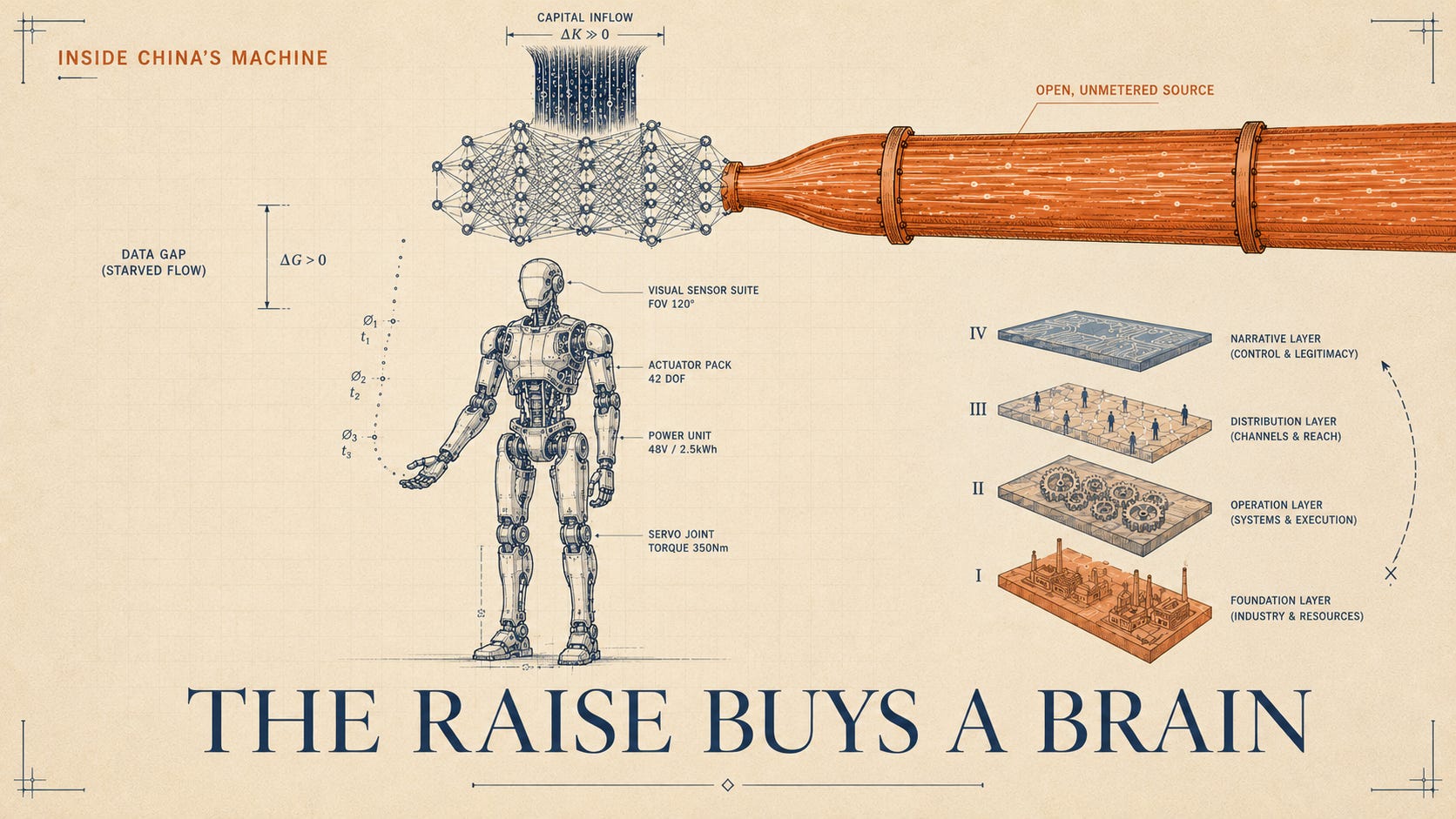
This is not a robot financing. It is a model financing, and the robot business is the collateral.
Claim type: Confirmed. Prospectuses filed with the Shanghai and Shenzhen exchanges.
The Money Is Not Buying Robots
Start with what the raise is not for, because the market’s read of these companies is a hardware read, and the hardware read is correct as far as it goes.
Unitree’s hardware business is exceptional and there is no need to hedge that. Revenue went from RMB 159mn in 2023 to RMB 1,699mn in 2025. Main-business gross margin went from 44.22 percent to 60.13 percent. Operating cash flow in 2025 was RMB 670mn.
It did this while cutting prices. Average humanoid selling price fell from roughly RMB 593,000 in 2023 to roughly RMB 166,000 in 2025, a decline of about 72 percent. Quadruped pricing fell far less, from roughly RMB 38,600 in 2022 to RMB 30,300 in 2025, so this is not a company-wide fire sale. It is one product line being driven down a cost curve.
A company that raised gross margin by sixteen points while cutting the price of its fastest-growing product by seventy-two percent is not running a hardware problem. It has solved one, by building the motors, the reducers, the encoders, the dexterous hands and the lidar itself, and by keeping bought-in components to between 14 and 18 percent of cost.
Which raises the question the use-of-proceeds table answers. If the hardware is solved, why is only 14.9 percent of Unitree’s raise going to a factory?
Because the thing all three are short of is not a robot. It is a brain.
What the Filing Admits
The most valuable sentence in Unitree’s prospectus is a disclaimer. The company asking for RMB 2.022bn to build an embodied foundation model is telling you it does not currently have one in a product.
The filing states that because embodied large-model technology is worldwide still at the research and testing stage, the company has not, during the reporting period, deployed its self-developed general embodied model at scale in any robot product. What ships inside the machines it sells is the self-developed motion-control model, which the industry calls the cerebellum, plus a third-party large language model for voice interaction.
That is the leader in humanoid unit shipments on its own disclosed count, more than 5,500 units in 2025, saying the intelligence inside its product is a control loop and someone else’s chatbot.
Deep Robotics says the harder thing, in the industry section of its filing. It tells the exchange that no embodied large model capable of supporting the full chain of multimodal perception, real-time interaction and fully autonomous decision execution is yet mature, and that the field is still exploring several routes in parallel with no converged direction and no industry consensus.
The routes it names are genuinely different bets. A vision-language model maps pixels to words, and something else must turn the words into motion. A vision-language-action model skips the words and maps pixels straight to joint commands, which is faster and far hungrier for recorded robot trajectories. A world model does neither: it learns to predict what happens next in the physical scene, and lets the robot plan against its own simulation of the future. Different data, different compute, different timelines.
So Deep Robotics is requesting RMB 1.169bn from public investors to spend on a technology, and telling the regulator in the same document that the field has not agreed on which technology it is.
None of this is a scandal. It is unusually candid disclosure and the system worked. The point is narrower, and it is a pricing point.
A Programme Neither Has Ever Run
Deep Robotics itemises its research spending by year in the filing. RMB 32.18mn in 2023, RMB 38.21mn in 2024, RMB 84.30mn in 2025. RMB 154.69mn across the entire reporting period. The single model project it is asking the public market to fund is RMB 1,169mn, which is 7.6 times everything it has ever spent on research and development.
Unitree is the same shape at larger scale. Its R&D expense for the first nine months of 2025, the largest research period in its history, was RMB 90.21mn, a research intensity of 7.73 percent of revenue against a comparable-company average of 27.92 percent. That is the cost structure of a premium consumer brand, not of a frontier technology company, and until now it was a compliment about discipline rather than an accusation. The model project is RMB 2,022.46mn, roughly twenty-two times that nine-month figure.
Name the definitional boundary rather than hide it. Expensed R&D and a multi-year use-of-proceeds budget are not the same measure, and dividing one by the other produces no meaningful multiple in any accounting sense.
So the claim is not arithmetic. It is this: two companies whose entire institutional experience is of running research programmes in the tens of millions of yuan a year have told the exchange they will now run one in the billions. That is not a scale-up. It is a change of species, attempted by hardware organisations, at the same moment, on the same thesis, with no shipped product to validate it.
The Brain It Must Beat Is Free
On 8 July 2026, six days after the CSRC waved Unitree’s registration through, Ant Group’s embodied-AI subsidiary Ant Lingbo open-sourced LingBot-VLA 2.0. Weights on Hugging Face and ModelScope, code on GitHub. Free.
The specification is the part that matters. The model was pre-trained on 60,000 hours of real physical data: 50,000 hours cleaned from a 90,000-hour corpus of real-robot recordings, plus 10,000 hours distilled from 20,000 hours of first-person human manipulation footage. Its pre-training coverage spans 17 robot brands and 20 morphologies. Two of those brands are Unitree and Leju. The efficient post-training variant runs inference in under 130 milliseconds on an RTX 4090, which is a consumer graphics card.
Claim type: Confirmed as a company announcement and technical report, published 8 July 2026 and carried by Chinese technology press. Coverage of a brand in pre-training data is a capability claim, not an adoption claim. Nobody has said Unitree uses this model, and this piece does not say so.
Now hold the two documents next to each other.
Unitree is asking public investors for RMB 2.022bn to build an embodied foundation model it has not shipped. A week ago, a company with Ant Group’s compute and data behind it published a competent one for nothing, pre-trained on Unitree’s own morphology, running on a gaming GPU.
The honest counters are real and they must be said. A generic cross-embodiment policy is not the same thing as a model trained on your own fleet’s failure data; owning the model owns the improvement loop, and it owns the margin. Open weights today do not imply open weights at the frontier tomorrow, and Ant is a strategic actor with strategic reasons. And LingBot has not displaced anything: it is a floor, not a ceiling.
But the floor is exactly what moved. The thing RMB 2.022bn has to beat is no longer zero.
The Input Is Not for Sale
Here is why the free model is not merely competitive pressure but a statement about what the money can and cannot purchase.
RMB 2.022bn buys compute. It buys researchers. It buys simulation infrastructure and a data-collection organisation. It does not buy the scarce input, because the scarce input is recorded trajectories of a physical body doing physical work, and those are not sold on a market. They are manufactured, one hour at a time, by a robot doing a job.
So how much work are these robots doing?
In the first nine months of 2025, Unitree’s humanoid revenue was 73.60 percent research and education, 17.39 percent commercial and consumer, and 9.01 percent industry applications. That industry-application slice was RMB 53.60mn of main-business revenue.
The second-round inquiry response then does what only an inquiry response does. It forces the company to take that slice apart, and the company writes this:
Enterprise tour-guiding is roughly 50 to 70 percent of it. Sales into clearly identified working scenarios, meaning smart manufacturing, intelligent inspection and logistics delivery, come to RMB 15.70mn, or 29.29 percent of industry applications. And, in a sentence the company had no reason to volunteer, it tells the exchange that because downstream customers develop their own applications on top of the machines, it does not fully know what its industry customers use the robots for. The RMB 15.70mn is a preliminary count. The remainder is tour-guiding “as understood.”
Claim type: Confirmed. Primary source, second-round inquiry response filed with the Shanghai Stock Exchange, read this session.
Read the scope precisely, because it is doing load-bearing work. Nine months, not a year. Humanoids, not the whole product line. And it is the working slice of the industry slice.
The company raising RMB 2.022bn to train an embodied model does not know what its robots are doing. That is not an accusation, it is a disclosure, and it is the most honest sentence in the filing. But it is also a statement about the fuel, because the fuel is precisely a record of what the robot is doing.
The humanoid shipment leader put RMB 15.70mn of machines into identifiable work in nine months. That is the size of the factory floor from which the training data is supposed to come. Ant published 60,000 hours of it for free.
Readers of the weekly will recognise this constraint, and this is the piece where it acquires a price. The model layer’s bottleneck was never GPUs or headcount. It is that robots cannot read the internet, so the fuel has to be burned into existence by deployment, and deployment at the market leader is currently a rounding error that the company cannot fully see.
What You Are Actually Buying at RMB 42 Billion
Unitree’s registration became effective on 2 July 2026, and every outlet has reported the listing valuation as approximately RMB 42bn. Readers of this publication should recognise the shape of that number, because it is the construction we took apart in the CXMT piece.
RMB 4.202bn of planned proceeds, divided by a minimum issue of 40,446,400 shares, gives RMB 103.89 a share. Applied to the post-issue share count that a minimum ten percent float implies, that gives RMB 42.02bn. The valuation is not an appraisal. It is a project budget divided by a share count, and it is a floor derived from how much money the company needs rather than from what the company is worth.
The floor is not a bad guide to the issue price, and it is worth saying why. Moore Threads listed on the STAR Market in December 2025 with a planned raise of RMB 8.0bn and an actual raise of RMB 7.997bn. Under the current regime the book is built to land on the project requirement, so the price converges on the floor. What the floor tells you nothing about is the second number. Moore Threads issued at a market capitalisation of RMB 53.7bn, opened at RMB 650 against an issue price of RMB 114.28, and traded above RMB 300bn on day one. MetaX listed twelve days later and closed its first session up 692.95 percent.
So the range that matters is not RMB 42bn. It is what a market that has repriced two GPU issuers by five to eight times in a single session does to the only listed pure-play humanoid maker in China.
And the earnings you would price it against are about to become unreadable. Unitree’s 2025 reported net profit was RMB 278.21mn; adjusted net profit was RMB 590.75mn. The gap is a RMB 349.07mn non-cash share-based payment on a pre-listing equity grant, booked to administrative expense and classified as non-recurring. It landed almost entirely in the first half of 2025, which is why the company reported a net loss that half. Guidance now has first-half 2026 reported net profit swinging to RMB 258mn to 306mn while adjusted net profit falls 6.43 to 21.97 percent. Add the charge back to the 2025 base and the underlying reported number is flat to down. The turnaround the headline will show is the absence of an expense that was never cash. The number that tracks the actual bet, adjusted profit, is going the other way, because the model spending has started.
The first instalment is already billed. In the first quarter of 2026 revenue rose 68.49 percent while adjusted net profit fell 52.55 percent, driven by an incremental RMB 38.33mn of quarterly R&D. That is under two percent of the model project, and the market has already flinched at it.
So price what the prospectus separates for you.
The first thing is a business. A cash-generative actuator and motion-control franchise with a real cost moat, sixty percent gross margins, global unit leadership, and a humanoid revenue base still 73.6 percent research and education. It is worth a great deal more than the RMB 12.7bn post-money at which it last raised privately in June 2025.
The second thing is an option, and the prospectus prices it for you at RMB 2.022bn of your money. It is an option on an embodied foundation model whose technical route the industry has not chosen, whose scarce input arrives at RMB 15.70mn of identifiable working deployment per nine months, at a company that told the exchange it cannot fully see where that deployment goes, and whose competent free substitute was published last week by a subsidiary of Ant Group.
The judgment is not that the strategy is wrong. It is close to the only strategy available: a humanoid maker that does not own the brain becomes a contract manufacturer for whoever does, and Unitree has looked at that outcome and declined it. The allocation is correct.
The judgment is that the market is applying a hardware multiple to a document that describes a model bet, and the arithmetic that makes the bet legible is sitting in the use-of-proceeds table, unread.
What Would Settle It
The weekly said to watch industrial revenue share and not R&D expense. That was right, and it was answering a different question, so the two belong on the same dashboard rather than in competition.
Industrial revenue share tells you whether the bet has fuel. It is the leading indicator of whether trajectory data is being generated at all, and it is the one thing Ant cannot give Unitree for free, because a general policy trained on other people’s robots is not a closed improvement loop on your own. Watch also whether the company stops saying it does not know what its robots are used for. A firm that can see its own deployment has begun building the loop. A firm that cannot has bought GPUs.
R&D expense tells you whether the bet is being placed. The model project is the thesis of this IPO and, on the available evidence that Unitree does not capitalise development spending, the expense line is the only place it will ever be visible. If R&D does not step up by an order of magnitude from the RMB 90mn nine-month run rate, the RMB 2.022bn is a story and not a programme, and what investors own is the hardware business, which should be priced as one.
Neither line is revenue and neither is reported net profit. Both of those will look fine, and both will be lying.
Before either, the pricing announcement lands, probably within two weeks. It discloses the issue price, the issue P/E, and the earnings base used to compute it. Chinese issuers must use the lower of the pre- and post-adjustment figures, which for 2025 is RMB 278.21mn, not RMB 591mn. [VERIFY against the announcement when it appears.] If so, the headline multiple will be roughly 151 times rather than the 71 times every piece of coverage has implied, and it will be double for a reason that has nothing to do with the business.
Inside China’s Machine is research, not investment advice. Figures are sourced to filed prospectuses, inquiry responses, and company announcements, with claim types marked where the source is secondary or forward-looking.