

The Ladder
China’s robot trajectory data acquired a wage before it acquired a price, and the gap between those two events is where the entire embodied-data economy currently lives.
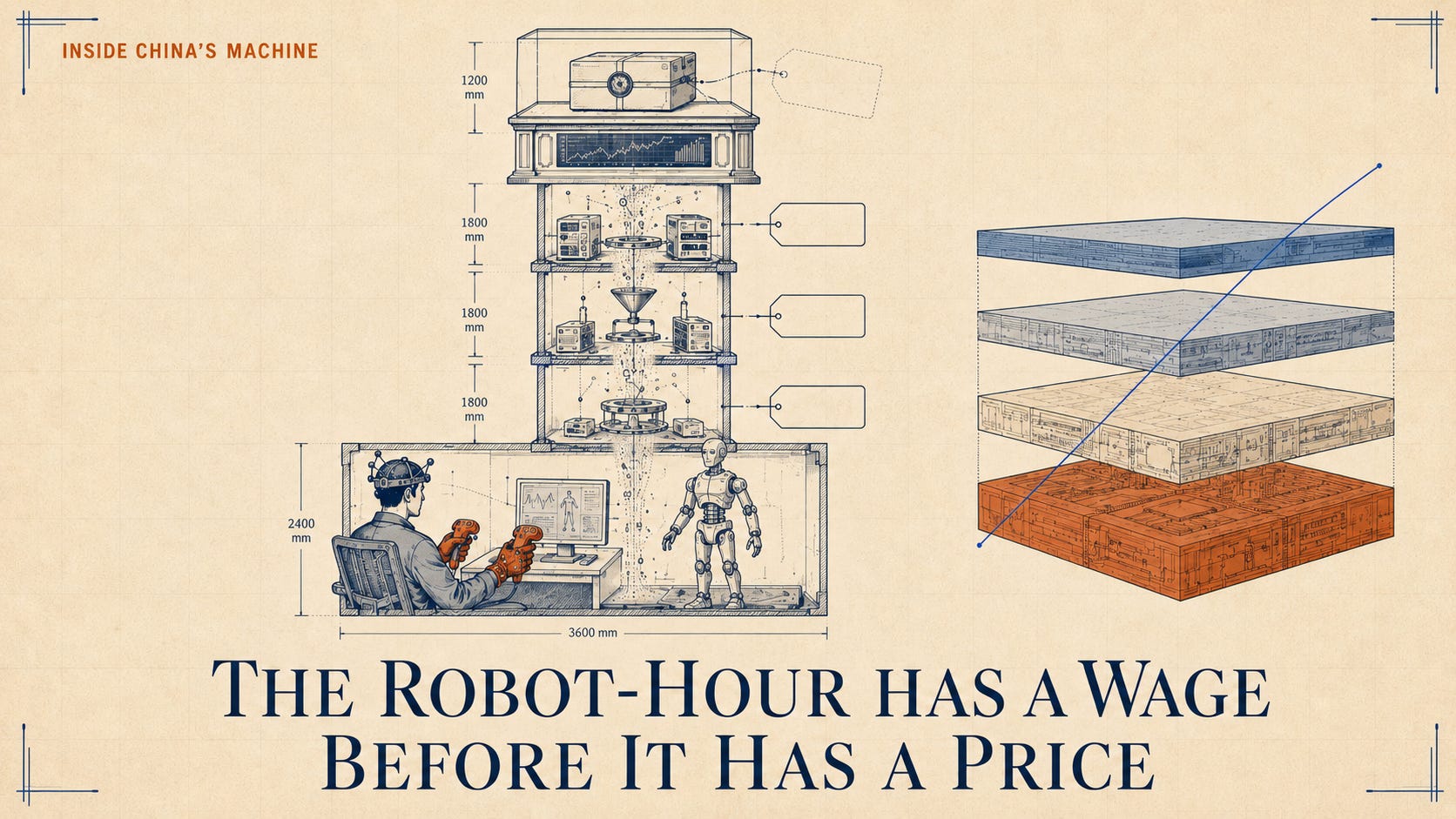
The wage is at the bottom of a ladder that can now be read rung by rung. A data collector, the person whose recorded movements become robot training data, earns 200 to 250 yuan for a nine-and-a-half-hour day, with night shifts reported up to 370, which the trade shorthands as roughly 30 yuan an hour. One rung up, data collected by workers wearing sensor rigs with no robot present is priced, by trade-press accounts, at a third to a half of real-machine data. Above that, data generated on actual robots through teleoperation sells for 500 to 1,000 yuan per hour, with brokers reselling the same hours to multiple buyers at multiples of their cost. And at the top, in January, the first embodied-intelligence dataset ever traded on a Chinese data exchange sold in Jiangsu on the day it listed, and neither the exchange, the seller, nor the state media that celebrated the milestone published what it sold for.
Every number on that ladder except the last is an estimate from trade reporting, not a filing, and this piece will say so at every rung, because the sourcing is itself the finding. Having a wage means the cost of manufacturing an hour of robot experience is now calculable. Having no published price means the asset that hour becomes still cannot be valued. Between the calculable cost and the asset that cannot be valued sits a spread of seventeen to thirty-three times, taking the trade’s 30-yuan shorthand against the 500-to-1,000-yuan selling band, and everything currently called the embodied-data industry, the collection centers, the brokers, the government-funded data plants this series has traced, is an occupant of that spread. This piece prices the bottom of the ladder, dissects the spread, and ends with the three documents that would finally publish the top.
A Day at 30 Yuan an Hour
Start with the wage, because it is the only rung anyone has stood on and described.
A reporter at the tech outlet Huxiu worked a shift as an embodied-data collector this summer and published the account in late June; the following details are that one person’s one day, reported firsthand and not independently verified, and they should be read as a specimen rather than a statistic. The interview was a group session of more than twenty applicants with near-universal pass rates. The screening that mattered was physical: height and weight checked, palm measured against a fixed glove size, a question about motion sickness in headsets. No degree, no experience. The job is advertised, frequently, under the title robot trainer. On site, phones are surrendered at the door. The work splits into two kinds: teleoperated collection, driving a dual-arm robot through tasks with handheld controllers while every motion is logged, and demonstration collection, wearing sensor equipment and performing tasks directly in staged real environments, a single scene occupying a team for two or three months. The shift ran nine in the morning to six thirty in the evening for a daily wage between 200 and 250 yuan, day-rate settlement available for part-timers, social insurance for full-timers, overtime routine.
A trade-press survey of the same labor market, also secondary and also unaudited, adds the distribution around that specimen: hourly rates near 30 yuan, a night-shift worker at 370 yuan a day, and attrition at one collection center reported at 70 percent.
Read the structure, not the anecdote. Group interviews, physical screening, day-rate settlement, night-shift rotations, high churn: this is the recruiting form of Chinese electronics manufacturing, transplanted whole onto the production of the scarcest input in the AI industry. The trade calls the facilities data factories, and the label is not a metaphor. The labor organization of trajectory-data production has already converged on the assembly line, complete with the assembly line’s wage, which runs a few hundred yuan a day, and the assembly line’s turnover. Whatever the embodied-data economy becomes, its manufacturing floor has been designed, and it was designed by copying the one China already had.
Divide the day rate by the shift and the raw number lands: 200 to 250 yuan across nine and a half hours prices collection labor at roughly 21 to 26 yuan per shift-hour before any adjustment for how much of a shift yields usable data. The trade’s 30-yuan shorthand sits just above that band, which is where a shorthand should sit. That is the wage of the robot-hour, and it is the first term of the cost construction this series is building.
The Spread
Between the 26-yuan shift-hour and the 500-to-1,000-yuan data-hour stands a stack of intermediaries, and the stack is where the money currently is.
The output price first, with its sourcing stated plainly. A STAR Market trade daily reported in April that real-machine embodied data trades domestically at 500 to 1,000 yuan per hour, with data collected by sensor-wearing humans and no robot expected to converge to a third to a half of that. A separate industry account puts standard packaged data at 300 to 500 yuan per hour and teleoperated real-machine data above 1,000, and describes a brokerage layer that resells identical hours to multiple model developers at more than ten times cost, with one independent data vendor reported to have booked 550 million yuan of new orders in the first quarter of 2026, its clients including the humanoid firms Zhiyuan and Galbot. None of these figures appears in any filing this publication has read. They are the going rates as the trade press hears them, which is precisely the condition the title of this piece describes: prices that circulate, and nowhere sit still on a public page.
What fills the spread between the wage and those rates is identifiable even where it is not priced. The robot itself, where one is used: this series established from Leju’s ChiNext filing that a humanoid sells to data collection centers at a recognized price of at least RMB 308,000 per unit, so depreciation on the instrument is real, though at any plausible utilization it amortizes to a small figure per hour against a four-digit selling price. The premises and staging. Quality inspection and annotation, a second layer of labor above the collector. And the brokerage margin, which on the reported resale economics is not a margin at all but the dominant term: selling one hour many times converts a labor cost into a licensing business, and licensing is where ten-times markups live.
One reconciliation belongs here, because this series has published a nearby ratio and the two must not be allowed to blur. Leju’s own dataset-construction budget, examined earlier in this series, allocates about seventeen yuan of wages and research expense for every yuan of equipment. That is a ratio of cost components inside one company’s internal build plan. The seventeen-to-thirty-three-times figure in this piece is a ratio of market output price to raw labor input across the whole chain. Same neighborhood of numbers, entirely different definitions, and the coincidence is exactly that. What the two figures jointly establish is one directional fact: at every altitude of this economy, from a filed corporate budget to a gray-market price sheet, the robot-data business is overwhelmingly a labor business wearing hardware as a uniform.
The Trade With No Number
Now the top of the ladder, where the market was supposed to become official.
On January 3, state and financial media reported the first embodied-intelligence dataset ever transacted on a Chinese data exchange: a listing by Jiangsu Zhujing Intelligence on the Jiangsu Province Data Exchange, sold, per the coverage, essentially on listing. The dataset’s contents were described in unusual detail. Roughly 25,000 structured clips across four scenarios, office, retail, dining, and housekeeping. Each clip about ten seconds, tens to hundreds of megabytes, containing the robot-view video stream and the full log of joint currents, angles, and torques, with the task instruction attached. The collection method, as the wire copy described it, was a human demonstrator whose motions were synced in real time to an adjacent robot, the machine’s own joints doing the recording.
Two computations follow from the disclosure, and the first is the arresting one. Twenty-five thousand clips of ten seconds is roughly 250,000 seconds, which is about 69 hours of data. The first exchange-traded embodied dataset in China, the transaction covered by the provincial government, the exchange, and the national financial wires as a zero-to-one breakthrough for the data-element market, Beijing’s policy project of turning data into a tradable factor of production, contained less than seventy robot-hours. At the trade-press rate band for real-machine data, the entire landmark would gross somewhere in the tens of thousands of yuan. The event’s significance was never the volume. It was the venue.
Which makes the second observation the structural one: the price was not published. Not by the exchange, whose institutional purpose is price discovery. Not by the seller. Not by any of the many outlets that carried the story. This publication checked the coverage end to end; the transaction has a date, a venue, a seller, a clip count, a file-size range, a sensor manifest, and no number. China’s data exchanges were built, explicitly, to move data pricing from bilateral gray quotes into public, referenceable markets. The first embodied transaction they hosted did the opposite: it demonstrated that the venue works while keeping the one datum the venue exists to produce. As a market event it discovered nothing. As an institutional event it is legible the same way this series has learned to read the data collection centers: the state side of this economy is currently in the business of demonstrating that a market will exist, which is not yet the business of operating one. The physical machine is being built ahead of its price signal, exactly as the fabs were, and the price signal, for now, lives where it has lived all along, in the trade’s unpublished quote sheets.
That completes the free layer: the wage established, the spread dissected, the official market shown to be a ceremony. The paid layer prices the labor term for the robot-hour construction this series is building toward, and names the documents that will force the number into the open.
Pricing the Labor Term
The robot-hour cost construction this publication announced needs three observable terms: what the equipment costs, what the labor costs, and what the compute costs. The equipment term was bounded earlier in this series from Leju’s filing. This piece bounds the labor term, and honesty about its shape matters more than false precision.
The floor is firm: 21 to 26 yuan per shift-hour of collector labor, from the reported day rates over the reported shift. What is not observable is yield, the fraction of a shift that becomes usable trajectory data after retakes, setup, quality rejection, and annotation. No source this publication has found states a yield figure, and this piece will not invent one. The honest statement is therefore a floor and a multiplier: the labor cost of one usable robot-hour is 21 to 26 yuan times a yield multiplier greater than one, plus the second-layer labor of inspection and annotation. For the construction ahead, the working consequence is that even at punishing yields, several shift-hours consumed per usable hour, the all-in labor term sits in the low hundreds of yuan, which is to say below the bottom of the 500-to-1,000-yuan selling band. The spread survives pessimistic yield assumptions. The current economics of the data factory are real, not an artifact of optimistic accounting.
The question an investor should hold is not whether the spread exists but which direction it closes from, and both ends are visibly in motion.
The wage end points up. Seventy percent attrition, if the reported figure is even directionally right, is the labor market’s verdict on 30 yuan an hour for work that surrenders your phone at the door, and the fix for 70 percent attrition is not culture, it is pay. The physical screening also caps the labor pool in a way electronics assembly never did: the glove has one size. A rising wage floor raises the cost of every hour in the country at once, including the hours the state’s data collection centers are budgeting with fiscal money, and it raises them before those centers reach full operation.
The price end points down. In mid-April, within two days of each other, the tactile-sensor firm Daimon released a dataset it projects at millions of hours within the year, ten thousand hours of it pledged open to the whole industry with the first batch already live on a public model community, and JD announced a full-chain embodied data infrastructure running from collection through its own trading platform, with a stated plan to mobilize up to 600,000 collectors for ten million hours of human-scene video within two years plus one million hours of robot-body data. Zhiyuan’s data subsidiary has launched a one-stop physical-AI data platform of its own. Projections are projections and are labeled as such here, and most of the JD volume is wearable-class video with no robot present, the tier the trade already discounts to a third or a half of real-machine rates. But the direction is unambiguous: open hours compete with sold hours at a price of zero, a retailer collecting inside its own warehouses and storefronts does not need the 500-yuan rate to cover a collector’s wage, and the million robot-body hours land in the exact tier the brokers currently price. The rate band is a scarcity rent, and the scarcity is being industrialized against.
So the labor term for the keystone is set, a floor in the twenties of yuan and a bounded multiplier, and the judgment on the spread is directional and holdable: it is a window rent, being closed from beneath by wages and from above by supply, and the speed of that closing determines what kind of market the state’s fiscally-built data centers open into when they reach capacity. If the spread closes before they do, the centers will have been built for a margin that no longer exists, and the fiscal price this series documented at Leju will stand as the high-water mark of the entire build-out. The compute term is now the only one missing, and it is the next piece in this sequence.
The Document That Publishes the Price
The number this whole piece circles, the public price of one hour of Chinese robot data, does not exist yet. Three document classes would create it, and they are listed in the order this publication expects them.
First, and most likely, a government procurement award. The data collection centers this series has traced are state-funded, and state money that buys data collection services at scale must eventually publish tender results with award amounts, and often unit pricing, because procurement disclosure rules require what commercial contracts do not. The first award notice that prices data collection by the hour or by the trajectory will be the first public price in this market, and it will arrive as a routine administrative document, not a press release.
Second, Leju’s inquiry response at the Shenzhen exchange, still unpublished as this piece goes out. The exchange has every reason to force decomposition of the data-center contracts that produced 44.94 percent of the company’s flagship revenue, and any decomposition that separates hardware from data-service performance obligations puts a filed, audited number adjacent to the trade’s rumored ones for the first time.
Third, the exchanges themselves, if a subsequent embodied listing publishes its price where the first did not. That would mark the moment the demonstration phase ends and the price-discovery phase begins, and it is the least likely of the three to come first, for the institutional reasons the Jiangsu trade just exhibited.
Whichever arrives first, the test it applies is the same. The trade says an hour is worth 500 to 1,000 yuan. The wage says an hour costs tens of yuan to make. The first public number will land somewhere against that spread, and where it lands will reveal whether China’s robot-data market is a real market clearing a scarce input, or a fiscal circuit renting a window. This publication is watching all three documents, and the robot-hour construction resumes the moment any one of them prints.
Inside China’s Machine is research, not investment advice. This piece contains no Confirmed market prices, and that is its subject. Collector wages, shift structure, and attrition are reported from a firsthand Huxiu account of one shift and an ITBear industry survey, secondary and not independently verified. The 500 to 1,000 yuan per hour rate band and the wearable-data discount are per a Kechuangban Daily report of April 17, 2026; brokerage resale economics and the 550 million yuan order figure are per the same ITBear survey. The Jiangsu exchange transaction details are per Nanjing municipal and financial wire coverage of January 3, 2026, which disclosed contents but no price. Leju’s equipment price and dataset budget composition are carried from this series’ earlier reading of Leju’s ChiNext filing, where their verification status is stated. Estimates of the industry’s accumulated data stock conflict by an order of magnitude across sources and are used here only at order-of-magnitude level. Supply-side platform announcements are per Daimon and JD releases of April 15 and 16, 2026, as carried by financial and trade media; their volume targets are Projected. Current as of July 18, 2026.