Inside China’s Machine · Where China’s Tokens Go, Episode 6
On 17 September 2026, at a State Council Information Office press conference, Wang Xiaoliang, head of the online audio-visual department at China’s broadcasting regulator, the National Radio and Television Administration (NRTA), said two things that belong together. In the first eight months of the year, 430,000 micro-dramas, the short serials that have become China’s busiest AI video business, had gone online, “of which AI drama is over 90%”. And the NRTA would fund dramas made with human actors, with platforms to open real-person zones. These remarks come from press reports by Xinhua, Yicai and 10jqka, not a transcript. Seven weeks later, an NRTA official told a forum, in Xinhua’s report, to “support real-person drama, regulate AI drama”, instructed platforms to “carry out ‘review every broadcast, full human review’”, and added that AI “can generate pictures but cannot generate life”.
So the regulator reports that AI has taken nearly all of the new supply, promises money to bring the human-made kind back, and asks for human eyes on every broadcast. Yet on the simplest reading that over-90% share does not reconcile with the quarterly counts, as the arithmetic below shows. And for the cheapest AI titles, the reviewer named in the regulator’s own rules is the platform. Human review is not the same as government review: under the Measures, a Class 3 title is reviewed by the broadcaster, which is the platform. An AI micro-drama with a general subject and an investment under RMB 300,000 does not go to a government reviewer before broadcast unless another test puts it in a higher tier. The platform reviews it before broadcast and reports the title’s information and programme number to the broadcasting authority online at the same time (Article 33 of the Measures).
Our judgment is that the rulebook prices the title, not the token. Its levers are an investment band that sets who reviews a title, a label, a programme number, control over airtime, a duty on platform algorithms, takedowns and fines. No rule in the micro-drama Measures, the two investment notices or the Cyberspace Administration release described below names the token or compute as a thing it prices, and no source among those texts, the press reports or the company and platform statements below shows whether takedowns and review reduce token demand. A rule need not name the token to affect it. The regulator reports tens of thousands of takedowns this year, most of them AI dramas. But a count of removed titles is not a token bill, and anyone sizing this demand should know which part of the chain has evidence behind it.
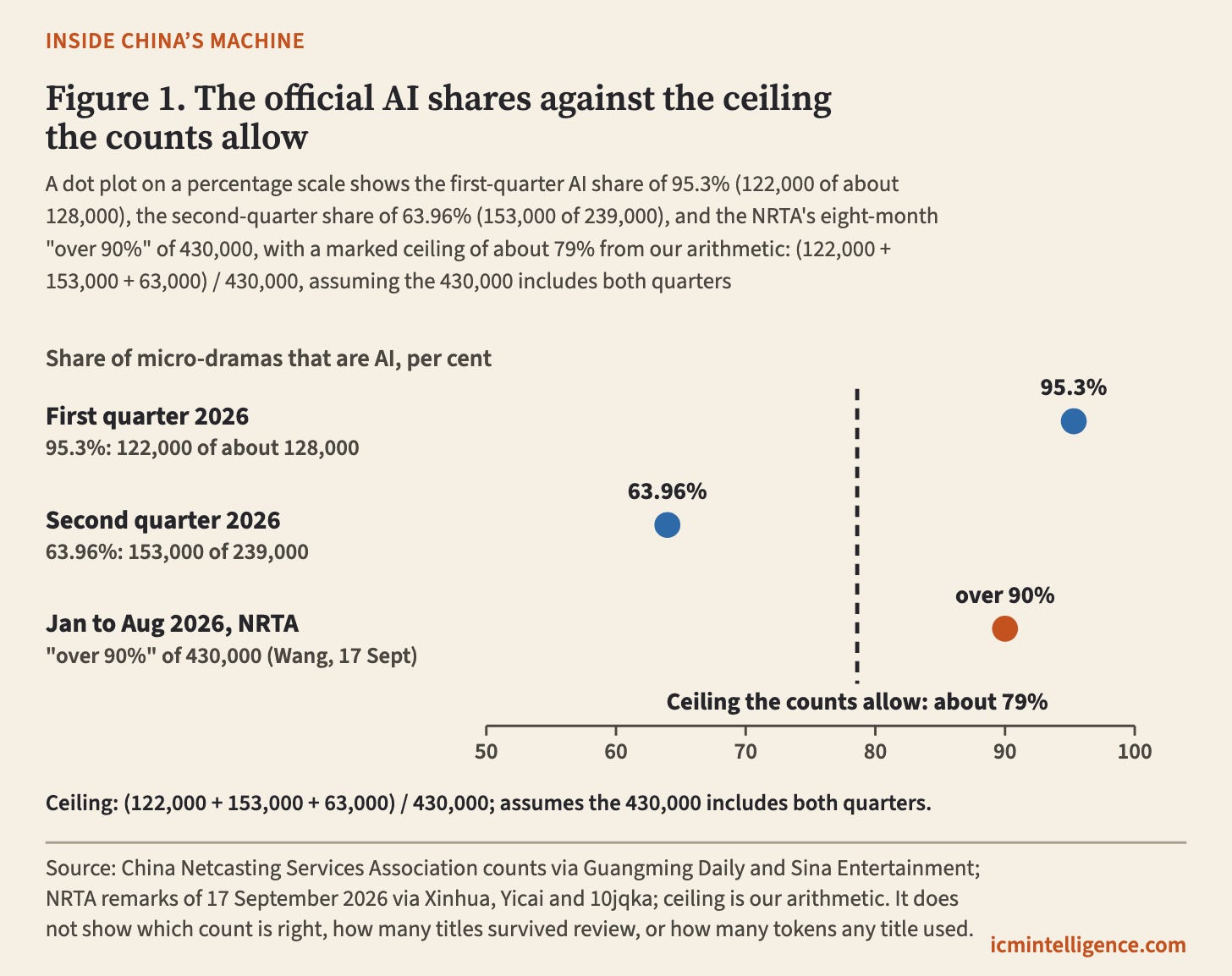
The first thing to check is the headline count. The China Netcasting Services Association publishes a quarterly guide to micro-drama creation, and its figures reach the public here through Guangming Daily and Sina Entertainment. For the first quarter of 2026 those reports give about 128,000 micro-dramas online, of which 122,000 were AI drama, or “over 95%” (95.3% by our arithmetic). For the second quarter, Sina gives 239,000 online, 86,000 of them real-person (drama with a human cast) and 153,000 AI, “the latter’s share falling to 63.96%”; Guangming says only “over six-tenths”. Then comes Wang’s 430,000 for eight months, over 90% AI.
Try putting those on one base. Assume the 430,000 includes both quarters. The quarters sum to 367,000, which leaves about 63,000 titles for July and August. Now be as generous as the reported counts allow: keep the 122,000 AI titles reported for the first quarter and the 153,000 for the second, and call every one of the roughly 63,000 July and August titles AI. Our arithmetic reaches 338,000 AI titles, about 79% of the 430,000. Over 90% of 430,000 would be more than 387,000. Rounding in the counts moves that ceiling by a point or two, not by ten.
If the 430,000 does not include both quarters, the check does not hold, and the question becomes what it does include. If it does, the three counts cannot all sit on one base or use one meaning of “AI drama”, a term that covers both AI-animated drama (manju) and AI real-person drama and has no fixed definition.
The second-quarter drop in AI’s share looks odd for a related reason. Subtracting 122,000 from 128,000 gives about 6,000 real-person titles in the first quarter, against 86,000 in the second. Our inference, which no source states, is that this jump may reflect a change in what was counted rather than in what was made. No source ties the fall to any rule, and it should not be read as a rule’s effect.