

The Third Term
The robot-hour cost construction this series is building needs three observable terms: what the equipment costs, what the labor costs, and what the compute costs. The equipment term was bounded from Leju’s filing. The labor term was bounded in the last piece, a floor of 21 to 26 yuan per shift-hour of collector labor beneath a market that sells the resulting data at 500 to 1,000 yuan per hour. This piece bounds the compute term, and the finding inverts the premise most readers will bring to it.
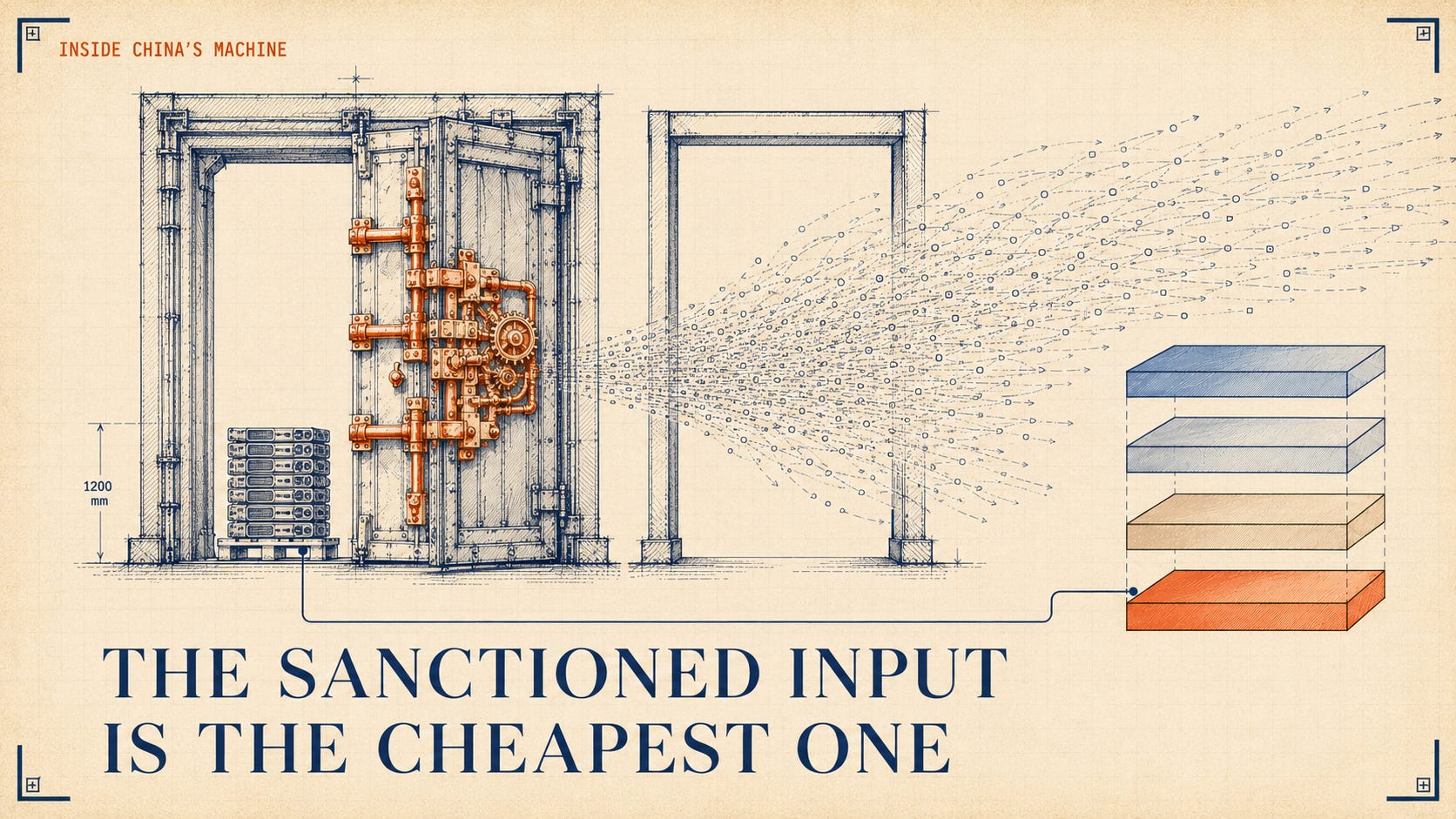
The premise is that compute is where China’s embodied-AI economics must break, because compute is the input Washington restricted. The observable prices say the opposite. Of the three terms, compute is the only one with a live, quoted, competitive rental market. Per usable trajectory-hour, it is the smallest of the three by the construction below, an order of magnitude under the labor term at domestic card rates. And it is the only term the state directly discounts at the point of purchase, with money raised through ultra-long special treasury bonds, at 10 or 30 percent off the invoice. The tight input in China’s robot-data economy is not the sanctioned one. It is trajectory data, which no export control touches, which has a wage but no public price. The sanctioned input is the slack one, and the distance between those two facts is what this piece measures.
One institutional discovery runs underneath the arithmetic, and it completes a pair with the last piece. The Jiangsu data exchange hosted China’s first embodied-dataset trade and withheld the price, a market demonstrated without the number a market exists to produce. The compute voucher does the mirror image. To claim the rebate, a buyer must file the bill with the actual card model exposed, the price, the scale, and the duration, and the state checks that filing against an internal price cap before paying out. Claim by claim, the rebate machinery is assembling a national census of real transacted card-hour prices, by card model, and publishing none of it. One arm of the institutional machine performs a market without a price. The other compiles the prices without a market display. Same state, same year, same missing page.
Two Curves, Crossing
The data curve and the compute curve crossed in 2026, and they crossed moving in opposite directions.
The data side was the last piece’s subject: a selling band of 500 to 1,000 yuan per hour that is a scarcity rent, being industrialized against from below by wages and from above by open-sourced and self-collected supply. That band, per trade reporting, points down.
The compute side spent two years pointing down and then turned. The decline first, with its source stated: per a Kezhi Consulting series carried by an industry conference organizer, secondary and not verified against the underlying contracts, monthly rental on an eight-card A800 server fell from 60,000 yuan in June 2023 to 28,000 in June 2025, a 53 percent drop, H800 servers fell 34 percent to 66,000, and H20 fell 17 percent to 25,000 over its shorter life. That is the falling series, and it ends in mid-2025. It cannot be spliced onto what follows as one curve, because what follows is a different market.
From late 2025 the direction reversed, and the reversal is stratified by sanction status. Per a 36Kr market report of June 2026, the one-year lease rate on an H100 rose from 1.70 dollars per card-hour in October 2025 to 2.35 dollars in March 2026, a rise of close to 40 percent, H200 rates reached 7.5 to 8.0 yuan per card-hour, and delivery windows for new high-end capacity stretched into 2027, which is the tell that the tightness is real rather than quoted. A rental vendor’s market commentary, a source with a commercial interest in the direction it reports and read accordingly, describes the same structure from inside the trade: Nvidia high-end tiers up 30 to 40 percent, mid tiers up 15 to 20, and domestically adapted packages built on Ascend 910B and 920 and Moore Threads parts up only 10 to 15 percent, with one regional market quoting domestic GPU rental at 1.8 yuan per card-hour against 2.5 for an A100. Every figure in this paragraph is Estimated, trade-sourced, and disclosed as such, because no filing prices a card-hour, which is precisely the institutional condition the next section examines.
Read the stratification, because it is the mechanism. The tiers that are rising fastest are the ones export controls make scarce: restricted silicon, allocated by long contracts, hoarded by the largest buyers, ByteDance reportedly planning to put half of roughly 160 billion yuan of 2026 capital spending into AI chips, a Projected figure from the same market reporting. The tier rising slowest is the one no restriction touches, domestic accelerators in ample supply. For a buyer who can only scale on domestic silicon, which is the legally durable position for every state-funded data collection center this series has traced, the relevant price is the bottom tier, and the bottom tier is both the cheapest in the market and the most insulated from the repricing above it.
One discipline before any of these numbers is used: a card-hour is not a commodity. An H200 hour, an A100 hour, and an Ascend hour do different amounts of work per hour, and comparing their prices without an equivalence basis is the definitional error this publication maintains a rule against. This piece therefore never nets the tiers into one compute price. It carries them as tiers, and the construction below runs on the domestic tier alone, because that is the tier the robot-data economy can actually buy at scale.
The Voucher and the Price Book
Now the fiscal layer, from the one document in this piece read in the primary this session.
On May 1, the Zhejiang Provincial Development and Reform Commission published the claim notice for the 2026 national artificial intelligence voucher, the compute voucher. The design, from the notice itself. The program is national, funded from ultra-long special treasury bonds, the same instrument that funds the country’s flagship infrastructure. It is a post-subsidy: the buyer rents compute first, on a real commercial contract, and claims afterward. Eligible claimants are universities, research institutions, and companies with genuine intelligent-compute rental demand, covering cloud and bare-metal resources, for contracts running May 2025 through April 2026. The support rate is tiered at 10 or 30 percent of the verified contract amount.
Two clauses in the notice carry more than their administrative weight.
The first: the subsidy is computed after a price verification, and where the verified amount sits at or above a price ceiling, the payout is capped at the ceiling. The state, in other words, holds a reference price list for rented compute, detailed enough to verify invoices against, and the notice does not publish it. A ceiling price that caps subsidies is an administered opinion about what a card-hour should cost, and it exists, in a table, somewhere in the program’s files.
The second: the claim materials must prove the card model, the price, the compute scale, the rental period, and the use, and the bill must expose the actual card type. Combine the two clauses and the shape of the machinery is unmistakable. Every claim cycle, the program ingests a province-by-province, model-by-model record of real transacted compute prices, verified against contracts, invoices, and payment records, and checks it against an internal ceiling. This is a price census running inside a subsidy, and it is the exact dataset whose absence defines the gray market described above, where the going rates live in vendor commentary and conference decks because no public document prices a card-hour.
Set this beside the Jiangsu trade and the pairing does the analytical work. China built data exchanges to move pricing into public view, and the first embodied trade on one withheld its price. China built a compute voucher to cut costs, and in operating it the state accumulates precisely the price transparency the exchanges were supposed to create, held privately. The institutional machine is not failing to produce prices. It is producing them selectively, and keeping them. For an investor, the consequence is direct: in both of the robot-hour’s non-labor input markets, the best price data in the country now sits in state files, and every disclosure event that leaks a row of it, a procurement award, an inquiry response, a published ceiling table, moves the informational floor of the whole sector at once.
That completes the free layer: the market stratified, the fiscal wedge documented, the price book located. The paid layer prices the compute term for the robot-hour construction and ranks the three terms.
Pricing the Compute Term
The construction follows the same honesty structure as the labor term: an observable floor, an explicit multiplier for what cannot be observed, and no invented precision.
The observable floor is the domestic card-hour: roughly 1.8 to 2.5 yuan at the regional quotes above, Estimated, trade-sourced. The voucher takes 10 to 30 percent off for an eligible claimant, putting the effective domestic rate at roughly 1.3 to 2.3 yuan per card-hour. Both ends of that band are soft, and the softness does not matter, because the term’s size relative to the other two is decided at any point in the band.
What cannot be observed is intensity: how many card-hours the embodied-data pipeline consumes per usable trajectory-hour, across preprocessing, training runs amortized over the dataset, and the light inference load of teleoperation itself. No filing states this number and this piece will not invent it. Call it k, card-hours per usable trajectory-hour, and hold it as an explicit unknown greater than one.
The construction is then a single line: the compute term equals k times 1.3 to 2.3 yuan. And the line is decisive without k being known, because of where the other terms sit. The labor term landed in the low hundreds of yuan per usable hour under pessimistic yields. For the compute term to reach even the bottom of that range, k would need to exceed roughly fifty domestic card-hours consumed per single usable trajectory-hour, sustained across the whole pipeline. For it to reach the 500-yuan bottom of the data-selling band, k would need to exceed two hundred. Nothing in the model layer’s own filed economics suggests embodied training burns at anything like that ratio against its data intake, and the efficiency direction this series tracks at the model layer runs the other way. Even granting the 2026 repricing full room to run, a doubling of domestic rates, several times the 10 to 15 percent the domestic tier has actually risen, moves the thresholds to roughly twenty-five and one hundred. The ordering does not flip.
So the ranking the keystone needs is now set, and it is the piece’s capital judgment. Per usable robot trajectory-hour: data sells in the hundreds to a thousand yuan, labor costs in the low hundreds, compute costs in the tens at plausible intensities, and equipment amortizes to less than that at any utilization a funded center can sustain. The robot-hour is a labor product with a data margin, and compute, the input the entire China-AI discourse treats as the binding constraint, is its smallest line.
Two model-layer anchors from this series’ filed record show what the opposite structure looks like, and why the embodied layer is not it. Zhipu’s audited first half showed 1,145.1 million yuan of compute service fees against 23.9 million of capital expenditure, a 48-to-1 rent-over-own ratio, and MiniMax’s cost of sales ran at roughly 98 percent compute, invoiced from Alibaba Cloud. That is what a compute-dominated cost structure is: it appears in the filings, unmistakably, as the largest line the auditor signs. No embodied-AI filing this series has read shows that shape. The three robot IPO prospectuses route 41 to 51 percent of their combined raise toward model development, and the last two pieces have shown what that money must actually buy: not primarily card-hours, which are cheap, discounted, and in ample domestic supply, but trajectory-hours, which have a wage, a gray-market price band, and no public market. Capital raised against a compute story will be spent on a data problem.
The sensitivity that matters is not k. It is the two policy variables on the cheap tier: whether the voucher renews past the April 2026 contract window, a program decision on treasury-bond money that can end as administratively as it began, and whether domestic card supply stays ample as the high tiers reprice, which is a substrate question this publication tracks at the fab level. Both risks push the compute term up. Neither, at the magnitudes in view, reorders the terms.
The Document That Reorders the Terms
Three disclosures would test this piece’s construction, listed in the order this publication expects them.
First, Zhipu’s Shanghai listing process. The STAR Market inquiry will force the full-year cost-of-sales decomposition and cloud unit economics that Hong Kong never required. That filing prices the model layer’s compute at audited resolution, and any embodied-adjacent line inside it, data services purchased, trajectory data licensed, becomes the first filed number adjacent to this piece’s k.
Second, a procurement award that prices intelligent-compute services per card-hour or per P. The state-funded data centers rent compute with fiscal money, fiscal money publishes tender results, and the first award notice with a card-hour unit price puts a Confirmed number under the domestic tier this construction rests on. The same document class this series named as the likely first publisher of a data price would, in one award, publish a compute price too.
Third, the ceiling table itself. If any claim cycle of the voucher publishes its price caps by card model, the price book comes out of the file, and the gray quotes this piece was forced to build on become checkable against an administered benchmark in a single afternoon. That publication would be the compute market’s equivalent of the exchange printing a price, and it is the least likely of the three, for the same institutional reasons the Jiangsu trade exhibited.
Whichever arrives first, the test is the same. This piece says the sanctioned input is the cheap one and the free input is the dear one, and that the robot-hour’s cost structure is labor and data wearing a compute story. The first filed card-hour price, the first audited data-purchase line, or the first published ceiling will say whether the construction holds. The equipment, labor, and compute terms are now all bounded. The keystone assembles them, and it is the next piece in this sequence.
Inside China’s Machine is research, not investment advice. The compute voucher’s design, funding source, subsidy tiers, price-cap verification, and card-model disclosure requirements are Confirmed from the Zhejiang Provincial Development and Reform Commission’s claim notice of May 1, 2026, read this session via its official publication. All market rental rates are Estimated from secondary trade sources and none appears in a filing: the 2023 to 2025 declining series is per a Kezhi Consulting compilation, the 2026 repricing and the 160 billion yuan capital-spending plan are per 36Kr reporting of June 2026, and the tier structure and the 1.8 and 2.5 yuan regional card-hour quotes are per a rental vendor’s commentary, a source with an interest in the direction it reports. The intensity multiplier k is an explicit unknown, not an estimate. Zhipu’s 48-to-1 compute ratio, MiniMax’s cost composition, the robot IPO raise allocations, and the labor and data figures are carried from earlier pieces in this series, where their verification status is stated. Current as of July 19, 2026.