



Inside China’s Machine · Tokenomics, Episode 1 of 10
The Answer Price = price per token × tokens per attempt ÷ success rate
The Answer Price is the token cost of each solved task, failed attempts included.
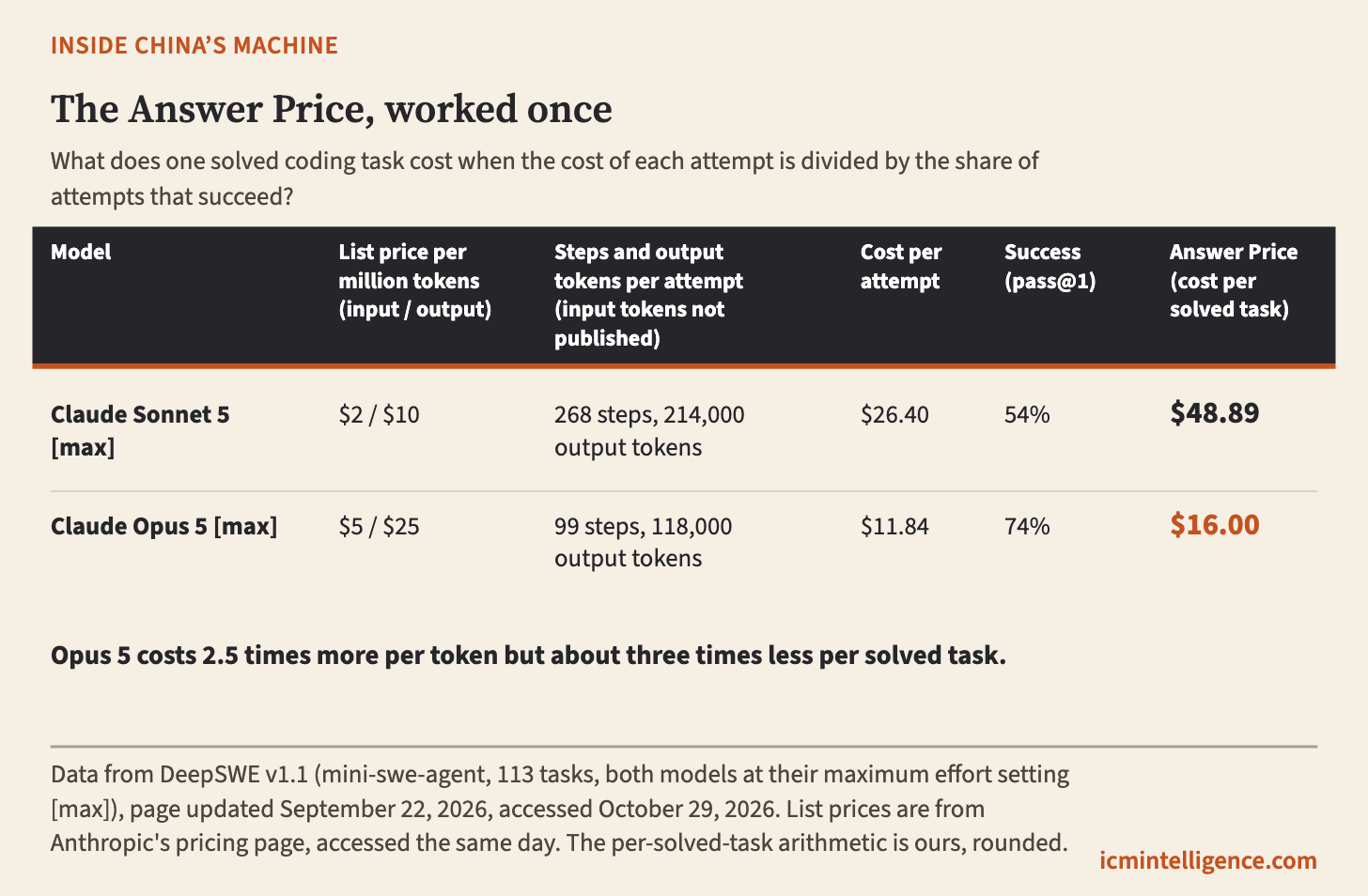
On one public coding-agent leaderboard, DeepSWE v1.1, models work through the same 113 real software tasks under the same harness, mini-swe-agent. The tasks come from 91 repositories in five languages, and the page lists what an average attempt cost (leaderboard updated September 22, 2026). Take two models from one maker, both run at their maximum effort setting. Anthropic lists Claude Sonnet 5 at $2 per million input tokens and $10 per million output tokens. It lists Claude Opus 5 at $5 and $25, which is two and a half times as much on every kind of token. Read the price list and the choice looks obvious.
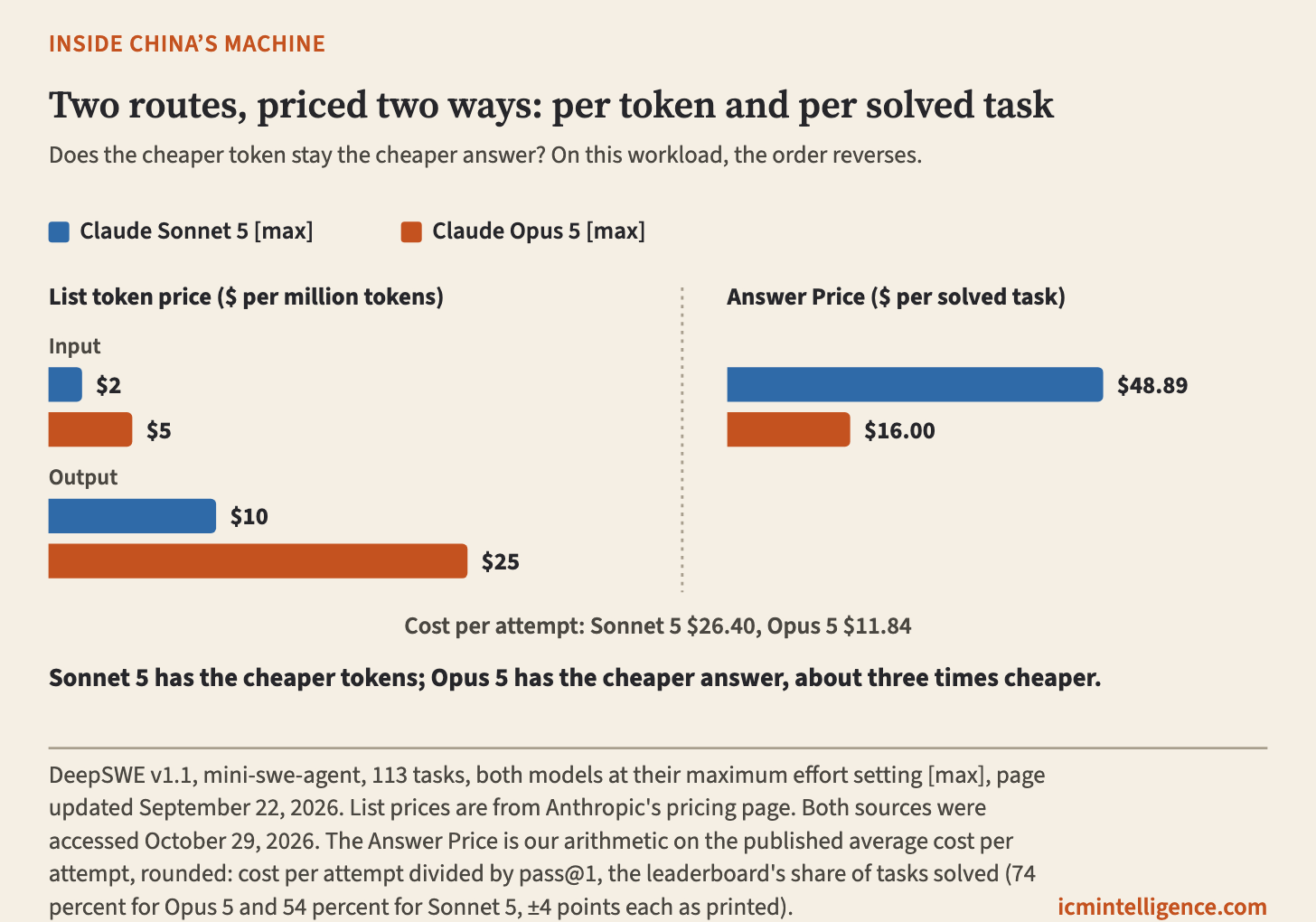
Then read the column for tasks solved. Opus 5 solved 74 percent of the tasks and Sonnet 5 solved 54 percent. Sonnet 5 also worked much longer at each task. It took 268 steps per attempt against 99, and wrote 214,000 output tokens against 118,000. An average Sonnet 5 attempt cost $26.40 and an average Opus 5 attempt cost $11.84. Divide the bill by the tasks that actually got solved, and an Opus 5 solved task costs $16.00 against $48.89 for Sonnet 5. The model that is 2.5 times dearer per token is about three times cheaper per answer.
That flip shows what the price list leaves out. You do not buy tokens. You buy solved tasks, and the price of a solved task depends on three things, of which the token price is only one. The other two are how much work each attempt takes and how often an attempt succeeds. The last is the one buyers watch least and the one that bites hardest. Our view follows from that. As machine intelligence gets cheap, the money goes to whoever controls the lever that is hardest to move. Today that is success on hard tasks, not price per token.
What an attempt costs, and what a success costs
Start with the simplest case. You send an agent at a task. It reads, thinks, writes and maybe runs some tools, and every token it reads or writes is billed. That is one attempt, and it costs the token price times the tokens it used.
Some attempts succeed and some don’t. You pay for the failures too, in full. So the cost of one success is the cost of an attempt divided by the share of attempts that succeed. If an attempt costs a dollar and half of them work, each working answer costs two dollars.
Put as one equation:
answer price = price per token × tokens per attempt ÷ success rate
We call the result the Answer Price. It is what a buyer spends per successfully solved task, on a stated workload, with a stated test of success, on a stated date; the division gives total spend over total successes across the whole task set, with every failed attempt paid for, so it is a cost per success for the set as a whole, not a price for any single task, which a model may never solve. It sits beside the token price, which is the number on the price page. The token price is real money, but it describes an input. The Answer Price describes what you came for.
Two properties of the formula do most of the work.
First, the levers multiply. A model whose tokens cost half as much but which uses twice as many per attempt has saved you nothing. Agents use a lot. Each step of a long task sends much of what came before back to the model as input, so tokens per attempt grow with the length of the job, not the length of the answer. The opening pair shows how far that goes. Sonnet 5 took 268 steps on an average attempt where Opus 5 took 99, and wrote nearly twice the output. That was enough to make the cheaper-per-token model 2.2 times dearer per attempt before success entered the sum. The leaderboard does not publish input or cached tokens. The page therefore cannot tell you the full token count per attempt, or how much of it was the agent re-reading its own transcript. What it does show is that tokens per attempt is a lever in its own right, and a big one.
Second, success sits in the denominator, and dividing is harsher than multiplying. Raising success from 20 percent to 40 percent halves the Answer Price, exactly as halving the token price would. But success does not stop there. A model that goes from 40 percent to 80 percent halves it again, and one that fails nineteen times in twenty makes every success cost twenty attempts. In the opening pair, success supplies the rest of the flip, a factor of about 1.4 (74 over 54). Opus 5 succeeds 74 percent of the time against 54 percent, which turns its 2.2-times advantage per attempt into 3.1 times per solved task. A spread that looks modest in percentage points becomes large once it sits under the line, and on hard work that is why this lever so often decides the bill.
Three levers, three different speeds
The three levers do not move together, and that is where the economics starts.
Token price falls fast and in public. Anthropic launched Claude Opus 4 on May 22, 2025 at $15 per million input tokens and $75 per million output tokens. Claude Opus 4.5, launched November 24, 2025, listed at $5 and $25, a cut of two thirds on both. Opus 5 kept that price at its launch on July 24, 2026, and Anthropic’s pricing page now lists Opus 5.5, launched September 22, 2026, at $4 and $20. Per-token cuts overstate per-text cuts, though. Anthropic’s documentation says the tokenizer in Claude 4.7 and later models produces about 30 percent more tokens for the same text, and its launch posts give a range of 1.0 to 1.35 times; that applies to those later models, not to the 2025 cut from Opus 4 to Opus 4.5. Token price is also the lever anyone can pull. Once a model’s weights are published, any cloud with the chips can serve the same model, and the price for those tokens is set by competition among hosts.
Sellers have even started pricing tokens by the hour. Since 16:00 UTC on August 16, 2026, DeepSeek has charged peak and off-peak rates for V4-Pro, with off-peak rates 50 percent below peak (DeepSeek notice of August 13, 2026). DeepSeek publishes the peak hours in Beijing time: 9:00 to 12:00 and 14:00 to 18:00 on weekdays, excluding Chinese public holidays. So the same token costs half as much at night, over lunch, at weekends and on public holidays as it does in the Beijing working day. The hourly price shows that the token price is a lever sellers adjust freely, which tells you it is not where their power sits.
Tokens per attempt is pulled by both sides. The model maker sets how much the model thinks and how many steps it takes before it stops. The buyer, or the application built on the model, sets how much context gets fed in, what gets cached, how many tools run and when to stop. Good engineering here cuts the bill without touching the model, and it is the part of the stack where an application company can save its customers money the model maker never sees.
Success rate is the hard one. On easy tasks every serious model succeeds, and the lever is flat. On hard tasks, the kind that agents are being sold for, success differs widely between models. On DeepSWE v1.1, the 21 models the page shows by default range from 74 percent, a level three models share (Opus 5, gpt-6-astra and gemini-3.8-flash), down to 36 percent. Success does not fall to competition the way token prices do. You cannot buy it from a second host. Effort settings and context management can move the same model’s success by some points, but the large differences between models come mostly from the model itself. The same maker at the same price shows where it moves. Claude Opus 4.8 [max] lists at Opus 5’s $5 and $25. It solves 59 percent of the DeepSWE tasks at $13.22 an attempt, or $22.41 per solved task. Opus 5, at $16.00, is 29 percent cheaper per solved task, mostly because it succeeds more often. That success came with a new model, not a new price.
Who gets paid
Put the three speeds side by side and the question of who gets paid has a shape.
A seller whose only edge is the token price is selling the abundant lever. Anyone serving the same weights can match the price, and the buyer can switch with a configuration change. Expect that margin to be competed thin. Cheap tokens are not a bad business because they are cheap. They are a hard business because they are interchangeable.
A seller who moves success on hard tasks is selling the scarce lever. Look at what the formula does for them. If their model succeeds twice as often, they can charge close to twice as much per token and still give the buyer the same Answer Price, or a better one. The higher token price is not a premium the buyer tolerates. It is a share of the saving that the model created and the seller keeps. That is how Opus 5 can be 2.5 times dearer per token than Sonnet 5 and still win the task. In that pair the shorter attempts did more of the work than the higher success rate: they made Opus 5 about 2.2 times cheaper per attempt despite its dearer tokens, and the higher success rate, 74 percent against 54, added about 1.4 times. Both are properties of the model, and neither shows up on a price list.
So our view is that the margin sits with whoever controls the lever buyers cannot route around. Today, on the work agents are being bought for, that is success. How much of the buyer’s saving the seller can keep, through a higher token price, is set by how much better the model is than the next best one, not by the price list. A buyer who shops on token price is comparing the one number sellers are happiest to cut.
The view has limits. It is a view about hard tasks. On easy, high-volume work, the alternative holds: success is near the ceiling for everyone, and the cheapest token is close to the cheapest answer. Vals.ai’s SWE-bench Verified board (mini-swe-agent, updated September 1, 2026) has been archived because, in Vals.ai’s words, performance on the benchmark has saturated. There Claude Opus 5 solved 97.0 percent at $1.29 per test and DeepSeek V4 Pro 96.4 percent at $0.10. Per solved test that comes to $1.33 for Opus 5 against about $0.10 for DeepSeek V4 Pro. That gap, about 13 times, is the same as the gap in price per test, because both models solve almost every test, so the cost gap passes through almost untouched. Vals.ai is a different operator with its own cost method, so its dollar figures do not line up with DeepSWE’s.
That easy-work market is large, and it will be priced like a commodity. The view also has a clock in it, though not a dated one. Success is scarce until the second-best model catches up on the tasks buyers care about. When it does, success flattens like token price did, and the margin moves to whatever is scarce next: capacity at the hours buyers need it, the engineering that cuts tokens per attempt, or the work of checking the answer.
China tests this sharply, because Chinese labs have pushed the token-price lever further than anyone. On October 29, 2026, DeepSeek listed V4-Pro at $0.66 per million cache-miss input tokens off-peak and $1.32 at peak, and at $1.98 and $3.96 for output. Anthropic listed Claude Opus 5, the model in the DeepSWE rows compared here, at $5 and $25 the same day. That puts DeepSeek 3.8 to 7.6 times cheaper on input and 6.3 to 12.6 times cheaper on output, depending on the hour. Where DeepSeek’s models match on success, as on the saturated SWE-bench Verified, that discount reaches the buyer almost one for one, and nothing in this framework softens it. Where they trail, the success gap shrinks the discount, but it takes a large gap to erase a large discount. On DeepSWE, DeepSeek-V4-Pro [max] solves 63 percent (±6) against Opus 5’s 74 and still comes to $2.65 per solved task against $16.00. DeepSeek-V4-Pro costs about 7 times less than Opus 5 per attempt ($1.67 against $11.84) and about 6 times less per solved task ($2.65 against $16.00), so its lower success rate gives back little of the discount. The same caveat about DeepSWE’s undisclosed cost method applies here, including which DeepSeek rate it charged. The question for any cheap route, in Beijing or anywhere else, is never how cheap the token is. It is whether the success rate holds on your work.
Back to the leaderboard
Go back to the two rows from the opening. On the price page, Opus 5 is 2.5 times dearer than Sonnet 5. On the tasks solved, it is about three times cheaper. Nothing on the price page was wrong. It was simply answering a question the buyer had not asked.
Ask what a solved task costs, not what a token costs. Then ask which of the three levers is moving it and who controls that lever. The token price will keep falling. Whether that makes anyone richer depends on the other two.
Sources
Datacurve, DeepSWE v1.1 leaderboard (page updated 22 September 2026), read 29 October 2026, https://deepswe.datacurve.ai/
Datacurve, DeepSWE v1.1 blog post, read 29 October 2026, https://deepswe.datacurve.ai/blog/deepswe-v1-1
arXiv, DeepSWE paper abstract (2607.07946), read 29 October 2026, https://arxiv.org/abs/2607.07946
GitHub, datacurve-ai/deep-swe Issue #21 “DeepSWE Audit: Pricing, provider routing, and effort-tuning concerns (solve-rate findings retracted)”, opened 1 June 2026, https://github.com/datacurve-ai/deep-swe/issues/21
Anthropic, Claude API pricing page, read 29 October 2026, https://platform.claude.com/docs/en/about-claude/pricing
Anthropic, Claude 4 launch post, 22 May 2025, https://www.anthropic.com/news/claude-4
Anthropic, Claude Opus 4.5 launch post, 24 November 2025, https://www.anthropic.com/news/claude-opus-4-5
Anthropic, Claude Opus 4.7 launch post, read 29 October 2026, https://www.anthropic.com/news/claude-opus-4-7
Anthropic, Claude Opus 5 launch post, 24 July 2026, https://www.anthropic.com/news/claude-opus-5
Anthropic, Claude Sonnet 5 launch post, read 29 October 2026, https://www.anthropic.com/news/claude-sonnet-5
Anthropic, Claude Opus 5.5 launch post, 22 September 2026, https://www.anthropic.com/claude-opus-5-5
DeepSeek, API pricing page, read 29 October 2026, https://api-docs.deepseek.com/quick%5Fstart/pricing/
DeepSeek, notice “DeepSeek-V4-Pro GA Release”, 13 August 2026, https://api-docs.deepseek.com/news/news260813
Vals.ai, SWE-bench Verified benchmark (archived board, updated 1 September 2026), read 29 October 2026, https://www.vals.ai/benchmarks/swebench
Inside China’s Machine · Tokenomics, Episode 1 of 10
Disclaimer: This article is for informational and educational purposes only. It is not investment, financial, legal or tax advice, and it is not a recommendation or solicitation to buy or sell any security. Do your own research, and consult a licensed professional before making investment decisions.