



Inside China’s Machine · Tokenomics, Episode 10 of 10
The Answer Price = price per token × tokens per attempt ÷ success rate
The Chinese state buys some of the country’s AI and pays part of other buyers’ bills, so who buys most cannot yet be known from public data, and the number that would settle it has not been published.
On 3 June 2025, Shenzhen prepared a submission under a national scheme that helps companies pay for computing. One sentence in it puts two numbers side by side: 拟上报核算后算力服务总额11.68亿元,算力服务申请补助总额1.29亿元. In our translation: a proposed submission of verified compute services totalling RMB1.168 billion, and requested subsidies totalling RMB129 million. The first number is the value of the verified compute services included in the proposed submission. The second is the amount the state was asked to contribute towards that bill. The record does not say who the buyers are. It shows spending submitted for government support, not a government purchase.
That sentence shows the problem with the most common question about Chinese AI demand, which is whether the state or the market is buying. The state does buy. It also pays part of the bill when someone else buys. Paid commercial channels are growing at the same time, and their filings do not say who the customers are. Our view is this: who buys most of China’s AI, or leads its demand, cannot be known from public data yet. The reason is not a shortage of numbers. China publishes plenty. Its numbers sit at different stages, at different layers of the supply chain, and in different units, and none of them separates the buyer from the payer. The number that would settle the question is specific: deduplicated final-buyer invoices at one layer of the supply chain, for one year, in one currency and on one tax basis, with reimbursements shown separately. Until that exists, anyone who says the state leads demand, or the market does, is offering a view.
The series’ core thread, the Answer Price, is the cost of a successful task: price per token, times tokens per attempt, divided by the success rate. A token is a small unit of text that a model processes and providers commonly charge for. It is a buyer’s number, and that matters here. A voucher can reduce what the buyer pays without reducing what the provider receives. The buyer’s bill and the state’s support then describe parts of the same spending, not two separate purchases.
The state buys, in cases you can read
Start with the plain case, where a government body buys.
A Chinese public body that wants to buy something usually runs a tender, a published competition in which suppliers bid. The public record of the result, naming the winner and the price, is called a tender award. An award is a promise to buy. It is not delivery, not acceptance of the delivered work, and not payment. Those come later, and for the cases below the records omit them.
Here are some awards. A hospital in Changzhou awarded RMB4,488,000 on 1 April 2025 for a model and compute platform. The award bundles the two and gives no figure for the model alone. A Beijing research platform awarded RMB1,960,000 on 18 September 2025 for hardware: AI servers plus management and storage nodes. An award for a project called Tanmai model, phase I, came to RMB2,438,000 on 12 January 2026. It bundled data, a platform, models, compute and cybersecurity, and its text ties the project to national policy: 围绕发展新质生产力核心目标,践行国务院国资委”AI+”专项行动部署. In our translation: centring on the goal of developing new quality productive forces and implementing SASAC’s “AI+” special-action deployment. SASAC is the State-owned Assets Supervision and Administration Commission of the State Council. The sentence shows how the buyer describes the project. It does not establish what motivated the purchase.
Look inside one award and the category “AI spending” starts to blur. On 29 October 2026, a package recorded as NIM compute and infrastructure was awarded for RMB9,246,200. The summary lists four BaoDe PR425KI G2 servers at RMB1,360,000 each. By our arithmetic that is RMB5,440,000, or 58.83 percent of the package. The rest is other items, and nothing in the record lets you reclassify those as spending on models. The summary also gives no count of accelerator cards, which do much of the AI computation, and no cost for them. So even a well-documented state purchase is a bundle in which the AI part has no clean edge.
Then there is a contract shape that is easy to misread. In March 2026, Guangxi police awarded a compute rental in three lots: China Mobile RMB15,178,276.80, China Unicom RMB10,850,000 and China Telecom RMB10,850,000. By our arithmetic the total is RMB36,878,276.80. The term matters more than the total: 租赁期为36个月, the rental period is 36 months (our translation), and it starts on accepted delivery. Spread evenly, the package works out to roughly RMB1.02 million a month. That figure is our arithmetic and nothing more. It is not an invoice, not 2026 cash spending, and not a price per GPU-hour, a unit measuring the use of one graphics processor for one hour. The clock starts only when police accept delivery, and the award notice does not give the acceptance date. The three carriers are also not necessarily delivering the same compute. Two of the lots carry the same headline price, but a matching price does not show matching capacity.
The Guangxi case also shows why the buyer’s identity is harder to pin down than it looks. At the service layer, the police are buying rented compute from carriers. At the hardware layer, those carriers may themselves be buyers. A record at one layer answers only that layer’s question.
Four stages, and why the big numbers sit at the early ones
A framework contract is an agreement that fixes suppliers and prices in advance. The actual purchases come later, as separate orders drawn against it. In this sample, the largest numbers are framework numbers. They describe the terms for possible purchases, not money already changing hands.
China Development Bank’s record of 9 March 2026 shows quotes of RMB63,479,700, RMB66,008,598 and RMB60,349,800, including tax, for three product routes, each with five years of maintenance. The record says the bank will 与3条产品路线供应商分别签订框架合同进行采购: sign procurement framework contracts separately with suppliers for the three product routes (our translation). The quotes are real. The record shows no orders drawn against them.
A bigger example comes from the operators themselves. In a filing, Digital China disclosed a framework with China Mobile for AI servers. It was signed on 22 August 2024 and expired on 31 August 2025, and lot 1 named 842 AI servers and supporting products. The filing says the actual amount executed is set by the specific purchase contracts: 实际执行金额以具体采购合同为准. Digital China’s 2024 annual report gives the package bid quotation as RMB19,116,746,188.47 excluding tax, with an awarded share of 10.53 percent (中标份额10.53%). Multiplying the two gives about RMB2.01 billion. That is our arithmetic, an illustration of how the package might be allocated. It is not executed orders and not revenue.
This case also shows the layer problem. China Mobile signed a framework to buy AI servers. But a compute operator buying servers may rent out the capacity, so the final buyer may sit further down the chain. A purchaser at the hardware layer does not tell you who the final buyer is at the service layer. Count a server framework as demand, then count its customers’ rental bills as demand too, and the same machines can appear twice.
Sometimes a tender stops partway. One college ended a procurement 因采购需求以及采购标的有重大调整,故终止本次采购活动: because of material adjustments to the procurement requirements and the items to be procured (our translation). That shows a plan changing. It does not show demand falling away; the record shows no re-tender.
The award, the framework, the order and the payment are four different stages, though not every purchase passes through a framework. The ledger below keeps each case at its own stage. Notice that none of these records gives a payment figure.
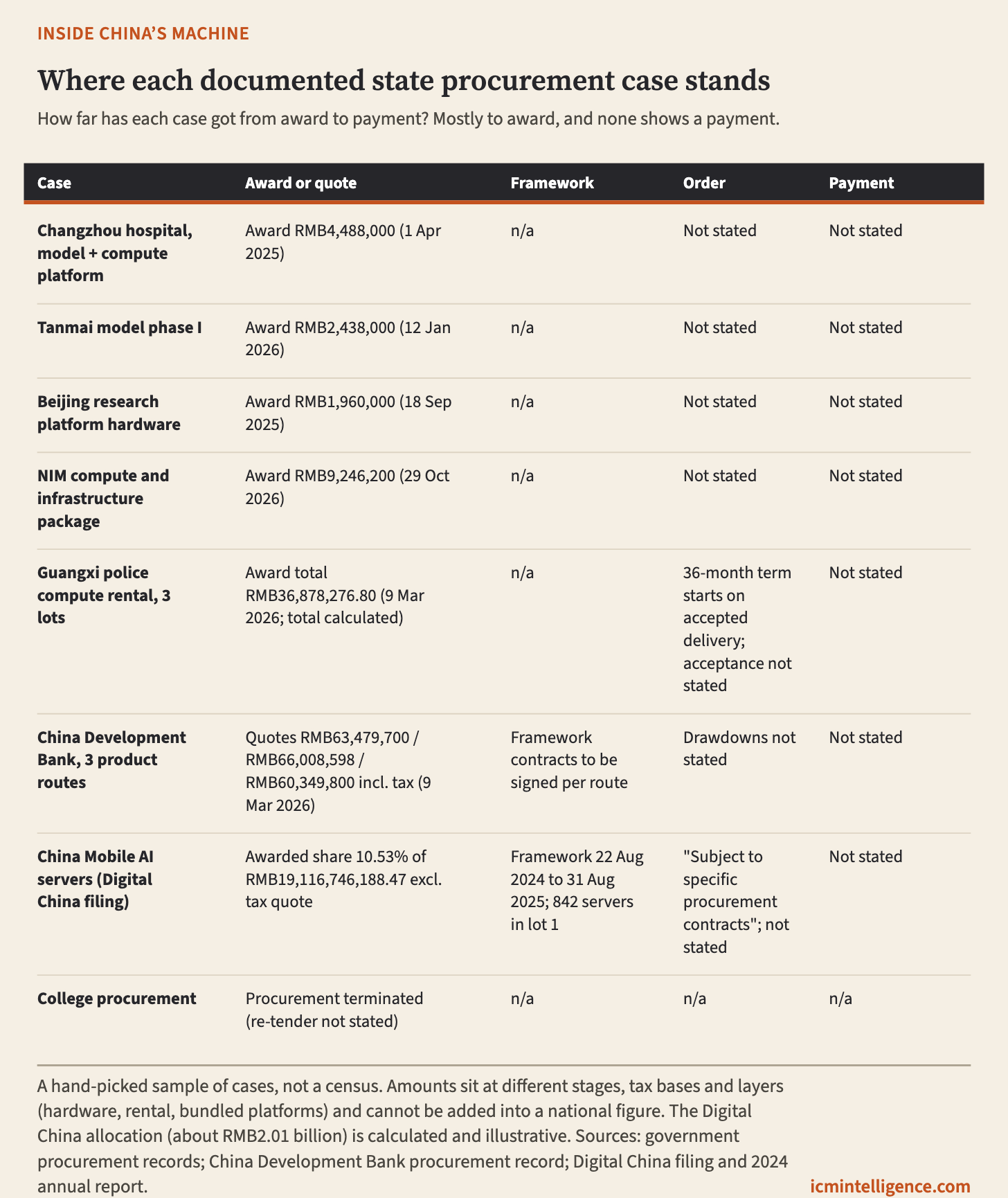
So the first half of the proof holds. The state demonstrably buys AI and compute, with dates, amounts and named suppliers. The same records show how weak a claim that “the state leads demand” would be as a national statement. These are cases, mostly at the award stage. They cannot be summed. Some sit at the hardware layer and some at the service layer, and adding amounts across layers can count one supply chain more than once.
The state also pays when someone else buys
The second half of the proof is the more interesting one, because it breaks the question in two.
A compute voucher is a coupon from a government scheme that pays for part of a company’s bill for computing. The company still signs the contract with a compute provider and still receives the invoice. The voucher then covers a slice of that invoice. Ask who bought, and the answer is the company. Ask who paid, and the answer is the company and the state, in proportions that depend on the scheme.
Shenzhen’s line from June 2025 is the clearest illustration, because it gives both the value of the services submitted and the support requested against them.
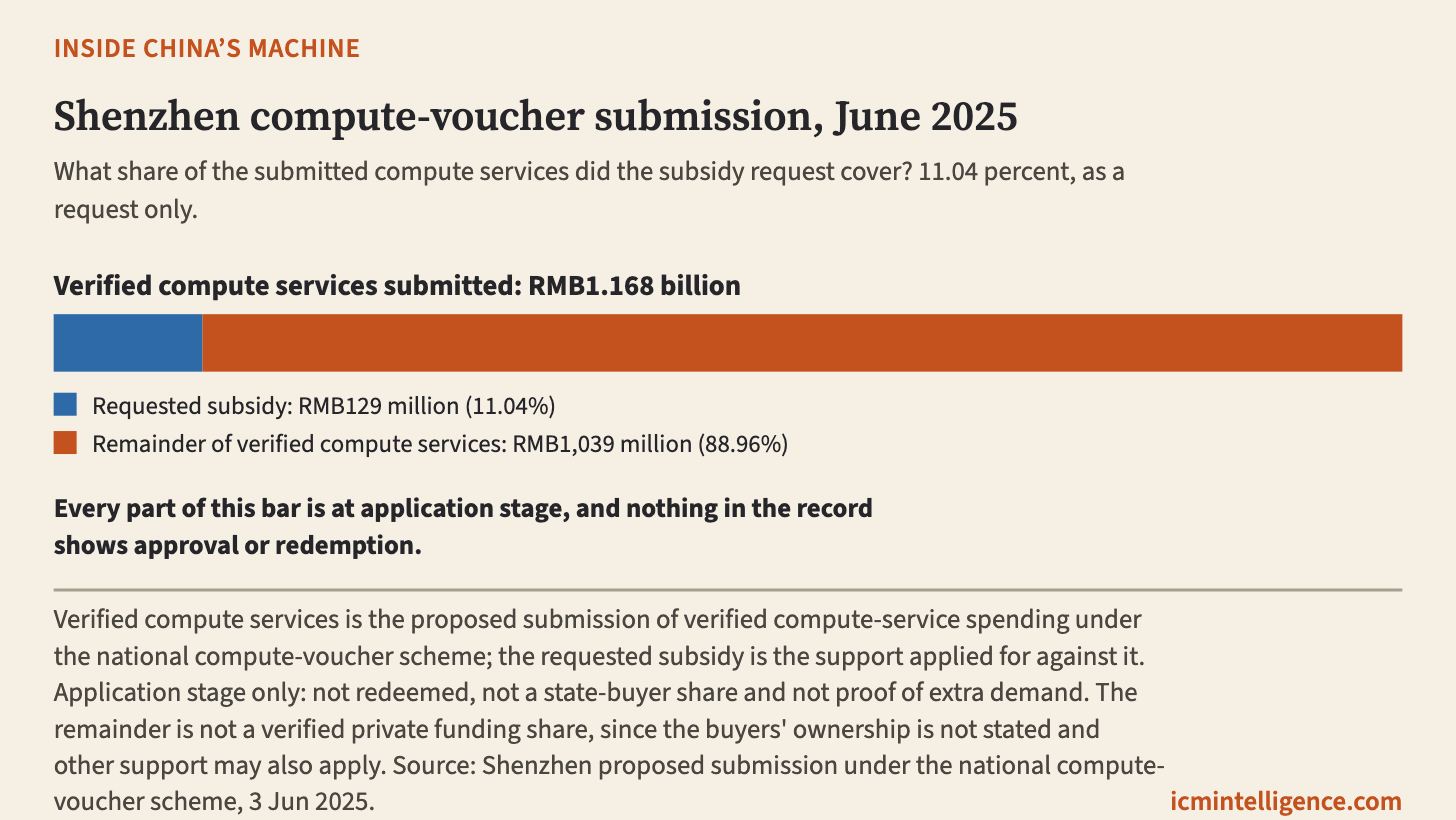
By our arithmetic, the requested subsidy is 11.04 percent of the verified services. It is tempting to read the other 88.96 percent as private money. The record does not support that. It does not say who the buyers are, and some of them may be state-controlled. Other support may also apply. It also does not say whether the applications were approved, or whether any vouchers were redeemed, meaning money was actually paid out against invoices. An application is a request. Redemption is the cash arriving.
Elsewhere the published numbers are the rules of the schemes, and the rules are ceilings. A ceiling is the most a scheme will pay. It is not what it usually pays. Shenzhen’s 2026 training vouchers say 以训力券单次抵扣不超过服务合同金额的50%: a single use of a training voucher offsets no more than 50 percent of the service contract (our translation). The limit rises to 60 percent for eligible start-ups less than a year old. Each beneficiary is capped at RMB10 million a year, must have at least RMB500,000 of eligible annual spending, and must buy from compute providers it is not affiliated with. Hubei’s 2025 scheme provides a 10 percent subsidy on actual compute expense, capped at RMB1 million per computing user a year: 给予10%的补助,单个用算主体每年累计最高补助100万元. Liaoning’s scheme for 2026 to 2028 lets combined local and provincial support reach no more than 30 percent of actual compute-contract spending (累计给予算力合同实际发生金额不超过30%的补贴), capped at RMB2 million per beneficiary a year. Beijing’s 2023 to 2025 scheme, in a 2024 reprint, set a 20 percent ceiling on the contract. That was its ceiling then. It is not a 2026 figure.
Shanghai’s notice of 7 May 2026 closes the loop with the private market. It supports 调用非关联方云平台部署的第三方大模型API产生的费用: the cost of calling third-party large-model APIs deployed on non-affiliated cloud platforms (our translation). An API, or application programming interface, lets one piece of software request services from another; here, customers send requests to a model over the internet and pay for usage. Under that clause, a private company buying model services by the call, from a cloud platform it is not affiliated with, can have part of that bill covered by public money. A buyer that looks entirely commercial can be partly subsidised.
Support also comes as funds and as cheaper inputs. Beijing’s Shijingshan district announced a compute fund on 7 February 2025, 设立规模1.9亿元, established at a scale of RMB190 million (our translation). That is the size of the fund. It is not the money actually paid in and not the value of services bought. Fujian in 2024 said it would 协调中国联通福建省分公司提供优惠的机柜租赁价格、电费补贴和其他优惠政策: coordinate China Unicom’s Fujian branch to provide favourable rack rental prices, electricity subsidies and other preferential policies (our translation). The support is arranged through the provider’s prices and subsidies. The rate per kilowatt-hour is not public, and neither is the amount paid.
Shenzhen’s first training-voucher issue, in March 2025, was reported on a government site as 总额近2亿元,惠及近40家人工智能和具身智能机器人企业: nearly RMB200 million in total, benefiting nearly 40 AI and embodied-robotics firms (our translation). That is an allocation, not redeemed cash. It may also overlap with the national-scheme submission above, so the two cannot be added.
One scheme does report redemption, and it shows how much care the numbers need even when they get that far. Xinhua reported that in Guizhou, as of 31 March 2026, 299 of the 333 voucher certificates issued under the 2025 scheme had been redeemed, for RMB98.02 million, and that 算力券资金执行率达到98%: the voucher fund execution rate reached 98 percent (our translation). By count, 299 of 333 is 89.79 percent, by our arithmetic. That is the share of certificates redeemed, not the share of money spent: certificates need not represent equal amounts. The 98 percent is a measure of fund execution whose denominator is not published. The two percentages measure different things, and the published information does not reconcile them. Guizhou has allocated RMB140 million for 2026, and dividing the 2025 redemptions by it would set one year’s results against another year’s budget.
A national action document names fiscal funds and government procurement among its policy instruments: 充分发挥财政资金、政府采购等政策作用, make full use of the policy roles of fiscal funds, government procurement and other instruments (our translation). It sets targets of more than 70 percent adoption of AI terminals and agents by 2027 and more than 90 percent by 2030. Those are targets. They describe what the document wants. They do not describe what has happened.
Now return to the Answer Price. A voucher at Shenzhen’s 50 percent ceiling would halve the buyer’s effective price on that invoice. With the task, token use and success rate unchanged, the buyer’s cost per successful task would fall with it, while the provider could still receive the full invoice amount. If you measure demand from the buyer’s side, the voucher makes the company look like a price-sensitive commercial buyer getting a good deal. If you measure from the seller’s revenue, the whole invoice looks like customer demand. Either way the state’s share disappears unless reimbursements are shown separately. There is also a trap on the other side: count the voucher as state spending and the whole supported invoice as customer spending, and the government’s slice is counted twice.
So “who buys” and “who pays” are two different questions. The documented cases answer the first in places. The voucher schemes show why the first answer does not settle the second.