Inside China’s Machine · Tokenomics, Episode 2 of 10
The Answer Price = price per token × tokens per attempt ÷ success rate
A token count measures what the machine read, not what anyone wanted done, and most of what an agent reads is its own past.
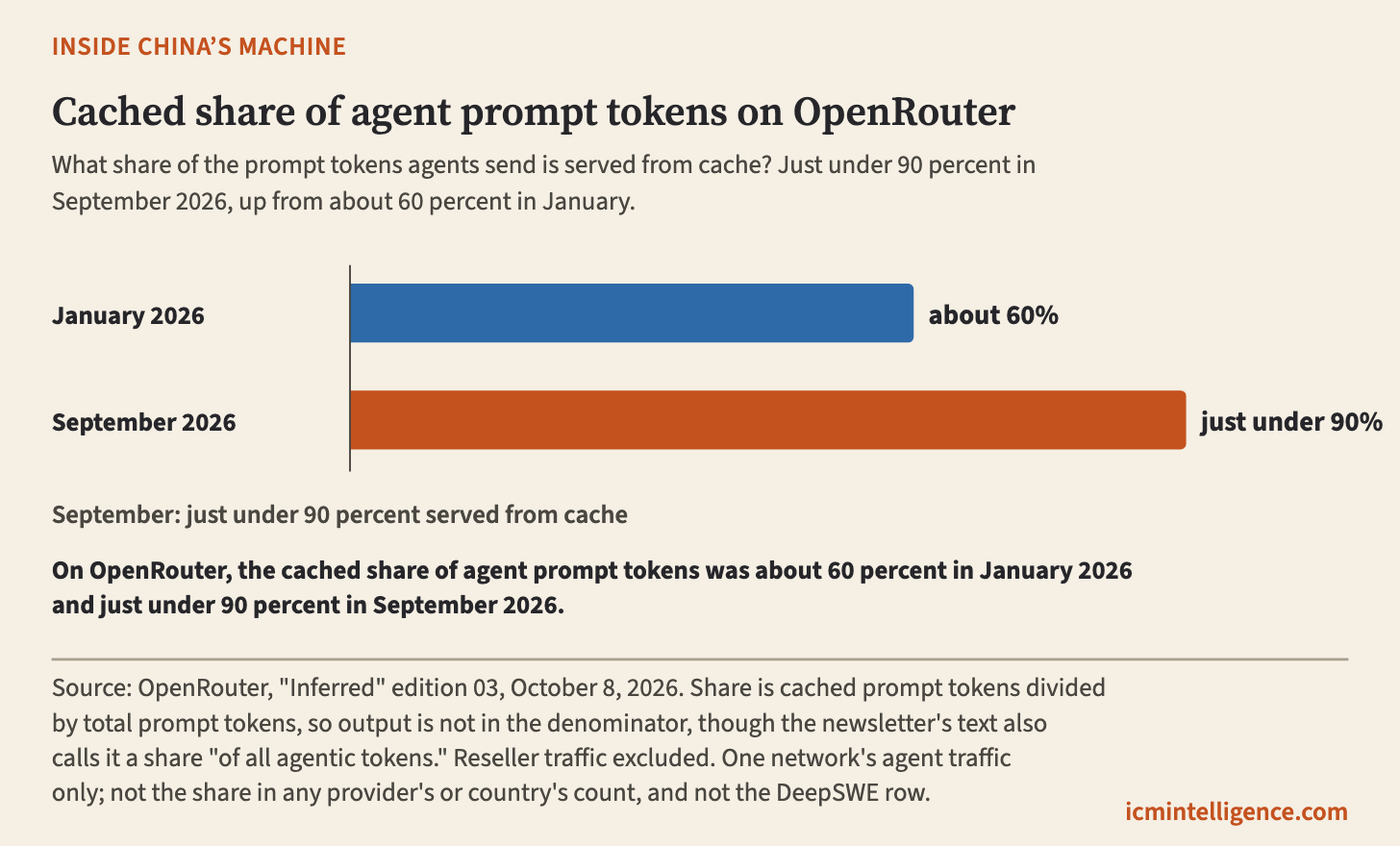
In the last week of September 2026, the API keys that OpenRouter classes as agents used about seven times as many tokens as the keys it classes as human. The routing platform reported this in its data newsletter, “Inferred” edition 03, published October 8. The same newsletter reports what those agents were reading. Just under 90 percent of their prompt tokens in September were cached. That is text the model had already been sent, served again from stored work. In January the share had been closer to 60 percent.
Put another way, of every ten tokens an agent on OpenRouter sent as input in September, about one was not served from cache. The other nine were text the model had already been sent, served again from stored work.
The newsletter computes the share as cached prompt tokens divided by total prompt tokens, so output is left out, although one sentence calls it a share “of all agentic tokens.” It excludes reseller traffic. It describes OpenRouter’s network and nothing wider.
A public benchmark shows what one of those agent runs looks like from outside. DeepSWE v1.1 sets 113 real software tasks under the mini-swe-agent harness, with the page last updated September 22, 2026. On it, DeepSeek’s cheaper model, deepseek-v4-flash, at max effort, took 153 steps per attempt and wrote 108,000 output tokens. Each attempt cost $0.46, and the model solved 53 percent of the tasks (±4 points). The page publishes no input or cached tokens, so it cannot say how much of those 153 steps was re-reading. It does say how many tasks got solved, which no token headline does.
Every cached token is a token. It is billed, at a lower price, and it is served.
That is the problem with the token boom. A token count measures what the machine read, not what anyone wanted done, and as agents take over, the count can grow faster than the work, because most of what an agent reads is its own past. The headlines are a platform’s weekly tokens, a provider’s tokens per month or per day, and China’s national daily figure. If they count cached input, they overstate useful demand, and the more agentic the traffic, the more they can overstate it. The number that measures demand is solved tasks. Until someone publishes that, token growth should be discounted. Anyone who sizes capacity or a business on raw token counts is probably reading the boom too high, by an amount no outsider can yet measure.
Why an agent mostly re-reads
A chat question is one exchange. You send a question, the model reads it and answers. There is no transcript to re-read, so nearly all the input is new.
An agent works in steps. It reads the task, thinks, runs a tool, reads the result, thinks again. A model does not remember the previous step on its own, so at every step the agent sends the whole conversation so far back as input: the task, every earlier thought, every tool result. Each step adds a little new material. The history it carries keeps growing.
Assume each step adds roughly the same amount. Then the 153rd step re-reads 152 steps of history to add one. New input grows in step with the number of steps, and total input grows with the square of it. Double the length of a run and the new material doubles, but the re-reading roughly quadruples.
The published measurements vary with the harness. OpenRouter’s agent traffic was just under 90 percent cached in September. Requesty, an API gateway, reported cache-hit rates for coding agents in April 2026 ranging from 45.5 percent for Kilo Code to 91.9 percent for Claude Code. It computes them as cached tokens over input tokens and does not state its sample size. A public set of coding-agent traces on Hugging Face (netpreme, undated, Claude Code harness on SWE-bench tasks) reports cache rates of at least 97 percent on average and at least 99 percent at the median. Those are the dataset caption’s own floor figures: it says “at least,” and gives neither a range nor exact values. Apart from Kilo Code’s 45.5 percent, all of them show agents reading mostly what they have already sent.
A cache hit is billed far below a fresh input token: 50 times less on DeepSeek’s current Flash model and 10 to 40 times less across Anthropic’s current models, at list prices read October 29, 2026. “Cache hit” is the providers’ name for this re-reading. When the start of a request matches text they processed recently, they reuse the stored work instead of computing it again, and they bill that hit below the normal input price. DeepSeek’s official price page lists its current Flash model (deepseek-flash, V4.1-Flash-1017) at peak list prices of 0.04 yuan per million input tokens on a cache hit and 2 yuan on a miss. That makes a hit 50 times cheaper. Off-peak, both prices halve. The page shows no effective date, and the DeepSWE row’s $0.46 reflects whatever prices applied when it ran. Anthropic’s price page, read the same day, lists cache reads at a tenth of base input for Claude Fable 5 ($1 against $10 per million tokens), a fortieth for Fable 5.1, and a twentieth for Opus 5.5 and Sonnet 5.5.
The re-reading is real. Without it the agent would forget what it was doing. But it is the machine’s memory, not the customer’s demand, and it is priced as such.