



Inside China’s Machine · Tokenomics, Episode 4 of 10
The Answer Price = price per token × tokens per attempt ÷ success rate
Where compute is tight, AI providers now price the working hour and the promised speed on top of the token, and the serving margin plausibly goes to whoever keeps machines busy at that speed, though no public filing yet shows it.
DeepSeek’s Chinese price page, last modified October 30, 2026, has two prices for each kind of token on the same model. For its Flash model, a million output tokens cost 8 yuan in the “高峰时段”, the peak period, and 4 yuan in the “空闲时段”, the idle period. The page then defines the peak period as Monday to Friday, excluding China’s statutory holidays, from 09:00 to 12:00 and from 14:00 to 18:00 Beijing time. Everything else is idle. That includes nights, weekends, holidays and the two hours in the middle of the day.
The clock follows the Beijing office day closely enough to leave out lunch. Nothing about the model changes at noon. What changes is who wants the machine. For seven hours a weekday, DeepSeek charges double. When the office empties, it charges half.
Half a world away, OpenAI’s price page lists four prices for one model, gpt-6.1-sol. Input costs $1 per million tokens on Batch, $2 on Standard, $4 on Fast and $12 on Ultrafast. The model and the provider are the same, and the price differs by a factor of twelve. The only thing that varies is when the work runs and how quickly the tokens come back.
That is this episode’s call. Where compute is tight, sellers no longer price only the token. They price the working hour and the promised speed. A buyer is paying for a service envelope, meaning when the work runs and how fast it returns, and that envelope has its own price schedule that sits on top of the token price. Who earns the margin from serving it is a separate question. The mechanism points to whoever can keep machines busy at the speed they promised, rather than whoever holds the cheapest chips. The public record cannot yet prove that.
One model, several prices
Once you know where to look, the pattern repeats across providers. Anthropic sells Claude Opus 5.5 at $4 per million input tokens on Standard, $2 on Batch and $8 on Fast. Google’s Gemini 4 Argon is $2 on Standard, $1 on Batch or Flex and $3.60 on Priority. On Amazon’s Bedrock in Sydney, the same DeepSeek v3.1 model is sold at half price on Flex and at 1.75 times the price on Priority. In China, Moonshot’s kimi-k3.1-pro costs twice as much on its Highspeed tier and 60 percent of Standard on Batch. DeepSeek’s own API does the same thing with a clock instead of a tier.
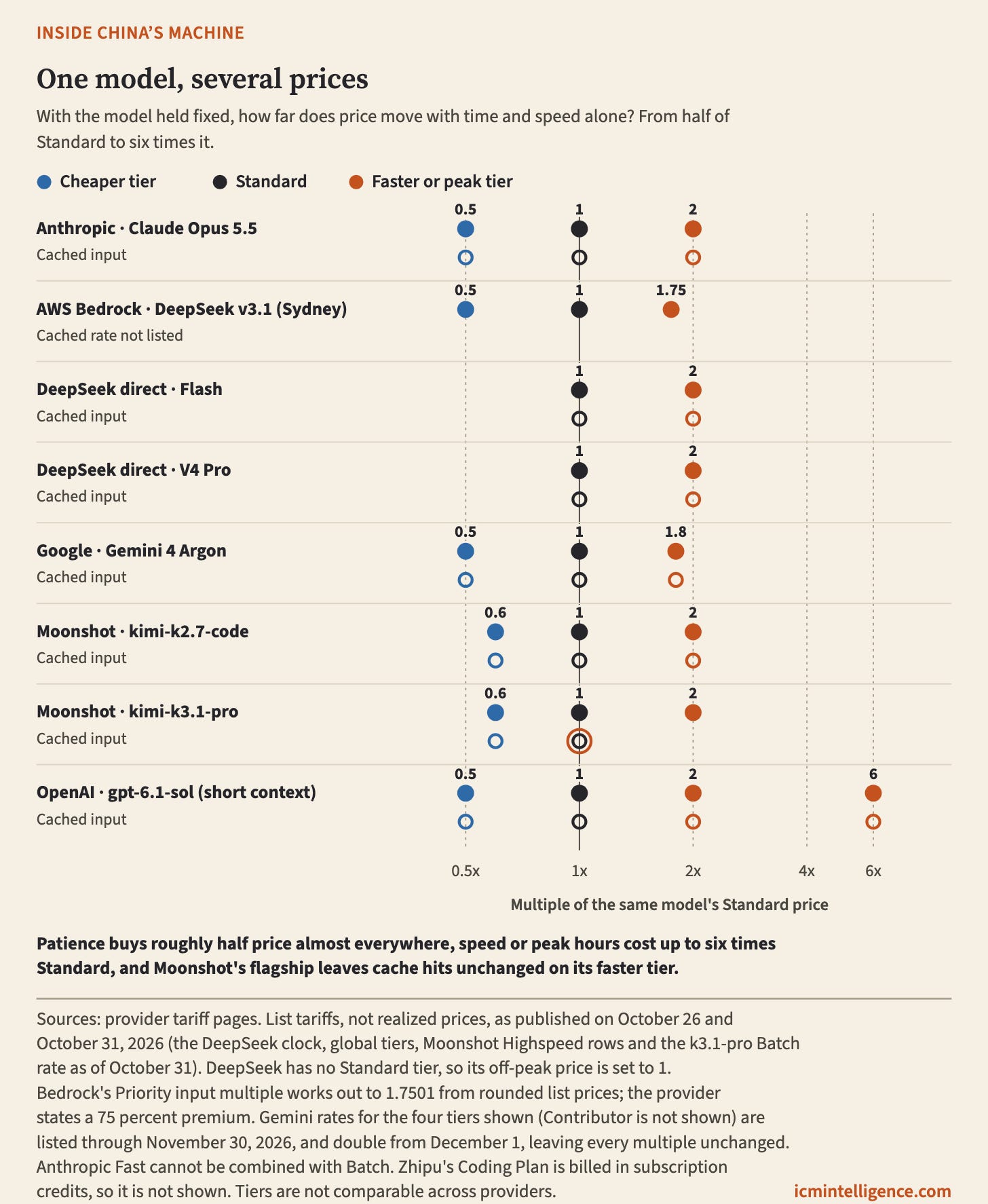
Two things in the figure are worth a second look.
The first is that the multiples hold when prices move. Google has already posted the Argon rates for December 1: Standard doubles to $4, Batch and Flex double to $2, and Priority doubles to $7.20. The base price changes, and the half-price and 1.8-times relationships stay exactly where they were. Google’s Flash list also doubles on a fixed date. Here the doubling leaves the shape of the tariff alone. The seller is adjusting what the token costs and separately holding what speed and patience cost.
The second is Moonshot’s flagship. On kimi-k3.1-pro, Highspeed doubles input, output and cache writes, but a cache hit costs 1.30 yuan per million tokens on both tiers. On the older kimi-k2.7-code, the cache hit doubles along with everything else. So on its flagship, Moonshot has chosen not to charge for speed on the re-reads. That choice matters a great deal for one kind of buyer. Agents mostly re-read their own notes, and those re-reads are cache hits. For an agent on k3.1-pro Highspeed, the effective premium is below 2x, because most of what it reads costs the same either way. The tier’s name says 2x, and the effective premium depends on how much of the workload is cached.
The mechanism behind all this is short. A serving machine earns the most when it runs many requests together in one batch. Batching raises throughput, but each request then waits for the others and comes back more slowly. A request that has to come back fast takes a share of the machine that could otherwise have served several slower ones, so the fast lane is priced at a multiple. Batch and off-peak pricing work the other way round. A buyer who can wait lets the seller fill hours that would otherwise sit idle, and those hours are sold cheaply because unsold machine time cannot be stored for later.