



Inside China’s Machine · Tokenomics, Episode 5 of 10
The Answer Price = price per token × tokens per attempt ÷ success rate
The highest reported margins in AI sit with chips, memory and the leading foundry, not with GPU renters or model makers, and no public filing can yet show whether that lasts.
In the second quarter of 2026, CoreWeave took in USD 2,575 million. CoreWeave rents out AI computing capacity. On those sales it reported a GAAP operating loss of USD 49 million, an operating margin of -1.903%. Two months later, Micron closed its fiscal year on 3 September. Micron makes the memory those chips cannot run without. Its cloud memory unit, which sells to the hyperscalers, the largest cloud computing providers, reported an operating margin of 76%, rounded and unaudited, for the final quarter. Both are operating margins. One belongs to a whole company and the other to a business unit, so they are not twins. Still, they answer the same plain question: after operating costs, including depreciation on equipment, how much of each dollar of sales is left?
At the memory maker, about three quarters is left. At the firm that buys chips and rents them out, slightly less than nothing is left.
Today the highest reported margins in the AI stack sit upstream, at the layers where capacity binds: chips, memory and the foundry. Upstream means the suppliers of the physical inputs; downstream means the businesses that use those inputs to sell computing, models and applications. The firms that rent that capacity, and the firms that sell models on top of it, report thin or negative operating margins; applications disclose too little to judge. Owning GPUs is not the same as keeping the surplus, and neither is selling the model that runs on them. This describes where reported margin sits now, as of the quarters that closed by October 2026. It is not a forecast. The second half of the question is whether the surplus stays upstream once new capacity arrives. The honest answer is that public accounts cannot tell yet, and the reason is worth understanding.
Why margin may sit upstream
Start with the plumbing. A company that wants to sell AI answers needs accelerators, the chips that do the computation; high-bandwidth memory, or HBM, to feed them data fast enough; and wafers from foundries, the factories that manufacture chips. Those are bought in advance, paid for in cash, and turned into revenue over years through rental, model access or application fees. Our reading: whoever holds the scarce capacity has leverage over the price at purchase, and everyone further down pays it, then competes for the buyer.
Memory and cloud sellers say supply is short. Microsoft, on its October call: “Customer demand continues to exceed available supply.” Oracle: “Customer demand for AI Cloud Training and Inferencing Services continues to grow faster than supply.” Training builds a model; inference runs it to answer a request. Samsung said its memory business set another record “by managing its product mix, with a focus on AI products, amid capacity constraints.” SK hynix disclosed on 28 October that long-term agreements cover “more than 50% of total production capacity for 2027 and 2028.” That statement is more limited than “sold out”: it covers more than half of capacity, not all of it, and long-term agreements are not fixed-price guarantees. None of these statements shows that all AI capacity is sold. What they do show is the seller’s position: at the moment of purchase, the buyer is the one waiting.
The margins match that position. They are reported under different definitions, and here each one keeps its own. Gross margin is what remains after the costs assigned to delivering the product. Operating margin also deducts operating expenses such as research and administration. Adjusted measures exclude further costs chosen by the company.
At the chip layer, NVIDIA’s consolidated GAAP gross margin was 71.1% for the fiscal year ended January 2026 (audited). For the quarter ended July 2026 it was 75.0% (unaudited; the company stated: “For the quarter, GAAP and non-GAAP gross margins were both 75.0%.”). That is the whole company’s mix, though Data Center made up USD 89,023 million of the quarter’s USD 96,221 million in revenue. Not every chip maker is so placed. AMD’s Data Center segment, which combines server CPUs with accelerators, earned a segment operating margin of 31.304% in Q2 2026 (calculated). That is a different measure from NVIDIA’s gross margin and is not ranked against it. It does show that “chips” is not one uniformly rich layer.
At the memory layer the figures are the most striking in the stack. Micron’s gross margin for fiscal 2026 was 80.716%, calculated from audited amounts. For fiscal 2025 it was 39.791%. Micron’s filing does not split the rise between higher prices for the same products and a more profitable product mix. SK hynix reported an operating margin of 80%, rounded (79.657% calculated), for Q3 2026, across all its DRAM and NAND memory, not HBM alone. Samsung’s chip division, which combines memory, foundry and logic, earned an operating margin of 72.4% (calculated).
At the foundry, TSMC reported a Q3 2026 gross margin of 66.4% and an operating margin of 58.7%, up from 59.9% and 50.8% for fiscal 2025 (audited). That covers all of its wafers, not only the AI ones.
The hyperscaler clouds sit in between, and their margins are hard to read. AWS earned a segment operating margin of 38.650% in Q3 2026, against 34.642% a year earlier. Google Cloud earned 36.214%, against 23.712%. Microsoft’s new Agents and Infra segment earned 52.813% in its first reported quarter. That segment was created in the quarter ended September, so it cannot be joined to the old Intelligent Cloud series: the businesses being measured have changed. Each of these figures combines training, serving, rental and in some cases applications. None tells us the margin on inference alone. Oracle discloses no margin at all for its cloud infrastructure, and dividing Oracle’s corporate profit by cloud revenue would mix profit from the whole company with sales from only part of it.
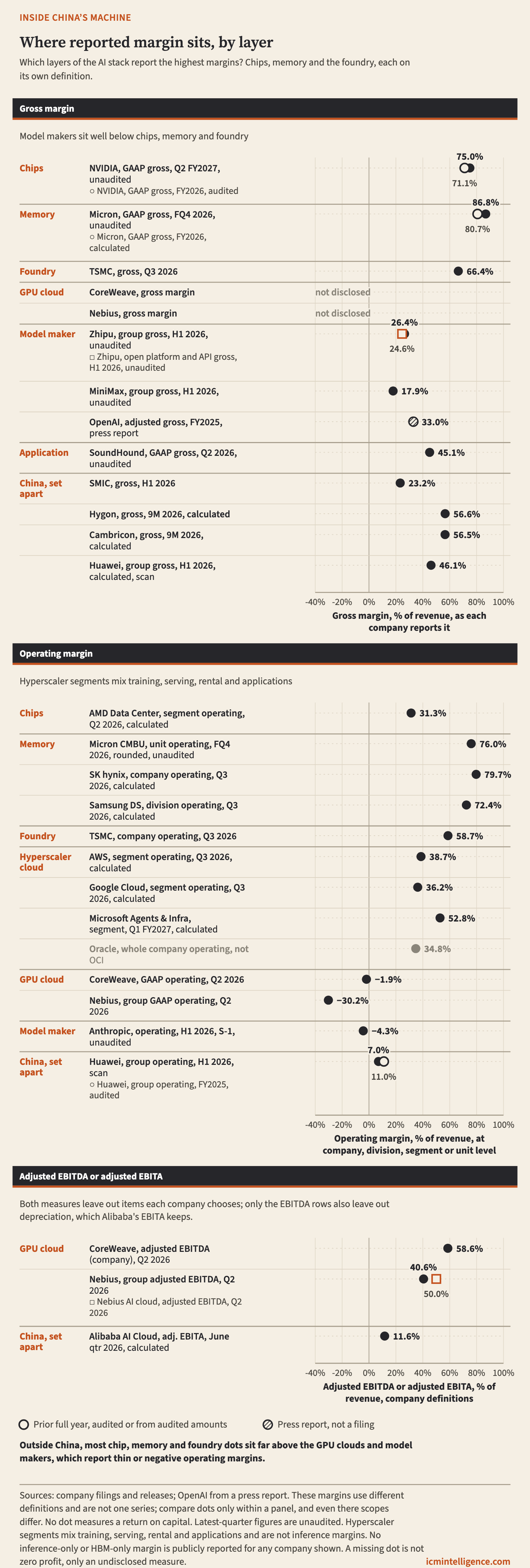
Read each panel separately, from top to bottom, and the pattern is clear. Outside China, most of the dots for the layers that make the scarce physical things sit between the high fifties and the high eighties, under their own definitions; AMD’s Data Center segment, at 31.304%, is the exception. The GPU clouds and the model maker that file operating results report margins near zero or below at the operating line; the hyperscaler segments are higher but mix many workloads. The third panel does not overturn that pattern: it shows that GPU clouds report much higher margins when depreciation and other excluded costs are left out. A missing dot does not mean zero profit, only that the measure is not disclosed.