


Inside China’s Machine · Tokenomics, Episode 6 of 10
The Answer Price = price per token × tokens per attempt ÷ success rate
Where compute is scarce, China’s AI providers now sell capacity by the hour, by queue position and by service level, so the race to cut token prices has become a contest over who can deliver at the hours customers want.
On 24 April 2026, DeepSeek published the launch prices for the preview of its V4 models. The graphic had the usual rows: input, output and cached input, in yuan (per million tokens, by DeepSeek’s convention). Tokens are the units of text a model processes or produces; cached input is material the service can reuse rather than process afresh. Underneath it was a footnote: “受限于高端算力,目前Pro的服务吞吐十分有限”. In our translation, constrained by high-end compute, Pro’s serving throughput is currently very limited. It added that Pro’s price should fall sharply once Ascend 950 supernodes ship in volume in the second half of the year. A price list is meant to tell you what something costs. This one also told you that you might not be able to buy much of it.
Our view is that China’s AI price war is over wherever compute is the binding constraint: wherever the machines available cannot serve all the work customers want done. It has not ended in a truce. It has turned into a different contest, over capacity and service level. In the race to the bottom on token prices, when ByteDance launched Doubao in May 2024 at 0.8 yuan per million input tokens and Alibaba halved qwen-max prices that September, from 40 to 20 yuan for input and from 120 to 60 for output, the number that mattered was the price per million tokens. The price notices of 2026 carry other things: a clock, a priority fee, a rationed plan, a rise in the list price of the compute underneath. What a buyer pays now depends on when the work runs, how fast it runs and how reliably it gets admitted at all. The obvious next question is who keeps the money from this, and the honest answer is that the public accounts cannot yet say.
The clock that flipped
The clearest case is DeepSeek’s own price page, which has now kept time in two opposite directions.
In 2025, DeepSeek’s discount came at night. Archive snapshots of its page from March to June 2025 show cheaper rates between 00:30 and 08:30 Beijing time, when, DeepSeek said, load was low and it moved nodes to research. DeepSeek’s price page, as archived on 21 August 2025, announced the night discount’s withdrawal for V3.1 from 6 September 2025. Archive snapshots record what a page said on a date, not when a policy began, but the direction is clear.
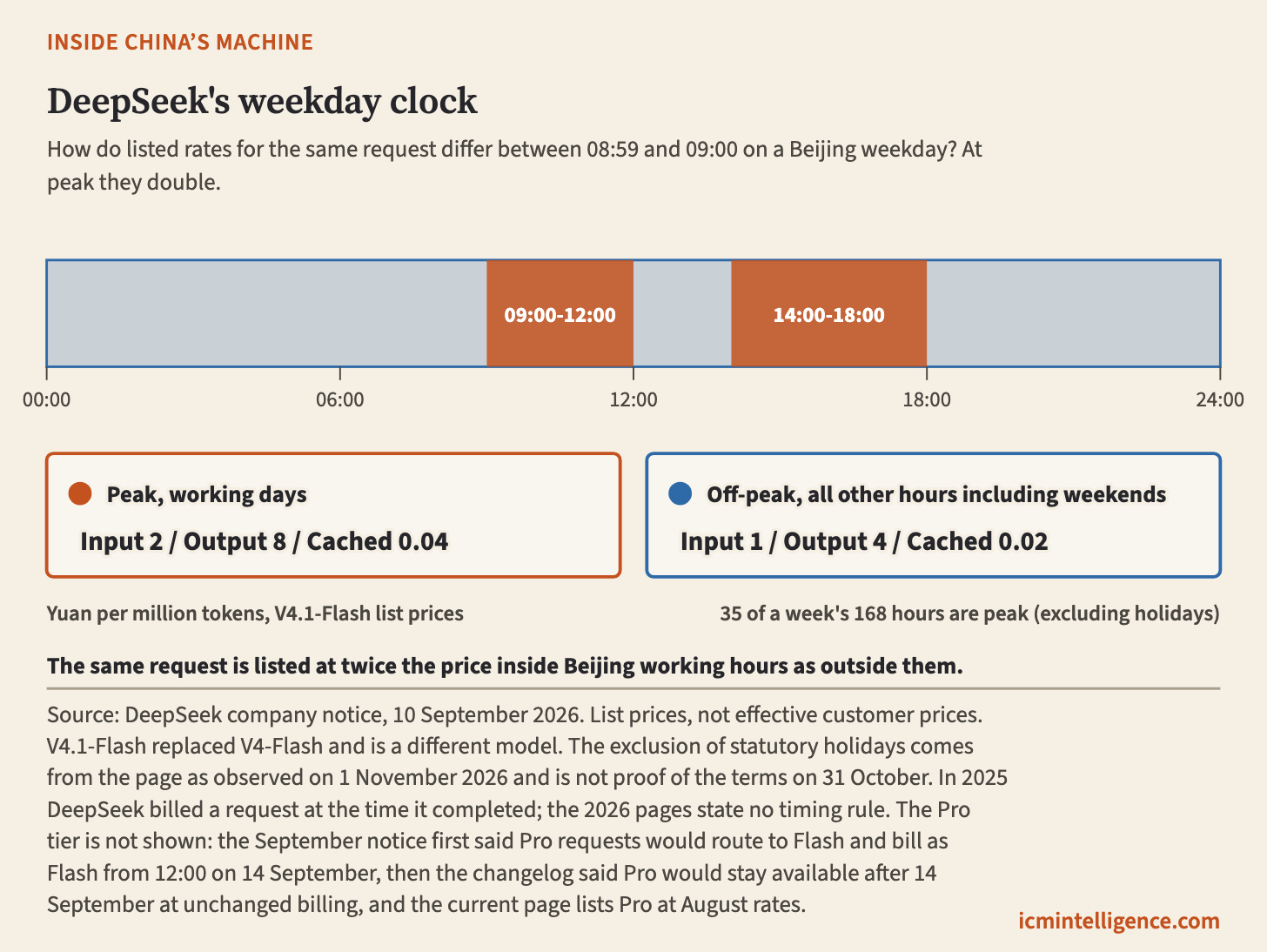
The 2026 clock runs the other way. On 13 August DeepSeek announced a peak and off-peak tariff, effective 17 August, and stated the rule plainly: “闲时价格为高峰时段价格的一半” (our translation: off-peak prices are half of peak prices). Peak hours are 09:00 to 12:00 and 14:00 to 18:00 Beijing time. The 2025 night discount sold spare capacity cheaply. The 2026 tariff charges a premium for Beijing daytime hours, when, by DeepSeek’s own 2025 account, its load is highest. Both make quieter hours cheaper, but the emphasis has shifted: from selling spare capacity at night to charging more for scarce capacity when customers most want it.
On 10 September DeepSeek replaced V4-Flash with V4.1-Flash and cut its rates. The headline is accurate but needs care. V4.1-Flash is a new architecture, so this is a model change, not a like-for-like price cut. Measured against the August V4-Flash off-peak rates, input fell from 1.5 to 1 yuan, output from 4.5 to 4 and cached input from 0.05 to 0.02. The clock stayed. The new peak rates are exactly double: 2 yuan input, 8 output, 0.04 cached. Peak is now defined as working days only, so weekends are off-peak, and the current page, observed on 1 November, also excludes statutory holidays.
Set that “cut” against the April preview, which listed Flash at 1 yuan input and 2 output (down from V3.2’s 2 and 3 in January). After September’s cut, off-peak input is back where the preview started. Off-peak output is double the preview rate, and peak output is four times it. Each step involves a different model or label (preview, general release, replacement), so this is not one product repriced three times. Still, a user following Flash through these changes saw input and output prices rise, then partly fall, while cached input prices fell throughout and the tariff acquired a clock. The September cut was a partial retreat on output prices that had moved up. It was not a return to the 2024 race.
DeepSeek’s explanation for the cut points at the same constraint as the April footnote. “得益于模型架构的创新,DeepSeek V4.1 Flash 能够以更低的成本服务更多的用户”, in our translation thanks to model architecture innovation, V4.1 Flash can serve more users at lower cost. The company added that its smaller KV cache (the working memory a model keeps so it can use earlier parts of a request without recalculating them) cuts high-bandwidth memory (HBM) needs to a quarter and solid-state storage needs to an eighth of the previous generation’s. Those figures describe memory requirements, not total cost or margin. They still show what the company is saving: scarce hardware per user served. When compute is scarce, DeepSeek’s cost story is getting more users onto the same machines.
What the clock does to a bill
The Answer Price is what a buyer spends per successful task. In its simplest form:
answer price = price per token × tokens per attempt ÷ success rate
The multiplication gives the cost of an attempt. Dividing by the share of attempts that succeed spreads the spending on unsuccessful attempts across the successful tasks. Where input, output and cached input have different rates, the cost of each is calculated separately and added together. Token price is one lever of three. The 2026 notices are interesting because between them they pull all three.
Start with the first lever, using DeepSeek’s clock in a scenario. This is arithmetic on list prices, not an invoice. Take a fixed job: 1 million input tokens and 0.1 million output tokens, with no tools, retries, storage or tax. With no cached input, it costs 1.40 yuan off-peak and 2.80 yuan at peak. If 90% of the input is cached, as can happen for agents re-reading context, it costs 0.518 yuan off-peak and 1.036 at peak. Caching cuts the bill a great deal, and the clock still doubles whatever is left. Moving the job to 20:00 halves the bill. That only helps a buyer who can wait. A batch job can. A developer whose coding agent is stuck at 10:30 on a Tuesday cannot, so the clock lands hardest on the most time-sensitive work, which may be the work a buyer values most.
Now the third lever, success rate. From 13 March, Baidu’s Coding Plan began throttling some models at peak hours: “将对高峰时间段内部分模型的调用进行限流处理”, in our translation calls to some models during peak periods will be rate-limited. Baidu said calls might slow, queue or fail. A failed call never appears as a price change, but it lowers the success rate. Where a failed or queued call is billed, or has to be paid for again by a retry, dividing by a smaller success rate raises the Answer Price while the list price stays the same. The notice does not say whether failed calls are billed. MiniMax offers the reverse: a priority tier at 1.5 times its standard tariff that buys admission priority and a lower chance of request failure. That tier is a separate service, not a rise in the list price, and the fee buys a better chance that the request gets in at all. A request being admitted is not the same as a task succeeding, but it is a precondition for success. MiniMax is charging for that precondition directly.
Zhipu applies the clock to quota rather than price. Under its coding plan of 15 March, GLM-5 and GLM-5-Turbo consumed quota at three times the base rate at peak and twice the base rate off-peak (”高峰期3倍,非高峰期2倍”), though as a promotion GLM-5-Turbo counted at only 1x off-peak through April. On 30 July it began counting weekends as off-peak all day, and its plan page, seen on 1 November, puts peak at Monday to Friday, 14:00 to 18:00. A buyer on a flat monthly plan therefore gets less work from the same allowance at the busy hour, without the price ever being called a price.
The middle lever, tokens per attempt, is where providers claim to be helping. DeepSeek’s 17 October revision left “API 调用方式与价格保持不变” (invocation and prices unchanged) and said the model now shortens task runtime and output length. If it uses fewer chargeable tokens to achieve the same result on a buyer’s own workload, the bill falls at an unchanged list price. It is a company statement with no invoice comparison behind it. The lever can also move the other way. In a scenario with a fixed token mix, a 20% cut in unit price is cancelled by 25% more chargeable tokens, and if the tokens double, the bill rises to 1.6 times its earlier level. None of the filings and notices cited here gives a matched series of Chinese customer bills, so nothing here shows that agent bills rose. The point is narrower: by 2026 the headline price was one lever of three, and the notices were moving the other two.