



Inside China’s Machine · Tokenomics, Episode 8 of 10
The Answer Price = price per token × tokens per attempt ÷ success rate
Chinese labs’ open weights give buyers a credible alternative supplier, but the cost of a finished task is set by cache hits, token use, service terms and utilization, and the public record cannot yet show whether they capped anyone’s price.
On 20 January 2025, DeepSeek announced its reasoning model R1 with this sentence: “今天,我们正式发布 DeepSeek-R1,并同步开源模型权重。” That means today we officially release DeepSeek-R1 and release its model weights at the same time. A few lines later came the part a buyer’s lawyer would notice: “完全开源,不限制商用,无需申请。” That means fully open, no commercial-use restriction, no application.
The thing given away needs a precise name. A model’s weights are the trained numbers that make it work. Publish them, along with the code that runs them, and anyone with suitable machines can run the model, adapt it or sell access to it. DeepSeek released R1’s weights and a technical report, with code and models under MIT, a short licence that permits almost any use. It did not publish a full training corpus in any source we reviewed. You could run R1 and modify it, but not, from what was published, rebuild it from scratch. In this series, only the second counts as open source. The first thing, which is what DeepSeek released, is better called open weights, and the difference matters for what follows.
Here is our view. Published weights from Chinese labs give a buyer a real alternative and a fallback: another supplier, or the option of running the model themselves. They do not tell the buyer what a finished piece of work will cost. That depends on how much of each request the provider can serve by reusing earlier work, how many tokens the model spends, which tier and rate limits apply, and, for anyone running their own machines, how busy those machines stay. Tokens are the small units of text a model reads and writes. So the comparison that matters is the bill for the same task, not the price per token. Two larger questions remain open. One is whether open weights pushed down what proprietary labs charge. The other is whether the lab or the company serving its weights holds the bargaining power. Neither can be settled from public records yet, and the reasons are specific enough to name.
The alternative is real
Within weeks, R1 was on sale from other companies. A host is a company that runs someone else’s model on its own machines and sells access to it. On 18 March 2025, Fireworks described its R1 price in a line that leaves nothing to interpret: “Matches standard DeepSeek pricing ($0.55/$2.19 per million tokens).” Those are list prices for input and output tokens. Tencent’s cloud, from 26 February 2025, listed R1 at CNY 4 per million input tokens and CNY 16 per million output tokens, the same as DeepSeek’s own price. Baidu’s Qianfan platform, on 5 February, listed it at CNY 2 and CNY 8, half the lab’s price on paper. The same announcement offered a free period of about two weeks, so for a while that nominal price was not what anyone paid.
A buyer who had heard of R1 at launch could choose among the lab and at least three hosts within about two months. Those hosts charged the lab’s price or less, and the buyer did not have to download or run the model. The alternative arrived as a set of suppliers.
The newer case is sharper and less tidy. Moonshot’s Kimi K3 lists at USD 3 per million input tokens and USD 15 per million output tokens, against USD 5 and USD 25 for Anthropic’s Claude Opus 4.8 (list prices dated 17 July and 28 May 2026). That makes K3 40 percent cheaper per token. Artificial Analysis, an independent evaluator, ran both on its Intelligence Index on 17 July 2026 and measured USD 0.94 per task for K3 against USD 1.80 for Opus 4.8, about 48 percent lower. That is the cost of running the evaluator’s tasks, not a token-price comparison. K3 scored 57 on that index, and the two models are not of identical quality, so this is a cost gap between different products.
Nor can the gap be credited to open weights. K3 had its API price by 17 July, and its weights repository licence was committed on 27 July. The cheap price came first, the licence ten days later. MiniMax launched M3.1-Flash as an API on 19 October 2026 with a promise rather than a release: “并将于稍后开放权重” (meaning: the weights will be made available later). Cheap Chinese APIs and open Chinese weights can arrive together. They are still two different things, and a buyer can have the first without the second.
The bill is not the token price
Cost is measured with one rule of thumb, the Answer Price: price per token × tokens per attempt ÷ success rate. It is the cost of a finished task, not of a token. We have no measured success rate for the task below, so everything that follows is cost per attempt. We can compare token prices and token use, but not the cost of a successful answer.
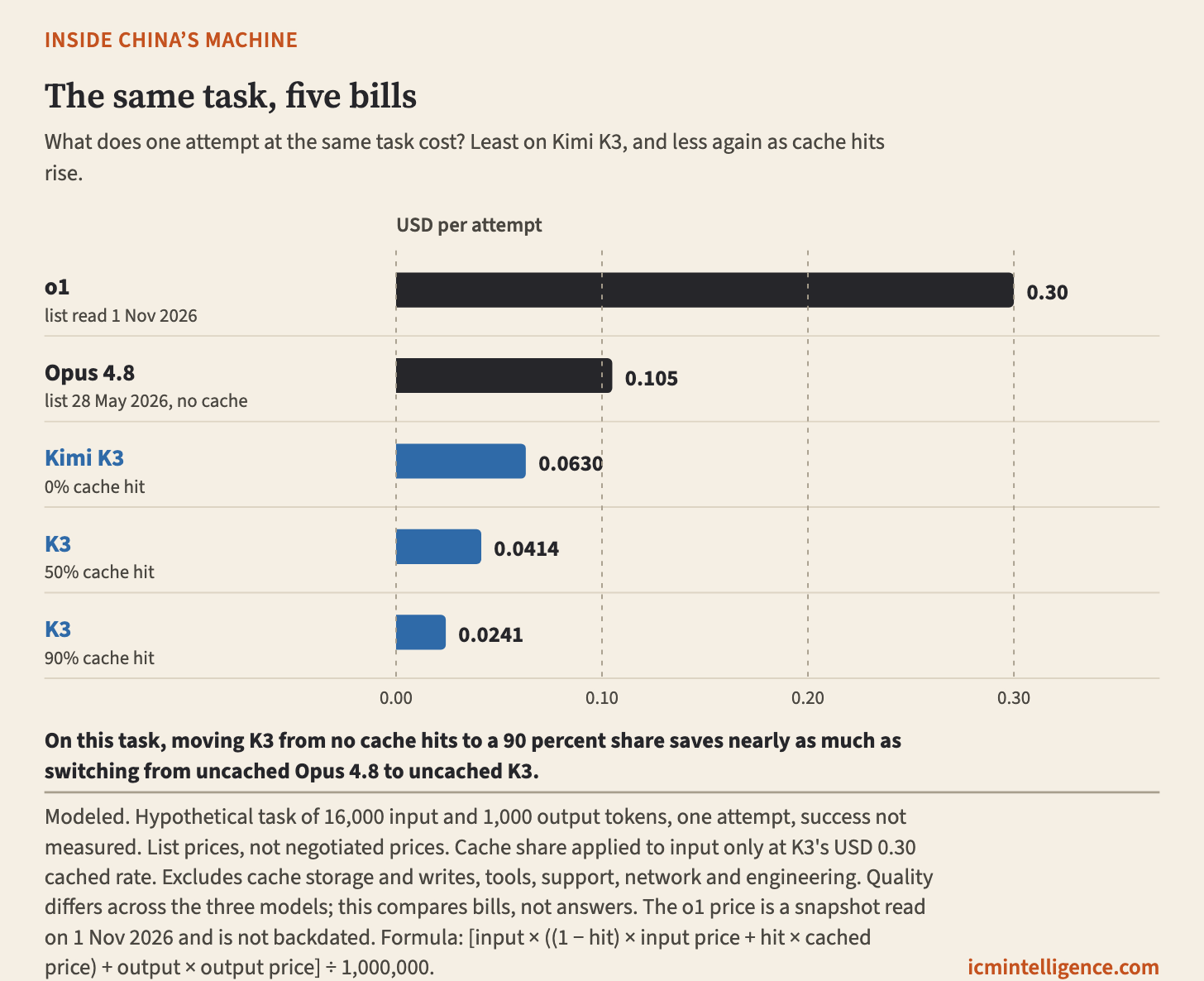
Take one hypothetical task: 16,000 tokens of input, such as a long document or a codebase excerpt plus instructions, and 1,000 tokens of output. These counts are invented for illustration and belong to no real buyer. At list prices, the modeled cost per attempt is USD 0.105 on Opus 4.8 and USD 0.063 on K3. On OpenAI’s o1, whose list price on 1 November 2026 was USD 15 / 60 per million input and output tokens, it is USD 0.30.
Now add one thing a per-token price does not show. A cache hit happens when the start of a request matches text the provider has just processed, such as the same long system prompt or the same files. The provider reuses that work and bills those input tokens at a lower cached rate. K3’s cached-input rate is USD 0.30, a tenth of its normal input price. Apply it to the same task, varying only how much of the input qualifies:
With no cache hits, the K3 task costs USD 0.063.
At half the input served from cache, it costs USD 0.041.
At 90 percent, it costs USD 0.024, which is 38 percent of the uncached bill.
Moonshot says its own coding workloads see cache hit rates above 90 percent. That is a company statement about its traffic, not a promise about yours. On this task, moving from no cache hits to a 90 percent share on K3 saves nearly as much as switching from uncached Opus 4.8 to uncached K3. The cache share depends on how a buyer structures their requests, and it does not appear on any price list.
The second lever is how many tokens the model uses. Start from the uncached bills and keep the task’s shape at sixteen parts input to one part output. K3 could then spend 1.67 times as many tokens as Opus 4.8 before the two bills matched. Hold K3’s input at 16,000 tokens, and its output could grow from 1,000 to 3,800 tokens before it cost what the Opus reference costs. That margin sounds comfortable until you see how much token use moves. On the Intelligence Index, K3 used 21 percent fewer output tokens than its predecessor K2.6. On Artificial Analysis’s agentic workload, AA-Briefcase, K3 used 120,000 output tokens per task against 42,000 for K2.6, 2.86 times as many, across 83 turns, at an average of USD 10.57 per task. There, K3 cost more per task than Opus 4.8. The same model, measured by the same evaluator in the same month, used fewer tokens than its predecessor on one workload and almost three times as many on another. Those two results describe different kinds of work and should not be averaged, and a list price says nothing about either.