

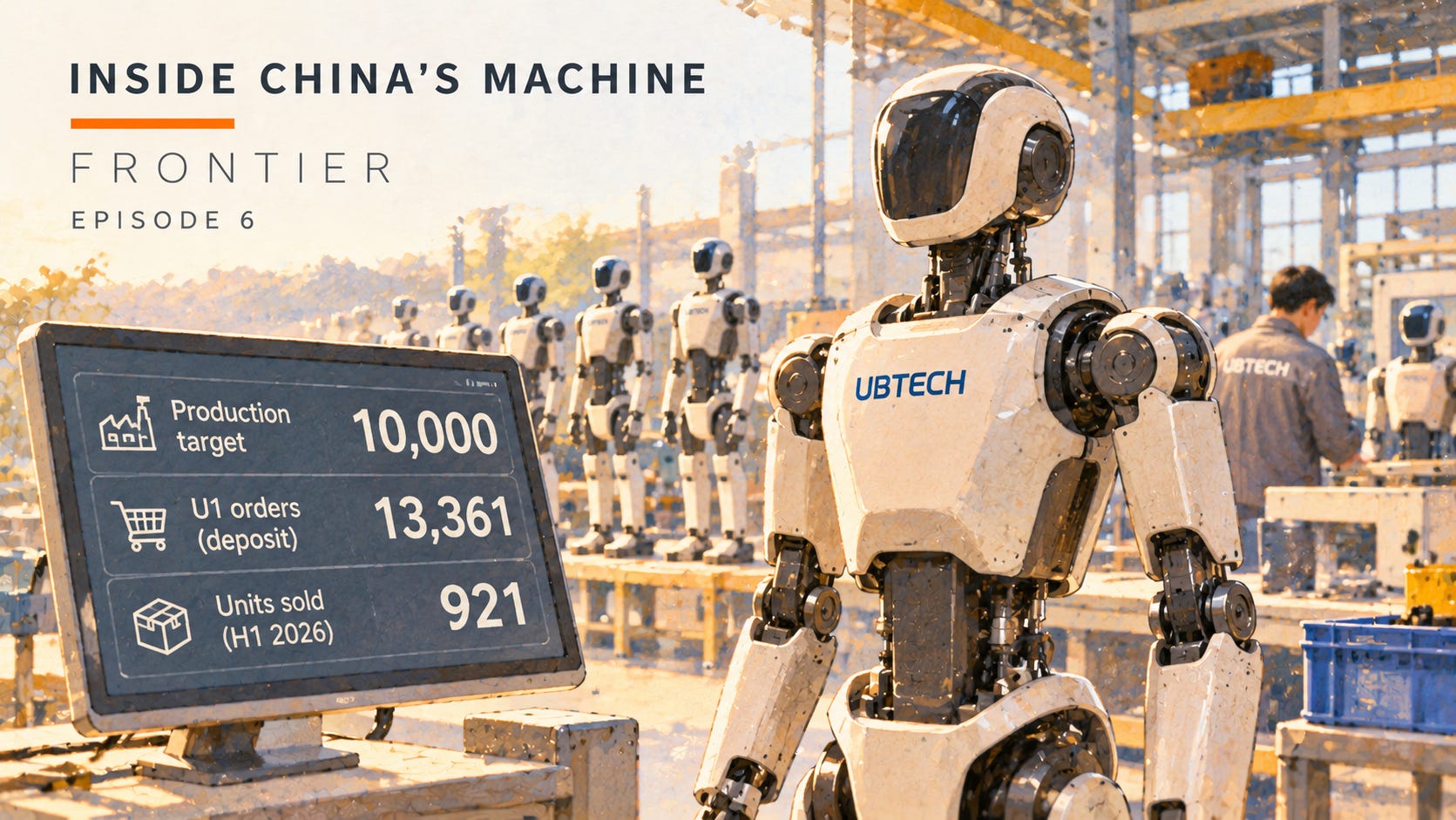
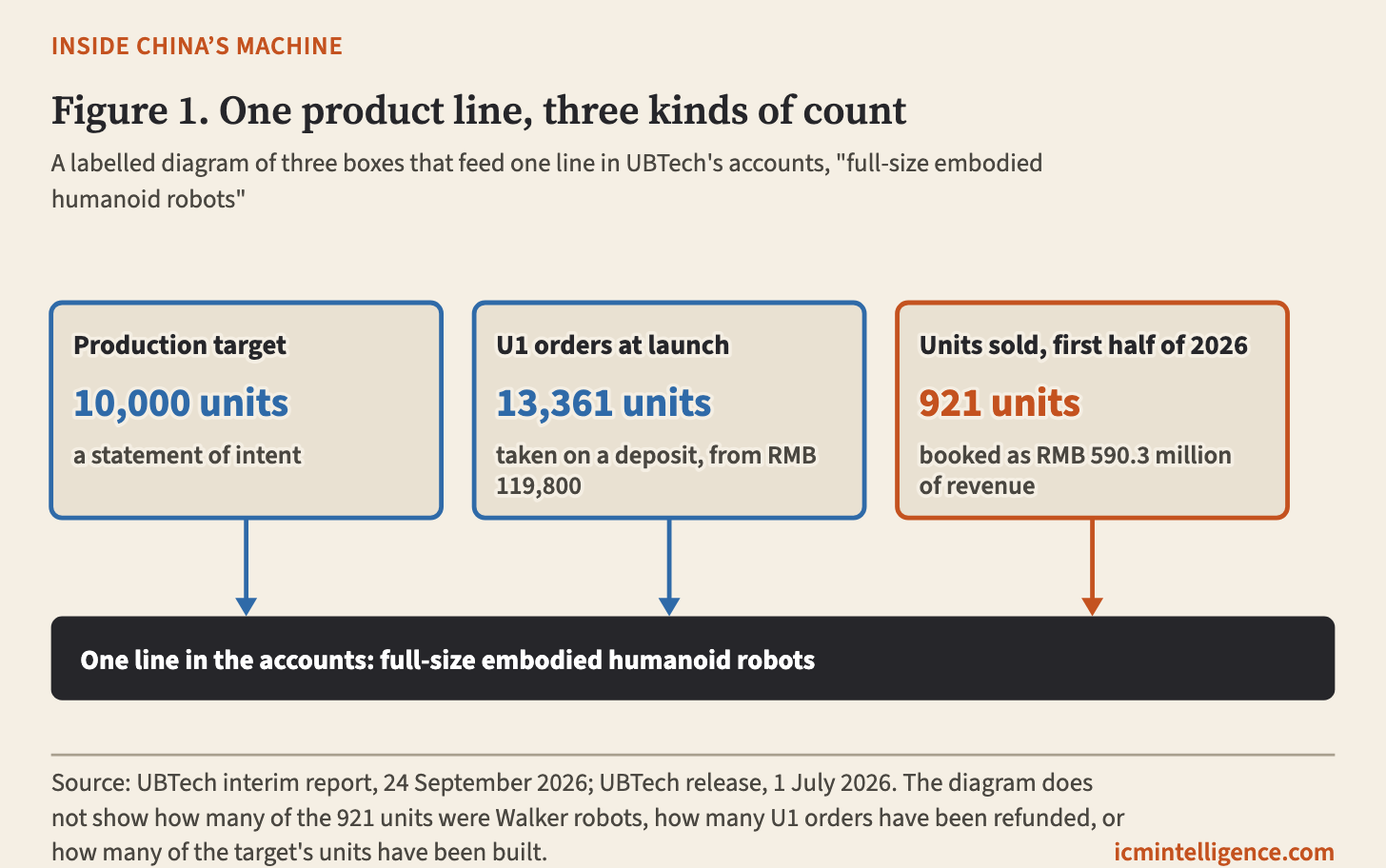
On 30 June UBTech, the Hong Kong-listed robot maker, launched a companion robot called the U1 and announced that “cumulative orders for the UWORLD U1 Series had surpassed 13,361 units”, with prices “set from 119,800 RMB”. Two months later its interim results repeated an “annual production target of 10,000 units” for full-size humanoids, and placed the U1 in the same product line as Walker, the robot it sells to factories. Put those two numbers together and the result looks like a company about to build ten thousand humanoids and already holding orders for more. The same report says something smaller. In the first half of 2026 UBTech sold 921 full-size humanoid robots, 9% of the target.
The headline numbers are not wrong. They count three different things: a production target, a tally of reservations for a cheaper consumer product, and a number of robots booked as sales. In the filings, the third count is by far the smallest. UBTech’s humanoid capacity and robot reservations sit well ahead of its paid factory sales. Building and reserving have outrun billing.
This matters to anyone whose plan rests on a unit count. A forecast for reducers, actuators or robot hands, a capacity investment, or a valuation that multiplies units by a price all inherit whichever of the three numbers they started from. Those numbers measure different things and move at different speeds.
Three counts, one line in the accounts
Take the target first. “10,000 units” is the company’s own production target, a statement about what it intends to build. Its history matters. In a release of 17 November 2025, UBTech was “targeting an annual capacity of 5,000 industrial humanoid robots by 2026, scaling to 10,000 units by 2027”. By the end of 2025, according to its annual results, it had “annualized production capacity of over 6,000” full-size humanoids. By the interim report, 10,000 had become the annual production target for this year. A capacity goal for 2027 arrived a year early as a production goal. Neither phrasing is a sales forecast. A plant built to make ten thousand robots says nothing about who will buy them.
Next come the orders. The 13,361 units are U1 reservations taken at launch. Jiemian, the Shanghai business outlet, reported in September that the U1 presale deposit was RMB 3,000 and was refundable without condition before 15 July. A refundable deposit of that size costs the buyer little and commits them to very little, roughly what a phone pre-order commits you to. The U1 is also a different machine from the one that made UBTech’s name. HK01 reported list prices of RMB 119,800 for the half-torso U1 Lite and RMB 169,800 for the full-body U1 Pro, and the company pitches the series at “commercial and consumer companionship scenarios”. Walker, the factory robot, sold at about RMB 600,000 on average in the first half, according to a Daiwa note relayed by the financial site 10jqka (Tonghuashun).
Last come sales. Of the three numbers, only the 921 units are booked as revenue: RMB 590.3 million in the first half, up 1,445% year on year. No U1 revenue appears in that half.
Following the U1 from launch night to the factory gate
The U1 shows best how far apart the counts sit, because its record runs from launch night to the start of deliveries.
On 1 July, the day after launch, HK01 reported that the chief executive aimed to complete delivery of the 10,000-plus units by 31 December. On the August results call, according to Jiemian, the chief financial officer put this year’s deliverable volume at about 1,500 to 2,000 units. Against 13,361 orders, that is a conversion of 11% to 15% within the year. In October a vice president told 21st Century Business Herald that the U1 had been reaching end customers in small batches since September, and that a cheaper edition was planned for the fourth quarter. A reported 1,500 to 2,000 deliveries against 13,361 orders, together with a cheaper model on the way, describes a launch whose reservation list ran far ahead of expected shipments this year. The company may not have expected every reservation to ship.
The balance sheet fits that picture. Deposits of RMB 3,000 on all 13,361 reservations would come to about RMB 40.1 million. Contract liabilities, the line where a company records customer payments for goods it has not yet supplied, rose by RMB 42.2 million over the half. The match is suggestive, not proof, because that line covers every product and includes a subsidiary acquired in 2026. Even read generously, it describes some tens of millions of yuan of refundable deposits, not a backlog.
Inventory also grew. At the parent company, which excludes the subsidiaries, inventory doubled in six months, from RMB 282.5 million to RMB 565.7 million. Across the group it rose 71%, and finished goods rose 57% to RMB 428.0 million. A company preparing a second-half ramp would carry more stock, so this does not show weak demand. It does show money tied up in robots before they become sales.
From the guidance to the units
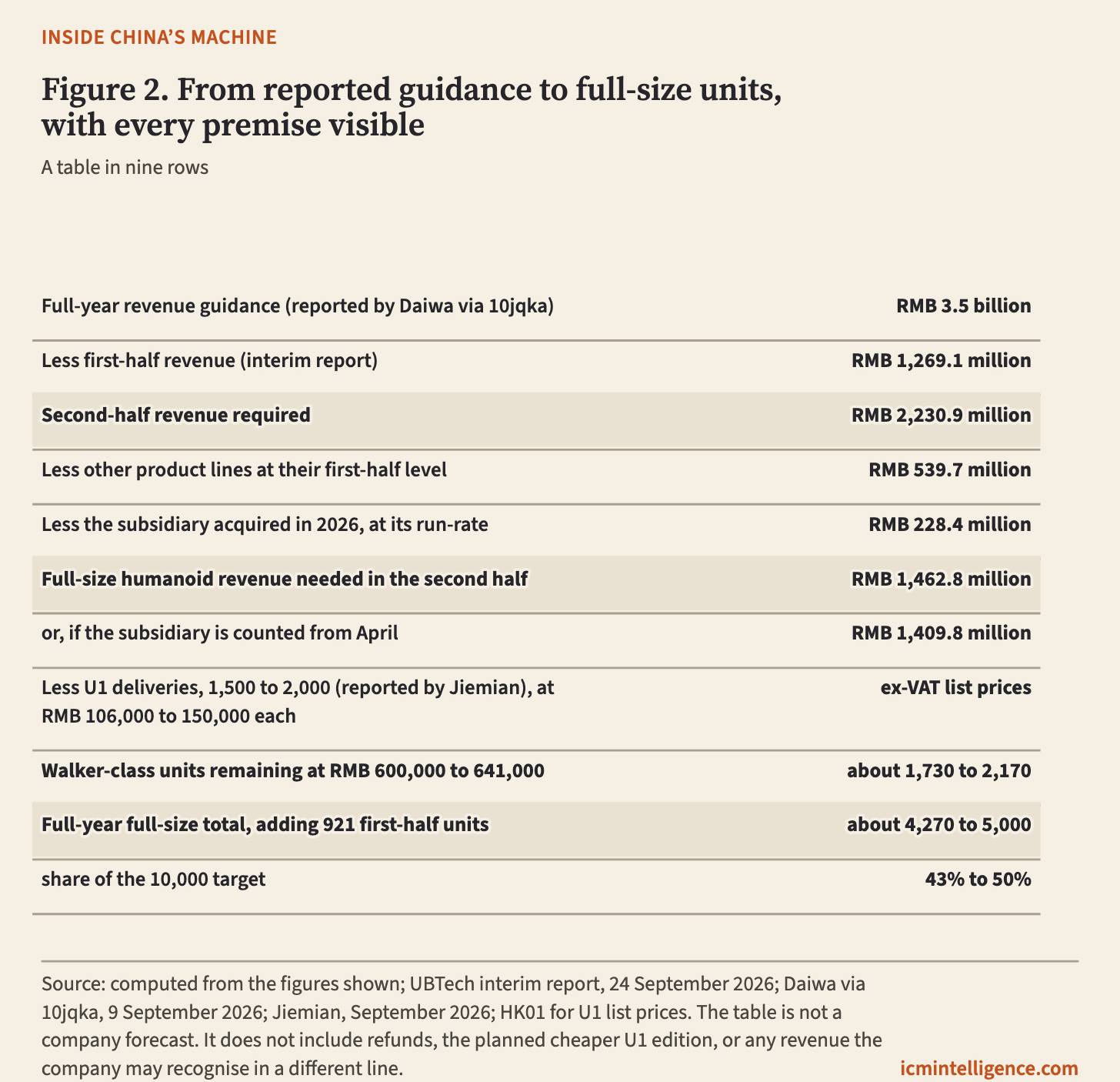
UBTech’s interim report contains no numerical revenue guidance. The guidance that circulates comes from Daiwa, which reported on 9 September that the company reaffirmed full-year revenue guidance of RMB 3.5 billion. If that figure is right, and if the CFO figure Jiemian reported is right, the two together say how many full-size robots the year can hold.
The arithmetic runs as follows. First-half revenue was RMB 1,269.1 million, which leaves RMB 2,230.9 million for the second half. Hold the other product lines at their first-half pace and the acquired subsidiary at its run-rate, and full-size humanoids need to bring in roughly RMB 1,410 to 1,463 million in the second half. Take out 1,500 to 2,000 U1 robots at about RMB 106,000 to 150,000 each. Both U1 prices are list prices assumed to include 13% VAT and are shown here without it; neither is necessarily the price actually realised. What remains supports about 1,730 to 2,170 second-half Walker-class robots at RMB 600,000 to 641,000. Add the 921 from the first half, and full-size sales for 2026 come to about 4,270 to 5,000 units, or 43% to 50% of the target. A third to two fifths of them would be companion robots. The total shifts by about 50 to 90 units depending on whether the acquired subsidiary is consolidated from March or April. The conclusion does not shift.
The result rests on two press-reported figures and is not a statement by the company. The guidance figure can also be read the other way: where the first calculation fixes U1 deliveries at the CFO’s 1,500 to 2,000 and solves for Walker-class robots, this one holds Walker at its first-half pace and solves for how many U1 reservations the guidance can pay for. If all 13,361 U1 orders were delivered this year and Walker continued at its first-half pace, revenue would be about RMB 4.0 to 4.6 billion, 1.16 to 1.32 times the reported guidance. On those assumptions, RMB 3.5 billion leaves room for roughly 5,500 to 8,200 of the 13,361 reservations to ship in 2026, 41% to 62%, so not all of them.
When units and revenue stop moving together
The U1 matters for a second reason. It changes what one unit is worth. In 2025 UBTech sold 1,079 full-size humanoids for RMB 820.6 million, about RMB 761,000 each. In the first half of 2026 the figure was about RMB 641,000, close to the RMB 600,000 average that Daiwa reports for Walker S2, down from RMB 700,000 to 800,000. The interim report puts a robot starting at RMB 119,800 into the same line. Every U1 that ships pulls the average down. The cheaper edition planned for the fourth quarter would pull it further.
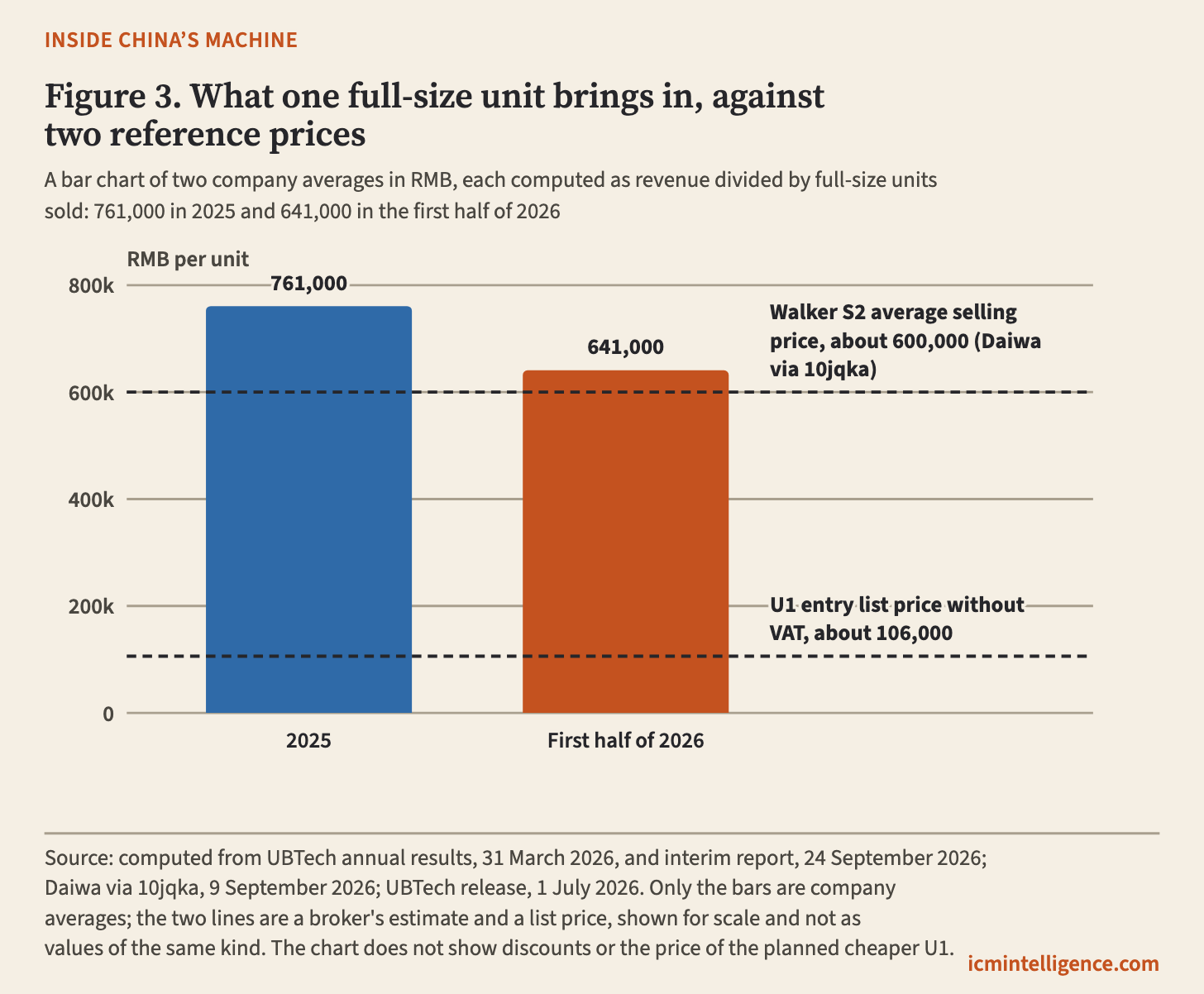
A line that blends a factory robot with a companion robot priced at about a sixth as much can report rising units without a matching rise in revenue. Anyone who sizes the market by units, which is most supply-chain forecasting, needs the product mix as well as the count. Units, read with the design of each model, tell a forecaster how many reducers and hands to expect. Revenue tells you what customers are willing to pay. Since mid-2026 that one line has held two different businesses.
The case for a timing gap
The strongest rival reading holds that UBTech built capacity ahead of sales and expects deliveries to bunch in the second half, so half the target is a timing gap and not a demand gap. Its evidence is real. UBTech ended 2025 with capacity of over 6,000, and its first-half sales, annualised, came to only about 31% of that. A plant described in the press as built for ten-thousand-unit capacity reportedly began operating on 12 September. The company said in November 2025 that orders for Walker S2 had passed RMB 800 million. On this view, 2027 converts what 2026 booked.
That reading may prove right. Two disclosures would help test it at the annual results, which last year came on 31 March. The first is full-year 2026 full-size units broken out by product. The second is any figure for U1 refunds or cancellations. If second-half Walker-class units come in well above two thousand, and U1 deliveries convert most of the 13,361 into robots and not refunds, the timing reading gains ground. If units land between two fifths and half the target and a third to two fifths of them are companion robots, the target measured what the company meant to make, not what it would sell, as its wording always allowed.
I expect the gap between what Chinese humanoid makers announce and what they bill to persist for some time. Capacity can be built on a budget, and reservations can be taken in a single launch night. Paid deployment needs a customer whose factory runs better with the robot than without it. That view would be wrong if industrial units began to track the targets within a year or two of each target being set.
Treat the next robot announcement the way the filings treat this one. Ask whether it counts what the company will build, what customers have reserved, or what customers have bought. For UBTech in 2026 the three answers are 10,000, 13,361 and 921. Of the three, only the smallest is revenue.
Sources
UBTech Robotics, Interim Report 2026 (24 September 2026), https://www1.hkexnews.hk/listedco/listconews/sehk/2026/0924/2026092401451.pdf, captured 2026-11-04. First-half revenue by product line, full-size humanoid revenue and units, the production target, balance-sheet lines.
UBTech Robotics, Interim Results Announcement 2026 (28 August 2026), https://www1.hkexnews.hk/listedco/listconews/sehk/2026/0828/2026082801691.pdf, captured 2026-11-04. The first-half results the interim report repeats.
UBTech Robotics, Annual Results Announcement 2025 (31 March 2026), https://www1.hkexnews.hk/listedco/listconews/sehk/2026/0331/2026033102607.pdf, captured 2026-11-04. 2025 full-size humanoid revenue and units; year-end capacity.
UBTech release, “UBTech Launches UWORLD U1” (1 July 2026; the launch event was on 30 June), https://www.prnewswire.com/ae/news-releases/ubtech-launches-uworld-u1-the-worlds-first-full-size-mass-produced-ultra-bionic-humanoid-robot-302815285.html, captured 2026-11-04. The 13,361 orders and the entry price.
UBTech release, “Walker S2 Begins Mass Production and Delivery” (17 November 2025), https://www.prnewswire.com/news-releases/ubtech-humanoid-robot-walker-s2-begins-mass-production-and-delivery-with-orders-exceeding-800-million-yuan-302616924.html, captured 2026-11-04. The capacity goals and the RMB 800 million of Walker S2 orders.
Daiwa note as reported by the financial site 10jqka (Tonghuashun), 9 September 2026, https://stock.10jqka.com.cn/20260909/c679736946.shtml, captured 2026-11-04. The reaffirmed RMB 3.5 billion revenue guidance and the Walker S2 average selling price.
Jiemian, “UBTech U1 delivery” report, September 2026, https://m.jiemian.com/article/15133669.html, captured 2026-11-04. The chief financial officer’s 1,500 to 2,000 U1 deliveries and the RMB 3,000 refundable deposit.
HK01, report on the U1 launch (1 July 2026), https://global.hk01.com/即时中国/60365658/, captured 2026-11-04. U1 Lite and U1 Pro list prices; the chief executive’s delivery aim.
21st Century Business Herald (21世纪经济报道), 14 October 2026, https://m.21jingji.com/article/20261014/herald/46d7d92d0820bda4be76d82b051b2e48.html, captured 2026-11-04. The vice president’s account of small-batch U1 deliveries and a cheaper edition.
Inside China’s Machine · Frontier, Episode 6
Disclaimer: This article is for informational and educational purposes only. It is not investment, financial, legal or tax advice, and it is not a recommendation or solicitation to buy or sell any security. Do your own research, and consult a licensed professional before making investment decisions.