


Inside China's Machine · Where China's Tokens Go, Episode 1
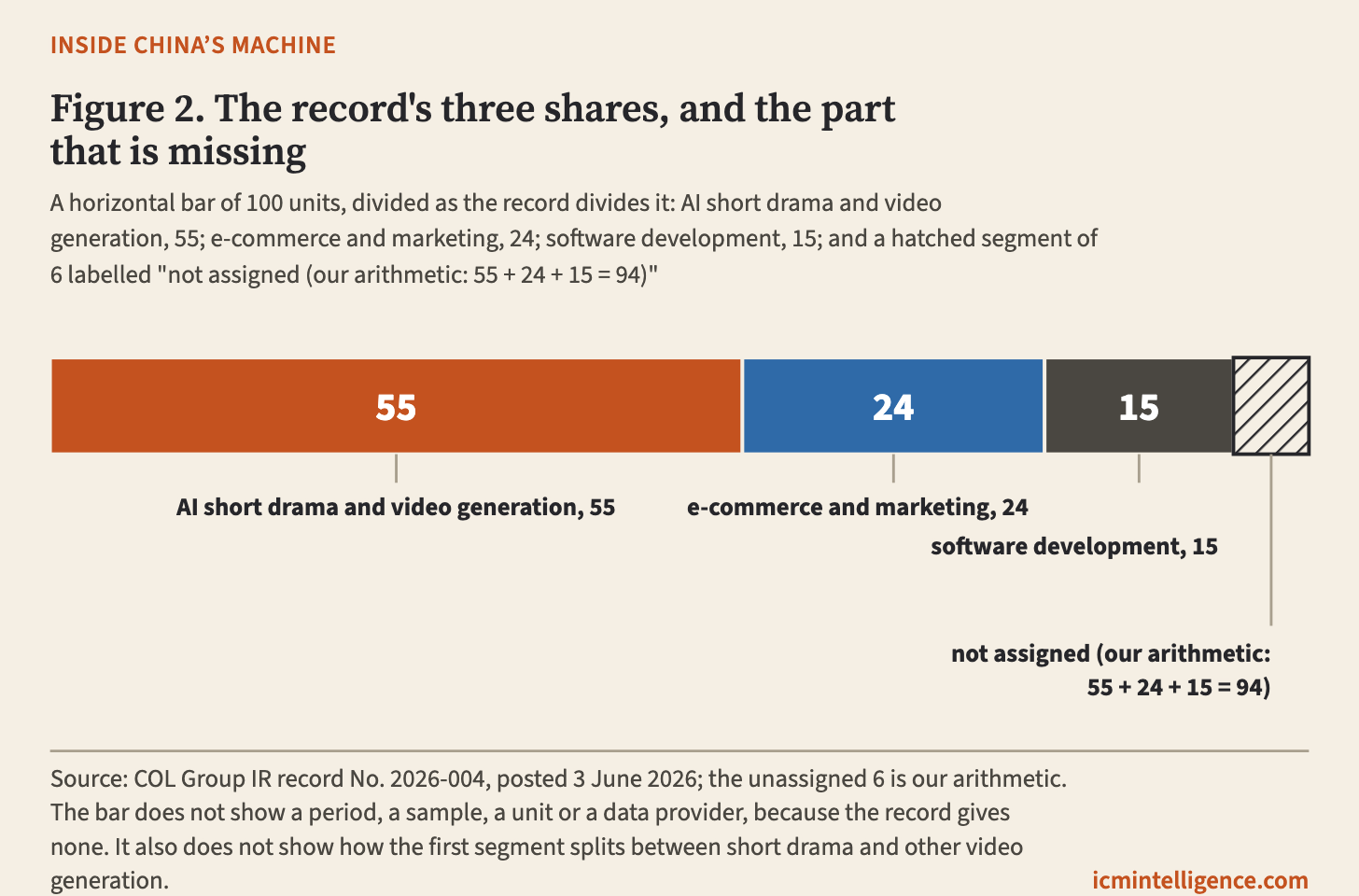
On 3 June 2026, COL Group (中文在线), a listed Chinese digital-content company, posted investor-relations record No. 2026-004. It is the write-up of a roadshow and phone call held in Beijing on 1 and 2 June, attended by about 40 named brokers and funds. Partway through, the record makes the case that tokens are flowing to entertainment. In English it reads: “From the distribution of industry call data, the shares of token consumption by scenario bear this out. Of all domestic token consumption, AI short drama and video generation ranks first at 55%; then e-commerce and marketing (livestream selling, ad marketing) at 24%; software development, which was once pinned with hopes by the Vibe Coding vogue, is only 15% even with Claude-type coding advances.”
Add the three shares and you get 94. That is our arithmetic, not the record’s. The remaining 6% is not assigned to anything. A leftover is not unusual in a pie chart. But a reader handed a national breakdown would expect either the full 100 or a stated “other”, and this one has neither. The gap is a small sign of something larger: the record gives the shares and nothing they could be checked against.
Our judgment is that the 55% cannot bear weight as a share of China’s tokens. It is a claim without a published measurement behind it, and on the evidence available it most likely describes some customers rather than the country. The record, in that one line, is the earliest document in the trail that states the split. It cites “industry call data” (行业调用数据) and gives no period, no sample, no unit and no data provider. Every later source in the trail either repeats it or narrows its scope. That does not make video small. IDC, working independently, puts video-generation models at 32.7% of China’s model-as-a-service revenue in the first half of 2026. Video is a large and fast-growing source of paying demand. The useful question is not whether the figure is 55%. It is “55% of what”.
What the record says, and what it leaves out
The record is eight pages long. Its attachment list reads “附件清单:无”, meaning none, and no source line appears anywhere in it. The category that ranks first is a merged one: “AI short drama and video generation”, not short drama alone. Short drama is the vertical-screen, minute-long serial format that Chinese apps sell by the episode. Video generation could cover advertising clips, e-commerce product video and anything else a video model renders. The record does not say how the two halves split.
The 15% belongs to software development. Some later press coverage turned it into research and development. One outlet, 财闻, wrote on 19 October that “only 15% really goes to R&D”. The record’s word is software development, which is a narrower thing.
The record also gives two reasons video might use so many tokens. First, it says AI drama with realistic human characters at 1080p usually uses two to three times the tokens of comic-style drama at 720p. Second, production teams repeatedly “draw cards” (抽卡): they regenerate a shot again and again and keep the one that works. The record adds that AI short drama and video generation token use “has reached over twice that of software development”. That is consistent with 55 against 15, but it is a restatement of the same claim, not a second source.
One number in the record does have a clear owner. The company says its own weekly-average call volume is up more than 20% on the previous period. That is a statement about COL’s own meter. The 55% is a statement about the industry’s meter, and the record does not say who read it.
The trail of the number
What happened next is the part that would surprise someone who has seen the 55% quoted as settled. The number moved from outlet to outlet. Its scope changed along the way, and the trail it leaves ends at the investor call.
On 4 June, Securities Times reported the record. It called the figure “the industry token call data the company cited” and gave only the 55%. In July, a note circulated that was attributed to Zhongtai Securities’ media and internet team. According to Shanghai Securities News, that note ranked first-half 2026 “B-side inference token consumption”, with short drama and video at 55% and marketing at 24%. B-side means business customers, and inference means running models rather than training them. The paper described the note’s scope as “clearly smaller than national”.
On 30 September, CAICT, the China Academy of Information and Communications Technology, released its Token Economy Development Research Report (2026). Tide News and Shanghai Securities News, both quoting it, say it gives 55% as the share of “whole-industry token consumption”. They also say it footnotes a Zhongtai Securities research report dated 20 May 2026, part five of a series on token economics in AI applications. That footnoted report is the earliest dated document in the trail, so the Tide News reporter went to it. By that reporter’s account, the Zhongtai report says token economics first reached scale in AI drama, marketing and e-commerce, and that for AI drama, token use is “nearly half of production cost”. According to the reporter, it contains no 55% split. So this rests on one named outlet’s reading.
On 23 October, Shanghai Securities News reported that it had found no authoritative data from before June corroborating the 55%. A brokerage official the paper quoted said the figure’s first explicit appearance “should be” the COL call. A compute practitioner, 程伟, told the paper the share “may be a conclusion drawn from one public-cloud platform’s data”, and that large internet firms’ in-house training compute, private deployments and research-institute compute “should not be counted”. The paper presented this as his speculation, not as data.
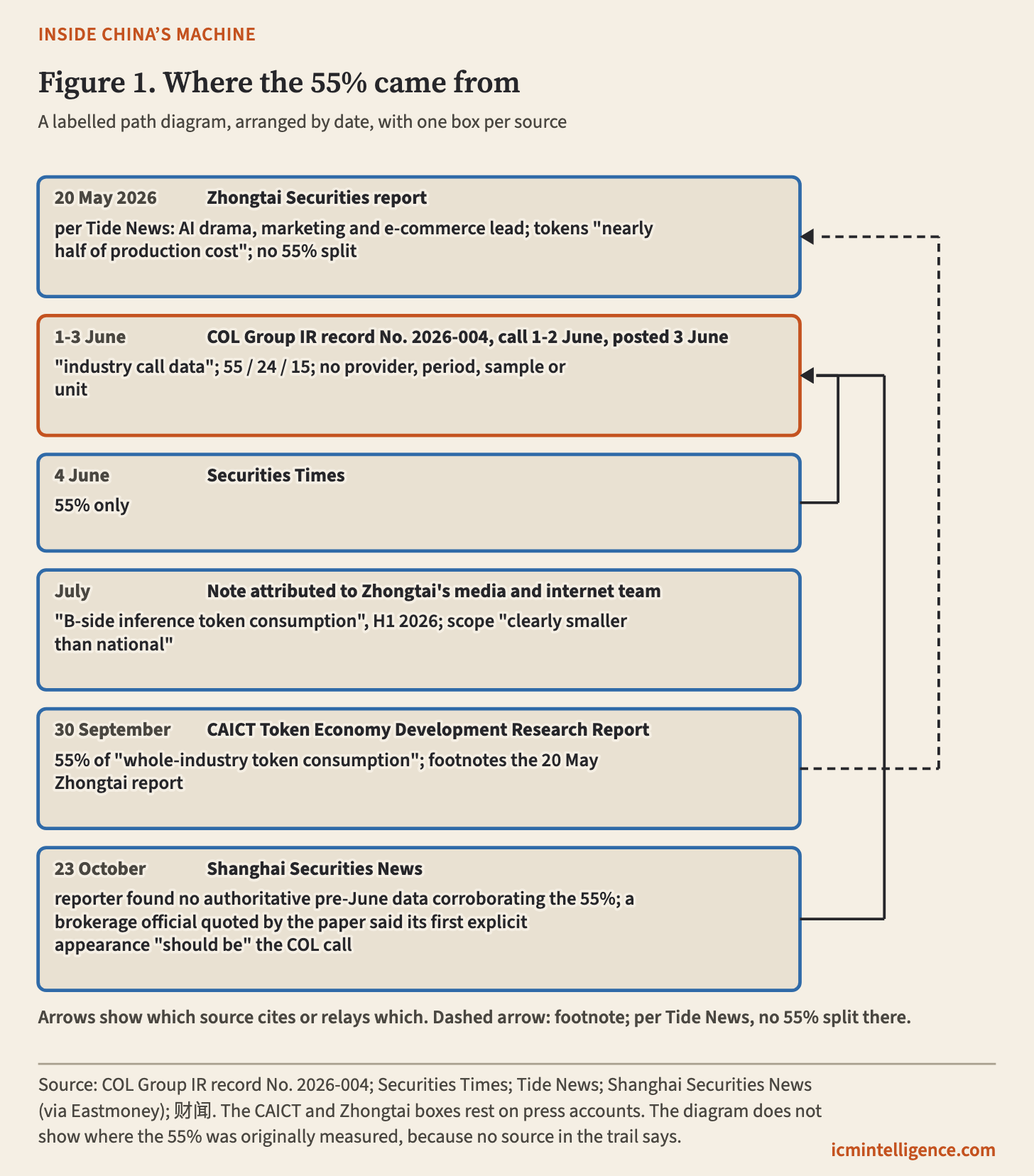
Read as a chain, the trail offers different scopes rather than repeated confirmations of one: an industry-wide share in the CAICT report, business-customer inference in the July note, perhaps a single cloud platform in compute practitioner 程伟’s speculation, and at the investor call only “industry call data”. Nobody along the trail has published what the number was measured on.
What a share of tokens can count
Start with the unit, because everything rests on it. A token is the unit a model provider meters. For a text model, it is roughly a word fragment. A video model’s provider meters tokens too, but a clip uses far more of them: ChinaTalk cites about 100,000 tokens for a five-second 720p Seedance clip, which it likens to roughly 200 chatbot answers. The record itself says realistic-human 1080p drama uses two to three times the tokens of comic-style 720p drama. So a share of tokens partly reflects how heavily each piece of work registers on the meter, not only how much work the customer is getting done.
Next, the denominator. “All domestic token consumption” sounds definite until you look for the totals it would be a share of. Three series exist. IDC’s states its scope, the public-cloud model-as-a-service market. The National Data Administration’s and CAICT’s do not state theirs.
The National Data Administration’s head, Liu Liehong, told a State Council Information Office briefing on 24 March 2026 that daily token consumption had passed 140 trillion. He said that was more than 1,000 times the 100 billion of early 2024, and more than 40% up in three months from 100 trillion at the end of 2025. In a separate monitoring report, CAICT put domestic daily consumption at about 500 trillion in June 2026, almost four times December 2025. It attributed part of the growth to more model-as-a-service platforms selling tokens through public-cloud APIs. IDC counts 2,857.9 trillion tokens across China’s model-as-a-service market in the whole first half of 2026.
Our arithmetic on those stated figures does not line up neatly. Going from 140 trillion a day in March to 500 trillion a day in June would be roughly a 3.6-fold jump in about three months. IDC’s half-year total works out to an average of about 15.8 trillion a day over 181 days. That sits far below even the March national figure of 140 trillion. IDC’s counts only public-cloud model-as-a-service tokens and the other two do not say what they count, so the gap shows the totals are not interchangeable; it does not show which is right. ByteDance’s Volcengine, meanwhile, reported its Doubao models alone at more than 120 trillion tokens a day in March and more than 180 trillion on 23 June. If Doubao and the national figure measured the same thing, one vendor would have been most of the country in March. More likely they measure different things. Nothing in these sources reconciles the three. And a share of “all domestic tokens” cannot be checked against two totals whose scope is unstated and a third narrower than all domestic tokens.
The other reading, heard fairly
There is a serious case that the 55% is right in direction even without a published measurement. It goes like this. Video tokens are heavy: higher resolution and realistic characters raise the count, and every usable shot may sit on a pile of discarded takes. Text workloads are many but light. So it would not take a large number of video customers to outweigh a large number of chat and coding users on a token meter.
Some ground-level signals fit this. A token-service platform interviewed by Tide News named three main customer types: foreign-trade service firms writing marketing copy and building overseas sites, AI short-drama firms, and technology firms, the last mostly “in a gradual introduction phase”. On that platform, a 55/24 split between video and marketing would not look strange. Production budgets point the same way. Jiemian reported that a 12-episode short drama “burns nearly RMB 200,000 of compute cost”, though it did not give the basis for that figure.
On this reading, the real question is not the token share but what a token share is worth in revenue. That leads to the independent data, which partly supports the rival reading and partly limits it.
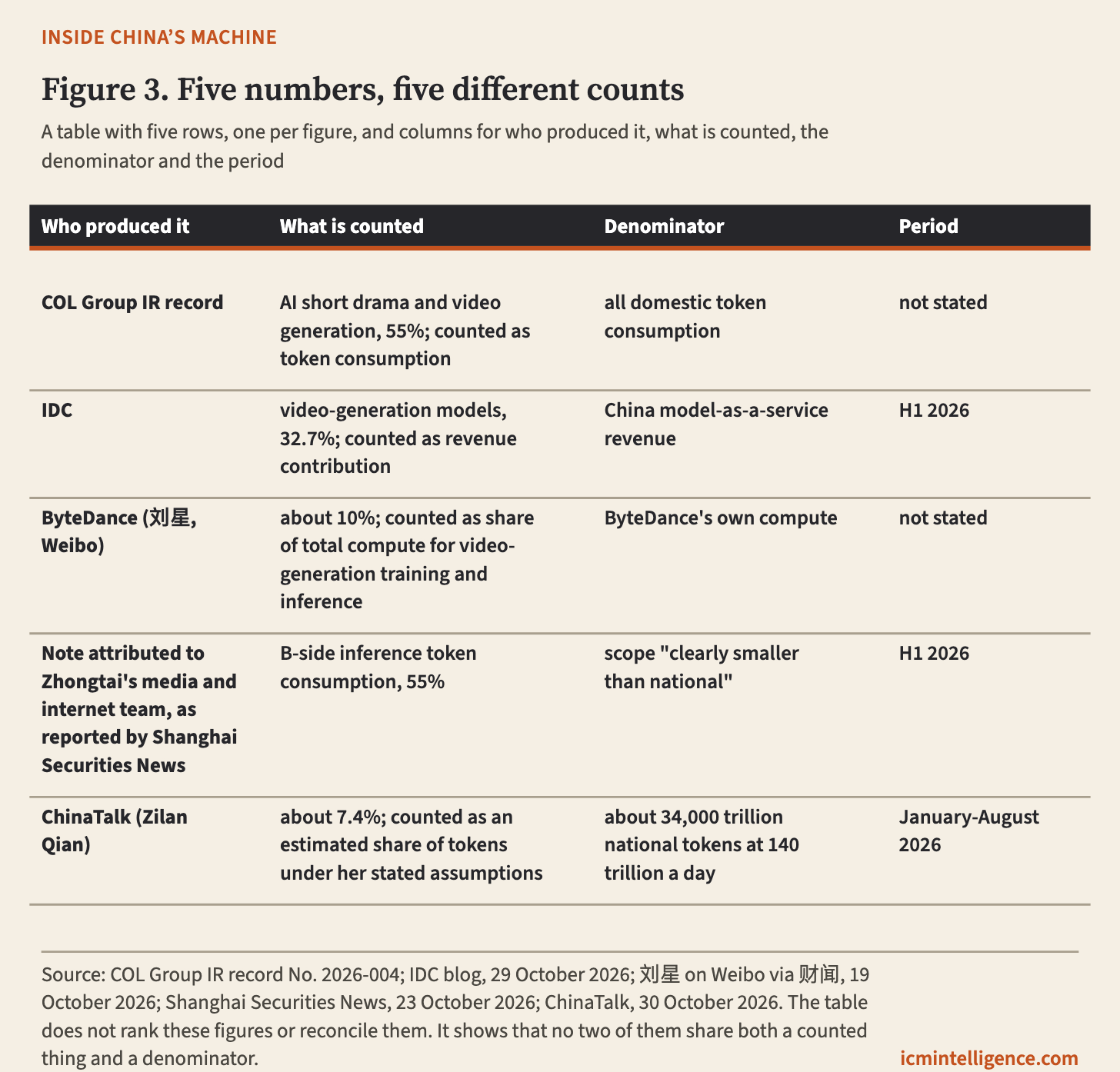
IDC’s own summary of China’s model-as-a-service market for the first half of 2026 puts revenue at RMB 10.63 billion, up 889.4%, on 2,857.9 trillion tokens, up 432.5%. By model type, large language models brought in 47.0% of revenue, video-generation models 32.7%, and other models 20.2%. IDC calls video generation an important “second growth curve”. It also says internet companies’ own workloads (recommendation, search, dialogue and coding) remain the “base” of the market’s revenue, with office automation and customer service adding growth.
So video is roughly a third of what the market was paid, measured by an outside firm over a stated period. That is not a niche. It is also not a majority, and it is a share of money, not of tokens. The two can diverge legitimately: if a video token is priced differently from a text token, the token share and the revenue share will differ even when both are measured perfectly. Of the two, IDC’s is the only one with a published scope.
Two other figures circulate as rebuttals, and neither settles it. On 19 October, ByteDance’s Doubao PR lead, 刘星, wrote on Weibo that about 10% of ByteDance’s total compute goes to training and inference for video-generation models. But that is a share of one company’s compute, including training. The 55% is a share of industry tokens. Neither number can be converted into the other, in either direction.
Separately, Zilan Qian at ChinaTalk built an outside estimate, “assuming, generously”. She assumed that all 430,000 micro-drama titles released between January and August 2026 were fully AI-generated, at 200 minutes of finished footage each, computed at 1080p and 24 frames per second. On her numbers that gives about 251 trillion tokens, or about 2,500 trillion once multiplied by ten for discarded takes. Her piece separately cites about 100,000 tokens per five-second 720p Seedance clip. Set against her figure of about 34,000 trillion tokens of national consumption over eight months at 140 trillion a day, she gets roughly 7.4%. It is a bounded estimate resting on her stated assumptions, not a measurement. The title count it starts from comes from China’s National Radio and Television Administration, and the briefing as reported gives no definition of “AI drama” or counting unit. Her denominator is also the national figure whose scope is itself unstated.
Notice that the estimate covers short drama only. COL’s category also includes all other video generation. So the 7.4% and the 55% are not even counting the same slice of activity.
What would decide it
The two readings make different predictions, and one kind of document would test them.
If the 55% describes a slice of customers, such as business-side inference on one public cloud, then a broader split should show video well below a majority of tokens. Internet companies’ own recommendation, search and chat workloads running on cloud model services would carry the weight that IDC already sees in revenue. If the heavy-token reading is right, a vendor serving a broad range of uses should still show video at or near a majority of tokens, and a revenue split for the same customers and period would show what those tokens were paid. If video were a majority of tokens but around a third of revenue on the same base, the gap between the two shares would then be the interesting number.
The figure to watch is a cloud or model vendor’s own split of tokens by use, with the period and the denominator stated. Until a method is published, anyone sizing China’s AI demand should read the 55% as a claim about an unspecified customer base, not an established national share. Video should be read as neither a settled majority nor a niche. The firmer number available puts it at roughly a third of what the model-as-a-service market was paid in the first half of 2026.
Video tokens are heavy partly because of the redraws, and what a redraw costs is the next question. For now, the 94 hinted from the start at a figure with nothing published to check it against, and the point to take away follows from that. A share of tokens measures how much of someone’s meter a use consumes; until you know whose meter, it is not yet a fact about China.
Sources
COL Group (中文在线), Investor Relations Activity Record No. 2026-004 (posted 3 June 2026; roadshow and call of 1 and 2 June), Eastmoney-hosted copy of the filing, https://pdf.dfcfw.com/pdf/H2_AN202606031823217652_1.pdf, captured 2026-11-07. The 55 / 24 / 15 sentence, the attachment list (”none”), the 1080p and draw-card remarks, COL’s own weekly call volume.
Securities Times (证券时报), 4 June 2026, https://stock.10jqka.com.cn/20260604/c677226962.shtml, captured 2026-11-07. Its report of the record.
Shanghai Securities News (上海证券报), “谁在制造词元消耗对立”, 23 October 2026, via Eastmoney, https://finance.eastmoney.com/a/202610233904643058.html, captured 2026-11-07. The July note, the brokerage official’s “should be”, 程伟’s remarks.
Tide News (潮新闻), 26 October 2026, https://tidenews.com.cn/news.html?id=3596271, captured 2026-11-07. Its account of the CAICT report and the 20 May 2026 Zhongtai Securities report; the token-service platform’s customer types.
财闻 (Caiwen), 30 September 2026 (CAICT report released) and 19 October 2026 (the 15% as “R&D”; 刘星’s Weibo post), https://www.caiwennews.com/article/1634675.shtml and https://www.caiwennews.com/article/1657301.shtml, captured 2026-11-07.
IT之家 (ITHome), 24 October 2026, https://ithome.com/1/017/518.htm, captured 2026-11-07. CAICT’s June 2026 monitoring figure of about 500 trillion tokens a day.
Xinhua, 24 March 2026, https://www.news.cn/tech/20260324/050774b26bc54f429fce2d21e284949a/c.html, captured 2026-11-07. National Data Administration: more than 140 trillion tokens a day.
Xinhua, 3 April 2026 (via Science and Technology Daily), https://www.news.cn/tech/20260403/c4f28c9bcccd4ed98456c07122f03a0b/c.html, and 10jqka, 23 June 2026, https://news.10jqka.com.cn/20260623/c677638966.shtml, captured 2026-11-07. Volcengine’s Doubao daily token figures.
IDC, China MaaS market, first half of 2026 (IDC blog, 29 October 2026), https://www.idc.com/resource-center/blog/中国maas市场实现近9倍增长-高增速下厂商加速涌/, captured 2026-11-07. Revenue, tokens and the split by model type.
Jiemian (界面新闻), October 2026, https://m.jiemian.com/article/15193592.html, captured 2026-11-07. The 12-episode short drama’s reported compute cost.
ChinaTalk, Zilan Qian, 30 October 2026, https://www.chinatalk.media/p/is-half-of-chinas-ai-making-slop, captured 2026-11-07. The 7.4% estimate and its assumptions.
Xinhua (Economic Information Daily), 18 September 2026, https://www.news.cn/tech/20260918/1fc21cfba8334e9bba130af8eb50b565/c.html, captured 2026-11-07. The National Radio and Television Administration’s count of 430,000 micro-dramas, January to August 2026.
Inside China’s Machine · Where China’s Tokens Go, Episode 1
Disclaimer: This article is for informational and educational purposes only. It is not investment, financial, legal or tax advice, and it is not a recommendation or solicitation to buy or sell any security. Do your own research, and consult a licensed professional before making investment decisions.