


Inside China’s Machine · Where China’s Tokens Go, Episode 2
On Volcengine’s price page, ByteDance lists a second of Seedance 2.0 video at 720p for about RMB 0.99. You would expect people who make AI drama to agree, roughly, on what the video in a finished minute costs. They do not. One producer’s numbers come to about RMB 180 of compute a minute. Another producer, estimating with the model company because the bill was never tallied, says about RMB 1,000.
The price of video alone does not explain the gap. A token is cheap, a redraw multiplies it, and a finished minute is still mostly something other than tokens. Of the cost splits that have been reported, none puts compute above half, and the one build-up that itemises every line puts it near 15%. So “video burns a lot of tokens” does not mean “video is costly to make”. It also tells you little about what a particular studio spends, because the variable that drives the compute bill is how many times a shot is drawn before one is kept.
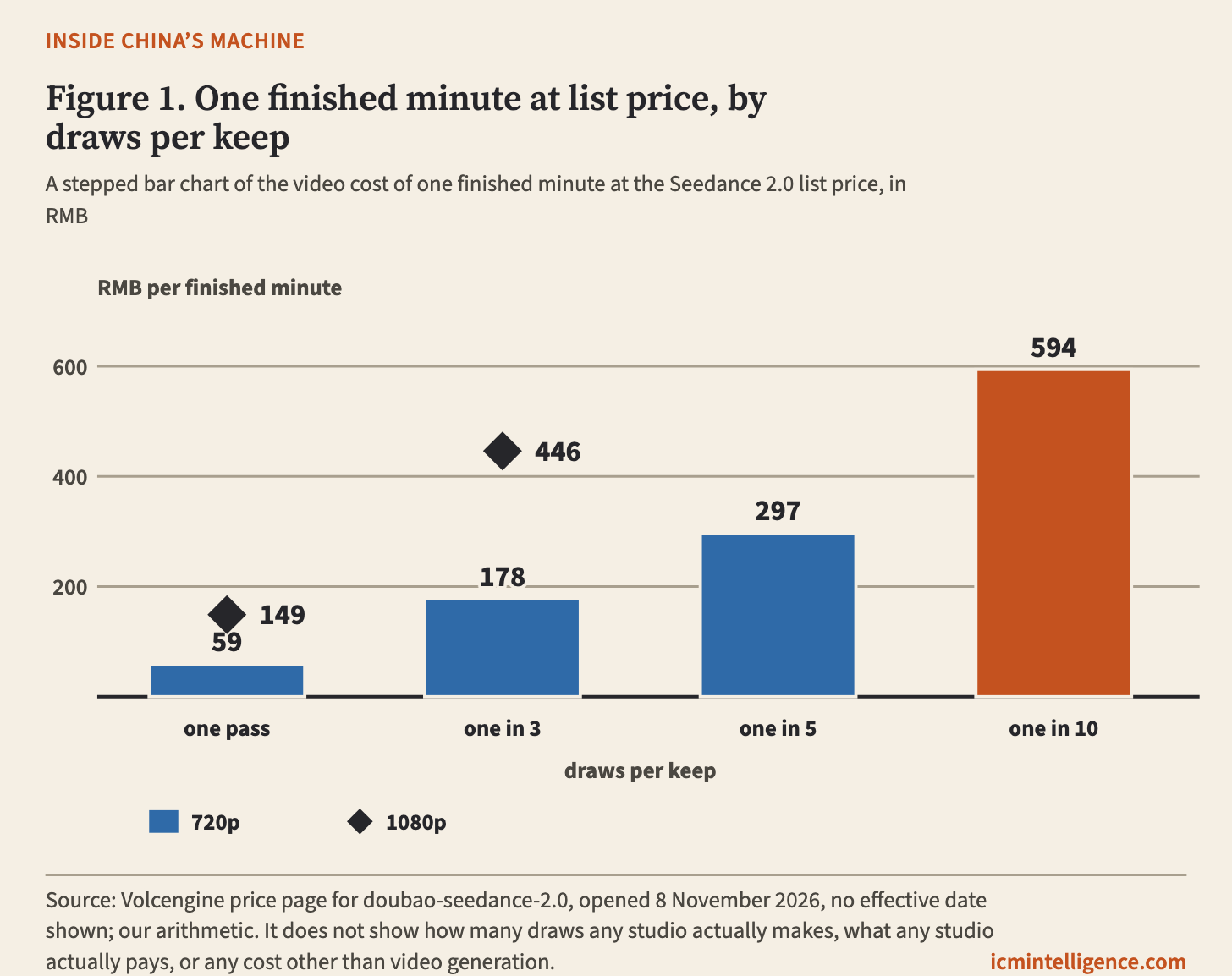
Start with one finished minute and assume the model gets everything right the first time. Sixty seconds at RMB 0.99 is about RMB 59, on our arithmetic. IT Home, reading Volcengine’s announced billing in March, gave RMB 46 per million tokens for video generated without video input, and about 308,880 tokens for a 15-second clip. On those figures a minute is about 1.2 million tokens, again our arithmetic, and it costs under RMB 60. A video token is its own unit at its own price, so a count of them means little until someone multiplies. MiniMax’s current models skip the token altogether and bill by the second of output: RMB 0.50 for its H3 model at 768p, RMB 0.16 for H3-Lite at 480p.
Resolution and model move the price a lot. The same Volcengine page lists 1080p at RMB 2.48 a second and the cheaper Seedance 2.0 mini at RMB 0.50 a second at 720p. Neither company’s page shows an effective date for its prices, and Volcengine’s is stamped as last updated on 3 November 2026. A list price says nothing about any discount a large customer gets. Still, a studio can do this sum before it shoots anything.
Nobody gets it right every time, however. The industry’s word is 抽卡, “drawing cards”, or the redraw. CLS glosses a draw as giving the model instructions such as prompts and first and last frames and waiting for the result; a practitioner it quotes, Chen Junjie, says an unsatisfying result means drawing again and again until satisfied; and CLS adds that “each draw means compute consumed”. The studio pays for the clips it throws away at the same rate as the clip it keeps. Keep one clip in three and, with clips of equal length, the studio pays for three generated minutes to get one finished minute: about RMB 178 at 720p. One in five is about RMB 297, and one in ten about RMB 594. Move to 1080p and one in three is already about RMB 446.
The price is on a web page, and the multiplier is much harder to find. Chen Jie, a senior director of large-model products at Volcengine, spoke at a Chengdu salon in late January. In a piece by the outlet Shuzhi Qianxian, republished by Jiemian, the reporter summarises his account: AI use in short drama and manju (漫剧, AI-animated drama) only began in 2025, for a fairly long stretch the draw rate was only 20%-30%, so full automation was not feasible, and value would rise markedly once the rate passed 50%. Read as the share of draws that come out usable, that is between about 3.3 and 5 draws per keep, on our arithmetic, and it comes from a vendor describing its own market. The same article says that by the first half of 2025 one team was generating 20 to 30 times to get one usable shot, a far steeper count than a 20%-30% rate implies, and the sources do not define their unit the same way. A column on Woshipm says the platform AniShort disclosed a 4-minute short with a draw success rate of 28.7%, or about 3.5 draws per keep, and RMB 1,890 of video generation, about RMB 472 a finished minute. The column names neither the model nor the resolution.
After Seedance 2.0 arrived, the claimed rates jumped. A TMTPost column said it and Kling 3.0 had raised usable output above 90%, and a Geek Park estimate relayed in a column on The Paper put Seedance 2.0 at 90%, against about 20% before. At 90% a shot takes about 1.1 draws. Neither column gives a sample or a method, and “usable” depends on who is judging. A studio called Xuebao (雪宝) said after the same release that “the draw rate still has problems”. A consultant quoted by Beijing News said fight scenes “need constant redrawing” and that teams stop after a number of draws for cost reasons. So the redraw count is partly a measure of the model and partly a budget decision about when a shot is good enough.
Now pay for the rest of the minute. The itemised build-ups, the ones that show their working, all come from one trade article: a 9 March 2026 piece by the trade account Short Drama Heima (短剧黑马) on The Paper’s creator platform, which quotes several named producers and studios and contains no audited costs. The other figures, from a DataEye research director, a Zhongtai Securities note as relayed by Tide News, a studio executive, the AniShort case and a BOC Securities estimate, come without itemised build-ups.
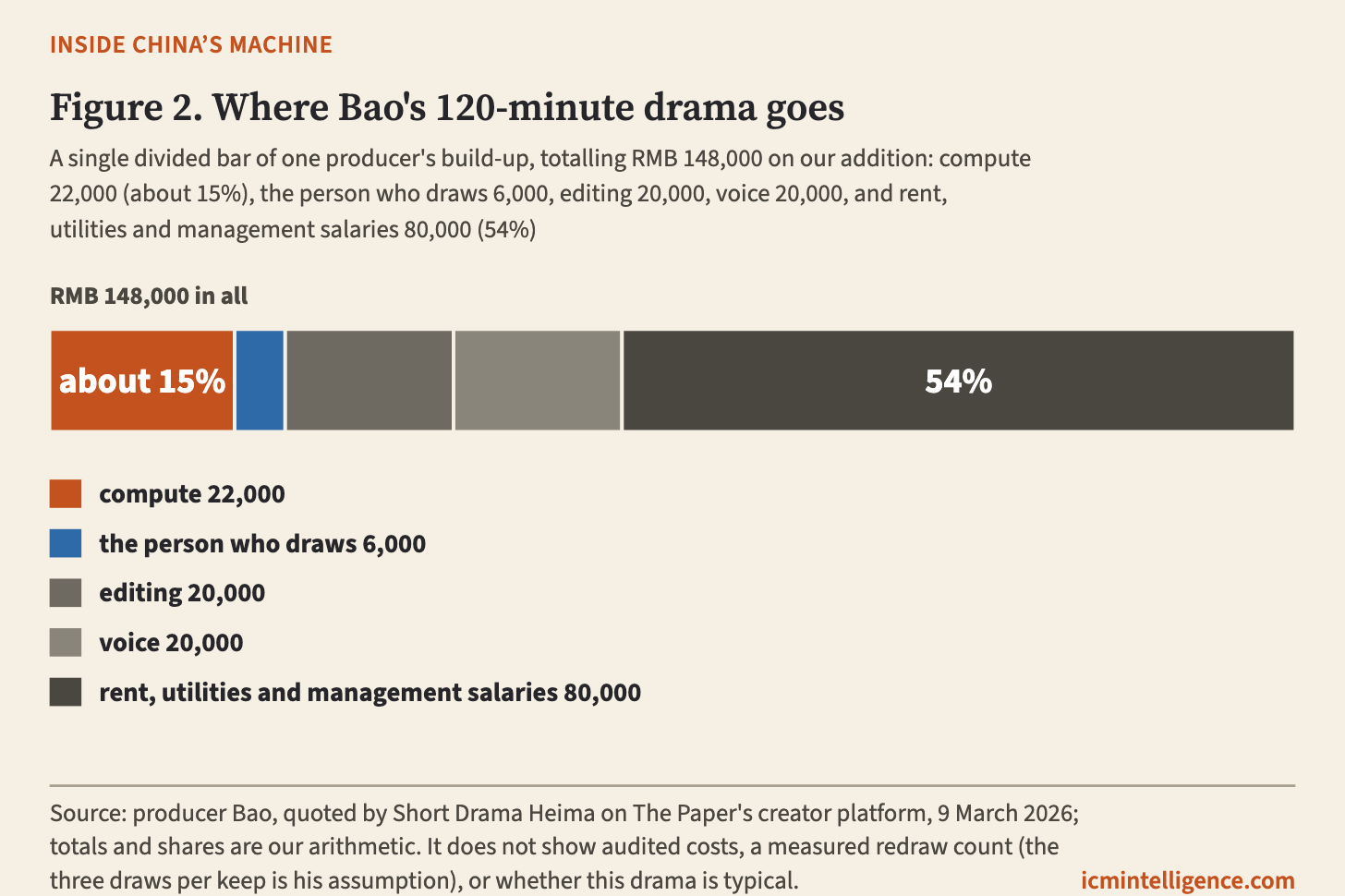
The fullest build-up belongs to a producer the article calls Bao (包总), costing a 120-minute AI real-person drama (仿真人剧, generated actors made to look like live ones). “Jimeng 2.0 is RMB 1 a second,” he says, pricing it as “Jimeng 2.0”; RMB 1 a second is in line with the Seedance 2.0 list price above. The producers and studios in the article name the model “Jimeng 2.0”, and we read it as Seedance 2.0 because the prices match; that is our reading, not something the article states. A 120-minute drama is 7,200 seconds, and with “say 3 draws to keep 1” that is about RMB 22,000 of compute. The three is his assumption, and it does most of the work in the figure. Then the person who does the drawing, RMB 6,000 for one month. Editing, RMB 20,000. Voice, RMB 20,000. Then rent, utilities and management salaries, RMB 80,000. The lines add up to RMB 148,000, which he calls about 150,000, “so a minute is about 1,500”. He states about RMB 1,500 a minute; his own lines give about RMB 150,000 over 120 minutes, which is about RMB 1,250 a minute, and the figure he states is a fifth higher than that.
Compute comes to about 15% of his total and about RMB 183 a finished minute. The largest line in a drama made by a video model is rent, utilities and management salaries, at 54%.
Others in the same article point the same way with less detail. A producer called Hai (嗨总) puts labour and compute together at around RMB 100,000 for a 120-minute drama made last December, about RMB 830 a minute on our arithmetic. Wang Li (王莉) of Hangzhou’s Jiuziyuan (九紫源), the source of the RMB 1,000 estimate, puts labour at about 70% of total cost and compute at only a small part, as the article reports it. If labour is about 70% of her total, compute and everything else are at most 30%, so a RMB 1,000 compute figure implies a total of at least about RMB 3,300 a minute on our arithmetic, well above the roughly RMB 1,250 in Bao’s own lines.
Elsewhere the share is disputed. Liu Zun, a research director at DataEye, told CLS that compute “costs the most, roughly 30%-50%” of AI real-person drama. Tide News says a Zhongtai Securities report of May states that token consumption is “close to half of production cost”. Chen Xing, founder of Beijing Tianjiao Xingchen Culture Media, told Tech Star, in an article Jiemian republished, that he keeps compute to 10%-20%; the base is not stated. Liu’s own inputs show how wide this can run: RMB 60-180 for a minute of video, 2 to 5 rounds of revision, and RMB 2,000-6,000 a minute in total. Taking rounds as a multiplier, that is RMB 120-900 of compute, or 2%-45% of the total on our arithmetic. On that reading his stated 30%-50% fits his own inputs only near the top of his redraw count and near the bottom of his total, and the high end of 50% is out of reach on them, since the top is RMB 900, or 45% of the RMB 2,000 bottom total. If his “2 to 5 rounds” are extra passes on top of the first, the top of the range is RMB 1,080 of compute a minute instead of 900, which on our arithmetic is 54% of RMB 2,000, so his range would be reached.
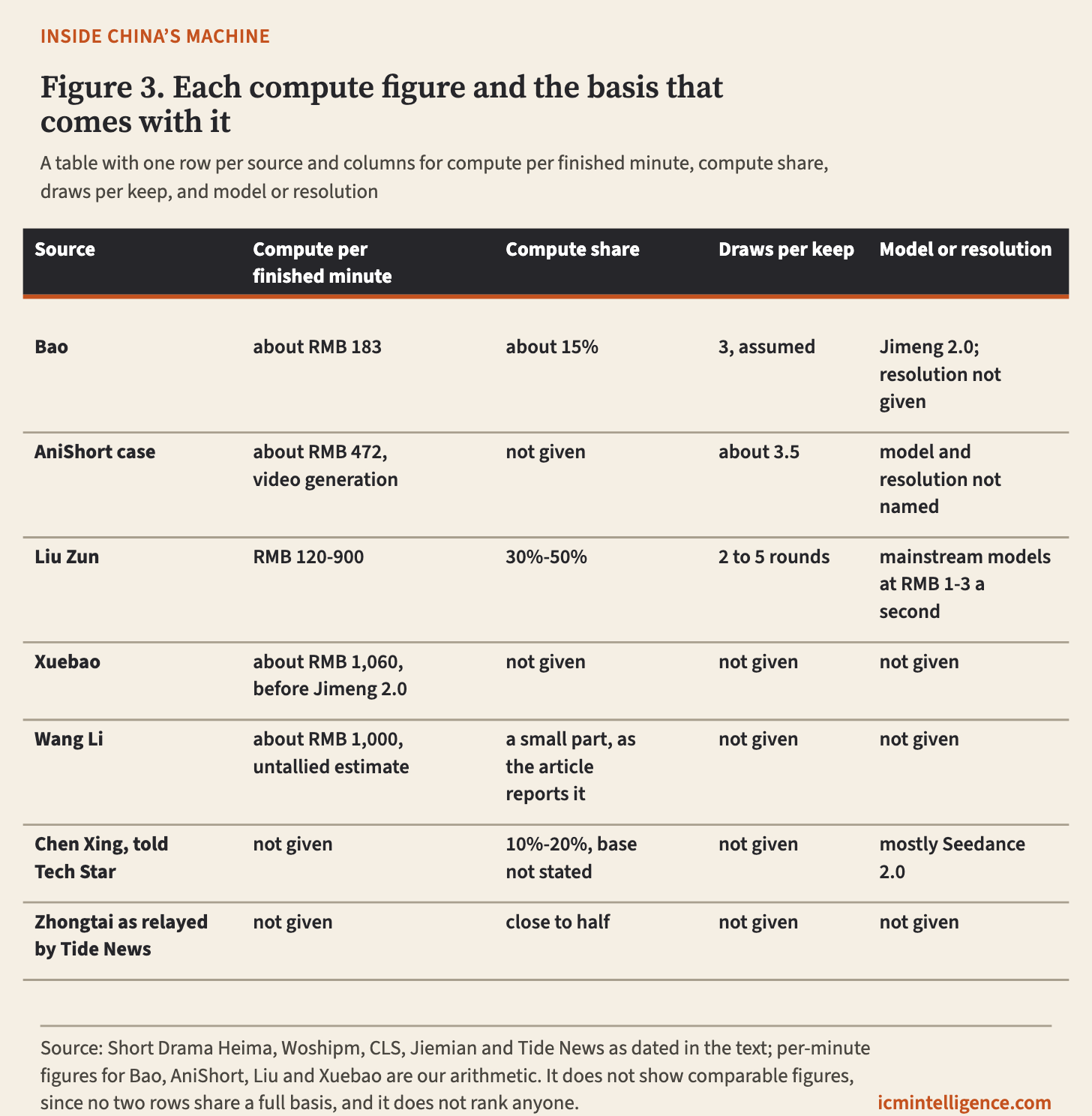
Even a headline number can sit one basis away from where it appears. In the same CLS article, the director of one AI short clarified that a widely repeated “RMB 3,000” was “the compute cost, not including labour and other costs”, for two versions of 4-plus and 6 minutes. A few lines away, an executive at Lingju Animation, Lü Shaolong, puts AI real-person drama at about RMB 3,000 a minute. The digits match and the things counted do not.
The serious objection to all this is that for a studio that cares about quality, the redraw is the main cost, and “cost fell” is true only of the cheap tier. BOC Securities, as reported on The Paper, has a 90-minute manju project falling from RMB 10,000-plus to about RMB 2,000 in compute and labour as usable rates rise from 20% to 90%. On our arithmetic that is about RMB 111 and about RMB 22 a finished minute for compute and labour together, and RMB 22 is below the RMB 59 of a single pass at the 720p list price, so the estimate must rest on a lower price per second than that, and the column on The Paper does not say what price it uses. After Jimeng 2.0, as the Short Drama Heima article reports it, Xuebao’s cost rose rather than fell; in the article’s own narration, the more demanding the quality, the lower the draw success rate, the more time and compute. The studio put the compute for an 80-minute drama made before that release at about RMB 85,000. On the night before the article ran on 9 March 2026, one team member spent the night on one 15-second shot at RMB 200 of compute. At today’s 720p list price, RMB 200 buys between 13 and 14 draws of that shot, though this is only an illustration, since the model and price at the time are not given.
The figures near RMB 1,000 a minute fit this reading. At the Seedance 2.0 720p list price, RMB 1,000 is about 17 draws per keep. At 1080p it is about 7. In a minute costing RMB 2,000, on the bottom of Liu’s range, RMB 1,000 would be half. So the RMB 1,000 in the opening is consistent with more attempts, a higher resolution or both; it need not mean a higher price for the same video.
Bao’s sheet shows how far that reading has to travel. Hold his other lines fixed and raise only the draws at RMB 1 a second. At ten draws per keep, compute is RMB 72,000 and about 36% of the total. It reaches half at about 17.5 draws, or about 7 at the 1080p list price. These are our sums, and they flatter the compute share if more draws also mean more paid hours, which they probably do. Our answer holds for now because no reported split goes above half, and because the producer who gave the RMB 1,000 figure still calls compute a small part. It would be wrong if a studio or platform published a cost split by minute with compute above half. A redraw ratio on one basis well above ten draws per keep for commercial work would test the redraw assumptions, but it would not by itself settle compute’s share. What would settle it is a redraw ratio and an all-in cost on one basis for a commercial series, and no published source gives both.
Until one does, a single cost per minute is a claim and should be read as one. If you are sizing this business, token volume helps explain what a vendor bills, and a studio’s economics need the rest of the sheet. Where compute is the largest single line in the reported splits, it is still not the majority. Where it is small, a studio’s own redraw count can still move it several times over. So ask four things of any cost per minute: how many draws per keep, at what resolution and on which model, whether it is compute alone or all-in, and whose arithmetic it is.
A second of video has a price anyone can look up; a finished minute has a redraw count, a payroll and a landlord, and none of those is on the price page.
Sources
Volcengine (火山引擎), Seedance 2.0 video generation price page (doubao-seedance-2.0, online inference), https://docs.volcengine.com/docs/82379/1544106, opened 2026-11-08 (stamped last updated 2026-11-03; no effective date). The per-second prices.
IT之家 (ITHome), 4 March 2026, https://www.ithome.com/0/925/937.htm, captured 2026-11-07. Volcengine’s announced billing of RMB 46 per million tokens and about 308,880 tokens for a 15-second clip.
MiniMax (稀宇科技) open platform price page, https://platform.minimax.cn/docs/guides/pricing, opened 2026-11-08. The H3 per-second prices and the earlier Hailuo per-video prices.
短剧黑马 (Short Drama Heima), “独家调查 | 仿真人剧成本3000/分钟上下”, 9 March 2026, The Paper creator platform, https://www.thepaper.cn/newsDetail_forward_32730858, captured 2026-11-07. The producers’ and studios’ build-ups.
财联社 (CLS), “AI仿真人剧成本几何”, 10 March 2026, https://www.cls.cn/detail/2308317, captured 2026-11-08. DataEye’s cost split, Lü Shaolong’s estimate, the clarification of the “RMB 3,000” figure, 抽卡.
新京报 (Beijing News), 22 January 2026, https://m.bjnews.com.cn/detail/1769062834129084.html, captured 2026-11-08. Lü Shaolong’s earlier and current per-minute figures; the consultant on redraws.
界面新闻 (Jiemian), republishing 数智前线 (Shuzhi Qianxian), https://m.jiemian.com/article/14086020.html, captured 2026-11-07. Chen Jie’s account of the draw rate; the 20-to-30-generation team.
界面新闻 (Jiemian), republishing Tech星球 (Tech Star), https://m.jiemian.com/article/15010778.html, captured 2026-11-07. Chen Xing’s compute share and Seedance spending.
人人都是产品经理 (Woshipm), column on AniShort, 2 September 2026, https://www.woshipm.com/ai/6458717.html, captured 2026-11-07. The 4-minute short, its RMB 1,914 cost and 28.7% draw success rate.
钛媒体 (TMTPost), 26 February 2026, https://www.tmtpost.com/7890548.html, captured 2026-11-07. The claim of over 90% usable output.
澎湃号·湃客 (The Paper), 解码Decode, 13 February 2026, https://m.thepaper.cn/newsDetail_forward_32592575, captured 2026-11-08. The Geek Park estimate and BOC Securities’ 90-minute example.
潮新闻 (Tide News), 26 October 2026, https://tidenews.com.cn/news.html?id=3596271, captured 2026-11-07. Its account of the Zhongtai Securities report of 20 May 2026.
Inside China’s Machine · Where China’s Tokens Go, Episode 2
Disclaimer: This article is for informational and educational purposes only. It is not investment, financial, legal or tax advice, and it is not a recommendation or solicitation to buy or sell any security. Do your own research, and consult a licensed professional before making investment decisions.