Inside China’s Machine · Where China’s Tokens Go, Episode 5
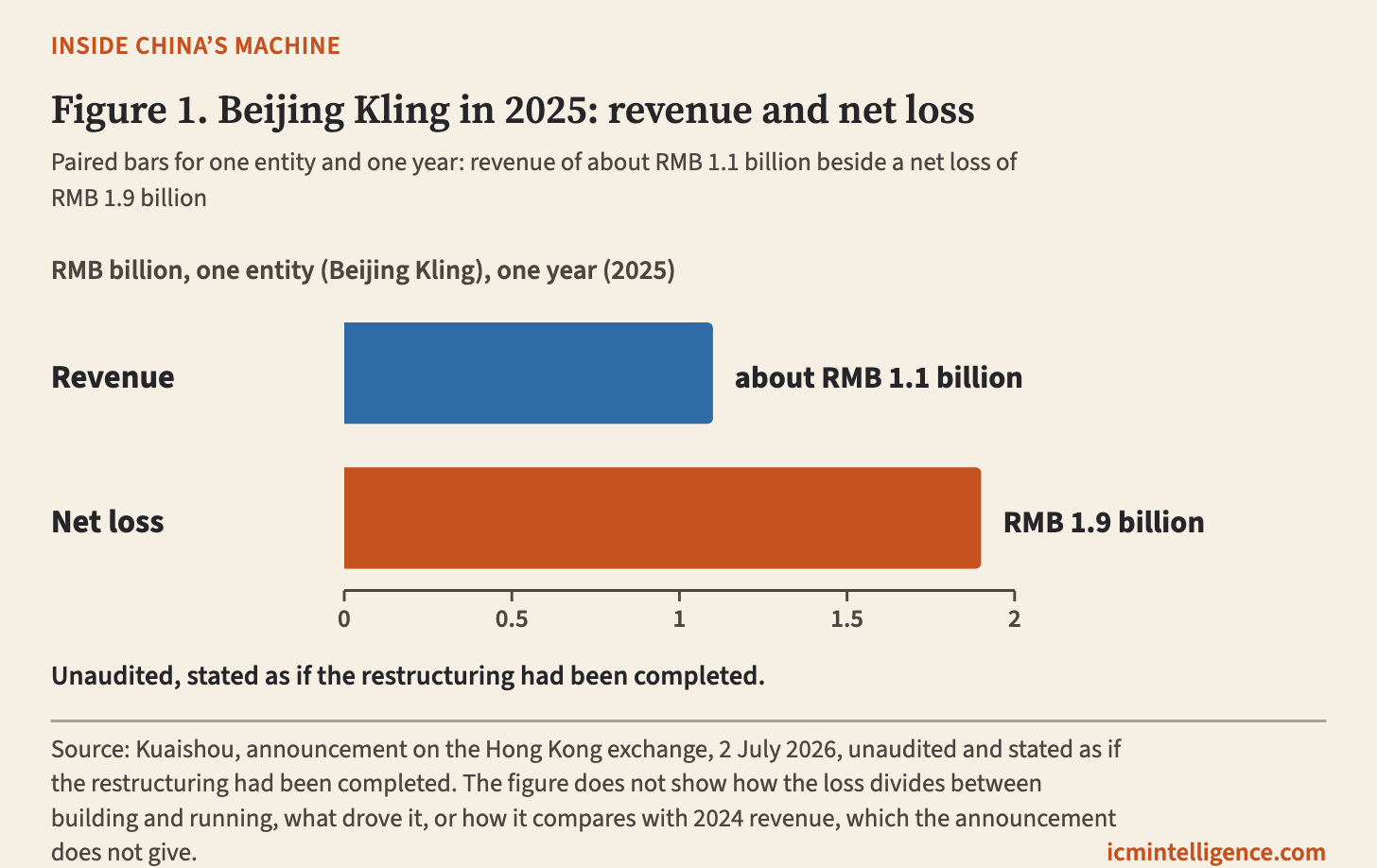
On 2 July 2026 Kuaishou told the Hong Kong exchange that outside investors had agreed to put up to US$3 billion into Beijing Kling, the company set up to hold its Kling video model business. Kuaishou’s quarterly releases give Kling’s revenue and no cost, margin or loss. The announcement went further. Assuming the restructuring had been completed, and on unaudited figures, Beijing Kling would have had revenue of about RMB 1.1 billion in 2025 and a net loss of RMB 1.9 billion, after a net loss of RMB 0.5 billion in 2024. Among the disclosures set out in this piece, no other video model business gives a profit line.
Ten months earlier Kuaishou’s finance chief, Jin Bing, had told investors that Kling “has already turned the gross margin positive at the level of inference compute.” Inference compute is the computing used to produce each clip a customer orders. The remark is known from The Paper’s report, carried by Sina Finance on 22 August 2025, with no figure given.
A business that loses money and a clip that earns money sound as if one statement has to give. Neither does, because a video model has two kinds of cost. Building it takes training, research and people. Running it takes compute every time someone asks for a clip. Jin’s sentence is about the second cost alone, while the net loss comes after both and after everything else the business bore. A bakery can make money on every loaf and still lose money in the year it built the oven.
Kling, Seedance, Hailuo and Wan are the models China’s AI drama studios use, so the natural question is whether making one of these models pays better than using one. Our answer is that nothing in the disclosures set out here lets a reader tell, on either side. The loss is a fact about one entity in one year, on a pro forma, unaudited basis, and no source set out in this piece shows what stating it as if the restructuring had been completed does to the figure. It is no verdict on making models. The margin is a fact about one cost, stated as a sign. What lies between them can be named exactly, and it comes to three numbers: the gross margin on running clips, what one model generation costs to build and how long it sells, and revenue for each video product apart from the company around it. Those three would settle the maker’s side of the question, whether running clips pays for building the model. The studios’ return on using the models is not given in the sources cited here either, so the comparison itself cannot be made from them. Anyone who has money or a supply contract riding on the phrase “video AI is a business” can put those three to whoever is using it.