

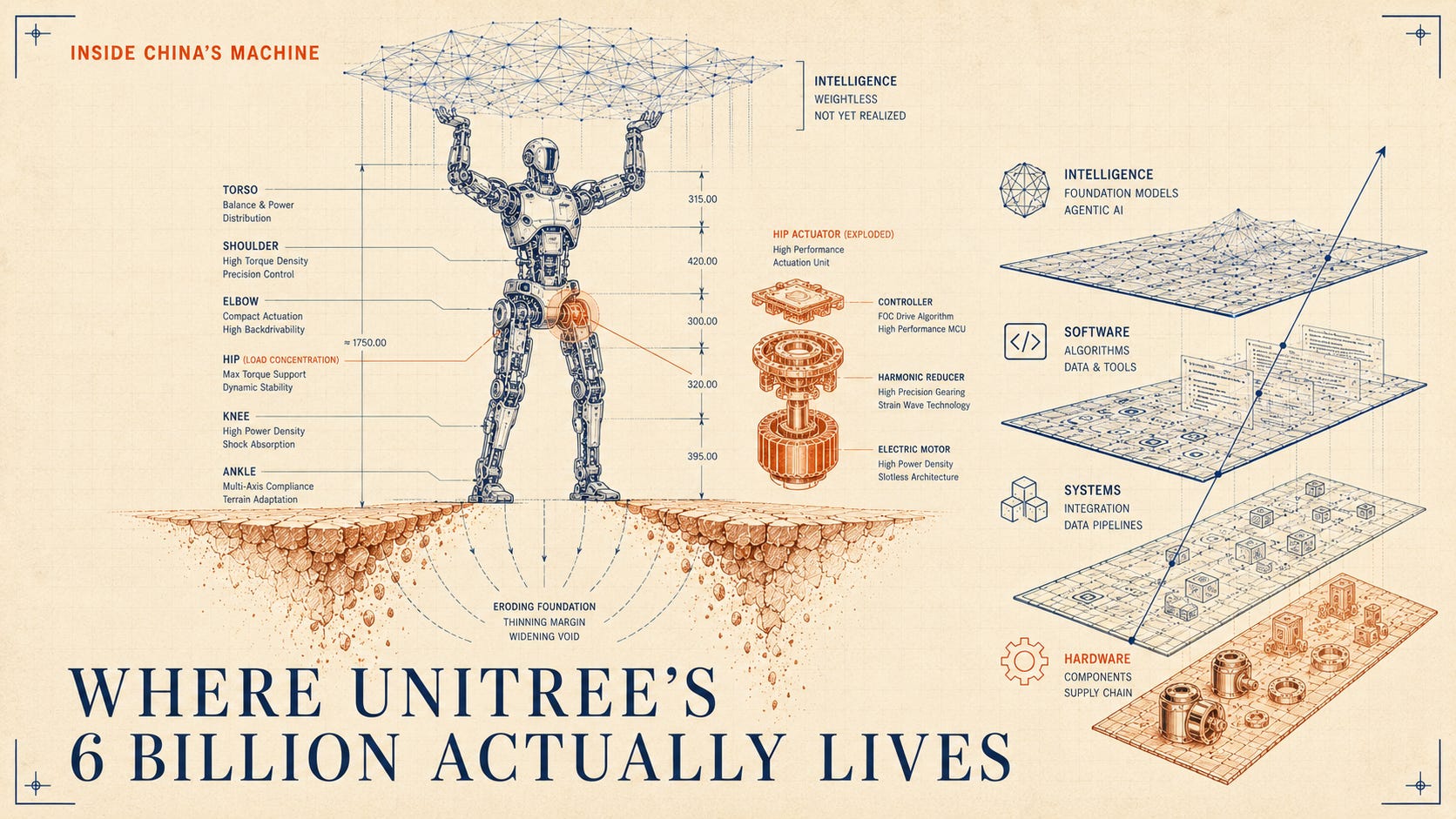
Last issue ended on a promise. The valuation does not break on revenue, it breaks on the margin, and the margin has a number attached to it. This is that number, and the table it lives in.
A quick orientation for anyone who did not read the first piece. Unitree is being priced right now for a STAR Market debut, on a band near 42 billion yuan, roughly 6 billion dollars. The bull case rests on a gross margin around 60 percent, unheard of in a field where most humanoid makers lose money outright. The bear case is that the same 60 percent is a hardware margin, and the IPO is asking the market to pay a software multiple for it. Below is the arithmetic that decides which case the price is actually making.
Start with what is filed, not what is pitched
Three numbers from the prospectus, all confirmed actuals for 2025.
Revenue was 1.699 billion yuan. Gross margin was 60.1 percent. And there are two profit figures, which matter more than they look. Attributable net profit was 278 million yuan. Net profit excluding non-recurring items was 591 million. The gap between them is mostly share-based payment, a real cost of hiring the AI talent the company is now paying for, added back in the adjusted figure. Use the adjusted 591 million as the cleaner read on operating earnings power, but keep the 278 million in view, because the market will eventually have to price the version that includes the cost of the people building the models.
At 42 billion yuan, those actuals imply the following:
Price to sales, on 2025 revenue: 24.7x
Price to earnings, on adjusted net: 71x
Price to earnings, on reported net: 151x
A hardware manufacturer does not carry a 25x sales multiple, let alone the 71x on earnings sitting underneath it. Comparable Chinese robotics names sit in the mid-teens on revenue, and only the highest-growth names push past that. So the price is not paying for what Unitree earned in 2025. It is paying for a forward number, a much larger one, and the entire question is what has to happen for that forward number to arrive.
What 42 billion is actually assuming
Forward earnings are the product of two things: how much revenue grows, and what margin survives the growth. The market has a strong view on the first and an unexamined assumption on the second.
On revenue, the conviction is earned. Unitree ranks first in the world by 2025 humanoid unit shipments in its own prospectus, humanoids crossed from 27.6 percent of revenue in 2024 to 51.5 percent by late 2025, and China’s embodied-intelligence policy tailwind is real. Nobody serious is betting against Unitree’s top line. Assume it doubles, triples, more. That is the priced-in case, and it is defensible.
On margin, the price is quietly assuming the 2025 level holds. That assumption is the load-bearing one, and it is the one the company itself is already walking away from.
The compression is not a forecast. It is in the filing:
2025 adjusted net margin: 34.8 percent
Q1 2026 adjusted net margin: 9.5 percent, against 33.8 percent in the year-earlier quarter
H1 2026 adjusted net margin, on the company’s own guidance: about 21 to 27 percent, midpoint near 24
Revenue grew 68 percent in Q1. Adjusted net profit fell 52 percent. The company’s guidance then walks the half-year net margin down to roughly two-thirds of the 2025 level. This is management telling you, in its own numbers, that the margin the valuation rests on is falling as the AI spend ramps. The bulls have priced the revenue and left the margin at its peak. The company has done the opposite.
The margin was built partly by not spending on the AI the IPO is selling
That compression is not a blip, and the reason is the fact almost no coverage connected. Unitree’s research spending has been remarkably light for a company being sold as an embodied-AI pure-play. R&D ran about 90 million yuan in the first nine months of 2025, roughly 7.7 percent of revenue. The ratio has fallen every year, from 31 percent in 2023 to 18 percent in 2024 to under 8 percent in 2025, and the prospectus concedes that in 2024 and 2025 the ratio dropped below the range of its own listed peers.
Part of that fall is arithmetic, and the company is right to flag it: revenue grew 335 percent in 2025, so a research budget that kept rising still shrank as a share of the top line. But the absolute base is genuinely small. Cumulative R&D across 2022 to 2024 was about 150 million yuan. UBTech, one of the company’s own chosen comparables, spent 478 million in 2024 alone. On a three-year basis, Unitree’s research bill was on the order of one-ninth of UBTech’s.
This is not a flaw in the operating model. It is part of the explanation of the margin. A meaningful piece of why Unitree clears a net margin the bulls compare to a software company is that it has not been paying for software. The lean research line and the 60 percent margin are the same fact seen twice.
And the IPO is the end of that arrangement, by the company’s own plan. Of the roughly 4.2 billion yuan being raised, about 2.0 billion is earmarked for the embodied-intelligence model project alone. That single line item is more than ten times the company’s entire 2022-to-2024 research spend combined. The prospectus is explicit that the model build needs large-scale data collection, compute, and factory-deployment training the company has not yet done. Management is telling you, in the use of proceeds, that the restraint which produced the margin is ending by design, and that the spending which replaces it lands on the income statement before the models it funds earn a yuan. The Q1 net margin of 9.5 percent is not noise. It is the first taste of a bill the IPO was written to run up.
The number the price holds constant is the one already moving
So the question is how much that bill moves the price. Here is the grid. Each cell is the forward price-to-earnings multiple you would be paying at a 42 billion yuan valuation, for a given combination of revenue and adjusted net margin. Revenue across the top, in billions of yuan. Margin down the side. These are scenario points, not forecasts. They exist to show the shape of the sensitivity, not to predict a cell.
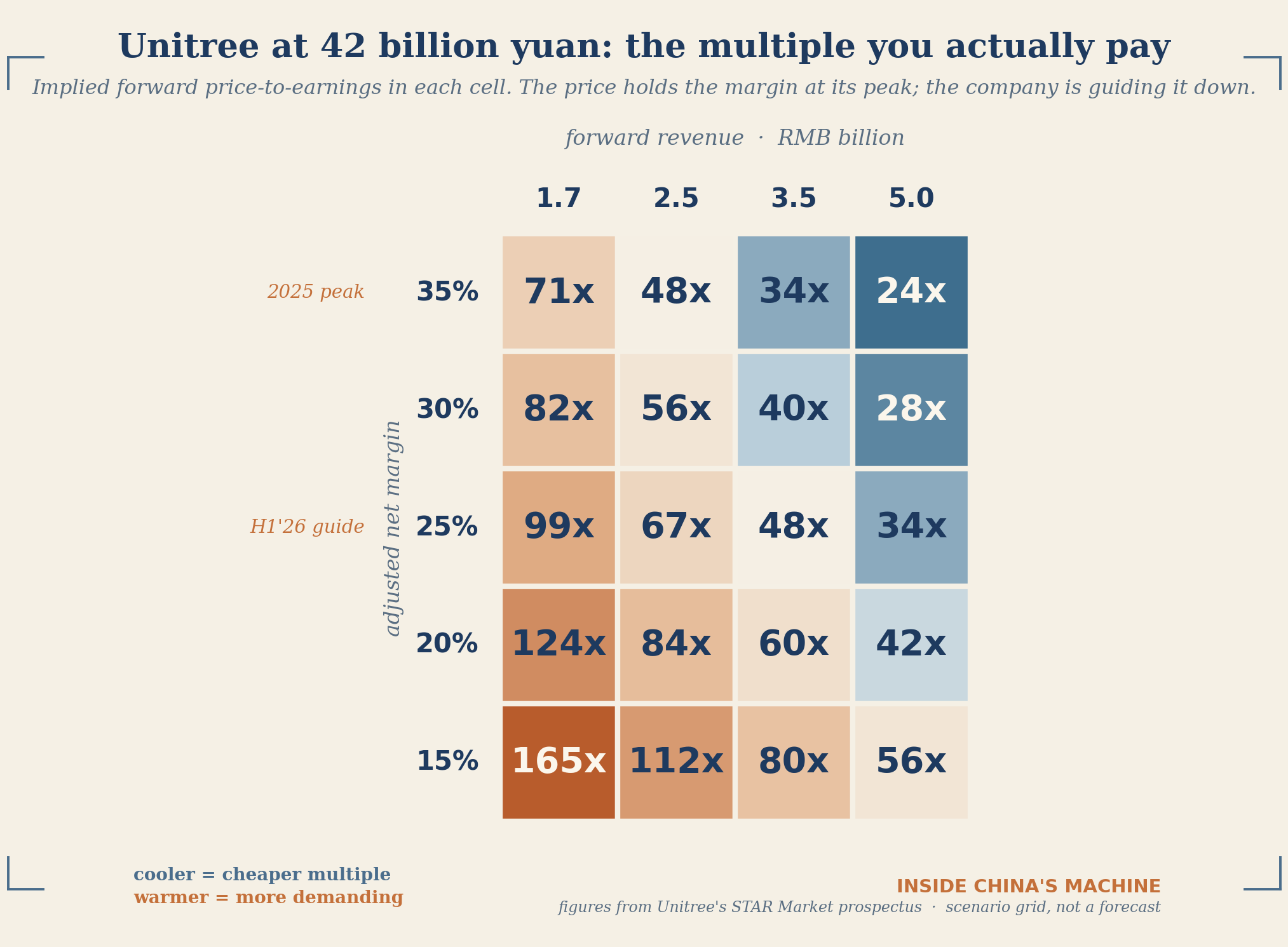
The 35 percent row is Unitree’s 2025 peak. The 25 percent row is roughly where its own H1 2026 guidance already sits. Read across any row and revenue growth pulls the multiple down, as it should. Read down any column and watch what margin does. At 3.5 billion of revenue, a doubling, the multiple you are paying swings from 34x at a 35 percent margin to 60x at 20 percent. Same revenue. The margin alone nearly doubles the price of the earnings. The valuation is far more sensitive to the variable the market is holding fixed than to the variable it is actively debating.
That is the whole thesis in one table. The market is long the secure variable and implicitly long the fragile one.
The break-even asks for a margin above the peak
Set a reference. Thirty times forward earnings is a generous multiple for hardware and a middling one for a real AI franchise, so use it as the line between a price that looks like growth-at-a-reasonable-level and a price that looks like a bet. This is a chosen benchmark, not a law.
To justify 42 billion yuan at 30x, here is the revenue each margin level requires:
At a 35 percent margin, revenue must reach 4.0 billion, a 2.4x from 2025.
At the guided ~23 percent margin, revenue must reach 6.1 billion, a 3.6x.
At 20 percent, revenue must reach 7.0 billion, a 4.1x.
And the same break-even read from the other side, solving for the margin each revenue level needs:
To justify the price at a doubling of revenue to 3.5 billion, the margin must be 40 percent. That is above the all-time peak Unitree has ever posted.
To justify it at a tripling to 5 billion, the margin must be 28 percent, still above the ~23 percent the company is guiding to right now.
This is the sentence the price is making and not saying out loud: revenue can double, and the stock is still not cheap at 30x unless the margin climbs past its own record. The AI pivot is supposed to be the thing that eventually lifts margin, through software attach and models that command a premium. Maybe it does. But the filing shows the opposite happening first, and for an unknown number of quarters, because you spend the margin before you earn it back.
The position this implies
This is research, not a call, so here is the researcher’s read rather than a verdict.
The 42 billion valuation is not expensive on revenue and it is not a fraud on margin. It is a specific, falsifiable bet: that Unitree’s gross margin durability survives contact with a compute-heavy model build, and that the software layer re-expands the margin before the market loses patience with the compression. Everything about the price sits on that one relationship. The revenue will very likely deliver. The revenue is not what you are actually buying.
So the number to watch is not the shipment count and not the top-line growth rate, both of which will look great and tell you nothing. It is the adjusted net margin, quarter by quarter, read against the 2025 peak of 35 and the guided 24. If it stabilizes and turns back up, the software story is real and the premium is earned. If it keeps sliding toward the Q1 print of 9.5, the market is holding a hardware company at a software price, and the 42 billion becomes the ceiling rather than the floor.
One honest caveat on the whole exercise. The 6 billion dollar number is a band, not a fact. The shares have not priced. If the book comes in below 42 billion, every multiple in that grid eases and the margin the price can tolerate falls with it. The model does not tell you the answer. It tells you exactly which line to watch to know when you have it.
That is the seam this publication was built to read. Silicon holds up the actuator. The actuator holds up the margin. The margin is now being spent climbing toward the intelligence layer, and the price assumes it makes the climb without paying the toll. Whether it does is the first real test of how the public market values a machine that is still assembling itself, one layer at a time.
Inside China’s Machine is research, not investment advice. Confirmed figures are from Unitree’s STAR Market prospectus and disclosures as reported by Caixin, the Shanghai Stock Exchange, and other primary-sourced outlets. Half-year figures are the company’s own guidance and are forward-looking. The sensitivity grid and break-even levels are the author’s scenario construction from those inputs, not forecasts. Valuation is the discussed pre-pricing band and will move at final pricing. Current as of July 10, 2026.