

On 20 August 2026, Alibaba reported its June quarter and, for the first time, split its AI business in two.
The first box, AI Cloud and Compute Services (compute, for short), rents out servers and holds T-Head, Alibaba’s own chip designer. The second, AI Labs and Applications (the labs), holds the labs behind Qwen, Alibaba’s family of models, along with the Qwen consumer app.
Compute earned RMB 5,628m, measured in adjusted EBITA, Alibaba’s own operating-profit figure. The labs lost RMB 13,861m on sales of RMB 3,338m, about four times what they sold, and Alibaba puts part of that loss down to the running cost of its consumer Qwen app. The loss is about two and a half times the profit beside it. A year earlier the two together lost RMB 805m.
Who pays for China’s AI models? It depends on the kind of company. Inside a large group, the group’s other businesses pay: at Alibaba, the shopping business, whose profit of RMB 39.7bn is nearly three times the labs’ loss. A model maker outside the group pays with its investors’ money. MiniMax is one: Alibaba holds an indirect stake of about 11% in it, and MiniMax bought about US$75.6m of cloud services from Alibaba Cloud in the first half of this year. Its research spending in that half was two and a half times its revenue, and it paid for its cash needs mainly from financing. In both cases spending on models ran ahead of what the models sold, and someone other than the models’ buyers covered the gap.
The one part of Alibaba’s AI business that made money is the part that owns the machines. The models are the cost.
Who is left with the profit from China’s AI models decides who can afford to build a frontier model and who has to be carried by someone else.
Is it just a consumer app?
Inference is running a trained model to answer requests, and the Qwen app is a consumer product reported inside the labs. Alibaba says the labs’ loss came mainly from increased investment in AI capabilities and “higher inference cost related to Qwen app”. So the RMB 13.9bn is not simply the cost of serving paying customers.
That is fair, and it does not change the answer. The question is who carries the spending, whatever it buys. The labs’ loss grew from RMB 3,224m to RMB 13,861m, about RMB 10.6bn worse, while their sales grew RMB 456m. Research and app costs are mixed inside that figure, and the AI side did not earn either back.
The shopping business carries it
Set against compute’s profit, the labs’ loss falls from RMB 13.9bn to RMB 8.2bn. E-commerce profit exceeds what remains, and the whole labs’ loss equals about 35% of it. This is an offset between segments in an accounting table, not a transfer of cash.
Compute’s margin is 11.6% on revenue of RMB 48.4bn, up 45%, with profit up 133%. On each added 100 yuan of revenue compute kept about 21 yuan of profit, which is the change in its adjusted EBITA divided by the change in its revenue.
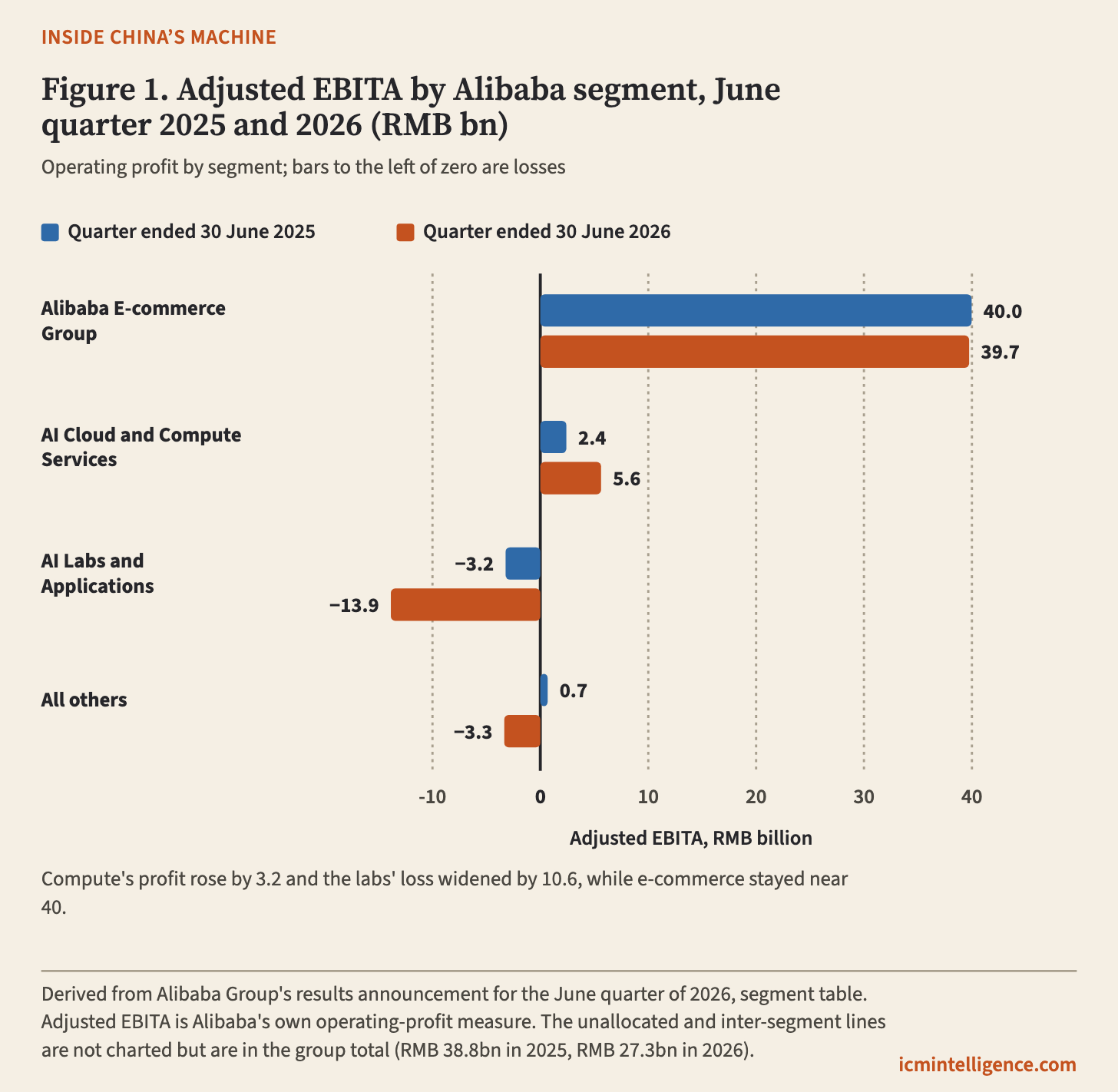
Compute’s bar grows by RMB 3.2bn and the labs’ falls by RMB 10.6bn. E-commerce, the tallest bar, barely moves. It was large and steady enough this quarter to absorb the labs’ loss.
A free app with a quota
The shopping business is not an accident of the accounts. Alibaba says the Qwen app is built into Taobao, Tmall and Taobao Instant Commerce to extend the reach of its e-commerce business, that 250 million users have had their first AI-driven shopping experience through the app’s agentic features, and that the link makes the AI and e-commerce businesses feed each other, which it calls a flywheel.
For someone building on the app, or backing a lab whose consumer app runs at a loss, the stake is whether “free” is a durable offer. CLS reported on 10 August that on 7 August the app launched an office assistant and other features free to all users, with extra usage for professional users to be paid for. CLS also reported that the app’s App Store page in August showed the office assistant in three paid tiers: RMB 200 a year, RMB 568 a year (RMB 49 a month) and RMB 1,499 a year (RMB 128 a month). Alibaba had not responded when that report was published. DoNews reported on 12 August that the tiers give 2, 5 and 20 times the usage quota on some features, and that basic office functions stay free with limited quota. Alibaba’s results came ten days after the CLS report and put part of the labs’ loss on the app’s inference cost.
Alibaba is not alone in this. DoNews reports that the rival app Doubao launched three paid tiers in June at RMB 688 to 5,088 a year, and that Baidu’s Wenxin tried charging in November 2023, ended the membership on 1 April 2025 and made the product free.
What the reports show is that the basics stay free while heavier use is rationed by quota and sold in tiers. They do not say which features cost most to run. Alibaba’s results carry no count of paying users, so how much the tiers recover is unknown, and Wenxin’s reversal shows that a paid tier can be abandoned.
The model company with a cloud bill
MiniMax shows the case without that tall bar. In the six months to 30 June it had revenue of US$116.6m and a gross profit of US$20.8m, a margin of 17.9% against 12.1% a year earlier, which it puts down mainly to improving infrastructure efficiency. Serving customers is getting better.
Training is the bill. Research and development cost US$296.9m, about fourteen times its gross profit, mainly from higher cloud services expenses for training. The loss for the period was US$358.0m.
So MiniMax pays for cloud services to train its models, and financing pays MiniMax. It says it funded its cash requirements in the half mainly from financing activities, and held US$1,322.8m at 30 June. Alibaba is both an indirect holder of about 11% of MiniMax and a supplier to it. Financing is supporting its training expansion, though MiniMax’s disclosures do not trace each dollar.
Owning the compute has its own bill. Alibaba’s capital expenditure was RMB 67.7bn in the quarter, 75% more than a year earlier, and its free cash flow was an outflow of RMB 44.7bn. These are group-wide figures. Alibaba ties the cash outflow mainly to higher cloud infrastructure spending, says the capital expenditure reflects continued investment in AI infrastructure to meet strong and growing customer demand, and lists higher prices for chip components among the reasons. For scale, group capital expenditure is 1.4 times compute’s quarterly revenue. The profit lands with the owner of the machines, and so does a large capital bill.
Whose bill comes round
If you buy or build on a Chinese model, the seller’s staying power depends on who pays for its compute and its losses. A lab inside a group with a large, profitable customer business, as at Alibaba, is carried by that business. A model company outside the group, as MiniMax is, is carried by the investors who financed it, and Alibaba, its cloud supplier, holds about 11% of it indirectly.
Two companies do not make an industry pattern. They show two ways the spending can be funded, and at both, in this period, spending on models ran well ahead of what the models sold.
A group lab depends on the size and steadiness of the business beside it. A model maker outside a group depends on its financing. The accounts show the bill and who has paid it so far: a shopping business in one case, financiers in the other.
Sources
Alibaba Group, announcement of results for the June quarter 2026, 20 August 2026 (HKEXnews), read 2026-10-21: https://www1.hkexnews.hk/listedco/listconews/sehk/2026/0820/2026082000745.pdf. Segment revenue and adjusted EBITA, the definition of adjusted EBITA, the Qwen app, capital expenditure and cash flow.
Alibaba Group, Form 6-K, Exhibit 99.1, the same results, 20 August 2026, read 2026-10-21 through a web reader: https://www.sec.gov/Archives/edgar/data/0001577552/000110465926099220/tm2623667d1_ex99-1.htm
MiniMax Group Inc., interim results announcement for the six months ended 30 June 2026 (HKEXnews announcement, as hosted by the company), read 2026-10-21: https://file.cdn.minimax.io/public/586c7995-cab1-41b5-9178-c06685b32c88.pdf. Revenue, gross profit, research and development expenses, loss for the period, cash requirements and cash balance.
MiniMax Group Inc., announcement of 26 August 2026 on continuing connected transactions (HKEXnews), read 2026-10-21: https://www1.hkexnews.hk/listedco/listconews/sehk/2026/0826/2026082601949.pdf. Alibaba’s indirect interest in MiniMax and MiniMax’s purchases of Alibaba Cloud services.
IBM Research, “What is AI inferencing?” (the definition of inference), read 2026-10-21: https://research.ibm.com/blog/AI-inference-explained
财联社 (CLS), “千问办公助理收费 会员套餐分旗舰、精英、高级三档”, 10 August 2026, read 2026-10-21: https://www.cls.cn/detail/2450364
DoNews, “阿里千问App上线付费会员服务,最高1499元/年”, 12 August 2026, read 2026-10-21: https://www.donews.com/news/detail/4/6667389.html
Inside China’s Machine · Frontier, Episode 2
Disclaimer: This article is for informational and educational purposes only. It is not investment, financial, legal or tax advice, and it is not a recommendation or solicitation to buy or sell any security. Do your own research, and consult a licensed professional before making investment decisions.