

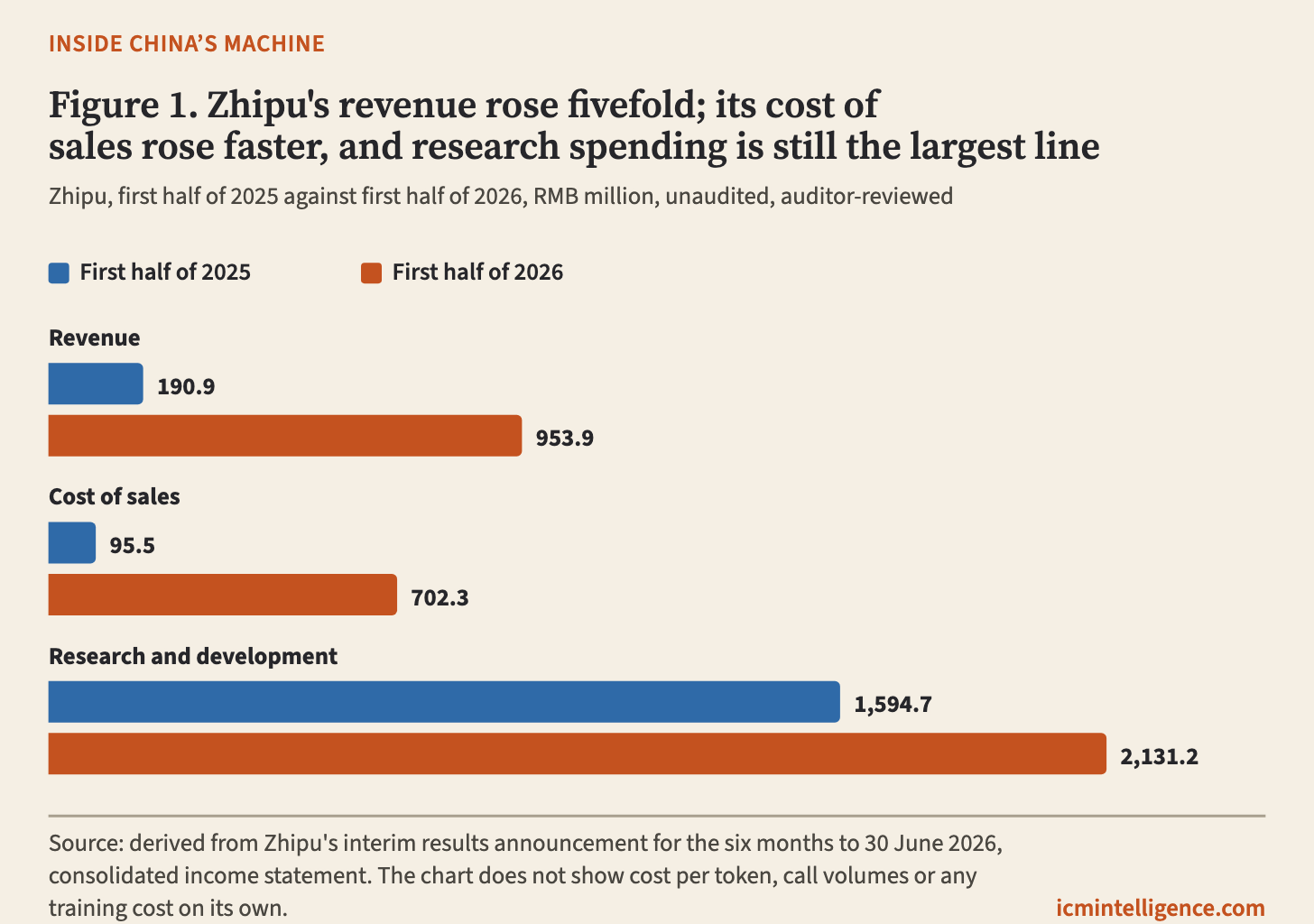
Zhipu’s interim results for the first half of 2026, filed in Hong Kong on 31 August, make two claims about the same six months. The Beijing model company says the cost of running a token on its platform fell 80% since the start of the year, with domestic chips now part of its main inference fleet. It also says its growth over those months was not bought by cutting prices: “volume is rising, and price is rising.” Further on, the income statement shows the cost of sales, which rose mainly on compute service fees, at more than seven times the figure for the first half of 2025. Research spending rose by a third. Operating costs as a whole rose by about half.
A cheaper token and a smaller bill are different things. At Zhipu, use grew far faster than unit cost fell, and part of the saving went to margin. What a model firm needs in chips and in capital follows how many tokens it serves more closely than what each one costs. A big efficiency gain does not mean a lab will need fewer chips or less capital; on the serving side, it has come with more.
The question matters because Chinese labs cannot buy all the compute they want, and each efficiency result raises the hope, or the fear, that they will need less of it. For someone who holds a position in a chipmaker, funds a model firm or sells cloud capacity, the answer decides whether a cheaper model shrinks the market or enlarges it. The case rests on companies’ unaudited interim figures, Zhipu’s auditor-reviewed; DeepSeek, the third example, publishes no financials.
Where the 80% went
Start with what Zhipu sells. Most of its revenue now comes from its open platform and API, where developers and companies pay for model calls by use. That line brought in RMB 825.2m in the half-year, up from RMB 29.1m, and made up 86.5% of total revenue of RMB 953.9m. Total revenue was five times the first half of 2025. The company says token calls on the platform rose more than fortyfold from the start of the year to late August. Calls on its Coding Plan, a subscription for programmers, rose more than twenty-three times.
Now the bill. Cost of sales was RMB 702.3m, against RMB 95.5m a year earlier. The filing puts the increase down mainly to higher compute service fees and calls it “basically in line with the revenue growth trend.” Compute for serving tokens sits in that line, and it rose more than sevenfold.
Hold one thing still to see why. If calls had stayed flat, an 80% fall in unit cost would have cut the serving bill to a fifth. Calls did not stay flat. More than forty times the calls at a fifth of the cost each comes to about eight times the serving compute, assuming the mix and quality of the work stayed the same. The group’s cost of sales rose 7.4 times. The two numbers do not match exactly: the call figure runs to late August and compares levels, while the financials compare one first half with another and include local deployment. That does not weaken the argument, because both point the same way: the serving bill rose by a multiple, nowhere near falling to a fifth.
Two other figures could mislead a quick reader. Group gross margin fell from 50.0% to 26.4%, which looks like efficiency running in reverse. The whole fall comes from a change in what Zhipu sells. Local deployment, the business of installing models on a customer’s own hardware, shrank from RMB 161.8m to RMB 128.7m. That business had carried all of last year’s gross profit. The API business that replaced it lifted its own gross margin from −0.4% to 24.6%. Second, Zhipu says its average API selling price roughly doubled while unit cost fell to a fifth. At face value, cost per yuan of revenue fell to a tenth (0.2 ÷ 2): last year the segment spent 100.4 yuan to earn 100, so it would spend about 10, a margin near 90%, far above the 24.6% it earned. The filing does not explain the gap. Larger models, Coding Plan seats, the timing of the period, or what “cost” covers could each account for part of it, and the average price is itself an average across products. Treat the 80% as a direction the company reports, not a margin you can compute.
The bill the 80% never touched
The serving bill is the smaller one. Research and development expense was RMB 2,131.2m, up 33.6%, and the filing attributes the rise mainly to continued, larger investment in model training. It was more than twice the half-year’s revenue. It was most of the RMB 3,114.5m Zhipu spent on cost of sales, selling, administration and research combined, a total up 49.5% on the year. Selling and administrative costs fell. The company spent less on running itself and more on compute.
Inference efficiency lowers the cost of answering a question, not, by itself, the cost of building the model that answers it, and the research line rose. How much of the RMB 2.13bn is training, and how much is staff and everything else, the filing does not say. That is the open question for anyone estimating a Chinese model firm’s capital need. Whatever the split, the serving saving did not stop that line rising.
A second firm, in its own currency
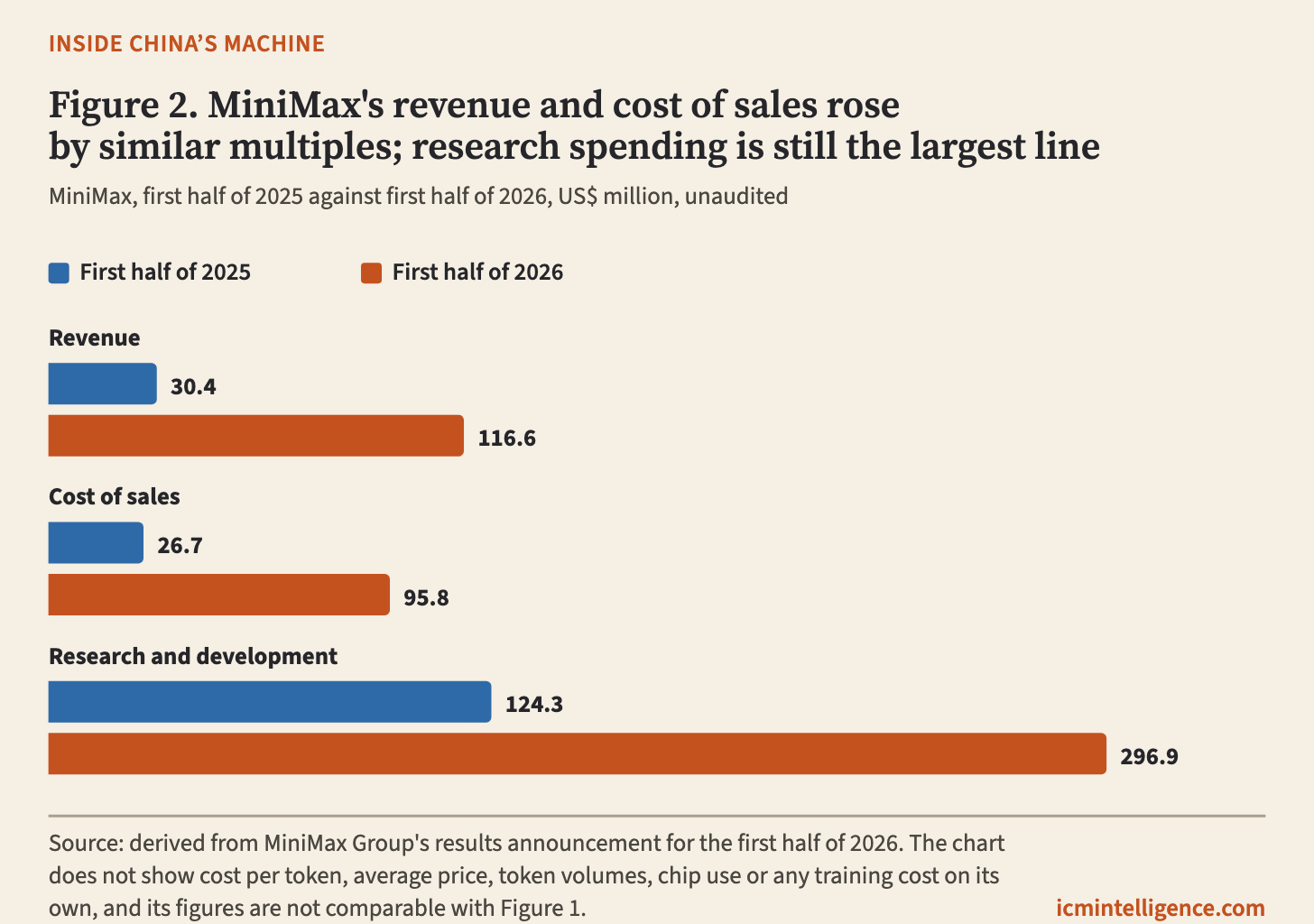
MiniMax Group, also listed in Hong Kong, released its first-half results on 26 August, unaudited and in US dollars. Its figures are not directly comparable with Zhipu’s, but the direction is the same. Revenue rose about 3.8 times and cost of sales about 3.6 times. Research and development rose about 2.4 times, which the company attributes mainly to higher cloud-services spending for training. Its chief executive says token consumption reached 20 times its January level by July. The release gives no unit cost, average price or chip detail. Gross margin rose to 17.9% from 12.1%, which MiniMax credits to improving infrastructure efficiency. The loss for the period under IFRS fell to US$358.0m from US$402.2m; the adjusted net loss, which the company defines itself, went the opposite way, to US$293.0m from US$138.7m. Efficiency arrived as a margin, not a smaller bill.
DeepSeek’s different saving, and the same answer
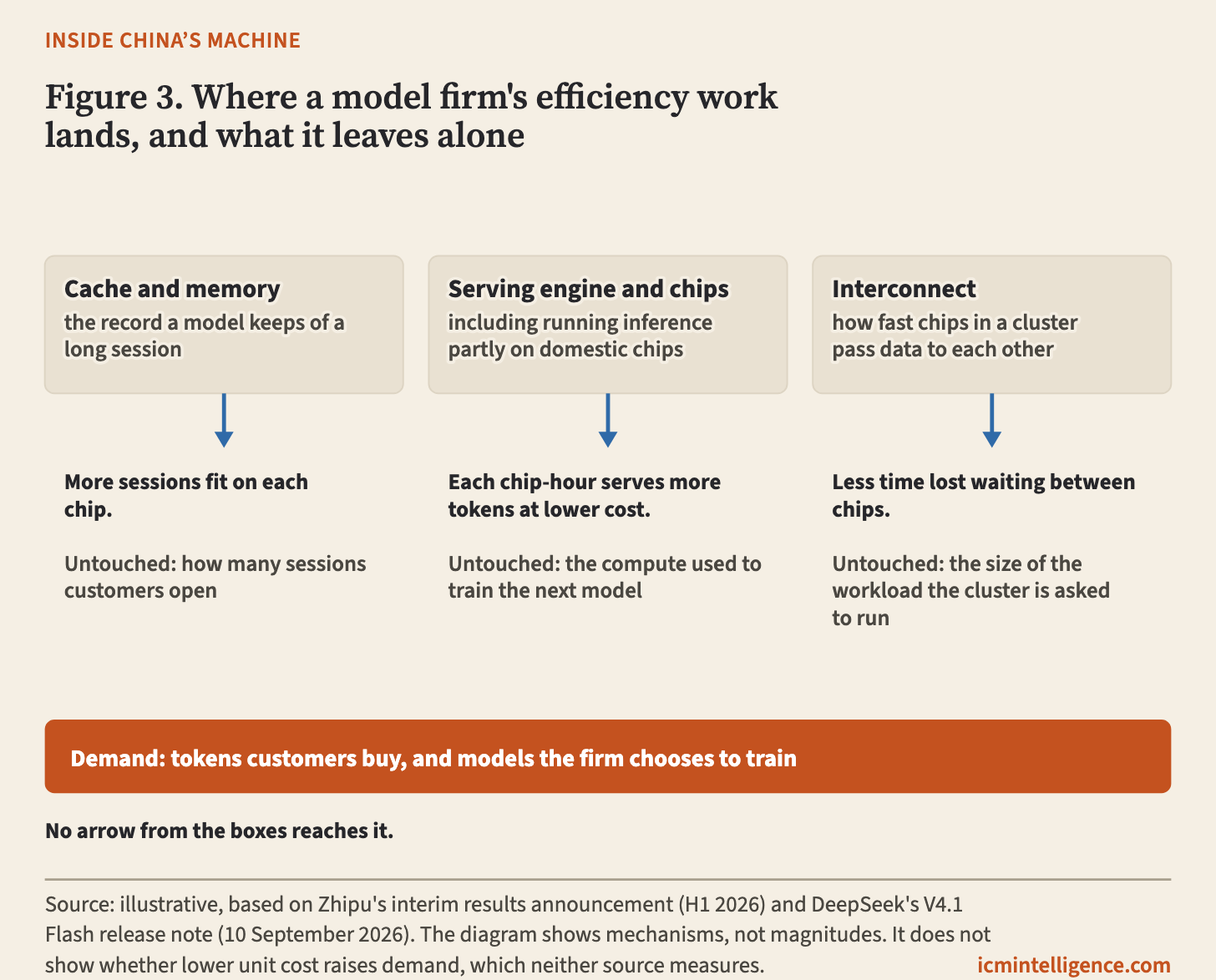
DeepSeek offers a different technique leading to the same place. In its V4.1 Flash release note of 10 September, the saving is in memory rather than chips. When a model works through a long conversation, it keeps a running record of everything it has already processed so it does not have to recompute it at each step. That record is called the KV cache. In a long agent session, where the model writes code, reads results and tries again for hours, the cache keeps growing. It sits in HBM, the scarce fast memory packaged next to the chip, and in SSD storage. Weights are shared across sessions, but each session’s cache takes its own memory.
DeepSeek says the new generation cuts its HBM need to a quarter, and SSD need to an eighth, of the previous generation’s. The note does not say which model, workload or hardware that comparison uses. DeepSeek’s gloss is that in agent use the charge for cache hits, reusing stored records, is often a large share of cost, so compressing the cache cuts the cost of agent tasks sharply. It is moving all V4 Pro traffic onto Flash at Flash’s price and plans to retire V4 Pro.
DeepSeek states why it cut the price. Because of the architecture, V4.1 Flash “can serve more users at lower cost, so we have lowered its price.” Zhipu moved serving onto domestic chips and retuned its stack. DeepSeek shrank the memory each session occupies. Each lowered the cost of a token. DeepSeek, in its own words, priced the saving into serving more; Zhipu’s calls grew as its prices rose. The release ends by inviting firms that self-host the model to get in touch if they have “2k GPUs and a storage cluster.”
The rival reading
The best rival reading points to Zhipu’s ratios. In the first half of 2025, research spending was 8.35 times revenue. A year later it was 2.23 times. By the company’s account, its loss fell from about 12.4 times revenue to 2.2 times on IFRS, the accounting standard behind the headline loss, and from 9.2 to 2.1 times on its own adjusted measure. On this reading, efficiency is what lets revenue outrun costs. The capital needed per yuan of revenue is collapsing, and the absolute loss will follow.
The ratios are real, and they matter. A firm whose operating costs grow slower than revenue is moving the right way. But a backer funds the absolute gap, not a ratio, and that gap has not closed. The loss for the period under IFRS fell 12.1%, to RMB 2.07bn. More than all of that narrowing came from a non-operating line, the change in value of financial instruments it issued to investors: a charge of RMB 22.1m against RMB 429.3m a year earlier. The adjusted net loss, which the company defines to strip out items like that, rose 12.1%, to RMB 1.96bn. Most ratios improved, yet the adjusted net loss grew.
The next reporting period will bear on this. If Zhipu’s adjusted loss falls in absolute terms while revenue keeps growing, that would be evidence for the rival reading, not proof, and would leave open whether efficiency or price rises did it.
What it changes
If you hold a position in chips or cloud capacity, this half-year gives a narrow but useful result. At one listed Chinese model firm, an 80% cut in unit serving cost, with domestic chips in the fleet, came alongside cost of sales more than seven times larger. MiniMax’s half points the same way, but two firms’ accounts are not a measure of total chip demand. Still, it shows how a serving-side efficiency gain behaves inside an actual business: it looks less like a shock to demand and more like the thing that made more use affordable. If you back a model firm, the capital it needs is set by how fast use grows and by what training costs, and a falling unit cost does not lower it on its own. If you follow export controls, the evidence reaches serving on domestic chips at a scale Zhipu describes as on the order of 100,000 chips, with the makers unnamed. It says nothing about training frontier models on those chips, and it should not be stretched to.
I expect China’s model firms to keep cutting cost per token while their capital need stays set by how many tokens customers buy and by how much they train. That view would be wrong if a firm’s cost of sales stopped tracking the tokens it serves, for example if calls kept multiplying while the compute bill flattened.
Zhipu’s sentence, “volume is rising, and price is rising,” shows why the 80% never shrank the bill. Tokens cost a fifth as much. Zhipu says customers bought more than forty times as many calls. The bill followed the calls.
Sources
Zhipu, interim results announcement for the six months ended 30 June 2026 (HKEXnews, filed 31 August 2026), captured 2026-10-26: https://www1.hkexnews.hk/listedco/listconews/sehk/2026/0831/2026083101540_c.pdf. Revenue, cost of sales, research and development, loss for the period and adjusted net loss, segment figures, the company’s account of its cost per token, call volumes and average price.
MiniMax Group, results announcement for the first half of 2026 (HKEXnews, 26 August 2026), captured 2026-10-30: https://www1.hkexnews.hk/listedco/listconews/sehk/2026/0826/2026082600680.pdf. Revenue, cost of sales, gross margin, research and development, loss for the period and adjusted net loss, US$ thousand, unaudited.
MiniMax, “MiniMax announces first half 2026 financial results” (company release), captured 2026-10-30: https://www.minimax.io/news/minimax-announces-first-half-2026-financial-results-1787744160. The chief executive’s statement on token consumption.
DeepSeek, V4.1 Flash release note (10 September 2026), captured 2026-10-26: https://deepseek.com/news/deepseek-v4-1-flash/. The memory comparison, the reason given for the price cut and the invitation to large deployers.
Inside China’s Machine · Frontier, Episode 4
Disclaimer: This article is for informational and educational purposes only. It is not investment, financial, legal or tax advice, and it is not a recommendation or solicitation to buy or sell any security. Do your own research, and consult a licensed professional before making investment decisions.