


ICM Landscape, Q3 2026: the first installment of a quarterly series tracking China’s humanoid robot industry.
Three numbers describe China’s humanoid boom, and none of them counts a robot doing paid work: a robot performing a task its owner pays for, as opposed to a demonstration, a research platform or a data-collection rig.
The first is units. IDC puts China’s humanoid shipments in the first half of 2026 at about 19,000. The second is price. When Unitree debuted on August 19 on Shanghai’s STAR Market, the exchange’s technology board, the market briefly valued it at ¥445 billion ($63 billion), 262 times its 2025 revenue. By September 24 the stock had lost 56 percent from that peak. The third is scenarios. In June, the Ministry of Industry and Information Technology (MIIT) and the state asset regulator SASAC launched a “real-scene training” action for humanoids. Its year-end targets are written in scenarios, more than 100 high-value ones, with no count of robots at work.
Each is real. Each measures something other than work, and the sections below take them in turn.
The First Number: Units Are Not One Unit
Volume is large by every tracker: Omdia estimated about 13,000 humanoids shipped worldwide in all of 2025, and Counterpoint Research estimates more than 22,000 worldwide for the first half of 2026 alone. The two come from different trackers, so read the jump as direction, not a growth rate. IDC’s 19,000 for China alone, above, is a different scope again. No source used here says what the robots are used for or in what mix.
A unit is not a fixed quantity of anything. Unitree’s compact R1 Air starts at ¥29,900, about $4,200, and its G1 starts at ¥85,000. UBTECH’s FY2025 annual report shows ¥821 million of full-size humanoid revenue on 1,079 units, about ¥761,000 each, or $107,000. Unitree’s prospectus shows ¥868 million of humanoid revenue in 2025 on 5,215 units sold (5,511 shipped), about ¥166,400 each, or $23,400. Those are segment revenue divided by units sold, not list prices. Unitree’s figure is also falling: the prospectus puts its average humanoid revenue per unit at ¥260,400 in 2024 and ¥593,400 in 2023, so 2025 was a 36 percent drop in a year.
Set side by side, the two companies booked humanoid revenue within 6 percent of each other, and one sold nearly five times as many robots. A thousand of one and a thousand of the other are different industries sharing a word.
That matters for the market shares the trackers publish. In the first half of 2026, two trackers, Counterpoint and Smart Analytics Global, put AgiBot at 43 to 44 percent of global units and Unitree at roughly 31 percent. Those are shares of units. A share of units says nothing about a share of revenue, and none of these trackers publishes the second.
AgiBot’s own counter is wider still. Its milestone of 15,000 robots by June 28 counts embodied-AI robots across all its product lines, including wheeled and industrial units, so it cannot be checked against tracker counts of humanoids.
The field, company by company
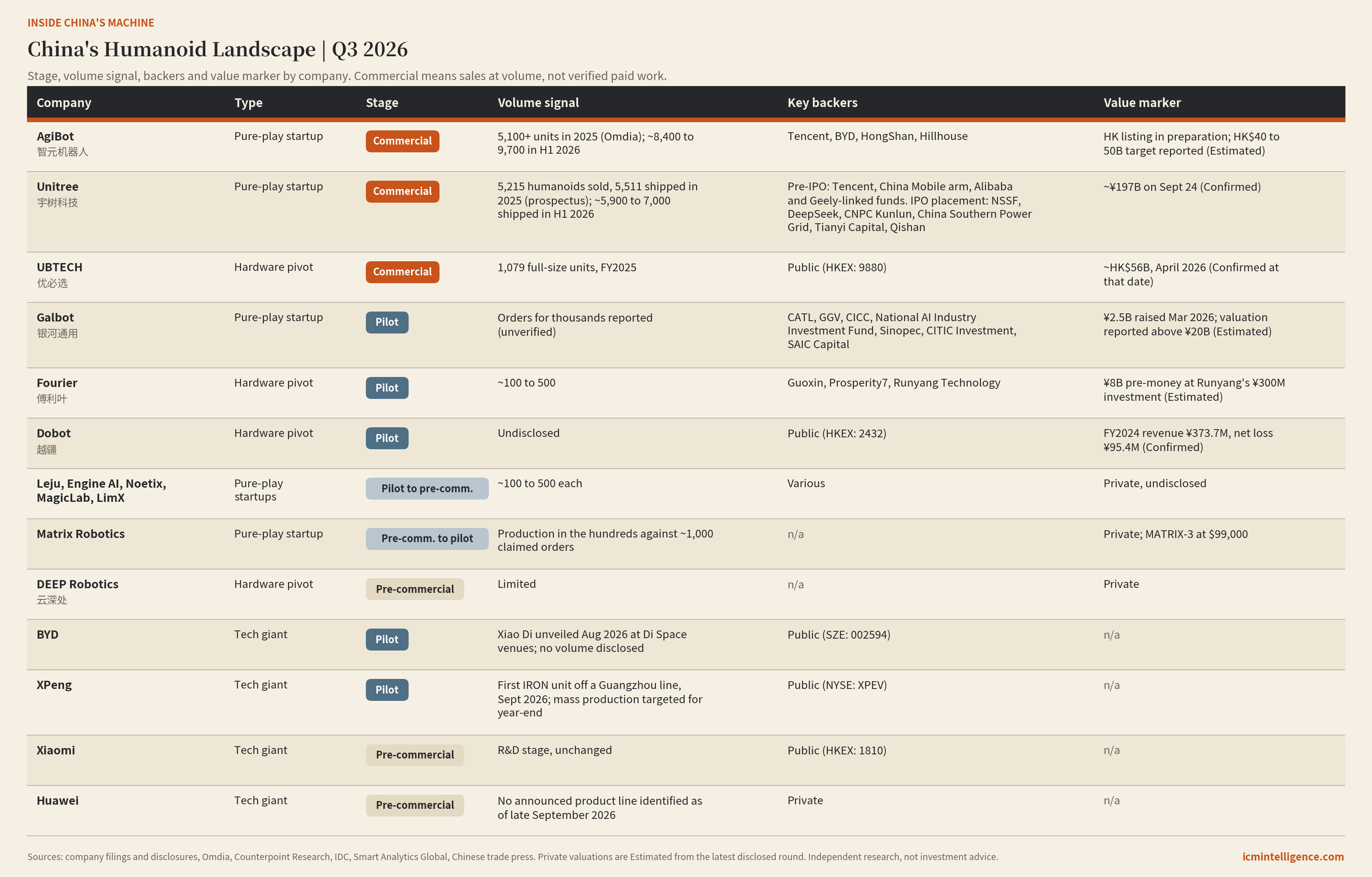
Stage definitions: pre-commercial means announced or unveiled with no external sales; pilot means paid pilots or a first production line; commercial means sales at volume from a running production line. Commercial does not mean verified paid work, which no company here discloses. Three companies sit in that top tier, and they are not alike: Unitree and AgiBot ship thousands of units a year, while UBTECH ships about a thousand full-size robots at roughly five times the price.
The Second Number: The Price of a Whole Company
Unitree: four prices in five weeks
Unitree priced its STAR Market listing at ¥150.80 per share on August 6, 2026. It reported 2025 revenue of ¥1.699 billion and net profit excluding non-recurring items of ¥591 million, a margin of about 35 percent on that basis. On debut, August 19, the stock rose 629 percent intraday to ¥1,100 and closed up 460 percent at ¥845. The company’s first-half 2026 results, published August 17, showed revenue of ¥1.152 billion, up 48.5 percent, and net profit excluding non-recurring items of ¥244 million, down 19.3 percent. That is a margin of about 21 percent.
Every market value below is share price times about 404.5 million shares, converted at ¥7.1 per dollar, so the four points share one method.
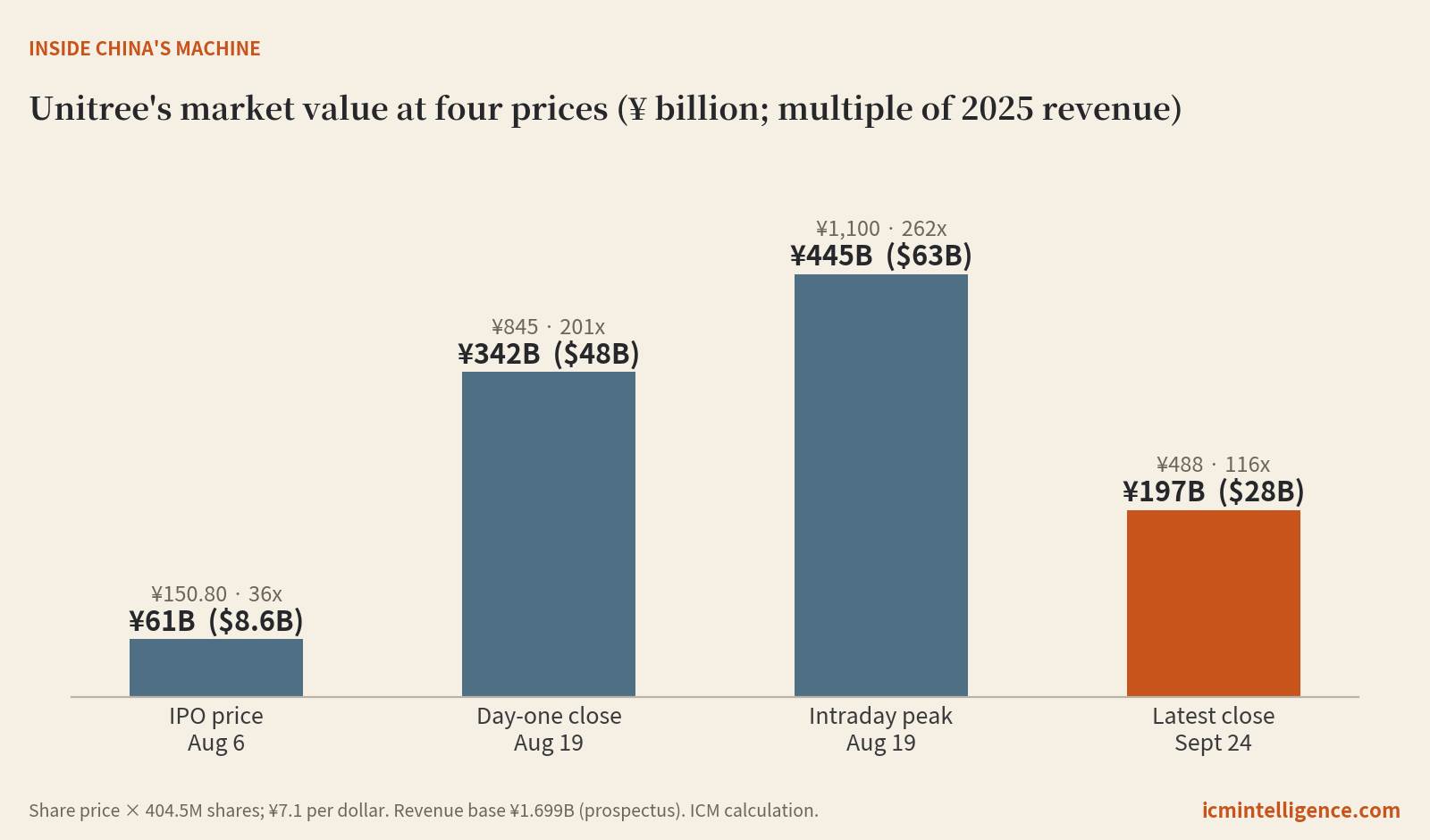
Unitree prices are frozen at the September 24 close.
By September 24 the stock was 56 percent below its peak and 42 percent below the day-one close. It still stood at 3.2 times the IPO price, about 116 times 2025 revenue and about 334 times 2025 net profit excluding non-recurring items. The multiple applies to the whole company. The prospectus puts humanoids at ¥868 million of the ¥1.699 billion, about half, with quadrupeds at about 42 percent, so it is not a humanoid multiple.
A price of 116 times revenue is a bet on growth far beyond current sales. The dedicated Unitree piece covers the company’s full arc.
What ¥197 billion needs
At 30 times mature earnings, the September 24 value needs about 95,000 humanoids a year at Unitree’s first-half margin, or about 58,000 at its 2025 margin. Unitree’s first-half 2026 shipments of 5,900 to 7,000 imply 12,000 to 14,000 a year. So the value needs seven to eight times the current run rate at the lower margin and four to five times at the higher one, with revenue per robot held at the 2025 level. “Mature earnings” means the profit Unitree might earn once growth slows, and 30 times is a mid-range multiple chosen for illustration. This is built from Unitree’s disclosed numbers, not company guidance, a forecast or a fair-value model.
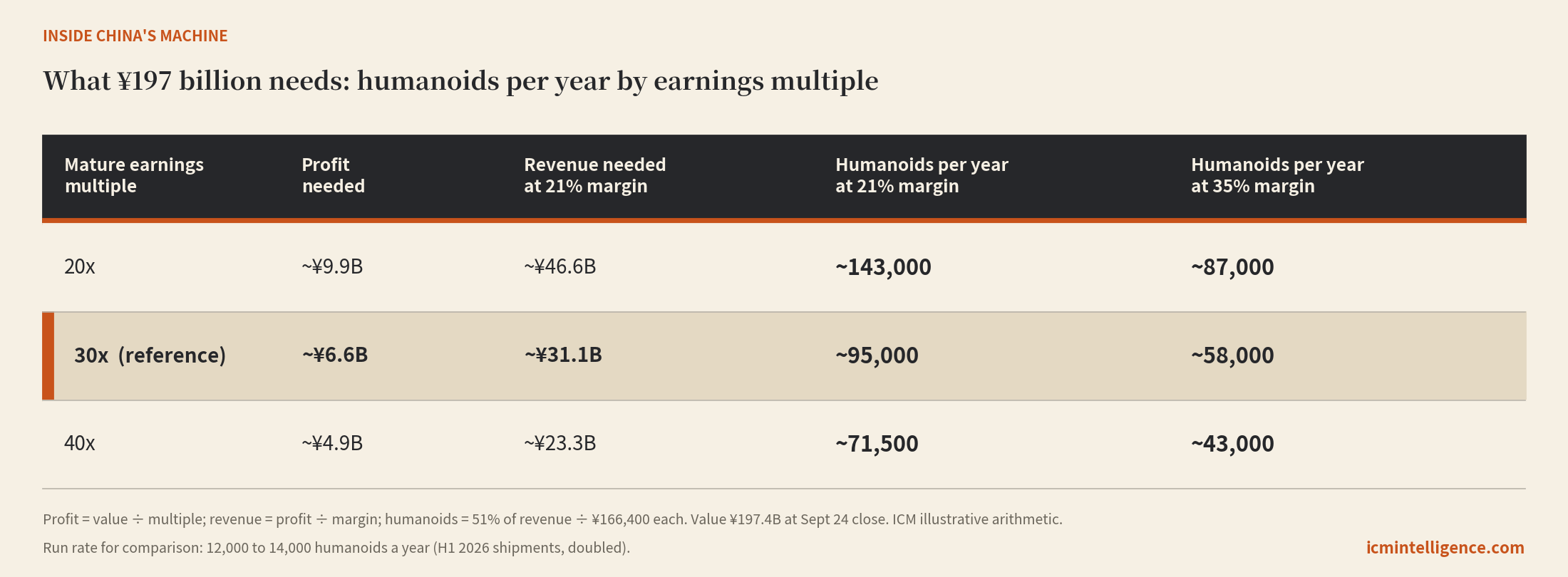
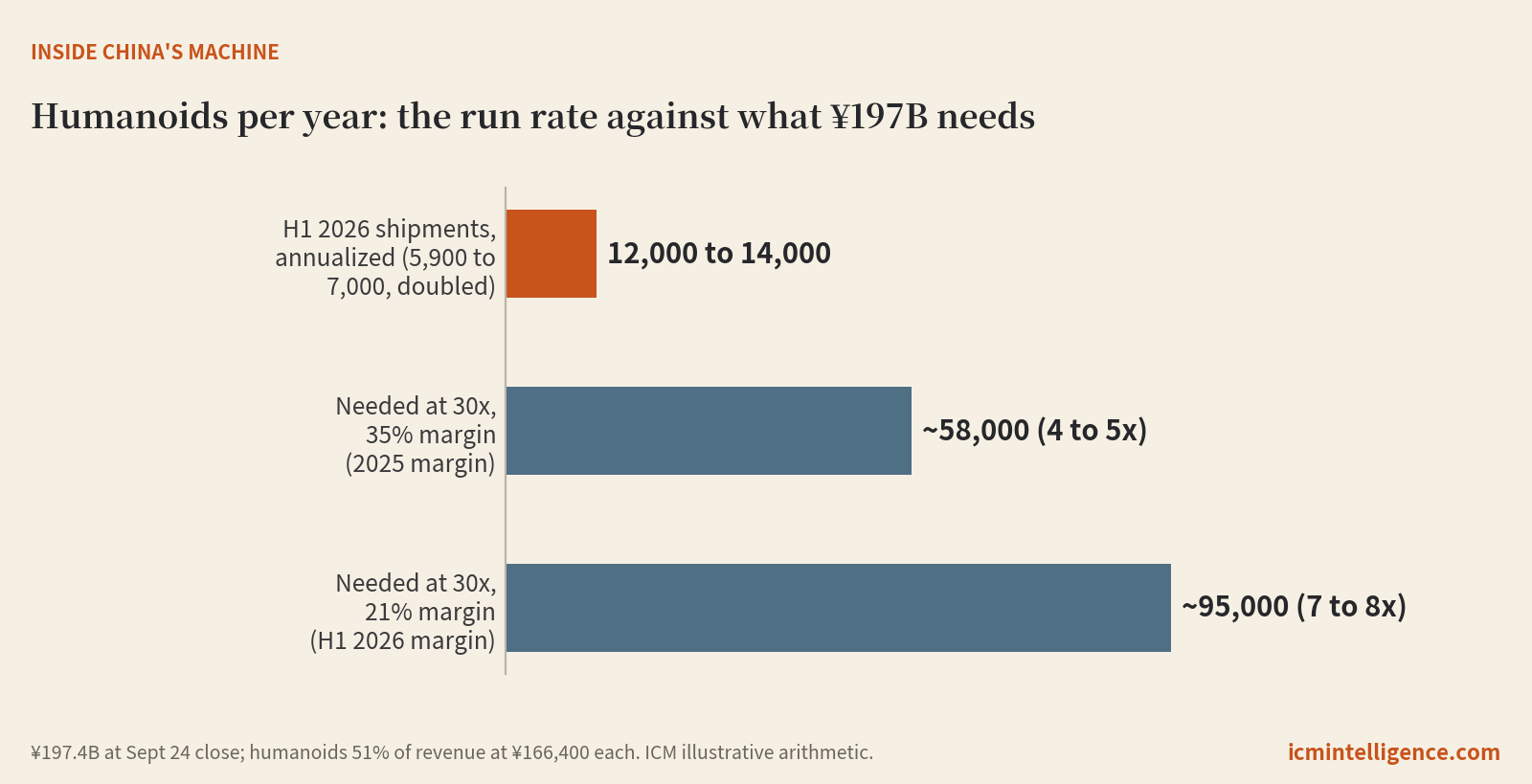
Each step is division: profit is the market value over the multiple, revenue is profit over the margin, humanoids are about 51 percent of revenue, and each humanoid brings in about ¥166,400. Two caveats move the answer most. The table keeps today’s product mix, so quadrupeds grow alongside humanoids. If quadrupeds and other lines stay flat, the humanoid volume needed is about 1.9 times higher, roughly 180,000 at 30x and the 21 percent margin. Mix can also cut either way: a shift toward cheaper models such as the R1 Air, at ¥29,900 against a ¥166,400 average, would raise the volume needed, and a shift toward full-size robots near UBTECH’s ¥761,000 would lower it. Smaller caveats: both margins come from a small book and are not proven rates at scale, and the table ignores the years it takes to get there.
Unitree: who buys the robots
The prospectus does not split humanoid sales by buyer type, so no buyer-mix percentage exists to quote. What it does say bears on the question.
The company lists five uses for its humanoids: scientific research, application development, education, cultural performance and smart services. Paid work in a factory or warehouse is not on the list. In the same filing it also says that most humanoids on the market remain at the stage of application-scenario testing, with no large-scale commercial deployment in daily-life or industrial settings.
Sales are spread thin. The five largest customers were 12.1 percent of 2025 revenue, and the largest, a European buyer, was 3.1 percent; JD.com was second at 2.9 percent. About 51 percent of revenue came from direct offline sales, 38 percent from distributors and 11 percent from online channels. That concentration is low, which means no single buyer explains the volume, and it also means the filing gives no view of what the many buyers do with the robots.
One buyer is visible: Galbot, itself a humanoid maker and a related party, bought ¥18.2 million of Unitree products in 2025, up from ¥0.4 million the year before, for its own research and for resale after secondary development. That is a humanoid company buying humanoid parts and platforms, which fits research and development demand more than paid work.
The hinge is repeat demand. Revenue from a lab, a data-collection program or a demonstration is real revenue, but it need not recur: those buyers purchase to learn or to show. Sustaining 95,000 a year needs demand that comes back, and a reorder is the first sign that a buyer found the earlier robots worth their price. It is still not proof of paid work, since a lab can reorder too, so it counts only alongside what the buyer uses the robots for. No company disclosure found so far reports repeat customers or their use.
UBTECH: similar humanoid revenue, different robots
UBTECH booked ¥821 million of full-size humanoid revenue in FY2025 and lost ¥790 million. At about HK$56 billion (¥51 billion) in April, the latest market value found, it was priced close to Unitree’s ¥61 billion IPO value, on FY2025 humanoid revenue within 6 percent of Unitree’s. Unitree’s stock then rose to ¥445 billion at its August peak and stood at ¥197 billion on September 24. Humanoid revenue does not explain that gap. Unitree earned ¥591 million excluding non-recurring items where UBTECH lost money. The requirement table above prices growth in volume and profit, not today’s humanoid sales. The dates differ by months, so read the comparison as an order of magnitude. The dedicated piece on UBTECH’s Walker S2 covers what factory autonomy saves in labor cost, and what it does not yet.
AgiBot: the next price
AgiBot is preparing a Hong Kong listing, with no public prospectus and no price yet. Reporting in July, citing an AgiBot investor quoted by Caijing, put its expected valuation at HK$40 to 50 billion, about $5 to 6 billion, a reported target and not a price. AgiBot’s Deng Taihua put 2025 revenue at ¥1.05 billion in April, a management figure, not a filed one. ¥4 billion is a market projection for AgiBot’s 2026 revenue. At HK$1 = ¥0.91, the reported target is about ¥36 to 46 billion. AgiBot is also reported to offer robots on rental terms, so its unit and revenue counts may not map cleanly to sales.
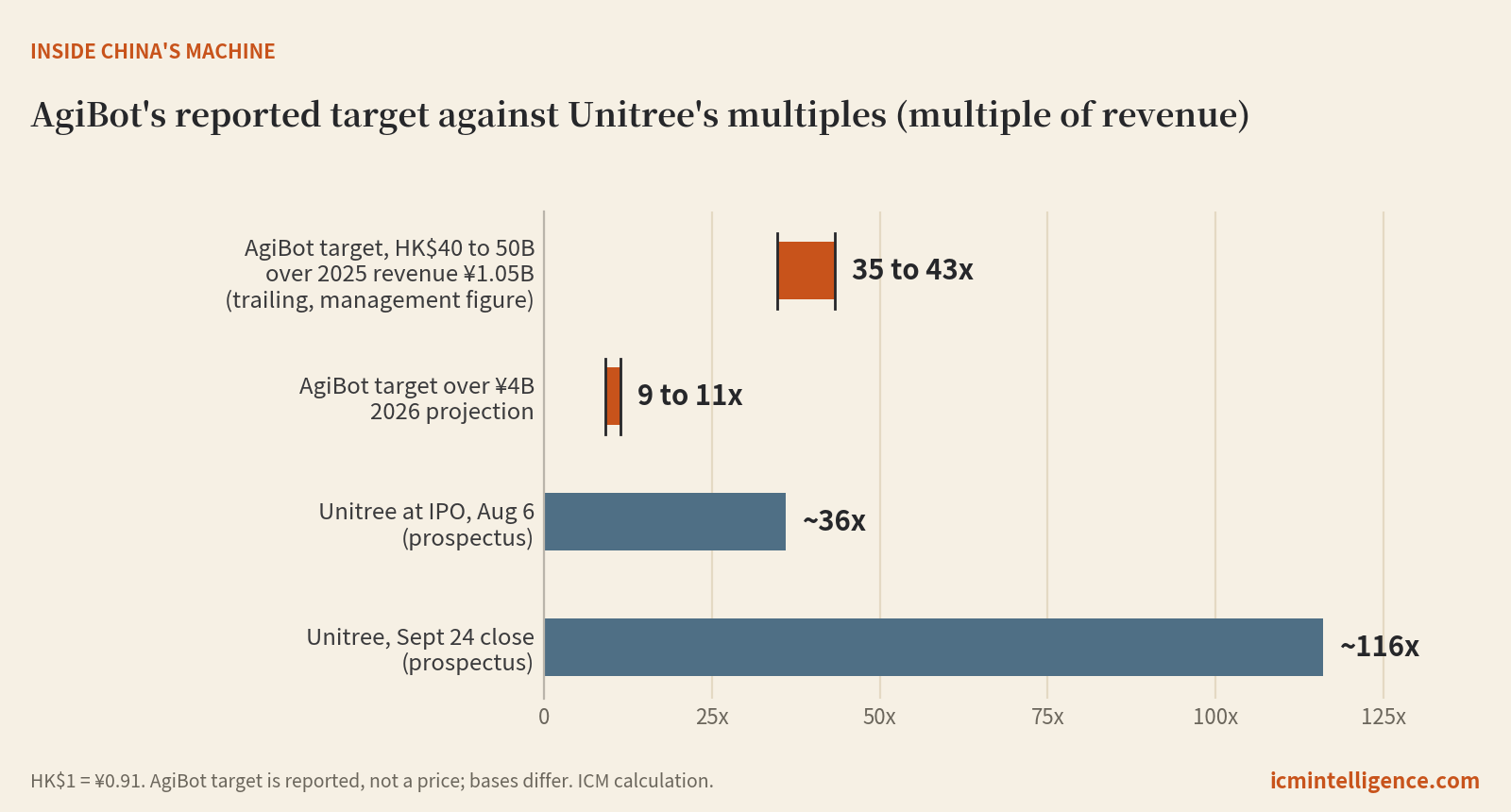
On trailing revenue, the reported target would list AgiBot near Unitree’s IPO multiple and far below its September 24 one. The bases differ, management-disclosed against prospectus and trailing against projected, so the table is a range, not a verdict. A filing would supply audited revenue and units, and the offer price would then show where the multiple lands. Whether the filing also shows what share of its units do paid work is the open question. The dedicated AgiBot piece covers the company in full.
The Third Number: The State Counts Scenarios
The June MIIT and SASAC notice sets a year-end goal: application verification and regular deployment in representative scenarios, what the notice calls entering “operating mode.” Its figures are all scenarios. It calls for more than 100 high-value application scenarios, at least 20 key scenarios from each of ten provinces and municipalities, and at least 10 from each named central state enterprise, the large firms the central government owns. It also aims to help form deployment capability at “ten-thousand-unit scale.” That is a capability aim, not a count of robots deployed, and the notice sets no count.
The scenario count cannot supply one, and the notice’s figures do not say who pays for the robots in those scenarios, so they do not show whether a scenario becomes an order or stays a demonstration. As an illustration, take the smallest headline figure, 100 scenarios. At 10 robots each that is 1,000 robots. At 100 each it is 10,000, the notice’s aim. The same target fits an industry of a thousand working robots and one of ten thousand.
The notice does add something the trackers and the market lack: verification. Results are to be checked by the user units or by entrusted third parties under scenario-specific test procedures, with MIIT and SASAC tracking and evaluating. If those results are published with robot counts, they would be the first count of robots deployed in verified scenarios, a step toward measuring work.
What to Watch
Each of the three numbers has a nearest step toward measuring work. For units, a tracker that splits shipments by use: paid work, data collection, research, performance. For scenarios, a published MIIT and SASAC verification result that gives the number of robots behind each scenario. For price, any disclosure of repeat customers, and Unitree’s third-quarter report, due by the end of October, its second set of figures since listing.
One set of Unitree results cannot show a sevenfold rise in volume. It can show whether humanoid revenue per unit stops falling from ¥166,400 while units climb, whether the margin recovers from 21 percent, and whether customers reorder and what they use the robots for. Without that, the ¥197 billion is pricing work that no disclosure yet shows.
Inside China’s Machine is independent research, not investment advice.
Sources and Data Attribution
Shipment estimates: 2025 (AgiBot, Unitree, global total): Omdia “General-purpose Embodied Intelligent Robots” report, January 2026, plus Unitree’s prospectus for its own 2025 figure. Independent, unaudited. H1 2026: Counterpoint Research (global, above 22,000), Smart Analytics Global (global, 19,100), IDC via TechNode (September 29, 2026; China above 19,000 of nearly 25,000 worldwide).
MIIT/SASAC notice on the 2026 humanoid and embodied-intelligence real-scene training action (June 2026): official text as reposted by Xinhua, Sina Finance and Eastmoney.
UBTECH financials: 2025 annual report (HKEX: 9880), with FY2025 results also reported by Sina Finance and Huxiu. Dobot: HKEX FY2024 results (HKEX: 2432).
AgiBot funding and IPO plans: Bloomberg, Reuters, Caixin Global, TechNode, and Caijing/Sina (July 24 to 25, 2026) for the HK$40 to 50 billion figure, attributed there to an AgiBot investor; 2025 revenue per Deng Taihua’s April 2026 disclosure (Tencent News, Sina Finance, ITHome), not a filed figure; the ¥4 billion 2026 figure is a market projection. AgiBot production milestones: company announcements (June 28, 2026), as reported by Sina Finance.
Unitree financials and customers: STAR Market prospectus (2025 revenue ¥1.699 billion; net profit excluding non-recurring items ¥591 million, 扣非净利润; humanoid units sold and shipped; average revenue per humanoid; top-five customers; channel split; Galbot related-party sales; IPO placement investors; R1 Air and G1 starting prices; filing language on the humanoid application stage). First-half 2026 results (revenue ¥1.152 billion, net profit excluding non-recurring items ¥244 million): Unitree’s August 17 update as reported by 21st Century Business Herald and Sina Finance. IPO pricing and post-listing trading: CNBC, Bloomberg, Nikkei Asia, The Robot Report, Outlook Business, Sina Finance, company disclosures; listing-day peak and close reconciled against Chinese-language coverage; September 24 close (¥488.00) from Baidu Finance, Futu and Ifeng quote pages. Market caps are share price times about 404.5 million shares, converted at ¥7.1/$. The “What ¥197 billion needs” tables and charts are ICM’s own illustrative arithmetic on those disclosed figures. Galbot funding: Caixin Global, Caproasia, 36Kr (36氪), company press releases. Fourier: TechCrunch, Xinhua, company announcements; 2026 update via Caixin/Cailianshe coverage of the Runyang Technology investment.
Tech giants: BYD’s Xiao Di unveiling (Sina Finance, Guancha, 21st Century Business Herald, Interesting Engineering); XPeng IRON production line (company announcement and trade press, Sept 2026). Matrix Robotics: company disclosures and WAIC/BEYOND Expo Macao coverage.
All private valuations are Estimated from the most recent disclosed round unless marked Confirmed. Multiples use ¥7.1/$, HK$1 = ¥0.91, and are pinned to the dates shown. Where sources conflict, the piece notes the discrepancy.